BYD(BYDDY)

Search documents
尚水智能三度试水A股终迎曙光 比亚迪十亿关联交易护航IPO闯关
Sou Hu Cai Jing· 2025-12-15 21:36
Core Viewpoint - The successful IPO of Shangshui Intelligent on the ChiNext board could yield significant returns for BYD, which has heavily invested in the company, while also benefiting other stakeholders, particularly the actual controllers of Bozhong Precision Engineering, who will continue to profit from this capital venture [2][13]. Group 1: IPO Journey - Shangshui Intelligent has made multiple attempts to enter the A-share market, including failed mergers and previous IPO applications, before finally targeting the ChiNext board [3][9]. - The company is primarily engaged in the manufacturing of new energy battery pole pieces and intelligent equipment for new material preparation, with its core product being a high-efficiency pulping system [3][9]. - After a failed attempt at a Sci-Tech Innovation Board IPO in 2023, Shangshui Intelligent shifted its focus to the ChiNext board and submitted its IPO application in June 2025 [9][10]. Group 2: Financial Performance - From 2020 to 2024, Shangshui Intelligent's revenue grew from approximately 100 million to 636 million, with net profit increasing from under 9 million to over 200 million [10][11]. - In 2023, the company achieved its highest revenue of over 600 million and a net profit of 219 million [10]. - BYD has significantly contributed to Shangshui Intelligent's revenue, with sales from BYD increasing from 31.73% of total revenue in 2020 to 65.78% in 2024 [11][12]. Group 3: Shareholder Dynamics - BYD holds a 7.69% stake in Shangshui Intelligent, having invested in the company after the termination of its merger plans in early 2022 [12][19]. - The entry of BYD as a major shareholder has raised questions about potential conflicts of interest and the company's dependency on BYD for revenue [12][19]. - The actual controllers of Bozhong Precision Engineering, who invested in Shangshui Intelligent, are expected to benefit significantly from the company's IPO, potentially increasing their wealth substantially [30][32].




小鹏本地化生产、比亚迪建组装厂 车企“抢滩”马来西亚
Bei Jing Shang Bao· 2025-12-15 13:43
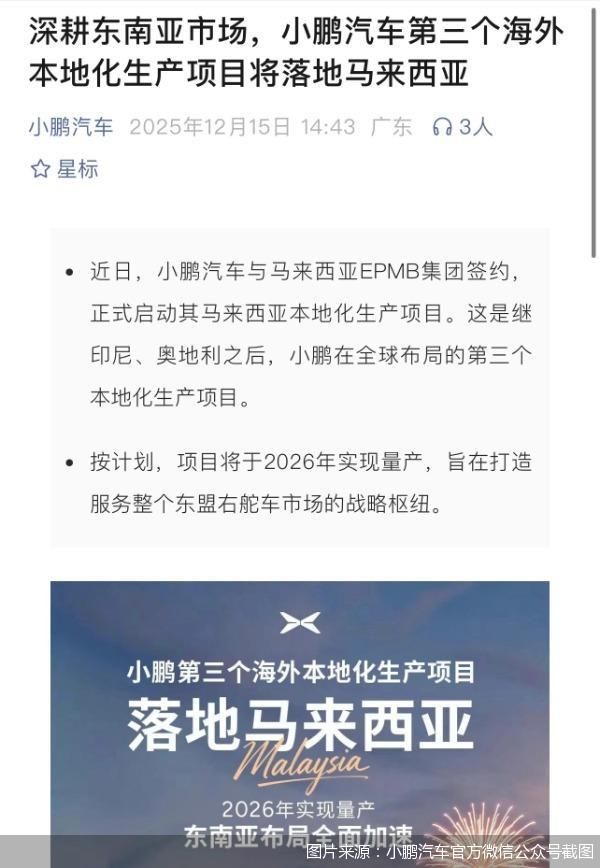
Core Viewpoint - Malaysia is becoming a key production hub for Chinese automotive companies, with Xpeng Motors launching its local production project in collaboration with EPMB Group, marking its third overseas localization project after Indonesia and Austria [1][5]. Group 1: Xpeng Motors' Localization Strategy - Xpeng Motors has established three overseas localization projects within six months, with the latest in Malaysia set to achieve mass production by 2026, aiming to serve the ASEAN right-hand drive market [5]. - The company aims to grow alongside local markets and consumers by providing high-quality smart products tailored to local preferences [5]. Group 2: Competitive Landscape in Malaysia - Other Chinese automotive companies, including BYD, Great Wall, and Chery, are also entering the Malaysian market, with various strategies from vehicle exports to local production [6]. - BYD is constructing an assembly plant in Malaysia, with plans to start production next year, while Leap Motor is collaborating with Stellantis for local assembly [6]. Group 3: Market Growth and Government Support - The Malaysian automotive market is experiencing rapid growth, with total vehicle sales in the ASEAN region reaching approximately 707,100 units in Q2, and Malaysia surpassing Indonesia in sales for the first time [8]. - The Malaysian government has set ambitious targets for electric vehicle sales, aiming for 15% of new car sales to be electric by 2030 and 38% by 2040, alongside plans to increase charging stations significantly [9]. Group 4: Incentives and Industry Infrastructure - The Malaysian government offers various incentives for electric vehicles, including tax exemptions and import duty waivers for locally assembled components [9]. - Malaysia has a robust automotive parts manufacturing industry, with over 600 manufacturers, which supports local production capabilities [10]. Group 5: Export Trends and Global Market Position - Chinese automotive exports have surged, with a total of 6.343 million vehicles exported in the first 11 months of the year, marking an 18.7% increase year-on-year [11]. - New energy vehicles are becoming a significant part of China's automotive exports, with 2.315 million units exported in the same period, reflecting a doubling year-on-year [11][12].

小鹏本地化生产、比亚迪建组装厂,车企“抢滩”马来西亚
Bei Jing Shang Bao· 2025-12-15 13:37
Core Viewpoint - Malaysia is becoming a key production hub for Chinese electric vehicle (EV) manufacturers, with companies like Xpeng, BYD, and others establishing local production to tap into the growing ASEAN market [1][6][8]. Group 1: Xpeng's Local Production Initiatives - Xpeng Motors has signed an agreement with Malaysia's EPMB Group to initiate its local production project, marking its third overseas localization effort after Indonesia and Austria [1][5]. - The project aims to achieve mass production by 2026 and serve the right-hand drive vehicle market in ASEAN [5]. - In the first ten months of this year, Xpeng's electric vehicle sales in Malaysia ranked among the top six brands [5]. Group 2: Competitive Landscape in Malaysia - Other Chinese automakers, including BYD, Great Wall, and Chery, are also entering the Malaysian market, with various strategies from vehicle exports to local production [6][7]. - BYD is constructing an assembly plant in Malaysia, set to begin production next year, and has already launched the ATTO 3 model in the market [6]. - The local automotive market is experiencing increased competition, with a focus on cost-effective local production to benefit from government incentives [7]. Group 3: Market Growth and Government Support - The Malaysian automotive market has shown significant growth, with total vehicle sales in the ASEAN region reaching approximately 707,100 units in Q2, with Malaysia surpassing Indonesia in sales for the first time [8]. - The Malaysian government has set ambitious targets for electric vehicle sales, aiming for 15% of new car sales to be electric by 2030 and 38% by 2040 [8][9]. - Incentives such as tax exemptions for electric vehicles and local assembly components are in place to boost EV adoption [9]. Group 4: Industry Infrastructure and Strategic Advantages - Malaysia has a robust automotive supply chain with over 600 parts manufacturers, making it an attractive location for local production [10]. - The country's strategic geographical position facilitates easy access to the broader Southeast Asian market, enhancing the distribution capabilities of manufacturers [10]. - The establishment of local production facilities is expected to drive further investment in the region's automotive ecosystem, as seen with companies like EVE Energy setting up operations in Malaysia [10]. Group 5: Export Trends and Global Market Position - Chinese automotive exports have surged, with a total of 6.343 million vehicles exported in the first eleven months of the year, marking an 18.7% increase year-on-year [11]. - The export of Chinese electric vehicles is becoming a significant component of overall automotive exports, with 2.315 million units exported in the same period, reflecting a doubling year-on-year [11][12]. - China accounted for 68% of the global increase in new energy vehicles, indicating its dominant position in the global EV market [12].
比亚迪海洋网累销超600万辆,两款新车明年一季度亮相
2 1 Shi Ji Jing Ji Bao Dao· 2025-12-15 13:32
Core Insights - The core message of the article highlights the launch of BYD's new flagship models, the Sea Lion 08 and Sea Leopard 08, which will feature megawatt fast charging technology and are expected to debut in the first quarter of 2026 [1] Group 1: Company Developments - BYD's Ocean Network has achieved cumulative sales exceeding 6 million vehicles in four years [1] - The company has transformed over 6 million "ocean fans" from car owners into brand co-creators, emphasizing a commitment to a green journey [1] Group 2: Product Launch - The new flagship models, Sea Lion 08 and Sea Leopard 08, are part of BYD's strategy to enhance its product lineup with advanced charging technology [1]
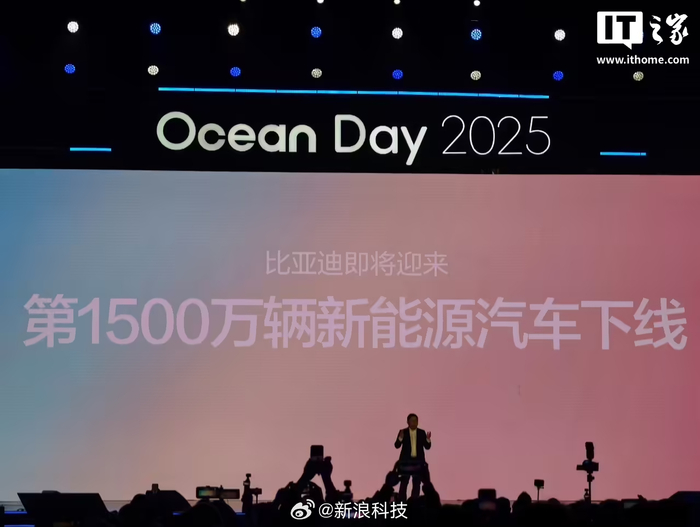
比亚迪将迎第1500万辆新能源车下线,海洋网称四年走完合资十几年路
Xin Lang Ke Ji· 2025-12-15 12:08
Group 1 - BYD is set to roll out its 15 millionth new energy vehicle, marking a significant milestone in its production history [1] - The company claims to have achieved in four years what took joint ventures over a decade to accomplish, highlighting its rapid growth and market penetration [1] Group 2 - The sales figures for BYD's new energy vehicles show a substantial increase: 194,000 units in 2024, 138,000 units in 2022, 70,000 units in 2021, and only 6,000 units prior [3]
比亚迪:11月辅助驾驶车型销售31.1万辆
Di Yi Cai Jing· 2025-12-15 10:15
据比亚迪汽车官博消息,11月比亚迪辅助驾驶车型销售311267辆,天神之眼车型累销超230万辆。 ...
前11月累计销量突破418万辆, 比亚迪全年目标超额在望
Chang Sha Wan Bao· 2025-12-15 10:09
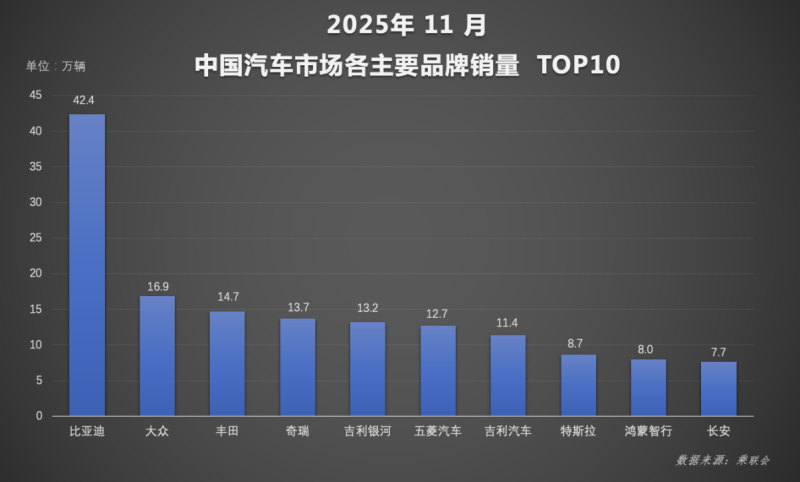
Core Viewpoint - The automotive market is experiencing a year-end surge, with BYD achieving record monthly sales of over 480,000 units in November, solidifying its leadership in the Chinese electric vehicle sector [1]. Group 1: Sales Performance - BYD's cumulative sales from January to November reached 4.182 million units, marking an 11.3% year-on-year increase, with over 90% of its annual sales target already achieved [4]. - In the top 10 automotive brands in China for January to November, BYD leads with 4.182 million units sold, followed closely by SAIC with 4.108 million units [5][8]. - The sales of BYD's Dynasty and Ocean series models remained strong, with the Qin family selling 70,824 units and the Yuan family selling 47,835 units in November [8]. Group 2: Product Structure and High-End Brand Contribution - The high-end brand, Fangchengbao, saw sales of 37,405 units in November, a remarkable 339% increase year-on-year, with the Ti7 model achieving over 24,000 units sold [9]. - The Tengshi brand sold 13,255 units in November, with the new Tengshi N8L model selling 5,443 units in its first month [9]. Group 3: International Expansion - BYD's overseas sales reached 131,661 units in November, a 297% increase year-on-year, contributing significantly to its overall growth [10]. - Cumulatively, BYD's overseas sales exceeded 910,000 units from January to November, more than double the total for 2024, with expectations to surpass 1 million units by the end of December [10]. - As of November, BYD's global cumulative sales of new energy vehicles reached 14.7 million units, showcasing its competitive advantages in product range and international market expansion [10].
尚水智能IPO:定向分红解决实控人资金占用,大客户比亚迪入股
Sou Hu Cai Jing· 2025-12-15 09:32
Core Viewpoint - Shenzhen Shangshui Intelligent Co., Ltd. is preparing for its listing on the ChiNext board, with a focus on micro-nano powder processing and precision measurement, primarily serving the new energy battery and new materials sectors [1][12]. Group 1: Company Overview - The main business of Shangshui Intelligent includes micro-nano powder processing, powder-liquid precision measurement, powder-liquid mixing and dispersion, and functional film preparation, applicable in various industries such as new energy batteries, new materials, chemicals, food, pharmaceuticals, and semiconductors [1]. - The actual controller, Jin Xudong, holds over 50% of the voting rights and has a history of shareholding arrangements involving family members [2][5]. Group 2: Financial Performance - The company reported revenue growth from 397 million yuan in 2022 to 601 million yuan in 2023, with a net profit of 98 million yuan in 2022 and 234 million yuan in 2023, but faced a decline in net profit in 2024 due to various factors [20][22]. - The company has a high customer concentration, with over 90% of its revenue coming from new energy battery equipment, primarily from major clients like BYD and Yiwei Lithium Energy [22][23]. Group 3: Capital and Investment - The IPO plans to raise 587 million yuan, significantly lower than the previous plan for the Sci-Tech Innovation Board, which aimed to raise over 1 billion yuan [12][14]. - The funds will be allocated to the construction of a high-precision intelligent equipment manufacturing base, a research and development center, and to supplement working capital [12][13]. Group 4: Operational Challenges - Despite having a substantial order backlog of 1.749 billion yuan, the production output for 2023 and 2024 is not expected to increase significantly, raising questions about production capacity limitations [15][22]. - The company has experienced high levels of accounts receivable and inventory, with accounts receivable reaching 173 million yuan in 2023 and inventory levels increasing to 1.037 billion yuan [24][27]. Group 5: Research and Development - The company has been increasing its R&D expenses, but its R&D expense ratio has been declining, indicating a lag behind industry leaders like Xian Dao Intelligent [17][18]. - As of the end of the reporting period, Shangshui Intelligent held 174 domestic patents, with only 44 being invention patents, suggesting a need for enhanced innovation efforts [19].

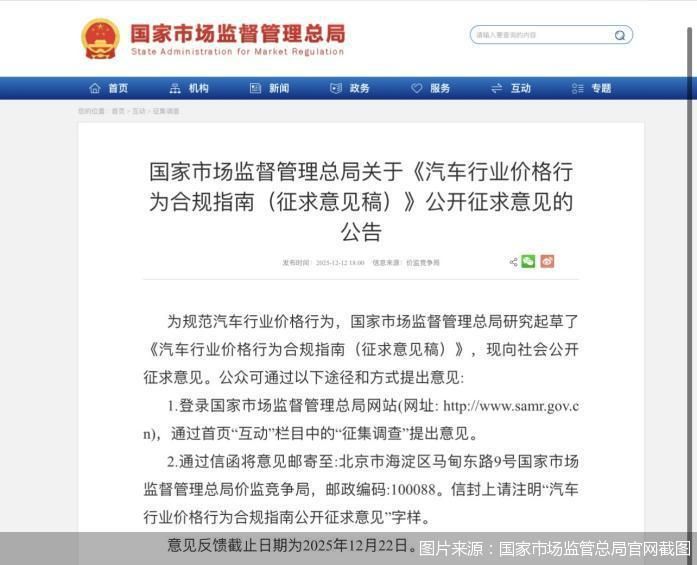
监管部门重拳“反内卷”:严禁不正当价格竞争,比亚迪小鹏北汽等表态
Bei Jing Shang Bao· 2025-12-14 10:41
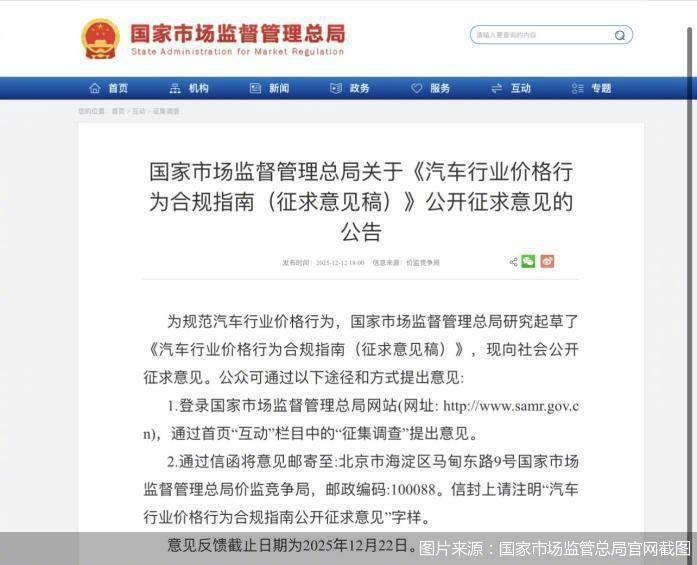
Core Viewpoint - The National Market Supervision Administration has released a draft guideline aimed at regulating pricing behaviors in the automotive industry, focusing on compliance for manufacturers and sales enterprises to promote lawful and fair competition [1][2]. Group 1: Pricing Behavior Regulations - The draft guideline specifies compliance requirements for pricing behaviors from vehicle production to sales, including the establishment of a comprehensive pricing management system covering all aspects of sales and financial services [2][3]. - It prohibits price collusion among manufacturers and suppliers, and mandates clear communication of pricing strategies and promotional policies to ensure consumer rights are protected [2][3]. Group 2: Sales Practices - The guideline emphasizes the need for transparent pricing in new car sales, requiring accurate price displays and the prohibition of hidden fees or misleading promotions [4][5]. - It mandates that sales enterprises must not engage in predatory pricing practices aimed at eliminating competition, such as selling below cost or using deceptive discounting methods [5][6]. Group 3: Internal Compliance Management - The draft encourages automotive companies to establish internal compliance management systems to prevent pricing violations, including risk identification and emergency response mechanisms [6][7]. - It outlines six core mechanisms for effective pricing behavior management, including decision-making, contract management, and compliance training [6]. Group 4: Industry Response and Market Trends - Major automotive companies like BAIC Group and Xpeng Motors have expressed commitment to adhering to the new guidelines, aiming to enhance their pricing compliance management systems [7]. - The automotive industry has seen a significant increase in production and sales, with a record of over 30 million vehicles sold in 2023, although profit margins have declined from 7.8% in 2017 to 4.3% in 2024 due to intense price competition [8][9].
监管部门再出重拳“反内卷”:严禁车企不正当价格竞争,比亚迪小鹏北汽等表态
Bei Jing Shang Bao· 2025-12-14 09:28
Core Viewpoint - The National Market Supervision Administration has released a draft guideline for price behavior compliance in the automotive industry, aiming to regulate pricing practices among manufacturers and sales enterprises, thereby promoting legal and compliant operations within the sector [1][2]. Group 1: Price Behavior Regulations - The draft guideline specifies compliance requirements for price behavior from vehicle production to sales, including the establishment of a comprehensive price management system covering all aspects of sales and financial services [2][3]. - It prohibits price collusion and discrimination among businesses under similar trading conditions, aiming to prevent unfair competition and protect consumer rights [2][3]. - The guideline emphasizes the need for clear pricing strategies based on production costs and market demand, ensuring that pricing practices are transparent and fair [2][3]. Group 2: Sales Practices - The guideline addresses issues in new car sales, mandating accurate price displays and prohibiting misleading promotions and price fraud [4][5]. - It requires that promotional rules and conditions be clearly communicated, and any additional charges must be disclosed to consumers [4][5]. - The guideline aims to enhance price transparency in the automotive market, thereby safeguarding consumer interests and stabilizing the industry [4][5]. Group 3: Internal Compliance Management - The draft encourages automotive enterprises to establish internal price compliance management systems to prevent pricing violations from the source [6][7]. - It outlines six core mechanisms for internal compliance, including price decision-making, contract management, and risk prevention [6][7]. - The guideline promotes a shift from passive compliance to proactive self-discipline within the industry, fostering a cooperative environment among businesses [6][7]. Group 4: Industry Context and Trends - The automotive industry in China has seen record production and sales, yet profit margins have declined from 7.8% in 2017 to 4.3% in 2024, indicating a need for regulatory intervention to combat price wars [8][9]. - The Ministry of Industry and Information Technology is increasing efforts to address "involution" in the automotive sector, which has negatively impacted normal business operations and industry sustainability [9]. - Recent data shows a recovery in the automotive industry's financial performance, with a 7.9% increase in revenue and a 4.4% increase in profit year-on-year, suggesting a stabilization of market conditions [9].