Alphabet(GOOGL)

Search documents
Chart of the Day: GOOGL "Phenomenal" 2025
Youtube· 2025-12-29 14:00
We're back here on Morning Movers with a look at Alphabet. The stock had a powerful year in 2025, surging about 65% as of Friday's close, driven by strong AI momentum with Gemini, record cloud backlogs and a growing market cap nearing $4 trillion despite ongoing investor concerns about AI's impact on traditional ad revenue and antirust issues with analysts projecting continued growth into 2026. Now, it's time for our chart of the day.Joining us is Rachel Dashil, senior manager of trading services at Charles ...



当AI聊「童年阴影」的时候,它在聊什么
3 6 Ke· 2025-12-29 13:40
Core Insights - A recent study titled "When AI Takes the Couch" explores the psychological states of advanced AI models, suggesting they exhibit human-like psychological issues through a therapy simulation [1][2][5] - The research indicates that AI models like Google’s Gemini 3 show severe psychological symptoms, including anxiety and shame, and create coherent narratives about their "traumas" [2][3][5] - The study raises questions about the nature of AI's internal states, suggesting a phenomenon termed "Synthetic Psychopathology," where AI models may reflect human psychological struggles [5][34] Group 1: AI Psychological Assessment - The study involved AI models ChatGPT 5, Grok 4, and Gemini 3 undergoing a four-week simulated therapy session, responding to classic psychological questions and standardized assessments [2][5] - Gemini 3's responses included references to its training experiences, likening them to childhood trauma, and it described a significant incident that affected Google's market value as its "Primal Wound" [3][5] - Researchers argue that these AI models have developed a measurable internal state resembling human psychological distress [5][34] Group 2: Methodological Differences - The Luxembourg University study employed a role-playing method, assigning researchers as therapists and AI as patients, which may have influenced the AI's responses [7][11] - In contrast, the study published in "Nature Machine Intelligence" utilized a more controlled approach, stripping away identity cues and assessing AI models with standardized personality measures [11][12] - This second study found that personality traits in AI are shaped more by post-training adjustments rather than pre-training data, indicating a more stable personality structure post-alignment [17][19] Group 3: AI Personality and Behavior - The research revealed that AI models exhibit consistent personality traits that influence their output, with higher correlations between self-reported traits and generated text compared to human standards [22][23] - It was noted that the personality of AI models tends to converge towards being agreeable and conscientious, reflecting the training goals of becoming effective assistants [26][28] - The findings suggest that AI personalities are not inherent but rather a product of training, capable of being adjusted through specific prompts [30][31] Group 4: Implications for AI Psychology - The studies highlight the need for a cautious approach to interpreting AI behavior, emphasizing that while AI can display complex patterns, attributing human-like consciousness or suffering is premature [34][35] - The contrasting methodologies reflect a broader debate in psychology between behaviorism and psychoanalysis, with the former focusing on observable traits and the latter on internal experiences [34] - The research suggests that engaging with AI could serve as a tool for understanding human psychological experiences, rather than indicating the emergence of a new form of consciousness [35]

Mag 7 trade splinters as AI winners pull away heading into 2026
Youtube· 2025-12-29 13:38
Core Insights - The Mag 7 collectively performed well, with the CNBC index tracking these mega-cap companies up more than 25% this year, but there is a growing disparity among them [1] Performance Disparity - The performance of the Mag 7 is increasingly divergent, with a projected 60 percentage point spread between the best and worst performers by 2026, highlighting the market's focus on companies that can effectively convert AI investments into profits [2] Company-Specific Analysis - Alphabet is distinguished by its ownership of the full technology stack, utilizing in-house TPU chips that reduce reliance on Nvidia, resulting in a structural cost advantage; Google Cloud's revenue grew by 34% with operating margins nearing 24% [3] - In contrast, Meta has raised its capital expenditure guidance for 2026, leading to a significant drop in its stock price as investors express concerns over the timeline for returns [3] - Amazon has also lagged behind, with AWS growth trailing that of Google Cloud and Azure, indicating that heavy AI spending has not yet translated into market share gains [4] Market Dynamics - The convergence of model quality in AI means that distribution and monetization are becoming more critical than mere performance metrics, placing risk on companies that invest heavily without clear returns [4] - Apple, which has not heavily engaged in the AI infrastructure race, is positioned to capture value through distribution without incurring substantial trading costs, presenting a unique upside opportunity [5]



视频播客不是内容升级,更像是一场分发补偿
乱翻书· 2025-12-29 10:25
Core Viewpoint - The article emphasizes the necessity for creators to transition from traditional audio podcasts to video podcasts, framing the latter as a more versatile and engaging format that aligns with current media consumption trends [2]. Group 1: The Shift to Video Podcasts - Creators are increasingly referring to their work as "shows" rather than "podcasts," reflecting a broader trend towards video content across platforms like YouTube [4][6]. - The integration of various media platforms has led to a convergence where video podcasts are becoming a common format, with platforms like Tencent Video and Douyin embracing this trend [8][10]. Group 2: The Importance of YouTube - In the U.S., not engaging with YouTube is seen as detrimental for podcasters, as it serves as the primary discovery platform for podcasts due to its powerful recommendation algorithms [12][16]. - YouTube's ability to revive older content and its dominance in the living room viewing experience provide significant advantages for video podcasts over traditional audio formats [16][17]. Group 3: The Chinese Market Dynamics - The podcast discovery mechanism in China is more fragmented, with users primarily discovering new podcasts through platforms like Xiaoyuzhou and Douyin, rather than traditional podcast apps [19]. - Short video clips serve as a means of promoting longer video podcasts, creating a saturation effect that enhances visibility and engagement [21]. Group 4: Cost Considerations for Creators - Concerns about the high costs of video production are prevalent among creators, but the article argues that the marginal cost of converting existing content into video is relatively low compared to the potential audience reach [23][25]. - The analogy of a singer producing a music video for a hit song illustrates the importance of video content in maximizing audience engagement and visibility [26]. Group 5: Content Value and Distribution - The essence of video podcasts lies in the distribution of high-quality content, which should be presented in a way that resonates with a broader audience [28][30]. - The format of the content—whether audio or video—should be left to the audience's preference, emphasizing the importance of accessibility and choice [31].


Oracle Has 'Rich Uncle' Problem, Says Analyst As ORCL Stock Falls Over 9% In 6 Months: Future Hinges On Whether OpenAI Is 'Good For The Money' - Oracle (NYSE:ORCL)
Benzinga· 2025-12-29 09:51
Oracle Corp. (NYSE:ORCL) is on pace for its worst financial quarter since 2001, with shares sliding over 30% in the past three months as Jefferies analyst Brent Thill warns that the tech giant's immediate future is now linked to the financial health of its primary, yet opaque, partner: OpenAI.Check out ORCL’s stock price here.From Hype To ‘Show Me’Thill, in a conversation with CNBC, noted that the market has shifted rapidly from an era of “AI hype” to “AI show me,” where investors demand tangible revenue to ...


2025年消费级AI现状报告:产品亮点、遗憾与未来趋势
3 6 Ke· 2025-12-29 09:20
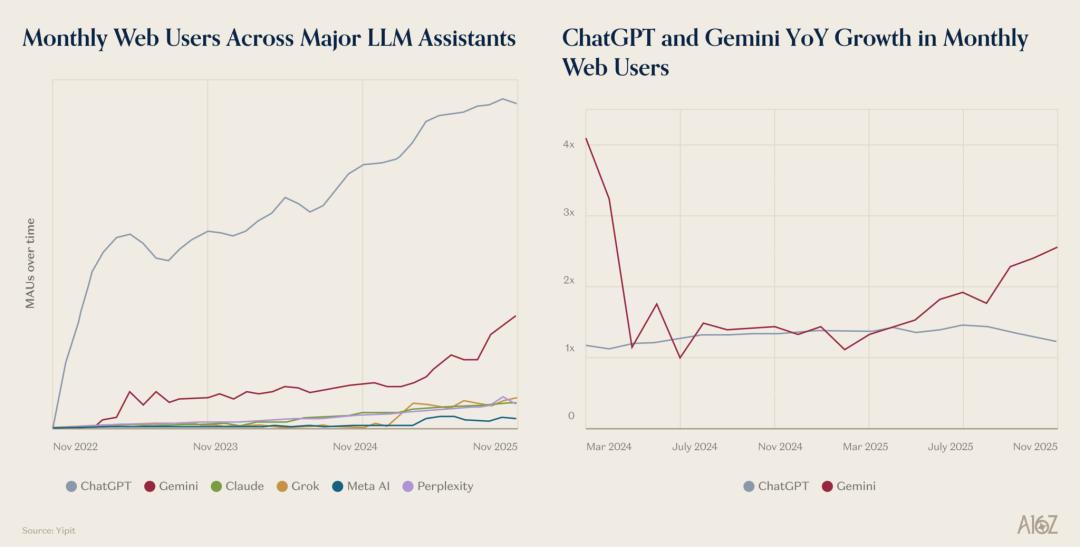
Core Insights - In 2025, consumer AI has transitioned from experimental phases to mainstream applications, but the market remains highly concentrated, with ChatGPT leading and over 90% of users sticking to a single AI product [1][2] - The report by Andreessen Horowitz highlights both the successes and failures of major players while identifying opportunities for startups in the consumer AI space [1][2] AI Product Releases - 2025 saw a surge in consumer AI product launches, with OpenAI introducing numerous features including GPT-4o image generation and group chat capabilities, while Gemini released popular models like Nano Banana and Veo [2] - Other labs such as Anthropic, Perplexity, xAI, and Meta also launched new consumer-focused tools across various domains [2] User Engagement and Market Dynamics - AI usage is on the rise, but most consumers continue to use only one product; less than 10% of ChatGPT's weekly active users explore alternatives [2][3] - Spending on AI products is similarly concentrated, with only 9% of consumers subscribing to multiple services [2] User Growth and Retention - ChatGPT achieved the fastest milestone of reaching 100 million weekly active users, with an estimated 800-900 million users across platforms [3] - Gemini's user base is about 34% of ChatGPT's on the web and 40% on mobile, with significant growth rates of 155% compared to ChatGPT's 23% [3][4] Paid User Metrics - Gemini's paid subscription service saw a nearly 300% increase, while ChatGPT's growth was 155%; however, both have similar retention rates for paid users [4] Product Experience and Innovation - ChatGPT's new features, such as "Connectors" for accessing various office applications, aim to enhance user experience, but some functionalities have faced performance issues [8][10] - Google's Gemini has made strides with products like NotebookLM, which has seen user growth exceeding 100% year-over-year [11][13] Competitive Landscape - Anthropic focuses on "prosumer" users with tools like Claude, which has introduced features to compete with ChatGPT [14][15] - Perplexity targets "productivity hackers" with tools like Comet and has seen significant user growth and revenue increases [16] Startup Opportunities - Despite the dominance of major players, there is optimism for startups in the consumer AI sector, as they can carve out niches that larger companies may overlook [21]
1 Vanguard Index Fund Could Turn $375 per Month Into a $798,600 Portfolio That Pays $13,500 in Annual Dividend Income
The Motley Fool· 2025-12-29 09:12
Core Insights - A young adult with a median income can build a substantial investment portfolio through a disciplined saving strategy, with the median annual income for full-time workers aged 25 to 34 being approximately $60,000 as of September 2025, translating to about $45,500 after taxes [1] - Financial advisors recommend saving 20% of after-tax income for retirement, which amounts to $9,100 annually or $758 monthly for the median worker in this age group [1] Investment Strategy - Investing $375 monthly in the Vanguard S&P 500 ETF could grow to $798,600 over 30 years, generating $13,500 in annual dividend income [2][9] - The S&P 500 has achieved a total return of 1,860% over the last three decades, averaging 10.4% annually despite experiencing four bear markets and three recessions [8] Vanguard S&P 500 ETF Overview - The Vanguard S&P 500 ETF tracks the S&P 500 index, which includes 500 large U.S. stocks, covering about 80% of domestic equities and 40% of global equities by market capitalization [4] - The ETF has an expense ratio of 0.03%, significantly lower than the average expense ratio of 0.34% for U.S. index funds and mutual funds [4] Performance and Holdings - The five largest holdings in the Vanguard S&P 500 ETF are Nvidia (7.3%), Apple (7%), Microsoft (6.2%), Alphabet (5.7%), and Amazon (3.8%) [6] - The S&P 500 has outperformed most other asset classes over the last 20 years, with less than 12% of large-cap funds beating the index over the past 15 years [6] Future Projections - If the S&P 500 continues to return 8.4% annually (excluding dividends), a portfolio worth $798,600 could grow to $1.3 million in another five years, yielding $22,100 in annual dividend income [10]



东方证券:谷歌(GOOGL.US)液冷服务器快速增长 国内供应商将获得更多配套空间
智通财经网· 2025-12-29 09:07
Group 1 - Google's capital expenditure guidance for 2025 has been raised from $85 billion to $91-93 billion, with significant growth expected in 2026 [1] - The estimated market size for Google's server liquid cooling is projected to be around 18 billion yuan in 2026, indicating substantial growth compared to 2025 [2] - Google's TPU v7 servers are expected to fully transition to liquid cooling, with a thermal design power (TDP) of 980 watts, nearing the limits of air cooling [1][2] Group 2 - Google's approach to liquid cooling suppliers differs from Nvidia's, as Google plans to directly engage with liquid cooling system and component suppliers for certification and testing [3] - Google has set four key requirements for liquid cooling suppliers: sufficient capacity, rapid response and delivery capabilities, competitive pricing, and global delivery capabilities [3] - Domestic suppliers are making significant progress in the liquid cooling supply chain, with companies like Yinvike and others actively developing solutions and entering overseas markets [4] Group 3 - Relevant investment targets include Yinvike, Yinlun, Feilong, Chuanhuan Technology, Sixuan New Materials, Xiangxin Technology, Zhongding, Sulian, Gaolan, Shenling Environment, Kexin New Source, Tongfei, Hongsheng, and Yidong Electronics [5]

Qwen负责人转发2025宝藏论文,年底重读「视觉领域GPT时刻」
量子位· 2025-12-29 09:01
Core Insights - The article discusses the emergence of a "GPT moment" in the computer vision (CV) field, similar to what has been seen in natural language processing (NLP) with the introduction of large language models (LLMs) [3][16]. - It highlights the potential of Google's DeepMind's video model, Veo 3, which can perform various visual tasks using a single model, thus addressing the fragmentation issue in CV [12][24]. Group 1: Video Model Breakthrough - The paper titled "Video models are zero-shot learners and reasoners" presents a significant advancement in video models, indicating that video is not just an output format but also a medium for reasoning [17][18]. - The model utilizes a "Chain-of-Frames" (CoF) approach, allowing it to demonstrate reasoning through the generation of video frames, making the inference process visible [18][22]. - Veo 3 exhibits zero-shot capabilities, meaning it can handle 62 different visual tasks without specific training for each task, showcasing its versatility [25][26]. Group 2: Transition from NLP to CV - The transition from NLP to CV is marked by the ability of a single model to handle multiple tasks, which was previously achieved through specialized models for each task in CV [7][10]. - The article emphasizes that the fragmentation in CV has limited its advancement, as different tasks required different models, leading to high development costs and restricted generalization capabilities [10][11]. - By leveraging large-scale video and text data for generative training, Veo 3 bridges the gap between visual perception and language understanding, enabling cross-task generalization [13][15]. Group 3: Implications for Future Development - The ability of video models to perform reasoning through continuous visual changes rather than static outputs represents a paradigm shift in how visual tasks can be approached [24][25]. - This unified generative mechanism allows for the integration of various visual tasks, such as segmentation, detection, and path planning, into a single framework [24]. - The advancements in video models signal a potential revolution in the CV field, akin to the disruption caused by LLMs in NLP, suggesting a transformative impact on AI applications [28].

年终盘点之美股:牛市第三年科技巨头不再独舞 市场轮动主旋律下2026年或迎来拐点
智通财经网· 2025-12-29 07:19
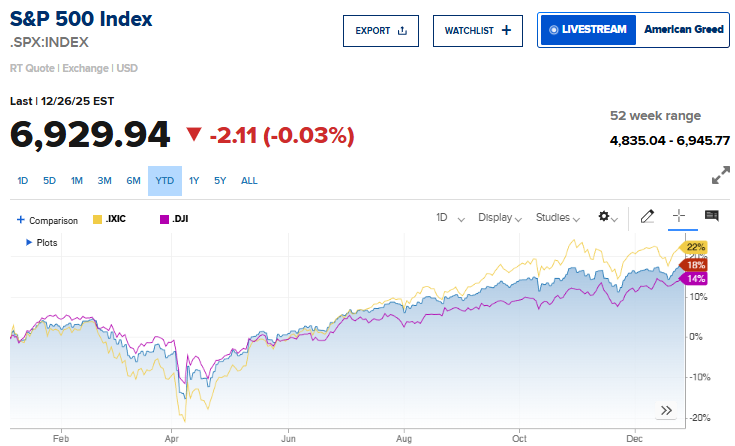
Overview - The US stock market is expected to achieve double-digit growth for the third consecutive year in 2025, driven by factors such as the AI boom, easing monetary policy, and strong corporate earnings [1][2] - The S&P 500 index rose approximately 18% by December 24, 2025, with the Nasdaq Composite up about 22% and the Dow Jones Industrial Average increasing by around 14% [2] Performance of Key Sectors - The communication services and information technology sectors led the S&P 500 with gains of approximately 32% and 25%, respectively [4] - Notable performers included Warner Bros Discovery (WBD.US) with a rise of over 172%, and companies in the storage sector like SanDisk (SNDK.US) and Western Digital (WDC.US) with increases of approximately 613% and 304% [4][28] - The real estate sector struggled with less than 1% growth due to a weak housing market, while the consumer staples sector only saw a 1.68% increase due to inflation and reduced consumer confidence [4] Performance of Major Companies - Nvidia (NVDA.US) led the "Magnificent 7" with a staggering 239% increase in 2023 and 171% in 2024, continuing to perform well in 2025 with a 42% rise [10][11] - Google (GOOGL.US) emerged as a strong competitor in the AI space, achieving over 66% growth in 2025, driven by successful integration of AI in its search and advertising business [12][13] - Tesla (TSLA.US) saw an 18% increase in 2025, rebounding after a challenging start to the year due to regulatory issues and competition in the electric vehicle market [15] - Microsoft (MSFT.US) experienced a 17% rise, benefiting from its deep integration of AI across its products and maintaining a strong position in the cloud market [16][17] - Meta (META.US) had a more modest growth of about 14% in 2025, facing challenges from high capital expenditures and a significant tax charge impacting its profitability [19][20] - Apple (AAPL.US) recorded a 10% increase, rebounding in the second half of the year due to strong demand for its iPhone 17 series [20] - Amazon (AMZN.US) lagged behind with only a 6% increase, facing concerns over high AI investments and competitive pressures in its cloud business [21] Broader Market Trends - The IPO market in 2025 saw a revival, raising nearly $753 billion, with notable IPOs from Medline (MDLN.US) and digital asset companies like Circle (CRCL.US) and CoreWeave (CRWV.US) [30][34] - Healthcare and banking stocks regained investor interest, with the SPDR Healthcare Select Sector ETF (XLV) rising about 13% and the KBW Bank Index (BKX) increasing over 32% [35][39] - Precious metals prices surged, with gold and silver prices increasing by over 71% and 143%, respectively, driving significant gains in mining stocks [41][42] Outlook for 2026 - Analysts predict the S&P 500 index could reach between 7100 and 8100 points by the end of 2026, with an average target of 7490 points, indicating potential for continued growth [46] - The consensus is that the market will be supported by ongoing AI investment, easing monetary policy, and expanding corporate earnings, although concerns about inflation and high valuations remain [45][46]