
Goldman Sachs(GS)

Search documents
Goldman Sachs (NYSE:GS) Quarterly Earnings Preview
Financial Modeling Prep· 2026-01-14 10:00
Core Viewpoint - Goldman Sachs is positioned to report strong quarterly earnings driven by growth in investment banking fees and net interest income, despite rising expenses and the exit from the Apple Card partnership [2][3][4]. Financial Performance - The company is expected to release its quarterly earnings on January 15, 2026, with an estimated earnings per share (EPS) of $11.69 and projected revenue of approximately $14.26 billion [2][6]. - Revenues for the quarter are anticipated to reach $14.54 billion, indicating a robust performance despite a decline in EPS due to increased expenses [2]. Growth Drivers - Investment banking revenues are projected to increase by 27% year-over-year, while net interest income (NII) is expected to grow by 39% year-over-year, showcasing the company's resilience in a competitive market [3]. - The exit from the Apple Card partnership is expected to add 46 cents to its Q4 EPS from reserve releases, although this will be counterbalanced by a reduction in revenues [4][6]. Historical Performance - Goldman Sachs has a strong track record of exceeding earnings expectations, surpassing the Zacks Consensus Estimate in the last four quarters with an average earnings surprise of 21.28% [5]. - The company's financial metrics include a P/E ratio of 17.42 and a price-to-sales ratio of 2.31, reflecting its market valuation [5]. Financial Leverage - The debt-to-equity ratio of 5.36 indicates significant financial leverage, which is a point of consideration for investors [5].


关税预期引爆囤货潮!铜价飙升现“稀缺溢价”,高盛警告涨势已脱离基本面?
Jin Rong Jie· 2026-01-14 09:47
Group 1 - The recent strong performance of copper prices is primarily driven by market expectations of potential U.S. tariffs on refined copper imports, leading to stockpiling behavior in the U.S. and significant "scarcity premium" in prices [1] - Goldman Sachs has raised its LME copper price forecast for the first half of 2026 from $11,525 per ton to $12,750 per ton, while maintaining its fourth-quarter 2026 forecast at $11,200 per ton, indicating that prices above $13,000 are unlikely to be sustainable [1] - The current copper price increase is not due to global supply-demand tightness, as Goldman Sachs projects a global copper market surplus of 600,000 tons in 2025, the largest absolute surplus since 2009, and has adjusted the 2026 surplus forecast from 160,000 tons to 300,000 tons [1] Group 2 - The U.S. decision on refined copper tariffs is a key catalyst for future copper price trends, with Goldman Sachs reducing the probability of timely tariff implementation from 55% to 45% following the White House's delay on lumber tariffs, reflecting a focus on "affordability" ahead of midterm elections [1] - Once the U.S. tariff decision becomes clearer, market attention will shift back to the fundamental global supply surplus, potentially signaling the end of the current price increase cycle driven by stockpiling [2] - From a longer-term perspective, Goldman Sachs predicts that a return to supply-demand balance starting in 2027 will help alleviate supply tightness in markets outside the U.S. [2]
什么信号?高盛警告:投资者涌向黄金避险“大错特错”
Feng Huang Wang· 2026-01-14 08:59
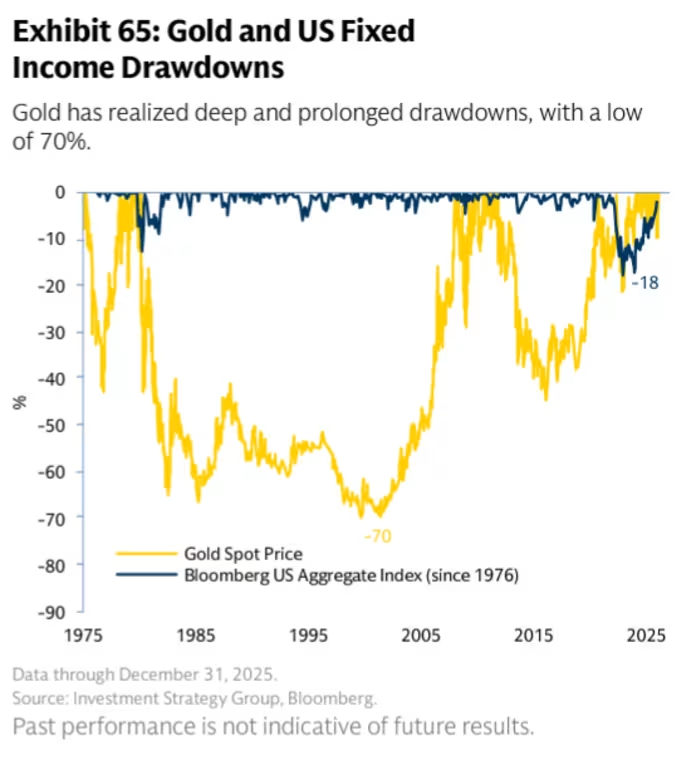
Core Viewpoint - In 2026, international gold prices have surged, reaching new highs, with spot gold rising nearly 7% to over $4,600. However, Goldman Sachs warns that investors flocking to gold for safety may be making a significant mistake, as the firm does not favor gold as a diversification tool in investment portfolios [1][4]. Group 1: Gold Price Trends - Gold prices experienced a significant increase of over 60% in 2025, marking the largest rise since 1979, and continued to reach new highs in 2026 [1]. - The SPDR Gold Shares ETF saw a substantial inflow of $950 million, reversing its outflow trend in 2026, with a net subscription of $118 million year-to-date [8]. Group 2: Goldman Sachs' Perspective - Goldman Sachs' investment strategy team highlighted that gold has historically shown deep and prolonged drawdowns, with a maximum drawdown of 70% [1]. - The volatility of gold is higher than that of U.S. stocks, and it has only effectively hedged inflation about half of the time over the past 20 years [4][5]. - Goldman Sachs recommends increasing exposure to U.S. stocks, suggesting that unless a recession is imminent, it is challenging to reduce U.S. stock holdings, as economic conditions will ultimately support corporate earnings [11]. Group 3: Contrasting Views - Wells Fargo Investment Institute anticipates further increases in gold prices in 2026, driven by geopolitical tensions and active gold purchases by global central banks [11]. - The Federal Reserve's expected interest rate cuts and a stable dollar are expected to support gold's performance in 2026, although at a slower pace than in 2025 [11].
看多中国经济,高盛预计今年底人民币汇率将升至6.85
21世纪经济报道· 2026-01-14 08:26
Core Viewpoint - Goldman Sachs has significantly raised its GDP growth forecasts for China for 2026 and 2027 to 4.8% and 4.7% respectively, marking the largest upward adjustment since 2019, driven by a new assessment of China's export prospects [1][4]. Group 1: Economic Forecasts - Goldman Sachs' optimistic outlook is based on three main factors: a positive global economic outlook, strong competitiveness in China's manufacturing sector, and a reduction in tariffs on Chinese goods by the U.S. [4][5]. - The bank predicts a 2.6% growth rate for the U.S. economy in 2026, which is higher than the market consensus of 2.0%, indicating stable demand for Chinese exports [4]. - The Chinese government's focus on building a modern industrial system and promoting technological self-reliance is expected to enhance China's competitive edge in global markets [4]. Group 2: Export Resilience - Approximately 80% of China's exports, including machinery, chemicals, and electronics, have shown a year-on-year growth rate between 5% and 15%, indicating broad resilience across various product categories [7][8]. - China's manufacturing costs are estimated to be 30% to 40% lower than those in other countries, contributing to the sustained growth of its exports despite tariff challenges [8]. Group 3: Currency Internationalization - The internationalization of the Renminbi (RMB) is expected to accelerate in the coming years, driven by China's growing economic share in the global economy, which is around 20% for both GDP and trade [11]. - The RMB currently accounts for only 2% to 3% of the global currency system, indicating a mismatch that is likely to correct over time as China's economic influence increases [11]. - The Chinese government aims to reduce reliance on the U.S. dollar, especially in light of geopolitical risks, by promoting the RMB's use in international trade and finance [12]. Group 4: Consumer Spending - To effectively boost consumer spending, policies should focus on providing financial support to low-income individuals, such as job creation and income increases, rather than relying solely on short-term measures like subsidies [16][18]. - The government is increasingly recognizing the importance of consumer spending, with initiatives like childcare subsidies aimed at directly enhancing household financial capacity [18]. - A significant portion of overall consumption comes from government spending on public services, which could play a crucial role in driving future consumption growth [18].
Asian stocks today: Markets rise after Wall Street tumbles; HSI adds 180 points, Nikkei up 1%
The Times Of India· 2026-01-14 03:35
Market Performance - Hong Kong's HSI traded at 27,037, up 188 points or 0.7% [2][4] - Nikkei increased by 864 points or 1.6% to 54,413 [2][4] - Shanghai and Shenzhen indices rose by 1.11% and 1.83% respectively [2][4] - South Korea's Kospi was down 4 points around 9 am IST [2][4] US Market Influence - US stocks retreated on Tuesday, with the S&P 500 pulling back from a record high [2][4] - Losses were primarily driven by banking shares after JPMorgan Chase & Co. reported investment-banking fees below guidance [2][4] - December inflation data did not significantly alter expectations for the Federal Reserve's interest-rate cuts [2][4] Bank Earnings Outlook - A heavy slate of bank earnings is being tracked, with results from major banks like Bank of America, Wells Fargo, Citigroup, Goldman Sachs, and Morgan Stanley expected soon [3][4] - The banking group is projected to achieve its second-highest annual profit on record, aided by policy changes under the Trump administration [3][4] Tariff Ruling Risks - The potential US Supreme Court ruling on President Trump's global tariffs is a key risk factor [3][4] - An unfavorable ruling could lead to a negative market response, although the administration has alternative legal routes to enforce tariffs [3][4] Commodity Market Trends - Brent crude prices extended gains, marking the largest four-day rise since June due to heightened rhetoric around Iran [3][4] - Silver prices continued to rise, achieving the strongest three-day rally on record [3][4]


全球资本2026年开年布局中国:股票与人民币成“双重押注”核心标的
Jin Shi Shu Ju· 2026-01-14 03:33
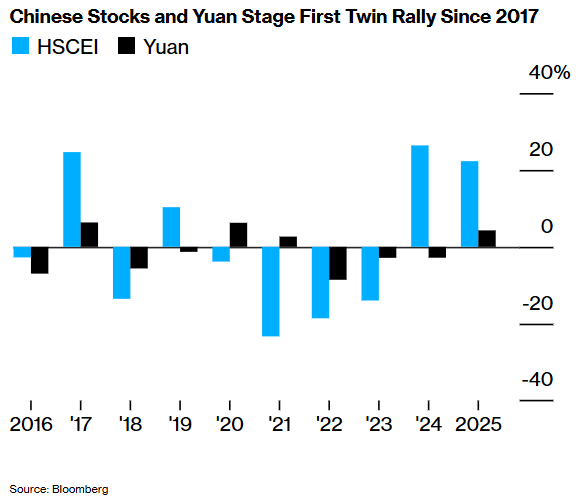
Core Viewpoint - Investors are increasingly betting on Chinese stocks and currency as global uncertainty rises, with major investment firms raising their assessments of China's stock market due to attractive valuations, supportive industrial policies, and optimistic profit outlooks [1][6]. Group 1: Stock Market Performance - The Chinese stock market and the Renminbi have experienced their first simultaneous rise since 2017, with a key index tracking Hong Kong-listed Chinese companies rising over 22% last year, marking it as one of the best-performing major indices globally [4][5]. - The A-share market has reached a four-year high, with the recent trading volume hitting a record 3.65 trillion yuan (approximately 523 billion USD), significantly above the past five-year average daily trading volume of 1.13 trillion yuan [10]. - Goldman Sachs has raised its year-end target for the CSI 300 index to 5,200 points, indicating a potential 9% upside from recent closing prices, and has increased its profit growth forecast for China from 4% in 2025 to 14% in 2026 and 2027 [7]. Group 2: Currency Outlook - The Renminbi is expected to strengthen, with predictions of it reaching 6.25 against the USD by the end of 2026, supported by strong exports and trade surpluses [11][12]. - Major financial institutions, including Citigroup and Bank of America, are optimistic about the Renminbi, with forecasts suggesting it could appreciate to 6.8 against the USD this year [11]. - The recent rise in the Renminbi has been linked to improved risk sentiment and returns calculated in USD, which could further support the stock market [4][11]. Group 3: Sectoral Insights - Analysts remain optimistic about various sectors, including healthcare, battery supply chains, and agriculture, with a renewed focus on underperforming sectors like real estate and real estate credit [11]. - The narrative around Chinese artificial intelligence has shifted investor sentiment positively, leading to a potential structural bull market despite economic fundamentals not fully supporting a broad bull run [10][11].

高盛逆势预警:投资者涌向黄金避险恐是重大误判!
Xin Lang Cai Jing· 2026-01-14 02:05
Core Viewpoint - Goldman Sachs warns that investors seeking refuge in gold may be making a significant mistake, despite the metal's price surge over the past year [2][13] Group 1: Gold Investment Outlook - Goldman Sachs' investment strategy team does not favor gold as a diversification tool in investment portfolios for 2026 [2][13] - The team highlights that gold has historically experienced deep and prolonged drawdowns, with a maximum drawdown of 70% [2][13] - Gold's volatility is noted to be higher than that of U.S. stocks, and it has only effectively hedged inflation in about half of the rolling 20-year periods [5][16] Group 2: Market Trends and Fund Flows - Investors have recently injected $950 million into the SPDR Gold Shares ETF, reversing a trend of outflows in 2026, with a net subscription of $118 million year-to-date [8][19] - The ETF saw a nearly 64% increase in 2025 and continues to rise, achieving its strongest annual performance since its launch in late 2004 [8][19] - As of the latest trading session, the gold ETF has risen over 6% this year, outperforming the broader U.S. stock market in 2026 [8][19] Group 3: Economic Factors Influencing Gold - Wells Fargo Investment Institute anticipates further increases in gold prices in 2026, driven by geopolitical tensions and active purchases by global central banks [11][22] - The expected interest rate cuts by the Federal Reserve and a stable dollar are projected to support gold's performance, although at a slower pace than in 2025 [11][22] Group 4: U.S. Stocks vs. Gold - Goldman Sachs' investment strategy team recommends an overweight position in U.S. stocks, suggesting that unless there is high certainty of an impending recession, it is difficult to underweight U.S. equities [23] - The team emphasizes that economic conditions will ultimately support earnings, with the S&P 500 index expected to follow the path of earnings [23]

高盛首席中国经济学家闪辉:看多中国经济 预计今年底人民币汇率将升至6.85
2 1 Shi Ji Jing Ji Bao Dao· 2026-01-13 23:16
带着这些问题,21世纪经济报道记者对高盛首席中国经济学家闪辉进行了独家专访。在她看来,驱动这 一乐观预期的核心动能,源于对中国出口前景的全新评估。 在全球经济的再平衡进程中,中国制造业凭借其深厚的产业链优势和不断增强的科技竞争力,正展现出 强大的增长韧性。 然而,经济"外贸强内需弱"的不平衡格局,也对可持续发展提出了深刻挑战。如何善用出口带来的宝 贵"窗口期",系统性地构建内需增长的长效机制,将是中国经济实现高质量、可持续发展的关键所在。 新年伊始,全球经济图景在不确定性的迷雾中展开。当多数市场参与者仍在谨慎观望时,国际知名投行 高盛却逆势而上,率先在去年10月将其对中国2026年和2027年的GDP增速预测分别上调至4.8%和 4.7%。这是自2019年以来,该行对中国经济增长预期做出的最大幅度上调,其乐观程度显著高于市场 平均预期。 这一判断的底气何在?在全球经济的顺风与逆风之间,中国经济这艘巨轮将如何航行? 出口预期强劲 《21世纪》:在当前的国际经济形势下,高盛对中国经济的预测相对其他外资银行显得更为乐观:将 2025年GDP增速从4.9%上调至5.0%,2026年从4.3%上调至4.8%,2027年 ...
中概股强势爆发,黄金再创新高
Ge Long Hui· 2026-01-13 22:17
Market Performance - The three major indices closed with slight gains, with the Dow Jones up 0.17%, the Nasdaq up 0.26%, and the S&P 500 up 0.16% [1] - Bank stocks collectively retreated, while technology stocks showed mixed performance, and Chinese concept stocks surged [1] Banking Sector - Citigroup experienced a significant drop of 2.98%, while other banks like Bank of America, JPMorgan, Zions Bank, US Bancorp, and Union Bank saw declines of over 1% [3] - Goldman Sachs was an exception, rising by 1.13% [3] Technology Sector - The technology sector displayed mixed results, with Advanced Micro Devices (AMD) rising by 2.22%, Google increasing by 1%, and companies like Tesla, Nvidia, and Apple showing slight gains [3] - Qualcomm faced a notable decline of 4.79%, Intel dropped by 3.27%, and META fell by 1.7% [3] Chinese Concept Stocks - Chinese concept stocks opened strong and maintained high levels throughout the day, with China Golden Dragon rising by 4.26% [3] - Alibaba surged by 10.17%, Bilibili increased by 8.95%, Xpeng Motors rose by 8.44%, and JD.com was up by 4.73%, while Pinduoduo saw a decline of 1.51% [3] Gold Market - COMEX gold prices opened strong and reached a new high, closing up 2% at $4608.8 per ounce, with a trading range between a low of $4520.8 and a high of $4640.5 [3]



Goldman Sachs drops a curveball on interest-rate cuts
Yahoo Finance· 2026-01-13 17:47
Group 1 - Goldman Sachs has revised its outlook on interest rates, pushing expected rate cuts to June and September 2026, indicating a slower easing process and lower recession risk [5][7] - The economic environment is normalizing, supported by benign inflation reports, durable growth, and reduced recession fears, leading to a more patient Federal Reserve [2][3] - The Federal Reserve's messaging aligns with a data-dependent approach, emphasizing the importance of fundamentals such as earnings and consumer demand in the current market context [3] Group 2 - Goldman Sachs has reduced its 12-month recession probability from 30% to 20%, reflecting increased confidence in the economy's resilience to higher rates [8]