Intel(INTC)

Search documents
苹果,再次豪赌芯片!
半导体行业观察· 2025-11-15 01:42
Core Viewpoint - The article discusses Apple's journey from reliance on external chip manufacturers to developing its own chips, highlighting the significance of the M1 chip and the company's ongoing efforts in vertical integration, including the development of a custom 100MP image sensor [1]. Group 1: Historical Context - In the 1980s, Apple relied heavily on Motorola's MOS 6502 processor, which was pivotal in the success of early Apple products like the Apple I and Apple II [3][4]. - The Macintosh 128K, launched in 1984, utilized the Motorola 68000 processor, marking a significant innovation in personal computing with its graphical user interface [4][6]. Group 2: Early Self-Development Efforts - In 1989, Apple initiated the "Project Aquarius," aiming to develop a multi-core CPU architecture to regain technological strength, but the project was ultimately terminated due to resource constraints [5][6]. - Despite the failure of early self-development efforts, Apple demonstrated a persistent desire to control its hardware future [6]. Group 3: Strategic Partnerships - In 1991, Apple formed a partnership with IBM to develop the PowerPC architecture, which was seen as a significant move against the dominance of Intel and Microsoft [8][13]. - The AIM alliance, consisting of Apple, IBM, and Motorola, aimed to create a unified standard in chips, hardware, and software, but ultimately, Apple only adopted the PowerPC chip without significant progress in other areas [24]. Group 4: Market Challenges - The launch of Windows 95 in 1995 marked a turning point, as it significantly improved usability and performance, leading to a decline in Apple's market share from 16% to 4% [28][29]. - The competitive landscape shifted dramatically, with Intel and Microsoft solidifying their dominance in the PC market, while Apple's reliance on the PowerPC architecture faced increasing scrutiny [30][32]. Group 5: Decline of PowerPC - Despite initial success with the Power Macintosh, the AIM alliance faced numerous challenges, including the failure of joint ventures like Taligent and Kaleida, which did not deliver on their promises [22][24]. - By the late 1990s, Motorola's inability to keep pace with Intel's advancements led to a decline in the PowerPC's relevance in the market [41][42]. Group 6: Transition to Intel - In 2005, Apple announced a transition to Intel processors, marking a significant shift in its hardware strategy as it sought to improve performance and compatibility with the broader PC ecosystem [46].





AMD继续蚕食英特尔份额
半导体行业观察· 2025-11-15 01:42
Core Viewpoint - AMD continues to gain market share in CPU shipments, outpacing Intel in most segments, while the overall x86 processor market remains subdued due to consumer concerns over tariffs leading to inventory accumulation [2][3]. Group 1: Market Share and Growth - AMD's market share in the x86 chip market has reached 30.9%, a 6% increase from the previous year, while excluding semi-custom products like gaming consoles, the share is 25.6%, up by 1.6% [2]. - In the server chip market, AMD's share has risen to 27.8%, an increase of 3.5 percentage points year-over-year, although Intel still holds over 72% of the market [3]. - AMD's desktop market share has grown nearly 5 percentage points to 33.6%, indicating a similar decline in Intel's share, which still retains about two-thirds of the market [3]. Group 2: Factors Influencing Market Dynamics - The overall market weakness is attributed to a decline in shipments in the system-on-chip (SoC) and embedded sectors, which were previously above seasonal norms [2]. - Intel's decline in entry-level mobile CPU shipments is linked to the company's shift in production capacity to other products, such as next-generation server chips [3]. - Both AMD and Intel have benefited from the launch of new server chips, which are priced higher, allowing for increased revenue despite stable shipment volumes [3]. Group 3: Arm Architecture Market - The total market share for chips based on Arm architecture is estimated at 11.6%, up from 10.9% in the previous quarter, indicating a growing presence in the PC and server markets [4].

硅谷10万人失业:科技巨头裁员潮AI成“背锅侠”?
Zhong Guo Jing Ying Bao· 2025-11-14 20:54
Core Insights - The recent news highlights that approximately 100,000 jobs have been lost in Silicon Valley due to the application of AI technologies and strategic adjustments by companies [1][3] - Major tech companies like Amazon, Microsoft, and Intel have announced significant layoffs despite reporting strong financial performance, indicating a shift in workforce allocation towards AI [2][4] Group 1: Layoff Statistics - Over 218 tech companies have conducted layoffs this year, totaling more than 110,000 employees [1] - As of October 2023, U.S. employers have announced 1,099,500 layoffs, a 65% increase compared to the same period last year, marking the highest number since 2020 [1] - Amazon plans to cut approximately 14,000 employees, while Microsoft has laid off over 15,000 since May [1][3] Group 2: Financial Performance - Despite the layoffs, Amazon reported a 13% increase in revenue and a 39% increase in net profit for Q3, with expectations of over 10% revenue growth in Q4 [4] - Other tech giants like Google, Microsoft, and Meta also reported over 10% revenue growth in Q3, with their stock prices reaching new highs [4] Group 3: Factors Behind Layoffs - The layoffs are not solely attributed to AI; they also stem from previous rapid expansions during the pandemic, followed by economic adjustments due to rising interest rates and a slowing economy [5][8] - The tech industry saw significant workforce growth from 2019 to 2022, with companies like Amazon doubling their employee count, leading to a necessary correction [7][8] Group 4: Future Workforce Implications - The acceleration of AI applications is reshaping the labor market, with a notable impact on entry-level positions and a shift towards requiring higher skill levels [8] - The rise of freelance work is evident, with approximately 38% of the U.S. workforce (around 64 million people) engaged in gig economy jobs, partly due to layoffs [8]



Fed rate cuts in December or January are immaterial for equities, says KKM Financial's Jeff Kilburg
Youtube· 2025-11-14 19:39
Core Insights - The market is experiencing profit-taking in AI-themed big tech stocks, but the damage is not considered severe [1][2] - Oracle has shown significant growth, with a 52-week range from $118 to $345, and is viewed as a strong investment opportunity [2][3] - Tesla is noted for its volatility, with recent trading activity showing a dip below $400, but it remains a long-term investment option [5][6] Company Analysis - **Oracle**: The company has a strong backlog of revenue and is seen as a buy on discount after a recent pullback. It almost reached a trillion dollars in market cap after a 40% decline [3][4] - **Tesla**: Despite recent volatility, Tesla is considered a pure play in AI and robotics, with potential for recovery above the $480 level [5][7] - **Palo Alto Networks**: This cybersecurity firm is expected to grow, although it has only increased by 12% year-to-date [4] - **Intel**: As a key US chipmaker, Intel is expected to benefit from government partnerships, despite some uncertainty regarding government ownership [4] Market Trends - There is a rotation towards "boring" blue-chip stocks such as Boeing, Waste Management, and Lockheed Martin, which are considered essential for the US economy [9][10] - The VIX has shown significant volatility, with a 20% intraday move, indicating market uncertainty despite a general belief in the AI theme driving the market [11][12] - The S&P 500 is projected to reach a target of 7100, with expectations of a Santa Claus rally led by technology stocks [12][13]



Tech crash alert: $1.5 trillion lost from US stock market in just 48 hours — Nasdaq, S&P 500, Dow fall as rate cut hopes fade
The Economic Times· 2025-11-14 17:13
Core Insights - Wall Street experienced a significant decline, with large-cap technology companies losing $1.5 trillion in market value over two days due to reduced expectations for a Federal Reserve interest rate cut in December [1][2][12] Market Performance - Major US indices faced volatility, with the Nasdaq Composite falling 1.5%, the S&P 500 dropping 1.1%, and the Dow Jones Industrial Average losing 479 points, marking the lowest intraday levels of the week [3][4][7] - The selloff on Thursday was noted as the worst one-day performance for major US indices since October 10, with the Dow reversing gains from the previous day [7][9] Technology Sector Impact - Top technology companies such as Nvidia, Microsoft, Palantir, Tesla, Amazon, Intel, and AMD saw sharp declines despite reporting strong earnings [2][15] - AI-focused stocks were particularly affected, as investors expressed concerns over overvaluation in companies heavily investing in artificial intelligence [2][8][15] Individual Stock Movements - Nvidia dropped 2.8%, AMD slid 4.7%, and both Tesla and Palantir fell 3% following larger declines on the previous day [6][15] - Significant losses were reported for Palantir (-11.0%), Tesla (-10.5%), Intel (-9.0%), and AMD (-8.0%) among others [14][15] Investor Sentiment - Investor concerns centered around the sustainability of the AI trade, with Oracle's pullback raising alarms about stretched valuations and rising debt [8][9] - Expectations for a Fed rate cut in December decreased, with traders now assigning a 52% chance of a quarter-point cut, down from 62.9% earlier in the week [9][15] Notable Gains Amidst Turbulence - A few companies saw notable gains, including Cidara Therapeutics which surged 105% after a $9.2 billion acquisition announcement by Merck, and Avadel Pharmaceuticals which rose 20% following a purchase offer [10][11]




Tesla, Intel And More Lead Tech Selloff As Stocks Decline—Bitcoin Slips To Six-Month Low
Forbes· 2025-11-14 15:40
Market Overview - Major U.S. stock indexes experienced significant declines, with the Dow Jones Industrial Average dropping approximately 550 points (1.1%), the S&P 500 declining 0.3%, and the Nasdaq erasing 1.1% as trading opened on Friday [1] - This follows a previous day where the indexes recorded their largest single-day losses since October, with declines of 1.6% for both the Dow and S&P 500, and 2.2% for the Nasdaq [1] Technology Sector Performance - Tesla shares fell to around $392, down 2.4%, contributing to losses in the tech-heavy Nasdaq, alongside declines from Intel (2.9%), AMD (3%), Alphabet (1.5%), Palantir (1.2%), Nvidia (0.4%), and Broadcom (1.2%) [2] - Other major semiconductor stocks faced a premarket selloff, with AMD, Broadcom, Qualcomm, and Intel dropping 2.39%, 1.12%, 1.43%, and 2.51% respectively [3] - Megacap stocks such as Meta, Amazon, and Microsoft also saw declines of 1.5%, 1%, and 0.3% respectively [3] Cryptocurrency Market - The cryptocurrency market faced a significant selloff, with Bitcoin dropping below $96,000 for the first time in six months, down more than 6.3% over the past 24 hours, reaching around $96,466 after earlier falling to as low as $94,592 [4] - Ether, the second-largest cryptocurrency, dropped to $3,130, down more than 10.3% over the past 24 hours [4] - Other major cryptocurrencies, including XRP, Solana's SOL, and Binance's BNB, experienced declines of 8.8%, 10.5%, and 6.2% respectively [4] - Crypto-linked stocks also declined, with MicroStrategy down 3.9% and Coinbase down 1.3% [4]

“十五五”系列研究之二:加速中国经济动力变革的十五大产业赛道
Tebon Securities· 2025-11-14 13:46
Group 1: Semiconductor Industry - The semiconductor industry is undergoing a transformation driven by accelerated technological iteration, supply chain restructuring, and deepening domestic substitution, with advanced process nodes becoming a core growth driver[17] - In Q2 2025, TSMC's revenue reached $30.239 billion, with advanced process nodes (3nm, 5nm, 7nm) contributing 24%, 36%, and 14% respectively to its revenue structure[18] - By 2024, China's semiconductor sales are projected to be $182.1 billion, accounting for 29.52% of global sales, while its wafer demand is only 5%, indicating a significant gap in domestic chip design capabilities[30] Group 2: AI Infrastructure and Applications - The AI industry is transitioning into a dual-phase of infrastructure development and deep industry integration, with domestic AI chip production and commercialization being key investment themes[39] - The demand for AI servers is expected to surge, driven by the need for robust computing power, which will enhance the domestic AI infrastructure[7] - AI is anticipated to become a foundational productivity driver in the economy, with significant potential for explosive applications in various sectors[39] Group 3: Nuclear Energy and New Energy Storage - Nuclear power is positioned as a clean and stable energy source, crucial for achieving dual carbon goals, with the industry entering a golden development period focusing on third-generation technology and breakthroughs in fourth-generation technology[7] - New energy storage technologies are rapidly advancing, with installed capacity expected to double under strong policy support, leading to a diversified technological landscape[7] Group 4: Emerging Industries - The commercial aerospace sector is transitioning from state-led initiatives to large-scale commercialization, with significant growth in low-orbit satellite demand and the development of reusable rocket technologies[7] - The pet economy is evolving into a mature market, with a notable shift towards high-end products and domestic brands gaining market share through online channels[8] - The CXO industry is entering a new growth cycle, with China holding nearly 30% of the global market share, driven by innovation in drug development despite geopolitical challenges[8]



英特尔,出现重大调整
半导体芯闻· 2025-11-14 11:09
Core Insights - Intel's CEO, Lip-Bu Tan, acknowledged significant changes in the AI leadership team following the departure of Sachin Katti, who was appointed as Chief Technology and AI Officer earlier this year [2][3] - Katti is set to join OpenAI to help build computing infrastructure for its general AI goals, highlighting a shift in Intel's AI strategy [2][3] - Tan emphasized the importance of AI as a top priority for Intel, aiming to establish the company as a preferred computing platform for next-generation AI workloads [3] Leadership Changes - The announcement of Katti's departure coincided with the exit of Saurabh Kulkarni, a senior executive in the data center AI division, who has joined AMD [4][5] - Anil Nanduri has taken over Kulkarni's responsibilities in AI product management [5] - Tan has been actively restructuring Intel's organization to reduce complexity and enhance innovation, marking his second major adjustment in two months [6][8] AI Strategy and Market Position - Intel's AI strategy aims to challenge Nvidia's dominance in the AI infrastructure market, with a focus on high-performance GPUs and cost-effective systems [2][10] - Katti previously outlined a new strategy involving heterogeneous systems designed to optimize performance for different stages of AI workloads, claiming a 70% cost-performance improvement compared to existing homogeneous systems [10][11] - The company is committed to an open software approach that supports multiple infrastructure vendors without requiring developers to change their usage habits [11]
“华尔街抄底王”Q3大举加仓惠而浦 清仓英特尔、甲骨文
Xin Lang Cai Jing· 2025-11-14 06:25
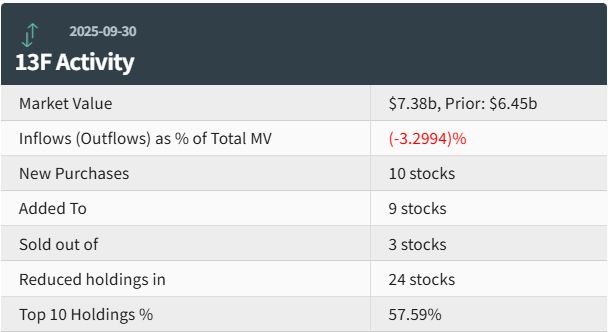
Core Insights - Appaloosa LP, led by David Tepper, reported a total market value of $7.38 billion for its U.S. stock holdings as of September 30, 2025, reflecting a 14% increase from the previous quarter's $6.45 billion [1][2] - The firm added 10 new stocks, increased holdings in 9 stocks, reduced holdings in 24 stocks, and completely sold out of 3 stocks, with the top 10 holdings accounting for 57.59% of the total market value [1][2] Holdings Summary - Alibaba (BABA.US) is the largest holding with 6.45 million shares valued at approximately $1.15 billion, representing 15.61% of the portfolio, down 8.73% from the previous quarter [2][3] - Amazon (AMZN.US) ranks second with 2.5 million shares valued at about $550 million, making up 7.43% of the portfolio, a decrease of 7.41% in share count [2][3] - Whirlpool (WHR.US) is the third largest holding with 5.5 million shares valued at around $430 million, a significant increase of 1966.95% in share count [3][5] - Nvidia (NVDA.US) is fourth with 1.9 million shares valued at approximately $354 million, an increase of 8.57% in share count [3][5] - Google (GOOG.US) is fifth with about 1.39 million shares valued at around $337 million, down 7.50% in share count [3][5] Significant Transactions - Appaloosa significantly increased its holdings in the KraneShares CSI China Internet ETF (KWEB.US), Qualcomm (QCOM.US), and Baidu (BIDU.US) [5] - The firm completely sold out of Intel (INTC.US), Oracle (ORCL.US), and Beike (BEKE.US) [5] - The top five purchases by percentage change in the portfolio included Whirlpool, AMD, KWEB, Qualcomm, and Fiserv (FISV.US) [6][7] - The top five sales by largest value included UnitedHealth (UNH.US), Intel, Vistra Energy (VST.US), Amazon, and Meta (META.US) [6][7]


科技股警报拉响?华尔街齐陷恐慌,“大空头”急流勇退!
Sou Hu Cai Jing· 2025-11-14 02:44
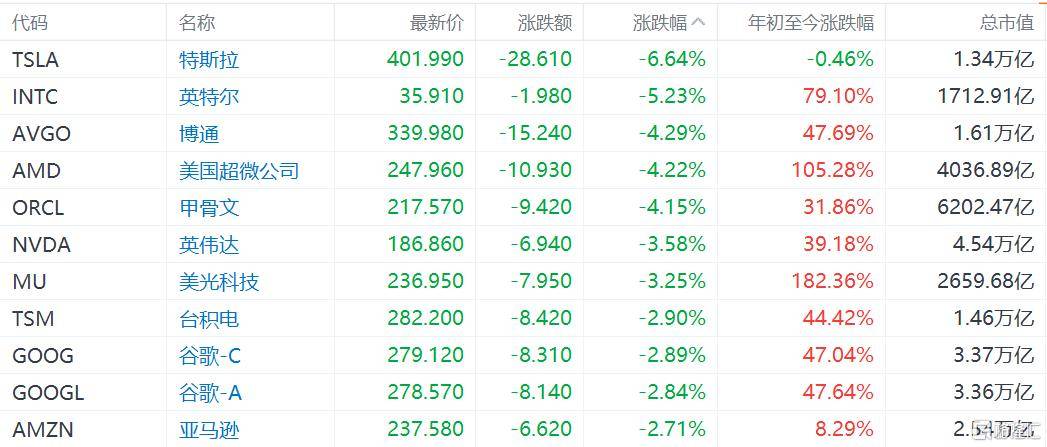
Core Viewpoint - The longest government shutdown in U.S. history has ended, but the stock market experienced significant turmoil, with fears exacerbated by economic data voids, mixed signals from the Federal Reserve, and a cooling AI market [1][6]. Group 1: Market Performance - The Dow Jones Industrial Average plummeted nearly 800 points, with major tech and chip stocks suffering severe losses [2]. - Tesla's stock dropped over 6%, resulting in a market value loss of $95.2 billion (approximately 675.5 billion RMB) in one night [3]. - Other notable declines included Intel down over 5%, and companies like Broadcom, Oracle, and AMD falling more than 4% [3][4]. Group 2: Economic Data and Federal Reserve Outlook - The market is now focused on delayed economic data, uncertainty regarding the Federal Reserve's interest rate cuts, and concerns over high-valuation tech stocks [7][8]. - The absence of the October Consumer Price Index (CPI) has created a significant economic data void, impacting market expectations for Federal Reserve rate cuts [11][9]. - Federal Reserve officials have expressed caution regarding interest rate cuts, with differing opinions on the timing and necessity of such actions [12][18]. Group 3: Michael Burry's Market Position - Notable short-seller Michael Burry has drawn attention for his significant short positions in Nvidia and Palantir, with a reported nominal value of over $1 billion [20][21]. - Burry later clarified that the reported short position was a media miscalculation, stating his actual investment was only $9.2 million [22]. - His recent criticisms of tech giants for alleged accounting manipulations have raised concerns about the sustainability of their profits [27].