
Intel(INTC)

Search documents
科技股最新财报季来了!英特尔打头阵,“七巨头”走势进一步分化?
第一财经· 2026-01-22 13:35
Core Viewpoint - The upcoming earnings season for major tech companies will be heavily influenced by artificial intelligence (AI) investments, with a focus on how these companies can monetize their substantial investments in AI technology [3][4]. Group 1: AI Investment and Financial Performance - Major tech companies like Amazon, Google, Meta, and Microsoft are planning to significantly increase their investments in AI data center infrastructure, with Amazon projecting $125 billion in 2025 and further increases in 2026 [6]. - Google has raised its 2025 capital expenditure forecast from $85 billion to between $91 billion and $93 billion, with substantial growth expected in 2026 [6]. - Meta's capital expenditure for 2025 has been adjusted to a minimum of $70 billion to $72 billion, with a notable increase in spending anticipated for 2026 driven by AI infrastructure costs [6]. - Microsoft has indicated that its capital expenditures will exceed $88.2 billion in 2025, with a record $34.9 billion spent in the first quarter of 2026, primarily on data centers and AI tool development [7]. - Market expectations for revenue growth are high, with Amazon's AWS projected to grow by 21%, Microsoft's commercial cloud by 25%, Google's cloud by 35%, and Meta's overall revenue by 30% [7]. Group 2: Market Dynamics and Stock Performance - The "Seven Giants" of the tech sector are experiencing divergent stock performances, with only Alphabet and Nvidia outperforming the S&P 500 in the past year [11]. - Apple has faced criticism for its insufficient investment in AI, leading to stock performance lagging behind the S&P 500 [11]. - Tesla's stock has also underperformed due to slowing electric vehicle sales, highlighting the varying fortunes among the "Seven Giants" [11]. - Analysts suggest that the market is beginning to differentiate between companies that can successfully leverage AI investments and those that may struggle, indicating a shift in investment strategies [12]. Group 3: Future Trends and Opportunities - The focus is shifting towards "AI beneficiaries," companies that will benefit from increased productivity and efficiency through AI applications, particularly in sectors like healthcare, industrial, and finance [12][13]. - AI investments are expected to lead to significant changes in corporate restructuring, productivity improvements, and profit enhancements across various industries [13]. - There is a growing preference for investing in companies involved in AI infrastructure, as well as sectors that may not be directly related to AI but will benefit from its advancements [13].






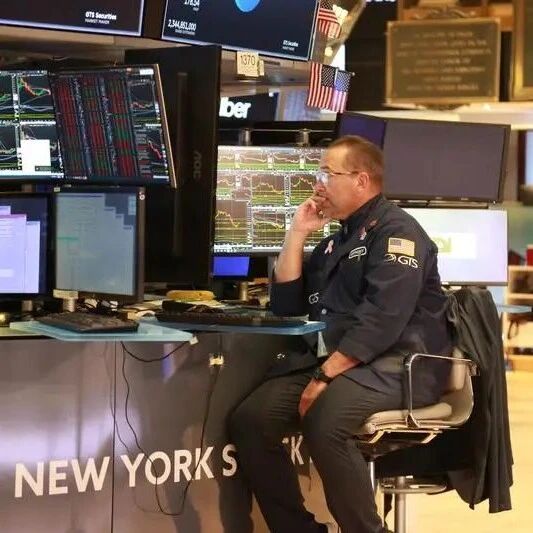
Earnings live: GE Aerospace orders surge, Procter & Gamble and Abbott stocks dip
Yahoo Finance· 2026-01-22 13:19
Group 1 - The fourth quarter earnings season is gaining momentum, with major financial institutions like Charles Schwab and regional banks such as Fifth Third set to report results, alongside Netflix and Intel, which are expected to draw significant attention [1][5] - An optimistic consensus is emerging, with 7% of S&P 500 companies having reported fourth quarter results as of January 16, and analysts projecting an 8.2% increase in earnings per share, marking the potential for the 10th consecutive quarter of annual earnings growth for the index [2] - Analysts had initially anticipated an 8.3% increase in earnings per share heading into the reporting period, a decrease from the previous quarter's 13.6% growth rate, but expectations have been raised recently, particularly for technology companies [3] Group 2 - The current earnings season is expected to test the improved stock market breadth observed at the beginning of 2026, with ongoing themes from 2025, such as artificial intelligence and economic policies, continuing to influence market dynamics [4] - In addition to Netflix and Intel, other notable companies reporting this week include United Airlines, 3M Company, D.R. Horton, Johnson & Johnson, GE Aerospace, Procter & Gamble, Abbott Laboratories, and Capital One [5]

三大股指期货齐涨,11月PCE数据今夜出炉
Zhi Tong Cai Jing· 2026-01-22 13:11
Market Overview - US stock index futures are all up, with Dow futures rising by 0.35%, S&P 500 futures up by 0.56%, and Nasdaq futures increasing by 0.83% [1] - European indices also show positive movement, with Germany's DAX up by 1.16%, UK's FTSE 100 up by 0.45%, France's CAC40 up by 1.19%, and the Euro Stoxx 50 up by 1.33% [2] Commodity Prices - WTI crude oil has decreased by 1.50%, trading at $59.71 per barrel, while Brent crude oil has fallen by 1.41%, priced at $64.32 per barrel [3] Economic Indicators - The market anticipates stable inflation pressures in the US for November, with a 95% probability that the Federal Reserve will maintain interest rates next week. The core PCE price index is expected to rise by 0.2% month-over-month and 2.8% year-over-year, indicating inflation levels significantly above the Fed's 2% target [4] Company News - GE Aerospace reported Q4 earnings that exceeded expectations, with adjusted EPS of $1.57, surpassing the forecast of $1.43, and adjusted revenue of $11.9 billion, exceeding the market expectation of $11.2 billion. The company projects adjusted EPS for 2026 to be between $7.10 and $7.40, indicating strong growth confidence [9] - Morgan Stanley and Allen & Company are set to earn $90 million from the Warner Bros. deal, with Morgan Stanley also profiting from a $17.5 billion bridge loan provided to Warner Bros. [10] - Anthropic PBC has raised at least $1 billion in its latest funding round, with its revenue run rate doubling since last summer to exceed $9 billion by the end of 2025 [11] - Intel has secured a significant contract with the US Missile Defense Agency for chip supply, with a maximum contract value of $151 billion, boosting investor confidence in the company's transformation plans [12] - Alibaba is preparing to spin off its chip company, Tsinghua Unigroup, for a potential IPO, reflecting strong investor interest in AI accelerators [12]



Intel Corp. (INTC) Soars to 52-Week High Ahead of Thursday Earnings
Yahoo Finance· 2026-01-22 13:08
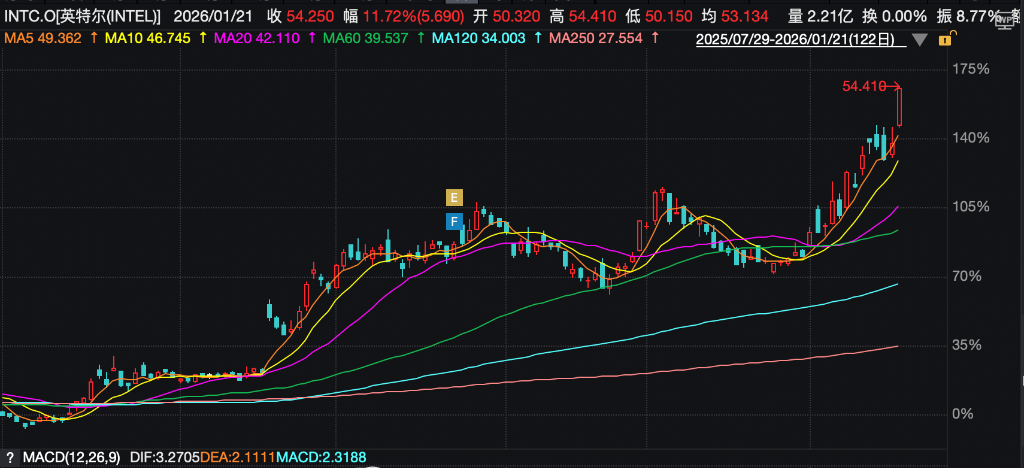
We recently published 10 Big Names Leaving Wall Street Behind; 7 Are Hitting Record Highs. Intel Corp. (NASDAQ:INTC) was one of the worst performers on Wednesday. Intel Corp. rallied to a new 52-week high on Wednesday, as investors loaded portfolios ahead of the results of its earnings performance for the full year and fourth quarter periods of 2025. At intra-day trading, the stock jumped to its highest price of $54.41, up 12 percent, before trimming gains to end the session just up by 11.74 percent at $ ...
美股前瞻 | 三大股指期货齐涨,11月PCE数据今夜出炉
智通财经网· 2026-01-22 13:03
1. 1月22日(周四)美股盘前,美股三大股指期货齐涨。截至发稿,道指期货涨0.35%,标普500指数期货涨0.56%,纳指 期货涨0.83%。 | = US 30 | 49,247.70 | 49,303.50 | 49,075.40 | +170.70 | +0.35% | | --- | --- | --- | --- | --- | --- | | = US 500 | 6.914.40 | 6.923.40 | 6.878.70 | +38.80 | +0.56% | | 틀 US Tech 100 | 25,536.10 | 25,573.10 | 25,341.60 | +209.50 | +0.83% | 2. 截至发稿,德国DAX指数涨1.16%,英国富时100指数涨0.45%,法国CAC40指数涨1.19%,欧洲斯托克50指数涨 1.33%。 | 3. 截至发稿,WTI原油跌1.50%,报59.71美元/桶。布伦特原油跌1.41%,报64.32美元/桶。 | | --- | | 雪 WTI原油 | 2026年3月 | 59.71 | 60.81 | 59.49 | -0.91 | -1.5 ...

算力税第二波,CPU涨价
Hua Er Jie Jian Wen· 2026-01-22 12:28
Core Insights - The global semiconductor market is undergoing structural changes, with the CPU sector gaining significant attention from capital markets as it transitions from a traditionally mature category to a focal point for investment [1][3] - The demand for CPUs is driven by the increasing application of AI agents, which require substantial computational resources for tasks beyond traditional AI training, leading to a re-evaluation of CPU's role in the computing ecosystem [3][9] Market Dynamics - Intel's stock reached a nearly four-year high with a year-to-date increase of over 44%, while AMD continues its upward trend; in the A-share market, Longxin Technology and Haiguang Information recorded significant daily gains of 20% and over 13%, respectively [1] - The market is experiencing a re-pricing of the "computing power tax," with CPUs becoming the second wave of cost bearers following the surge in GPU demand due to AI training [1] Supply and Demand Trends - The consensus among institutions indicates that the current changes in the CPU market are not cyclical but are driven by structural transformations due to the scaling of AI applications [3] - IDC forecasts that the number of active AI agents will grow from approximately 28.6 million in 2025 to 2.216 billion by 2030, representing a compound annual growth rate of 139%, suggesting a significant increase in CPU demand [3] - Supply constraints are evident, with Intel's advanced process capacity utilization reaching 120%-130%, and TSMC's advanced packaging capacity bottlenecks extending CPU delivery times from the normal 8-10 weeks to over 24 weeks [3][8] Technological Shifts - The traditional focus on GPU for AI computation is shifting as AI agents evolve to require more complex task execution, with CPUs handling 80%-90% of the workload related to task orchestration and data processing [4][6] - The transition to a "sandbox execution" model in AI platforms is creating new demand characteristics for CPU resources, which are now more closely tied to user scale and task concurrency rather than GPU quantity [5][6] Pricing and Future Outlook - The supply-demand imbalance is leading to expectations of price increases, with Intel and AMD planning to raise server CPU prices by 10%-15% due to the anticipated supply constraints [8] - The strategic value of CPUs is being reassessed as they become central to system management and resource coordination in the evolving landscape of AI applications [9]

Intel price target raised to $36 from $35 at Bernstein
Yahoo Finance· 2026-01-22 12:20
Group 1 - Bernstein analyst Stacy Rasgon raised the price target on Intel (INTC) to $36 from $35 [1] - The firm maintains a Market Perform rating on Intel shares ahead of quarterly results [1] - The firm is increasing its server market assumptions while lowering its PC assumptions going forward [1]
冰与火之歌:英特尔的绝地反击与王者归来
格隆汇APP· 2026-01-22 12:04
Core Viewpoint - Intel, once a dominant player in the CPU market, faced significant challenges leading to a $2.92 billion loss in Q2 2025, but is poised for a turnaround due to strategic investments and internal reforms [5][10][12]. Group 1: Current Challenges - Intel reported a net loss of $2.92 billion in Q2 2025, with a gross margin dropping below 30%, indicating severe distress in its core business [5]. - AMD's EPYC series has captured over 40% market share, leading to a 15% year-over-year decline in Intel's Xeon orders due to its lag in 10nm technology [5][6]. - The company's foundry business has been unprofitable, with a market share of less than 3% and quarterly losses exceeding $1 billion [5][6]. Group 2: Strategic Turnaround - In August 2025, the U.S. government invested $8.9 billion for a 9.9% stake in Intel, becoming its largest shareholder, signaling a commitment to U.S. chip independence [9]. - Nvidia invested $5 billion in Intel, agreeing to collaborate on developing integrated GPU and CPU solutions, marking a significant shift in the competitive landscape [9]. - Intel's cash reserves increased to $30.9 billion following these investments, providing a financial cushion for future operations [9]. Group 3: Internal Reforms - CEO Pat Gelsinger initiated a major restructuring, laying off 35,000 employees to reduce annual operating costs by $23.3 billion, reallocating funds towards advanced process technology and AI development [10][11]. - The company reintroduced a "20% free time" policy for engineers to foster innovation, leading to significant improvements in process technology yields [10]. - Intel is shifting towards a more open business model, securing orders from Apple for low-end M-series chips and exploring further collaborations [11]. Group 4: Market Dynamics and Future Outlook - In 2026, Intel faces a "happy trouble" with a chip shortage driven by unexpected demand for server CPUs, leading to increased analyst ratings [12]. - However, there are concerns about supply chain mismatches and price increases driven by OEMs rather than Intel's pricing strategy [12][14]. - The sustainability of the current demand surge is questioned, as rising storage prices may lead to a market correction [14]. Group 5: Broader Implications - Intel's recovery is seen as a case study in aligning corporate strategy with national interests and industry trends, emphasizing the importance of internal transformation [16]. - The company's future performance will be closely watched, particularly regarding the mass production of its 18A process technology and ongoing competition with AMD [16][17].

Wall Street Breakfast Podcast: Intel Surges Into Earnings
Seeking Alpha· 2026-01-22 11:56
Group 1: Intel and Semiconductor Sector Performance - Intel shares increased by 11% ahead of its fourth-quarter financial results release [3] - Other semiconductor stocks also saw gains, with Micron Technology up 6.6%, AMD up 7.7%, and Nvidia gaining nearly 3% [3] - J.P. Morgan noted that many semiconductor firms have "considerable upside" in the AI accelerator total addressable market [4] Group 2: Earnings Expectations - Wall Street anticipates Intel to report earnings per share (EPS) of $0.08 on revenue of $13.39 billion, indicating a 6% decline during the quarter [4]

黄仁勋,再次驳斥“AI泡沫”论!
Shen Zhen Shang Bao· 2026-01-22 11:50
2026年,是"AI泡沫元年"? 近期,全球科技股市剧烈波动,芯片价格暴涨,一年"烧钱"数万亿美元。当地时间1月21日,在瑞士达 沃斯举行的世界经济论坛上,英伟达CEO黄仁勋面对全球媒体,回应了持续数月的"美国AI泡沫"质疑 称:"这并非泡沫,而是人类历史上规模最大的基础设施建设,还需要数万亿美元投资。" 黄仁勋话音刚落,1月22日,以重仓投资OpenAI著称的日股软银集团股价暴涨11.61%。 从"AI元年"到"泡沫元年"的资本狂飙 如今,全球AI浪潮进入第四年,时间线上标注着一系列"元年"。2022年,ChatGPT以最快用户破亿的速 度问世,被称为"AI元年";2023年,"大模型元年"开启;2024年,"AI应用元年"到来;2025年,"AI智 能体元年"开启。而进入2026年,一个新的称谓正在形成——"AI泡沫元年"。 泡沫还是基石?黄仁勋将AI产业架构比作"五层蛋糕" 如今,全球资本高度集中于AI赛道,加剧了泡沫破灭的风险。从2025年底开始,投资者开始集体追 问:"AI泡沫会不会破灭?" 值得注意的是,OpenAI、英伟达、甲骨文的"循环交易"加剧了市场对泡沫的担忧,英伟达对OpenAI进 行投 ...
