Lilly(LLY)

Search documents
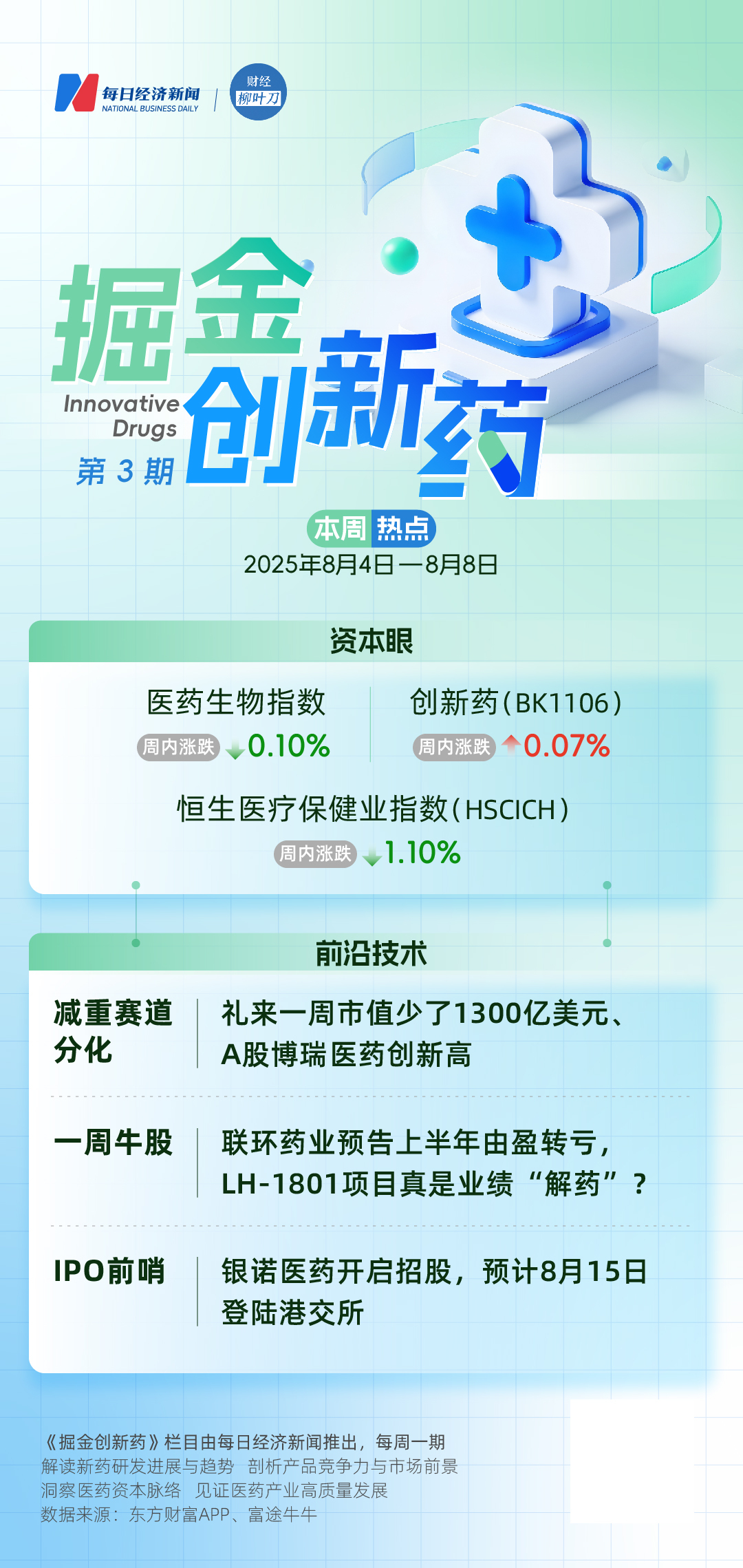
礼来一周市值少了1300亿美元;联环药业预告上半年由盈转亏,LH-1801项目真是业绩“解药”? | 掘金创新药
Mei Ri Jing Ji Xin Wen· 2025-08-11 11:55
Core Viewpoint - The pharmaceutical and biotechnology sectors are experiencing mixed performance, with innovative drug stocks showing significant volatility and a shift in market sentiment towards weight loss medications, particularly in the context of recent earnings reports and clinical trial data [3][10][11]. Group 1: Market Performance - The pharmaceutical and biotechnology index fell by 0.10%, slightly outperforming the Shanghai Composite Index by 0.02 percentage points [3]. - Among 140 innovative drug stocks in A-shares, only 34 saw an increase, a decrease of 72 from the previous week, indicating a notable pullback [4]. - In Hong Kong, 39 innovative drug stocks were tracked, with 22 experiencing gains, suggesting a relatively better performance compared to A-shares [4]. Group 2: Notable Stock Movements - In A-shares, Lianhuan Pharmaceutical led with a 31.41% increase, attributed to its LH-1801 project still in the R&D phase [5]. - Conversely, Yifang Bio saw a significant decline of 16.91% due to a large discounted block trade [5]. - In Hong Kong, Gilead Sciences-B experienced a 30.29% increase, reflecting strong market interest [6]. Group 3: IPO Developments - Guangzhou Yinnuo Pharmaceutical Group has initiated its IPO process, expecting to list on the Hong Kong Stock Exchange on August 15, with plans to issue 36.56 million H-shares at a price of HKD 18.68 per share [8][9]. - The company focuses on metabolic diseases and has a core product, Eisuparaglutide α, approved for type 2 diabetes treatment, with projected sales of HKD 38.14 million in the first five months of 2025 [8]. Group 4: Weight Loss Drug Market Dynamics - Major players in the weight loss drug market, such as Eli Lilly and Novo Nordisk, have seen significant market cap losses due to disappointing clinical data, with Eli Lilly losing USD 130 billion in a week [10][11]. - Despite the downturn for these companies, the overall market for weight loss drugs remains robust, with innovative products from Chinese companies gaining traction [11][12]. - New entrants in the GLP-1 drug market are focusing on improved efficacy and safety profiles, aiming to meet diverse patient needs [11][12]. Group 5: Industry Insights - The innovative drug sector in China is transitioning from a follower to a leader in global drug development, with a significant share of new drug transactions [17][18]. - The industry faces challenges such as market entry efficiency and the need for mechanisms that reward innovation, which are critical for sustaining growth and avoiding market saturation [18][20].


12.4%减重数据逊于竞品,为何成礼来(LLY.US)千亿市值“蒸发器”?
Zhi Tong Cai Jing· 2025-08-11 08:56
Core Viewpoint - Eli Lilly's stock plummeted despite exceeding Q2 financial expectations and raising guidance, primarily due to concerns over the efficacy of its oral weight-loss drug Orforglipron in late-stage trials [1][3] Financial Performance - Eli Lilly reported a 72-week average weight loss of 12.4% with Orforglipron, meeting the primary endpoint of the Phase 3 ATTAIN-1 trial, but this was perceived as underwhelming compared to competitors [1][3] - The company raised its full-year revenue guidance to $60-62 billion, surpassing the previous estimate of $58-61 billion, indicating strong fundamentals [4] Market Reaction - Eli Lilly's stock fell 14% in a single day, marking its largest drop in 25 years, followed by an additional 2% decline the next day, resulting in a market value loss of nearly $100 billion [1][3] - In contrast, competitor Novo Nordisk's stock rose over 12% during the same period, benefiting from the negative sentiment surrounding Eli Lilly [1] Analyst Opinions - Leerink Partners downgraded Eli Lilly's rating from "outperform" to "market perform," reducing the target price from $944 to $715, citing lower-than-expected weight loss results and increased competition [2] - Bank of America analyst Tim Anderson argued that the market reaction was excessive, maintaining a "buy" rating and a target price of $1,000, emphasizing that the disclosed data was only preliminary [2] Industry Context - The global market for weight-loss drugs is projected to reach $95 billion by 2030, down from previous estimates of $130 billion, reflecting a shift in market expectations [3] - The competitive landscape in the GLP-1 market is intensifying, with concerns over pricing pressures and inadequate insurance coverage for weight-loss medications in the U.S. [2][6] Strategic Implications - Eli Lilly's valuation has been impacted by the market's shift from rewarding solid fundamentals to demanding exceptional performance, leading to a reevaluation of its growth potential [4][5] - The company faces the challenge of refocusing market attention on its diverse pipeline and robust operational capabilities to navigate the current crisis [6]
“指数权重跌至数十年来最低点”!美国医药股被市场“抛弃”了
Hua Er Jie Jian Wen· 2025-08-11 03:04
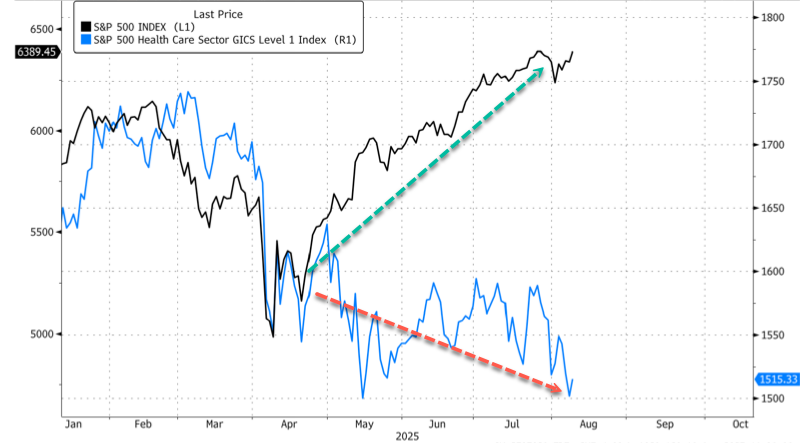
Core Viewpoint - Investor sentiment is highly pessimistic, and U.S. pharmaceutical stocks are facing the most severe challenges in decades [1][3]. Group 1: Market Performance - Major biopharmaceutical companies experienced significant sell-offs during the recent earnings season, leading to a weak overall performance of the sector [1][3]. - The healthcare sector's weight in the S&P 500 index has dropped to its lowest point in decades [1][9]. - Vertex Pharmaceuticals and Eli Lilly faced substantial declines, with Vertex dropping 20.6% on August 4 due to setbacks in its pain medication project, while Eli Lilly recorded its largest drop since the dot-com bubble [4][7]. Group 2: Stock Volatility - The average volatility of healthcare stocks during this earnings season reached ±6%, marking one of the highest volatility records in history [3][9]. - Other major healthcare stocks, including Novo Nordisk, McKesson Corp, and UnitedHealth Group, saw declines of 10% to 20% post-earnings [3][7]. Group 3: Policy Uncertainty - Policy uncertainties, particularly regarding the Trump administration's Most Favored Nation pricing proposal and potential tariffs on the pharmaceutical industry, are major challenges for pharmaceutical stocks [8][9]. - Analysts are closely monitoring the potential announcement of pharmaceutical tariffs, expected in mid-August, which could further impact the sector [8][9]. Group 4: Company-Specific Developments - Despite the overall weak performance, some companies like Johnson & Johnson and Gilead Sciences showed strong results, with Gilead's stock rising 6% last week and a year-to-date increase of 30% due to robust HIV business growth [7]. - The weight loss drug sector has been particularly hard hit, with Eli Lilly losing $100 billion in market value due to disappointing data on its oral weight loss medication [7].


北美医药生物-一图胜千言-A picture is worth a thousand words
2025-08-11 02:58
Summary of Key Points from the Conference Call Industry Overview - The conference call focuses on the **Biopharma** industry in **North America** with a comprehensive analysis of the **US drug market** as per **IQVIA Rx** data [1][6]. Core Insights - The **Total Prescription Year-over-Year (YoY) growth** for the week ending August 1, 2025, was reported at **+2.8%**, an increase from **+1.7%** the previous week and **+2.6%** over the past 12 weeks [1][6]. - For the week ended August 1, the **US total market weekly TRx YoY change** was **+2.8%**, compared to **+0.9%** a year ago. The **rolling 4-week TRx YoY** was **+2.9%** and the **rolling 12-week TRx YoY** was **+2.6%** [2]. Company-Specific Developments - **Bristol Myers Squibb (BMY)**: - The drug **Cobenfy** was approved for schizophrenia on September 26, 2024. The current scripts are approximately **2,010** for the week, up from **1,950** the previous week. To meet 2025 consensus expectations, Cobenfy's TRx needs to track at **~2-3x** the volumes from recent schizophrenia launches [3]. - The consensus estimate for Cobenfy has decreased from **$196 million** to **$171 million**, implying that approximately **129K TRx** are required to meet these estimates [3]. - **Vertex Pharmaceuticals (VRTX)**: - The drug **Journavx** was approved for acute pain on January 30, 2025, with current scripts at approximately **6,800**, up from **6,430** the previous week. It is noted that hospital scripts, which account for about **35%** of total scripts, are not captured by IQVIA [4]. - To achieve a sales target of **$78 million**, approximately **345K total scripts** are needed, assuming a **$225 net price per script** [4]. - **Gilead Sciences (GILD)**: - The launch comparison for **Yeztugo** (lenacapavir) shows current TRx at approximately **210**, down from **300** the previous week. The injectable formulation accounts for **50%** of total TRx [5]. Additional Insights - The **extended unit (EUTRx)** weekly YoY growth was reported at **+1.9%**, which is below the TRx YoY growth [2]. - The **sequential weekly TRx growth** was **-0.1%**, an improvement from **-1.2%** the week before [2]. - The **biopharma industry view** is categorized as **attractive**, while the major pharmaceuticals industry view is **in-line** [7]. Notable Trends - The **momentum of top outpatient drugs** indicates varying performance across different companies, with notable declines in some established drugs like **Humira** (AbbVie) showing a **-40%** YoY change, while newer drugs like **Mounjaro** (Eli Lilly) and **Zepbound** (Eli Lilly) show significant growth rates of **69%** and **257%** respectively [24]. Conclusion - The conference call highlights a positive trend in the US drug market with specific growth in total prescriptions. However, individual company performance varies significantly, with newer drugs showing strong growth potential while established drugs face declines. The insights provided can guide investment decisions in the biopharma sector.


行情前瞻暨个股推荐(GLP-1口服方向)
2025-08-11 01:21
Summary of Conference Call Records Industry Overview - The innovative drug sector is experiencing a short-term correction, but it is not affected by Trump's tariffs, providing a buying opportunity [1] - The GLP-1 market is thriving, with Novo Nordisk and Eli Lilly's weight loss drug sales exceeding $30 billion in the first half of the year, expected to reach $60-65 billion for the full year [1][4] - The global innovative drug market is projected to reach $1.5 trillion by 2030, with China expected to account for 30%, corresponding to a market value of approximately $6 trillion, indicating significant growth potential from the current $2.6 trillion [1][5] Key Companies and Performance - Novo Nordisk's semaglutide sales reached $5.458 billion in the first half of the year, a 78% year-on-year increase, but the company lowered its full-year guidance due to market competition and the impact of Eli Lilly's tirzepatide [1][9] - Eli Lilly's tirzepatide sales reached $5.69 billion in the first half, a 223% year-on-year increase, and the company raised its full-year revenue guidance [1][9] - The oral GLP-1 drug development trend is shifting towards multi-target iterations, but development remains challenging [3][10] Market Dynamics - The A-share pharmaceutical index fell by 0.8% this week but has risen by 21.2% since the beginning of the year, outperforming the CSI 300 by 26.9% [2] - The performance of various sectors within the pharmaceutical industry shows mixed results, with medical devices up by 3% and traditional Chinese medicine down by 1.9% [2] Investment Opportunities - The innovative drug export logic is shifting from domestic to overseas markets, with leading companies like BeiGene expected to see significant revenue growth, projected to reach $5 billion by 2025 [5] - The market share of Chinese innovative drugs in the global market is expected to increase from 5% to 30% through business development (BD) strategies [5] - Recommended companies with high growth potential include Innovent, 3SBio, and BeiGene, with a focus on companies like Boryung Pharmaceutical, which could reach a market value of $200 billion if successful in overseas expansion [8][11] Additional Insights - The current market share of A-shares and H-shares in the innovative sector is low at 1.7% and 1.8%, respectively, compared to 3.5% in the US market, indicating substantial growth potential [6] - The oral GLP-1 drug delivery methods are evolving, with Boryung's technology achieving over 8% bioavailability, positioning it as a leader in the industry [10]
GLP-1药物销售强劲 礼来猛追诺和诺德
Bei Jing Shang Bao· 2025-08-10 16:33
Core Insights - Eli Lilly's aggressive push in the GLP-1 drug market has forced Novo Nordisk to lower its annual forecasts twice, with Tirzepatide becoming increasingly common on U.S. pharmacy shelves [1][3] - Eli Lilly's H1 2025 revenue reached $28.2862 billion, a 41% year-over-year increase, driven significantly by its diabetes business, which contributed nearly half of its revenue [1][3] Financial Performance - Eli Lilly's revenue breakdown for H1 2025: - U.S. market: $19.304 billion, up 43% - Europe: $4.963 billion, up 74% - Japan: $0.923 billion, up 11% - China: $0.917 billion, up 20% - Other markets: $2.18 billion, up 7% [1] - The diabetes segment, particularly Trulicity, Mounjaro, Humalog, and Jardiance, contributed $13.9728 billion [1] Product Performance - Tirzepatide's sales in H1 2025: - Mounjaro (diabetes version): $9.0407 billion, up 85% - Zepbound (weight loss version): $5.6933 billion, up 223% [2] - Zepbound's Q2 revenue was $3.381 billion, a 172% increase, while Novo Nordisk's Wegovy grew at 75% [3] Market Position - Eli Lilly's prescription share in the U.S. GLP-1RA market reached 57%, up from 53.3% in Q1, surpassing Novo Nordisk's 42.5% [2] - The revenue gap between Tirzepatide and Novo Nordisk's Semaglutide has narrowed to less than $2 billion [3] Competitive Landscape - Novo Nordisk's market challenges include a decline in growth expectations for Wegovy and Ozempic, leading to a significant drop in its market capitalization [3][4] - Analysts note that Eli Lilly's success is attributed to the superior efficacy of Tirzepatide and its established sales channels, which have been enhanced by its long-standing experience in the GLP-1 market [4]
新药周观点:创新药6月进院数据更新,多个新纳入医保创新药快速进院-20250810
Guotou Securities· 2025-08-10 11:03
Investment Rating - The report maintains an investment rating of "Outperform" with a target price set for leading stocks [3][4]. Core Insights - The innovative drug sector is experiencing fluctuations, but several catalysts are anticipated, including academic conferences, business development achievements, and negotiations for medical insurance [2]. - The National Medical Insurance Administration has updated the data on innovative drugs included in the medical insurance directory, showing rapid hospital admissions for several newly included domestic innovative drugs [2][22]. Summary by Sections Weekly New Drug Market Review - From August 4 to August 10, 2025, the top five companies in the new drug sector by stock price increase were: Beihai Kangcheng (+73.1%), Jiahe Biotech (+39.0%), Gilead Sciences (+30.3%), Heyu Biotech (+21.1%), and Hengrui Medicine (+15.3%). The top five companies with the largest declines were: Hutchison China MediTech (-13.8%), Frontier Biotech (-13.4%), Yifang Biotech (-11.7%), Haichuang Pharma (-9.9%), and Maiwei Biotech (-9.2%) [1][16]. Recommended Stocks to Watch - The report suggests focusing on potential overseas licensing opportunities for significant products, including differentiated GLP-1 assets from companies like Zhongsheng Pharma, Kangyuan Pharma, and Gilead Sciences. Additionally, upgraded PD-1 products from Kangfang Biotech and others are highlighted [2][22]. Key Analysis of the New Drug Industry - The report notes that several innovative drugs newly included in the medical insurance directory are rapidly entering hospitals, with notable growth in hospital admissions for drugs such as Zaiqiang Pharma's recombinant thrombin and Hengrui Medicine's Tazemetostat [2][22][23]. New Drug Approval and Acceptance Status - This week, three new drug applications were approved, including Adalimumab injection from Wuhan Biological Products Research Institute, Dulaglutide injection from Shandong Boan Biotech, and Evinacumab injection from Xi'an Janssen [28][29]. Additionally, four new drug applications were accepted, including Trastuzumab injection from Amgen and others [28][30]. Clinical Application Approval and Acceptance Status - A total of 55 new drug clinical applications were approved this week, while 31 new drug clinical applications were accepted [10][31].



替尔泊肽卖爆了!销量暴增46%,礼来第二季度盈利超预期
GLP1减重宝典· 2025-08-10 09:29
Core Viewpoint - Eli Lilly's Q2 performance exceeded market expectations, but disappointing results from oral GLP-1 drug trials led to a 13% drop in stock price [5][7]. Group 1: Financial Performance - Eli Lilly reported Q2 revenue of $15.56 billion, surpassing Wall Street's expectation of $14.69 billion; earnings per share were $6.31, above the forecast of $5.56 [5]. - U.S. market revenue reached $10.81 billion, with GLP-1 drugs Mounjaro and Zepbound seeing a 46% year-over-year sales increase, although an 8% price reduction limited revenue growth [5]. Group 2: Market Competition - Eli Lilly's Zepbound has outperformed Novo Nordisk's Wegovy in the competitive GLP-1 market, with Zepbound's prescription volume increasing by 225% year-over-year, totaling over 418,000 weekly prescriptions, compared to Wegovy's 35% increase and 281,000 weekly prescriptions [7]. - The oral GLP-1 drug orforglipron showed disappointing results in late-stage trials, with a 25% dropout rate in the highest dosage group, raising concerns about trial design [7]. Group 3: Future Outlook - Eli Lilly plans to submit data for orforglipron to the FDA this year, with hopes for approval and market entry next year [7]. - Novo Nordisk has lowered its 2025 outlook due to competitive pressures, while Eli Lilly holds over 60% of new weight loss prescriptions in the U.S. GLP-1 market [7][8].
Eli Lilly: Another Not-To-Miss Dip
Seeking Alpha· 2025-08-09 15:08
Core Insights - Eli Lilly (NYSE: LLY) experienced a significant stock decline despite reporting strong Q2 2025 results and providing upgraded guidance, indicating a disconnect between company performance and investor sentiment [1]. Company Performance - The company reported robust Q2 2025 results, which typically would be expected to drive stock prices higher [1]. - The upgraded guidance suggests positive future expectations, yet the stock still plunged, highlighting potential investor concerns or market dynamics [1]. Investor Sentiment - The trading session for Eli Lilly serves as an example of investor psychology, where even strong financial results may not be enough to prevent stock price declines [1].

Trump GLP-1 Pilot Program Could Boost Novo Nordisk & Eli Lilly
MarketBeat· 2025-08-09 14:00
Core Viewpoint - The healthcare sector is facing volatility due to President Trump's tariff threat on imported pharmaceuticals, which has led to a 2.74% decline in the sector over the past week and a 5.13% loss year-to-date, the worst among all S&P 500 sectors [1] Company-Specific Insights - Novo Nordisk experienced a 5.79% decline in stock price over the past five days following disappointing earnings, but rebounded due to weak trial data from Eli Lilly, which saw its shares drop nearly 11% [2] - Eli Lilly reported strong demand for its anti-obesity drugs, Mounjaro and Zepbound, despite a recent stock decline of 14.49% this year [9][15] - Novo Nordisk's Q2 revenue was $11.95 billion, slightly below expectations, but it reported a 16% increase in sales for its diabetes drug Ozempic and weight loss drug Wegovy compared to the previous year [10] Industry Trends - The Trump administration's initiative to cover weight loss drugs under Medicare and Medicaid could significantly increase access to these medications, potentially benefiting Eli Lilly and Novo Nordisk [5][8] - The global weight loss drug market is projected to grow at a compound annual growth rate of 31.66% from 2024 to 2030, with North America currently holding a 37.67% revenue share [13][14] - The U.S. anti-obesity drug market is valued at $6.62 billion and is expected to reach $7.13 billion by 2030 [14]