
L'Oreal(LRLCY)

Search documents
当商业与文化相遇,北京消费图景中的“美之道”
Xin Jing Bao· 2025-11-14 02:44
Core Insights - The article highlights the transformation in consumer behavior in Beijing, where individuals are increasingly seeking cultural identity and emotional resonance behind beauty products, rather than just their efficacy or brand [3][4][5] - L'Oréal Group's "Essentiality of Beauty" concept aims to convey the essence and rich connotations of beauty, integrating it with Eastern philosophy to foster participation in the exploration and creation of beauty [5][6][16] Economic Impact - Beijing's overall consumption market has shown growth, with a total retail sales volume of 980.31 billion yuan in the first three quarters of the year, reflecting a year-on-year increase of 0.5% [4] - Retail sales of fashion and entertainment goods, including jewelry and cosmetics, have seen significant increases, with jewelry sales up by 33.5% and cosmetics by 8.1% [4] Cultural Integration - L'Oréal's collaboration with the National Museum of China showcases a cultural project that reinterprets historical artifacts through a modern lens, emphasizing the integration of beauty with deep cultural narratives [6][8] - The "Beauty Path" project aims to explore the rich expressions of beauty in historical culture, quality of life, and social economy, enhancing visitor engagement through interactive experiences [8] Employment and Innovation - L'Oréal has created over 330,000 direct and indirect jobs in China, demonstrating its significant contribution to the local economy [22] - The company has established a comprehensive innovation system in China, conducting extensive research on local consumer preferences and developing a robust supply chain that supports local production [20][22] Strategic Vision - L'Oréal's "Beauty Path" philosophy is structured around three components: "Theory," "Path," and "Show," aimed at deepening public engagement with the concept of beauty [16] - The company emphasizes its commitment to localizing its operations and understanding the unique beauty culture in China, positioning itself as a leader in the beauty industry [22]



L’Oréal to Sell 3 Billion Euros of Bonds to Help Finance Kering Beauté Buy
Yahoo Finance· 2025-11-13 15:51
Group 1 - L'Oréal has priced a 3-billion-euro triple-tranche bond to finance part of its acquisition of Kering Beauté [1] - The bond offering consists of an 850-million-euro two-year floating-rate bond, a 1-billion-euro five-year fixed-rate bond, and a 1.15-billion-euro long 10-year fixed-rate bond [1] - The net proceeds from the bond issuance will be used for general corporate purposes, including financing the Kering Beauté acquisition [2] Group 2 - The strategic partnership between L'Oréal and Kering was announced on October 19, involving a multibillion-euro deal [2] - L'Oréal will acquire The House of Creed and enter into 50-year exclusive licenses to develop and sell fragrances and beauty products for Kering's brands Bottega Veneta and Balenciaga, with Gucci to follow after its current contract with Coty Inc. ends in 2028 [3] - The joint venture agreement is valued at 4 billion euros, payable in cash at closing, with L'Oréal also paying royalties to Kering for the use of its licensed brands [4]
深度 | CDA2025观察:美妆医研共创迈向新高度
FBeauty未来迹· 2025-11-13 14:44
Core Insights - The beauty industry is undergoing a technological transformation, with the integration of medical research driving value upgrades in cosmetics. This dual integration of medicine and beauty is defining a new competitive logic in the industry [3][6][24]. Industry Trends - The 20th China Dermatology Association (CDA) conference showcased over 10,000 dermatologists and more than 100 companies, including both domestic and international beauty brands, highlighting the industry's focus on scientific collaboration [3][4]. - The concept of "medical-research co-creation" emerged as a key theme, with brands actively participating in discussions on how to contribute to the skin science system, moving from mere users of research to active participants in scientific understanding and industry standards [7][24]. Brand Innovations - Winona, a brand known for its scientific foundation, showcased its "NUTE" principle at CDA 2025, which emphasizes clinical needs, unique mechanisms, technology empowerment, and credible evidence in product development [10]. - HBN, a domestic skincare brand, initiated the establishment of a group standard for "Cosmetic Efficacy Evidence Weight Assessment Guidelines," aiming to shift the industry from experience-driven to evidence-based competition [11][13]. - Estee Lauder's Clinique presented a white paper on the causes and distribution patterns of post-inflammatory hyperpigmentation, demonstrating the brand's commitment to scientific validation [14][16]. Research and Development - The integration of research and clinical application is evident in the initiatives taken by brands like Giant Bio and Zhenyan Bio, which are expanding the boundaries of medical-research co-creation through innovative collagen products and clinical studies [20][22]. - The collaboration between brands and medical experts is evolving, with companies like Ximu Yuan conducting extensive research on sensitive skin, showcasing a shift from being mere users of research to contributors to scientific inquiry [24][25]. Future Outlook - The CDA conference highlighted a significant shift in the beauty industry towards a more scientific and collaborative approach, with brands, medical institutions, and research organizations forming a new ecosystem that emphasizes shared data and mutual advancement [47][48]. - The focus on original ingredient research is becoming a core strategy for leading domestic brands, as they aim to differentiate themselves from homogenized competition [38][39].


《美之道》中国首发:欧莱雅用“美丽经济学”重塑消费产业价值链
Sou Hu Cai Jing· 2025-11-13 04:18
Core Insights - The launch of "The Way of Beauty: Decoding the Essence of Beauty" by L'Oréal China at the China International Import Expo represents a significant milestone in the company's 28-year journey in the Chinese market, showcasing a methodology for understanding beauty as a driving economic force [1][6][10]. Group 1: Background and Market Context - L'Oréal's history in China reflects the evolution of the cosmetics industry, with the market size surpassing 1 trillion yuan in 2024, making it the largest cosmetics consumer market globally, driven by rising incomes and changing consumer demands [6][7]. - The shift in consumer preferences from mere product efficacy to a focus on safety, cultural significance, and brand values has created new challenges for the industry and laid the groundwork for the book's development [6][7]. Group 2: The Concept of Beauty Economics - "The Way of Beauty" aims to transform the perception of beauty from a subjective concept into a quantifiable economic model, demonstrating that beauty can generate profits, create jobs, drive innovation, and open new markets [10][11]. - The book highlights that L'Oréal China has created over 330,000 direct or indirect jobs, with each job generating an average of 20 additional jobs in related sectors, significantly exceeding the industry average [11]. Group 3: Industry Trends and New Markets - The book identifies emerging consumer segments, including male consumers and the elderly, indicating a broadening market for beauty products, with male consumers spending over 1,000 yuan annually on cosmetics [12]. - The "silver economy" is also highlighted, with a 14.41% year-on-year growth in beauty and personal care products for older consumers, reaching 44.138 billion yuan in 2024 [12]. Group 4: Global Perspective and Value Chain Reconstruction - "The Way of Beauty" serves as a model for multinational companies on how to localize their business strategies in China, emphasizing the importance of integrating into the national economic framework for sustainable development [16][17]. - The book illustrates how L'Oréal aligns its business practices with China's goals of high-quality development and common prosperity, thereby reinforcing its commercial foundation through social value creation [17]. Group 5: Insights from Influential Figures - The book has received endorsements from prominent figures, emphasizing its role in enhancing Sino-French economic ties and showcasing the vitality and innovation of the cosmetics industry [22][23]. - The perspectives shared by industry leaders highlight the book's comprehensive analysis of the beauty industry, its achievements, and the challenges it faces, providing valuable insights for both practitioners and consumers [23].

GUCCI美妆,谁的蛋糕?
Mei Ri Jing Ji Xin Wen· 2025-11-13 03:46
Core Viewpoint - Coty has filed a lawsuit against Gucci and its parent company Kering in the UK commercial court, highlighting tensions in luxury beauty licensing agreements as Coty's contract with Gucci is set to expire in 2028 [1] Group 1: Legal Action - Coty is suing Gucci and Kering over the beauty licensing agreement [1] - The lawsuit reveals underlying conflicts in luxury beauty brand partnerships [1] Group 2: Contractual Changes - Coty's licensing agreement with Gucci will end in 2028 [1] - Kering announced a long-term partnership with L'Oréal in October 2025, planning to transfer Gucci's beauty business to L'Oréal after Coty's contract expires [1] - The new agreement between Kering and L'Oréal will establish a 50-year exclusive licensing partnership [1]

财经观察丨爆发的香水市场
Xin Hua Wang· 2025-11-12 08:01
Core Insights - The Chinese perfume market is experiencing significant growth, with an average increase of over 20% in the past five years, projected to reach a market size of 250 billion in 2024 and potentially exceed 300 billion in 2025, with expectations to surpass 500 billion by 2029 [1] International Brands Dominance - International brands are key players in the high-end perfume market, with L'Oréal reporting an 11% growth in its perfume business for the first half of 2025, and Estée Lauder noting a 9% organic net sales growth in the Asia-Pacific region, driven by the Chinese market [2] - The competitive landscape of the Chinese perfume market resembles a pyramid structure, with high-end segments dominated by international brands such as Chanel, Dior, and Jo Malone [2] - Data from major sales platforms like Taobao and Tmall indicate that international brands continue to dominate the top ten perfume sales rankings [2] Localization Strategies - International brands are increasingly localizing their products by incorporating culturally significant ingredients and launching limited edition gift sets for traditional Chinese festivals [3] - The import value of perfume products in China surpassed that of body care products for the first time in Q1 2025, with a strong growth trend reflected in a 20.5% year-on-year increase in import value to 600 million USD in the first half of 2025 [3] Domestic Brands' Emergence - Domestic brands are actively competing in the mid-to-high-end market, with brands like Guansha and Wenxian achieving higher price points than some international counterparts [4] - Cultural storytelling is becoming a crucial strategy for domestic brands to enhance their market positioning, with a focus on integrating Eastern aesthetics into their products [5] - Domestic high-end perfume brands are attracting investment from major players like L'Oréal and Estée Lauder, indicating growing interest and potential in this segment [5] Market Potential and Trends - The Chinese perfume market has a low penetration rate of only 5%, compared to 40% in mature markets, indicating substantial growth potential [6][7] - The market is evolving towards a more diverse segmentation, with a notable increase in demand for niche and unique fragrances that reflect individual preferences [7] - The overall market structure is shifting, with high-end perfumes gaining a larger share, while low-end segments are experiencing slight declines [7]
最新,全球美妆十强排名又变了
3 6 Ke· 2025-11-12 02:29
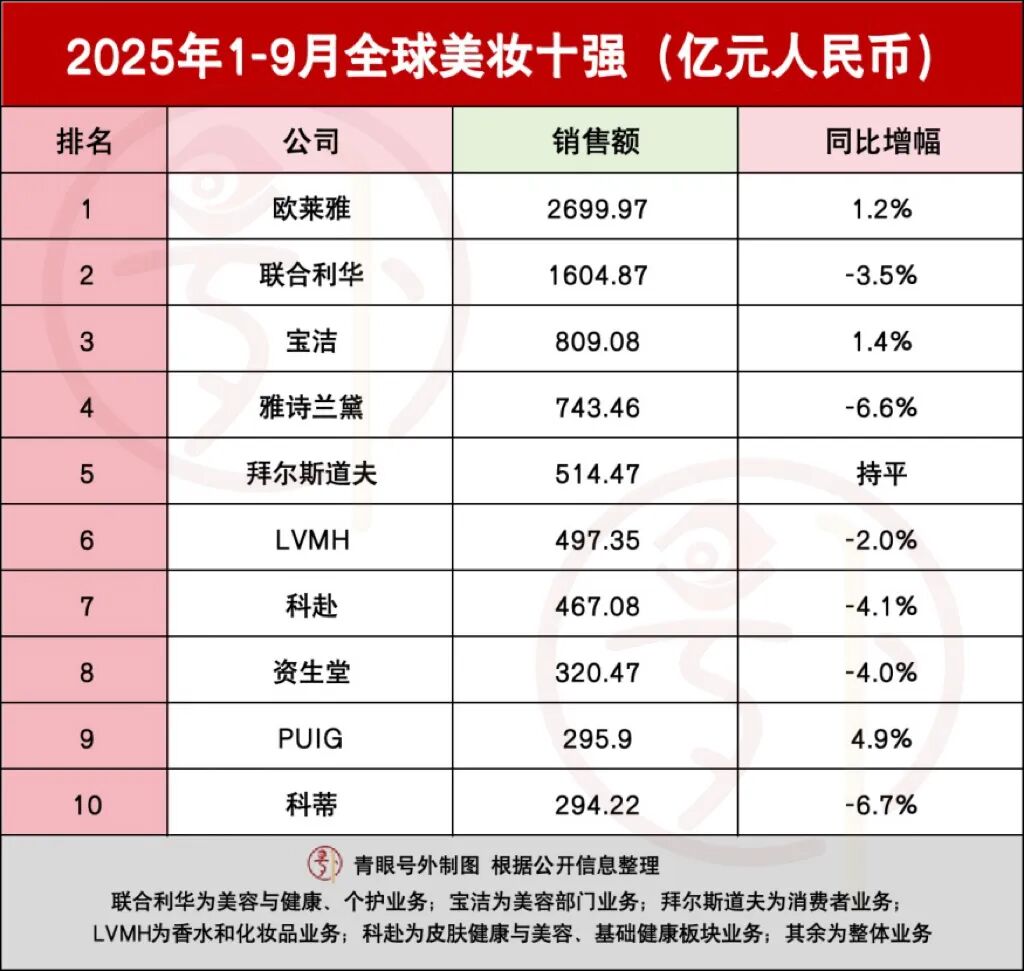
Core Insights - The global beauty market is undergoing transformation amidst resilience, with the top ten beauty companies showing mixed performance in sales and growth [1][10] - The overall sales of the top ten beauty companies reached 824.69 billion RMB in the first three quarters of 2023, a 5.3% increase from 783.42 billion RMB in the same period last year [1][2] Sales Performance - L'Oréal leads the ranking with a sales figure of 269.99 billion RMB, marking a 1.2% increase [2] - Unilever follows with 160.49 billion RMB, but experienced a decline of 3.5% [2] - Procter & Gamble and Estée Lauder reported sales of 80.91 billion RMB and 74.35 billion RMB, respectively, with growth rates of 1.4% and a decline of 6.6% [2][3] - Only L'Oréal, Procter & Gamble, and Puig showed sales growth among the top ten companies, while Coty experienced the largest decline at 6.7% [3] Strategic Adjustments - Companies like Unilever and Coty are undergoing significant strategic changes, including layoffs and asset divestitures, to adapt to market conditions [4] - Estée Lauder has initiated a "Reinventing Beauty" plan to restructure its operations and brand management [4] High-End Beauty Market - The high-end beauty market is showing signs of recovery, with Estée Lauder reporting a 4% increase in net sales in Q3 2023 [7][8] - L'Oréal's growth in the high-end skincare segment in China has been a significant driver of its performance [8][10] China Market Dynamics - The Chinese market is emerging as a new growth engine for international beauty companies, with Coty reporting a 15% increase in high-end beauty sales in China [10][11] - Procter & Gamble's sales in the Greater China region grew by 5%, indicating a positive trend [10][11] - Estée Lauder has begun to treat the Chinese mainland as a separate reporting region, highlighting its importance [11] Future Outlook - The global beauty market is in a phase of adjustment, with high-end beauty recovery and the Chinese market's resurgence being key factors for future growth [10][11] - Companies that can adapt to changing consumer demands and leverage digital transformation are likely to succeed in the evolving competitive landscape [11]

海外美妆龙头财报跟踪:高端是否率先复苏?
2025-11-12 02:18
Summary of Conference Call Records Industry Overview - The high-end beauty market in mainland China is showing signs of recovery, with several foreign beauty brands such as La Perla, L'Oréal, and Estée Lauder reporting performance growth, reversing previous declines. This recovery is primarily driven by high-end consumer demand rather than currency fluctuations [1][2][4]. Key Insights and Arguments - **Market Recovery**: LVMH achieved mid-single-digit growth in mainland China for the first time in the third quarter, exceeding market expectations. La Perla reported double-digit growth, a performance not seen in years [2][3]. - **Long-term Trends**: Despite short-term uncertainties, companies like Shiseido and L'Oréal expect the trend of high-end beauty market recovery to continue. Shiseido has adjusted its business metrics to reflect double-digit growth when combining travel retail and domestic sales [1][4]. - **Consumer Demand**: The demand for beauty and health remains strong, with companies like L'Oréal and Puig seeing significant performance in medical-grade skincare and fragrance categories [1][5][6]. - **E-commerce Growth**: Online channels are crucial for sales growth, with L'Oréal's e-commerce channel in China experiencing double-digit growth. Offline sales in high-end malls are also showing signs of recovery [8]. Additional Important Points - **Promotional Strategies**: During the recent Double Eleven shopping festival, foreign brands like Lancôme and Helena Rubinstein achieved significant online growth, primarily through discount strategies, which impacted profit margins [9]. - **Local Brand Advantage**: Chinese local brands have advantages in supply chain responsiveness and understanding rapidly changing consumer demands. This positions them well for long-term market share growth [13][15]. - **Market Sentiment**: The overall market sentiment in 2024 is low, but the beauty sector shows resilience. Companies like L'Oréal have begun to recover after experiencing negative growth in previous quarters [5][11]. - **Competitive Landscape**: The competition between foreign and local brands is characterized by foreign brands leveraging online discounts while local brands focus on supply chain agility and consumer responsiveness. This dynamic is expected to continue without significantly hindering local brands' growth [15]. Conclusion - The high-end beauty market in China is on a recovery path, driven by strong consumer demand and effective sales strategies across various channels. While the overall market sentiment remains cautious, the resilience of the beauty sector and the competitive advantages of local brands suggest a promising outlook for future growth.
新机遇:意向成交额创历史新高
Jin Rong Shi Bao· 2025-11-11 00:54
Core Insights - The eighth China International Import Expo (CIIE) showcased China's commitment to high-level opening-up and its role in providing new opportunities for global development [1][2] - The event featured participation from 67 countries and regions, with 19 national leaders or senior officials attending, highlighting the global interest in engaging with the Chinese market [1][2] - The expo facilitated significant trade agreements, including coffee cooperation between Brazil and Chinese enterprises, and a shrimp trade agreement with Honduras [2] Group 1 - The CIIE serves as a platform for connecting global producers with Chinese consumers, as emphasized by Turkish representatives [1] - The inclusion of a dedicated section for least developed countries (LDCs) saw a 23.5% increase in participation, with 163 companies showcasing unique products [2] - Major brands, such as L'Oréal, participated extensively, demonstrating the strong market appeal of China with 25 brands and numerous product launches [2][3] Group 2 - New participants, like Sonova from Switzerland, highlighted the importance of the Chinese market for global business growth and investment [3] - The expo facilitated various activities aimed at promoting trade, investment, and consumption, enhancing its role as a significant platform for international business [3] - The total intended transaction amount reached $83.49 billion, marking a 4.4% increase from the previous year and setting a new record [3]
8大外资集团总裁最新表态,洞见中国美妆市场未来
FBeauty未来迹· 2025-11-10 10:17
Core Viewpoint - The article highlights the significant shift in international beauty companies' strategies from "deepening local presence" to "empowering global results," driven by China's innovation ecosystem and supply chain capabilities [3][6][32]. Group 1: L'Oréal - L'Oréal views China as a crucial market and innovation hub, celebrating the 20th anniversary of its R&D center in China, emphasizing that investing in China is investing in the future [5][6]. - The company announced three major achievements at the expo, including the release of a sociology book on beauty, a partnership for consumer rights protection, and a strategic collaboration with Alibaba Cloud [7]. Group 2: Procter & Gamble - Procter & Gamble emphasizes innovation as a means to enhance consumer lives, focusing on consumer-centered strategies to drive category growth and value creation [9][10]. - The company has seen positive market responses to its commitment to innovation and consumer needs, leading to a more sustainable growth path [9][11]. Group 3: Estée Lauder - Estée Lauder's participation in the expo marks a significant moment as it showcases all its brands in China, reflecting its commitment to deepening interactions with Chinese consumers [14]. - The company reported a 9% organic sales growth in mainland China, highlighting its strong performance in the high-end beauty market [14]. Group 4: Shiseido - Shiseido positions itself as an industry innovator, focusing on addressing core challenges in the beauty sector while expanding its scientific and sustainable practices [17][18]. - The launch of the RQ PYOLOGY brand at the expo signifies Shiseido's commitment to the future of the beauty industry in China [19]. Group 5: Amorepacific - Amorepacific views the expo as a strategic platform for deep dialogue with the Chinese market, focusing on local innovation and sustainable development [21][22]. - The company aims to enhance its local R&D capabilities and consumer engagement through various initiatives [25][24]. Group 6: Kao - Kao emphasizes its commitment to the Chinese market, showcasing a diverse range of products and innovations at the expo [28][29]. - The company highlights its collaborative approach between its Japanese headquarters and local R&D teams to meet Chinese consumer needs [30]. Group 7: Henkel - Henkel's participation in the expo reflects its long-term strategic planning and commitment to the Chinese market, showcasing new products and innovations [37][39]. - The company aims to transition from a multi-brand operator to a value chain leader, enhancing its local manufacturing capabilities [39].
