
Meta Platforms(META)

Search documents
四大科技巨头今年欲砸6500亿美元加码AI,分析师:别为AGI“倾家荡产”
Di Yi Cai Jing· 2026-02-08 06:49
美国科技巨头大举"撒钱"的举动正令资本市场感到忧虑。 上周,在亚马逊宣布计划向人工智能(AI)及相关基础设施领域注资2000亿美元后,股价于6日早盘应 声下跌近9%。然而,市场的冷静反应并未浇灭这场AI投资热潮。根据谷歌、微软、亚马逊和Meta在近 日披露的最新资本支出计划,这四大科技巨头在2026年的开支总额预计将高达约6500亿美元。 在理论定义中,AGI被视为AI的终极状态,意味着系统能在会计、法律等多个白领专业领域达到并取代 人类的智力水平。 而驱动这些巨头"不计成本"投入的核心逻辑,很大程度上寄希望于通用人工智能(AGI)的实现,以及 随之而来的数万亿美元潜在回报。正如硅谷风投机构红杉资本(Sequoia Capital)合伙人卡恩(David Cahn)所言:"唯有AGI的实现,才能证成未来十年这一量级的投资提案。" 然而,业内对AGI实现路径正涌现出越来越多的怀疑。彭博行业研究高级中国科技分析师罗伯特·李 (Robert Lea)在接受第一财经记者采访时表示,鉴于当代AI模型存在根本性的逻辑缺陷且方法论较为 单一,仅仅通过扩展现有模型,即行业目前盛行的做法,不太可能实现AGI。 模式识别并非真智 ...




计算机周观察20260208:AI军备竞赛持续升级,关注高壁垒软件及云服务
CMS· 2026-02-08 06:42
证券研究报告 | 行业定期报告 2026 年 02 月 08 日 AI 军备竞赛持续升级,关注高壁垒软件及云服务 计算机周观察 20260208 TMT 及中小盘/计算机 海外互联网大厂发布季报,资本开支持续超预期。过去一周,微软、META、 亚马逊、谷歌等海外科技大厂先后发布季度财报,四家公司明确表示将持续扩 大 AI 领域的相关投资。SaaS 商业模式遭受质疑,关注高壁垒软件及云服务。 ❑ 亚马逊 AWS 超预期大增,资本开支持续扩大影响自由现金流。亚马逊 25 财 推荐(维持) 行业规模 | | | 占比% | | --- | --- | --- | | 股票家数(只) | 285 | 5.5 | | 总市值(十亿元) | | 3.8 | | 流通市值(十亿元) | | 3.8 | 行业指数 % 1m 6m 12m 绝对表现 2.2 8.8 26.8 相对表现 5.3 -4.1 6.0 资料来源:公司数据、招商证券 -30 -20 -10 0 10 20 30 40 Feb/25 May/25 Sep/25 Jan/26 (%) 计算机 沪深300 相关报告 1、《板块配置进一步下降,服务器、 智驾获机 ...
大手笔AI投资之后:亚马逊、谷歌、Meta要花光现金流了?
硬AI· 2026-02-08 06:18
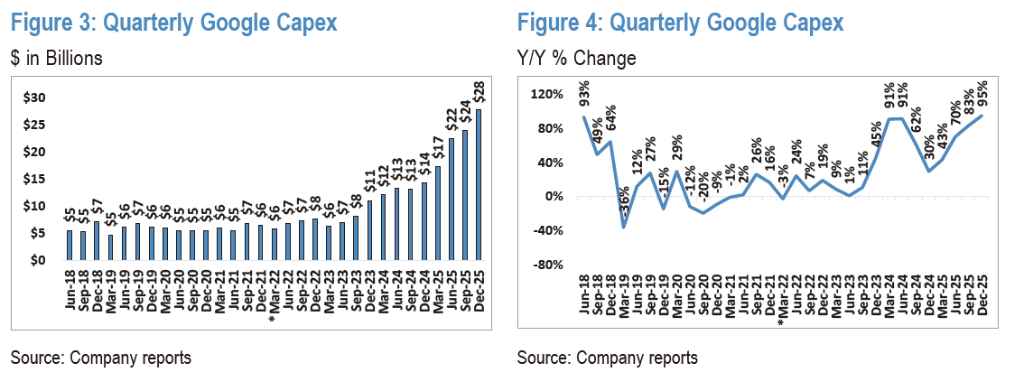
如今,6450亿美元的账单已经摆在桌上。当硅谷巨头们正试图用今天的现金流,甚至未来的债务去购买一张通往AI时代的门票时,如果这场豪赌不能在未来转化为实实在在 的收入增长,2026年的现金流危机,或许只是估值重构的序章。 硬·AI 作者 | Kozmon 编辑 | 硬 AI 随着AI基础设施建设的军备竞赛进入"深水区",一个令投资者不安的转折点已然浮现:为了支撑AI算力需求,亚马逊、谷歌和Meta正面临自由现金流被 耗尽甚至透支的风险。 根据摩根大通2026年2月5日发布的研究报告,美国四大云巨头——亚马逊、谷歌、Meta和微软,2026年总资本支出预计将达到6450亿美元,同比激增 56%,新增支出将达到惊人的2300亿美元。 对于投资者而言,2026年,或将是紧盯科技巨头资产负债表的一年。 01 谷歌97%的增速 与 亚马逊的"现金赤字" 在这场基建狂潮中, 谷歌的投入非常激进。 2026年,谷歌的资本支出指引已上调至1750亿至1850亿美元,同比增速高达97%,其资金正疯狂涌向服务器和技术基础设施。 如果说谷歌还只是在"疯狂花钱",那么亚马逊则堪称"透支未来"。 2026年,亚马逊的资本支出指引约为20 ...


大手笔AI投资之后:亚马逊、谷歌、Meta要花光现金流了?
Hua Er Jie Jian Wen· 2026-02-08 05:23
随着AI基础设施建设的军备竞赛进入"深水区",一个令投资者不安的转折点已然浮现:为了支撑AI算力需求,亚马逊、谷歌和Meta正面临自由现 金流被耗尽甚至透支的风险。 根据摩根大通2026年2月5日发布的研究报告,美国四大云巨头——亚马逊、谷歌、Meta和微软,2026年总资本支出预计将达到6450亿美元,同比 激增56%,新增支出将达到惊人的2300亿美元。 对于投资者而言,2026年,或将是紧盯科技巨头资产负债表的一年。 谷歌的97%增速与亚马逊的"现金赤字" 在这场基建狂潮中,谷歌的投入非常激进。 2026年,谷歌的资本支出指引已上调至1750亿至1850亿美元,同比增速高达97%,其资金正疯狂涌向服务器和技术基础设施。 如果说谷歌还只是在"疯狂花钱",那么亚马逊则堪称"透支未来"。 2026年,亚马逊的资本支出指引约为2000亿美元(同比增长52%)。但问题的核心在于,亚马逊赚回来的现金已经盖不住支出了——据标普全球 市场分析师预测,亚马逊2026年的运营现金流(OCF)约为1780亿美元。 这意味着,亚马逊的资本支出将超过其运营现金流,导致实质性的现金净流出(Burn Cash)。此外,据《The I ...
豪赌!四家巨头狂砸4.6万亿押注AI!“没有一家愿意输!”黄仁勋力挺:AI需求火爆,庞大支出合理、可持续
雪球· 2026-02-08 05:04
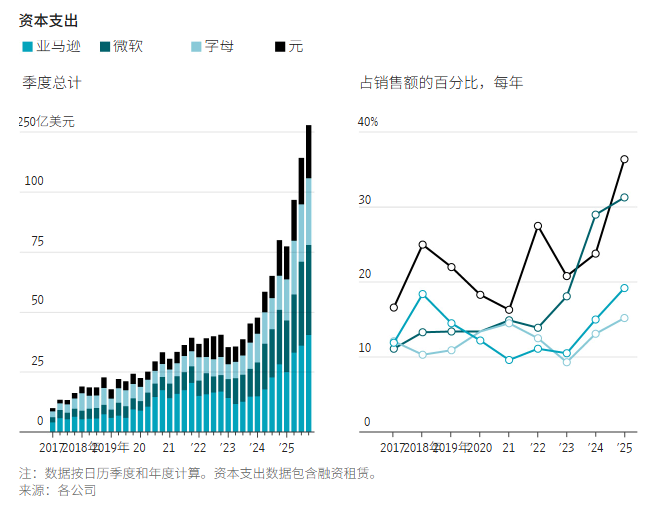
Group 1 - The core viewpoint of the article is that major tech companies are significantly increasing their capital expenditures on AI infrastructure, with a total expected spending of $660 billion (approximately 4.58 trillion RMB) this year, which is a 60% increase compared to 2025 and more than double the spending of 2024 [4][5] - Companies like Amazon, Google, Meta, and Microsoft are leading this investment trend, with Amazon projected to spend $200 billion by 2026, exceeding analyst expectations by 38% [5] - The competition among these tech giants has shifted from business operations to a focus on the underlying computational power needed for AI, indicating a strategic pivot in the industry [5][6] Group 2 - The massive capital expenditures have raised concerns about the financial performance of these companies, leading to a collective decline in their stock prices, with Google, Microsoft, Amazon, and Meta experiencing drops of 4.48%, 6.77%, 12.11%, and 7.68% respectively [8] - Analysts predict that these high capital expenditures may negatively impact free cash flow, with forecasts indicating Amazon's free cash flow could be -$17 billion by 2026 and Alphabet's could plummet nearly 90% this year [10] - The market sentiment has shifted rapidly from fear of missing out (FOMO) to a defensive stance against tail risks, reflecting growing concerns over the sustainability of such high spending [8] Group 3 - NVIDIA's CEO Jensen Huang supports the substantial investment in AI infrastructure, describing it as reasonable and sustainable, driven by high demand for computational power [12][15] - Huang emphasizes that as long as companies continue to profit from AI, they will keep increasing their investments, highlighting the potential for ongoing growth in the sector [15] - He notes that this investment wave represents one of the largest infrastructure builds in human history, driven by the needs of AI companies and large-scale enterprises [15]


AMZN, GOOG, MSFT, META, ORCL Plan $700 Billion in Largely AI-Related Capex in 2026. Where the Cash Comes From
Wolfstreet· 2026-02-08 02:48
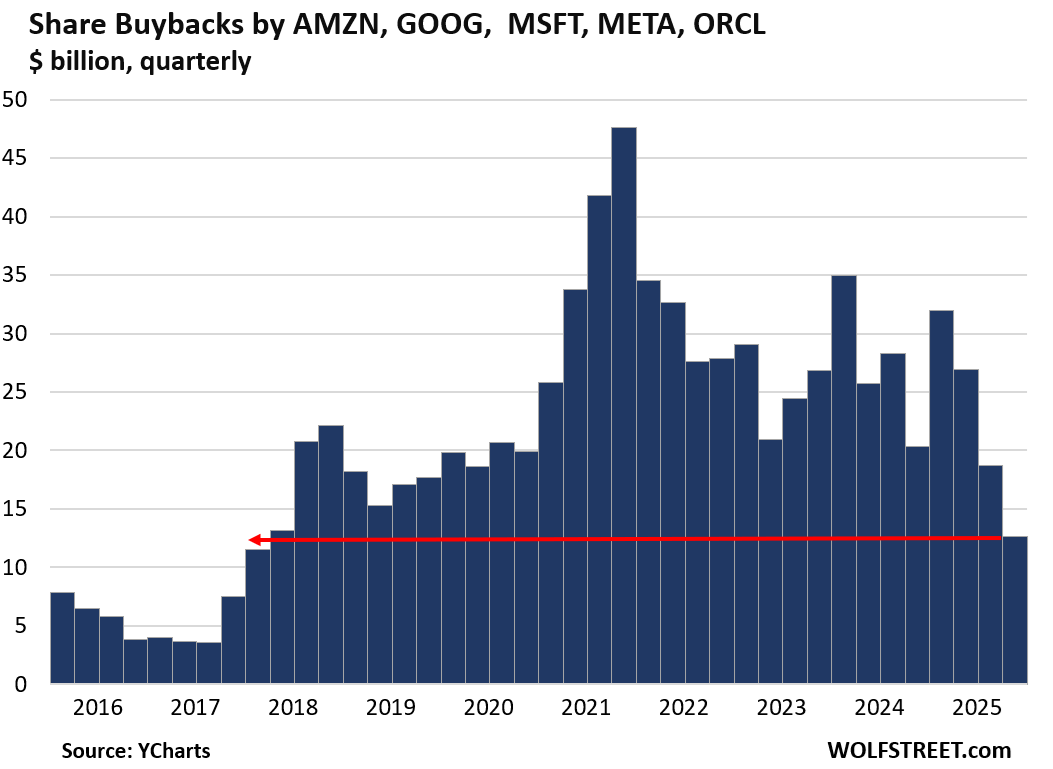
Core Viewpoint - Big Tech companies are planning to invest approximately $700 billion in capital expenditures by 2026, primarily focused on AI infrastructure, which includes data centers and related equipment [1][21]. Investment Plans - The five major companies are expected to contribute to 2.1% of current-dollar GDP through these investments [2]. - Other companies are also increasing capital expenditures, indicating a broader economic stimulus as long as this trend continues [3]. Share Buybacks and Funding Sources - Concerns exist that the increased spending may come at the expense of share buybacks, which have already begun to decline [2][7]. - The funding for the $700 billion investment will come from various sources, including reduced share buybacks, new share issuances, and debt issuances [5][9][19]. - Specific companies have already shifted from share buybacks to issuing new shares, such as Oracle, which issued $2.1 billion in new shares in 2025 [5][13]. Financial Performance and Debt - In Q4, share buybacks for the five companies dropped to $12.6 billion, the lowest since Q1 2018, compared to a peak of $149 billion in 2021 [7]. - Companies like Amazon and Meta have significantly reduced their share buybacks to allocate funds for AI investments [6][8]. - Oracle's recent bond offerings have seen high demand, indicating strong investor interest in corporate debt [16][19]. Operating Cash Flow - The operating cash flows for these companies are substantial, with Amazon generating $126 billion and Alphabet $127 billion in 2025, which can help fund the planned investments [20][23]. - Utilizing operating cash flow for investments is seen as a positive contribution to economic growth [23]. Economic Impact - The shift from share buybacks to investments in AI infrastructure is expected to stimulate economic growth, although it may not be well-received by shareholders [21][22]. - The overall investment strategy is viewed as a significant stimulus for the economy, provided that financial markets remain stable [23].

通信行业周报:北美云厂商业绩超预期,关注CPO及产业链公司投资机会
GUOTAI HAITONG SECURITIES· 2026-02-08 02:45
Investment Rating - The report maintains a positive outlook on the communication equipment and services industry, particularly focusing on investment opportunities in CPO and related supply chain companies [3][11]. Core Insights - North American cloud vendors have reported better-than-expected earnings, with significant capital expenditure guidance increases from major players like Google and Amazon, indicating strong growth in the AI computing industry chain [3][11]. - The report highlights the rapid growth of the optical communication industry driven by AI applications, with leading companies achieving record highs in stock performance [6][9]. - The transition from Scale-OUT to Scale-UP in optical applications is emphasized, suggesting a broadening of application scenarios and increased demand for optical modules and components [6][9]. Summary by Sections Weekly Viewpoint - The optical communication sector is experiencing unprecedented growth, with major cloud companies significantly increasing capital expenditures, leading to a strong performance in the optical communication supply chain [9]. - The report notes that while the market is currently experiencing fluctuations, long-term investment opportunities are becoming more apparent, particularly in the context of rising prices for optical fibers and components [9]. Industry News - Major cloud service providers like Google and Amazon have substantially raised their capital expenditure forecasts for 2026, with Google estimating between $175 billion and $185 billion, nearly double that of 2025, and Amazon projecting around $200 billion, a 50% increase from the previous year [11][24][25]. - The report discusses the implications of a recent tax increase on value-added services in China, which may impact the revenue and profit margins of major telecom operators [12]. Investment Highlights - The report indicates that the proportion of holdings in the optical communication sector has increased, reflecting a positive market sentiment driven by AI-related infrastructure investments [11][41]. - The domestic new generation computing infrastructure is set to enter a new cycle, with significant opportunities arising from the ongoing global infrastructure wave [11][41]. - The report suggests that the AI-driven network upgrades will enhance communication capabilities, leading to rapid advancements in network innovation and technology applications [11][41].


AI交易“被忽视的风险”:万一,天量资本开支“花不出去”
Hua Er Jie Jian Wen· 2026-02-08 02:17
AI的故事,正在从"软件吞噬世界",演变为"硬件被世界卡住"。 在极度撕裂的美国政治环境中,能让极左翼参议员伯尼·桑德斯(Bernie Sanders)和极右翼州长罗恩·德桑蒂斯(Ron DeSantis)站在同一阵线的 议题几乎不存在——除了"遏制数据中心"。 这不仅是华盛顿的政治奇观,更是华尔街面临的冷酷"物理修正"。当硅谷巨头们挥舞着比"阿波罗登月计划"还要昂贵的支票簿,试图通过堆砌 算力延续AI繁荣时,他们撞上了由政治和物理电网极限共同筑就的高墙。 纽约州立法者也已经提出法案,计划对新建数据中心的建设和运营许可实施至少三年的暂停。纽约至少是第六个考虑暂停新数据中心建设的 州。 总之,从佛罗里达州的社区抗议,到德克萨斯州电网的监管急刹车,一个被市场忽视的风险正在急剧升温:如果物理电网接不上、政治环境不 答应,那原本计入估值模型的数千亿美元资本开支,可能根本"花不出去"。 当桑德斯与德桑蒂斯"合谋" 桑德斯和德桑蒂斯在绝大多数议题上势同水火,但在数据中心激增的问题上,他们达成了罕见的共识:必须踩下刹车。 这种跨党派"联合"的敌意,源于美国民众对"AI副作用"的切肤之痛。全美各地,数据中心24小时不间断的低 ...
AI周报 | 微信屏蔽元宝、千问红包链接;马斯克宣布SpaceX收购xAI
Di Yi Cai Jing Zi Xun· 2026-02-08 01:05
微信屏蔽元宝、千问红包链接 2月4日上午,记者在微信群中点入好友发出的元宝红包,显示"网页包含诱导分享、关注等诱导行为", 提醒用户可以通过浏览器访问。随后,元宝红包在微信的分享改为口令的形式。微信安全中心公众号发 文称,微信对以春节为主题集中爆发的过度营销、诱导分享等违规行为进行打击。2月6日,千问在春节 活动的第一天,微信链接也被屏蔽了,部分用户在千问APP点击分享活动至微信好友时,已自动改为复 制口令形式。 【点评】:这场争夺AI入口的春节"撒币"大战,正变得前所未有地复杂与激烈。各厂商抢夺AI入口,但 可能都没有预料到,最激烈的竞争出现在国内最大的社交平台微信上。目前看来,或许微信社交裂变的 方式无法成为任何一家AI应用厂商扩大用户池的杀手锏。或许各大厂商接下来要靠产品实力说话了。 SpaceX收购xAI,马斯克打造AI太空帝国 当地时间2月2日,马斯克旗下的太空探索技术公司SpaceX宣布收购人工智能初创公司xAI。在公告中, 马斯克强调,将xAI并入SpaceX,旨在打造一个"垂直整合的创新引擎",覆盖从地面到太空的完整技术 链条。该公告发布于xAI官网,并由马斯克本人署名。据外媒援引知情人士消息 ...


The U.S. construction industry’s need for labor is soaring and will need half a million new workers next year while AI giants ramp up spending
Yahoo Finance· 2026-02-07 20:56
Recent data on the U.S. job market has flashed some worrying signs lately, but the construction industry sees greater demand for workers. The Associated Builders and Contractors trade group estimated in a report last month the industry will need to bring in 456,000 new workers in 2027, up 30.7% from the 349,000 needed this year. “Failing to do so will worsen labor shortages, especially in certain occupations and regions, placing further upward pressure on labor costs,” ABC Chief Economist Anirban Basu ...