Morgan Stanley(MS)

Search documents
Morgan Stanley: I Was Overly Critical But Valuation Worries Are Real (Rating Upgrade) (NYSE:MS)
Seeking Alpha· 2026-01-17 11:51
Core Viewpoint - The analyst downgraded Morgan Stanley to a sell rating in late August, but the stock has since increased by approximately 27%, suggesting that the initial assessment may have been overly critical [1]. Company Summary - Morgan Stanley's stock performance has shown a significant increase of around 27% since the downgrade [1].


中国市场杀疯了!资本大迁徙全都纷纷押注中国?外资为何要去中国
Sou Hu Cai Jing· 2026-01-17 05:13
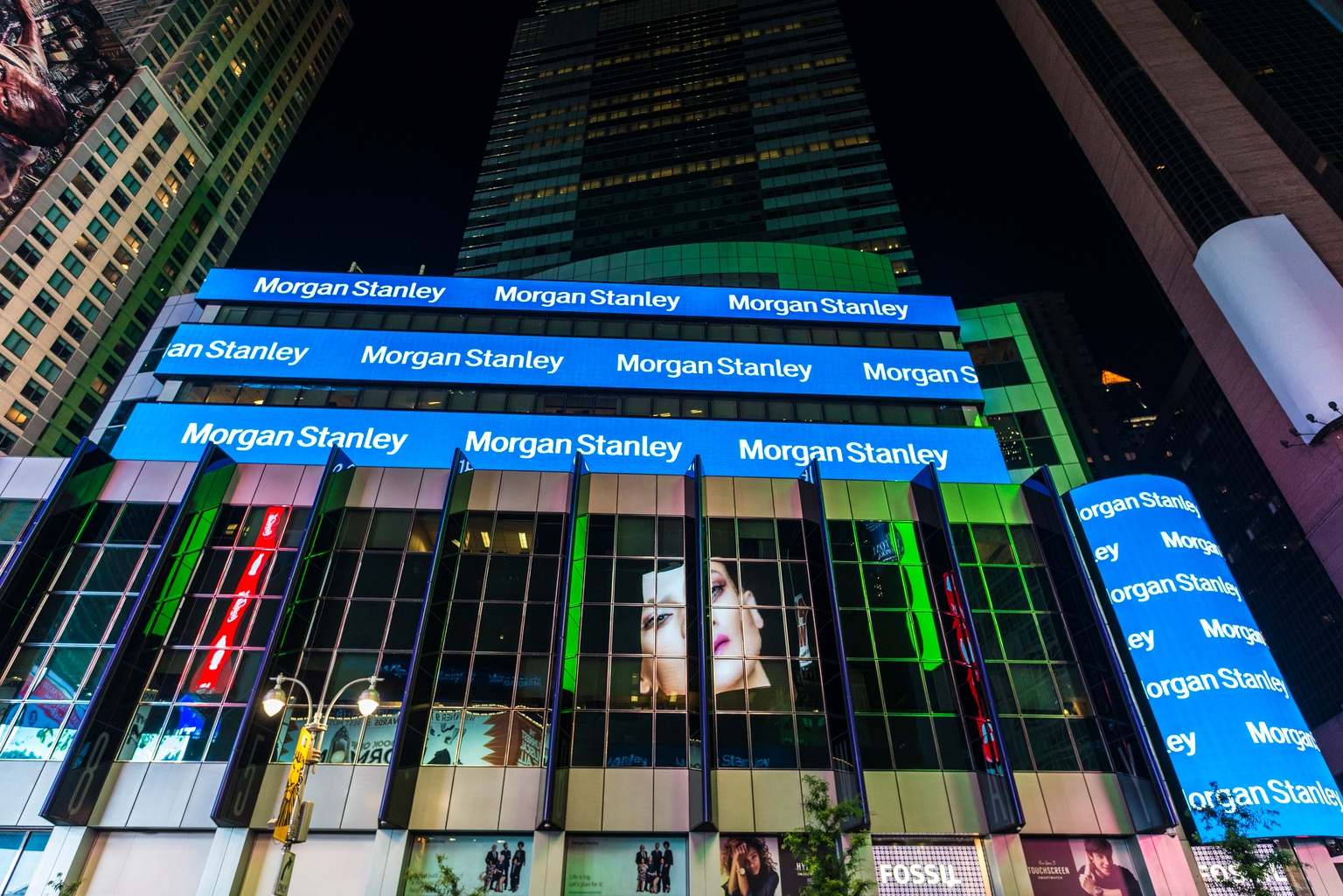
Group 1 - The main theme of the capital market in 2026 is a strong focus on investing in China, with significant enthusiasm from foreign investment banks like Goldman Sachs and Morgan Stanley, predicting annual stock market growth of 15%-20% over the next two years [3] - Major international companies are expanding aggressively in China, with Müller planning to open 200-500 stores in five years and Lexus establishing its first overseas electric vehicle base in Shanghai [5] - Despite the excitement, some companies like IKEA are facing challenges, with closures in major locations indicating a potential misalignment with evolving consumer preferences [5][10] Group 2 - The decline of IKEA is attributed not to the failure of the Chinese market but to its inability to adapt to the fast-paced changes in consumer behavior, as traditional large stores are less appealing in the era of instant retail [7][8] - The luxury car market is not declining; rather, domestic brands are capturing market share with innovative electric vehicles, while traditional luxury brands like Porsche and BBA are struggling due to slow adaptation to market trends [12] - Northbound capital is increasingly investing in Chinese assets, with trading volumes expected to exceed 50 trillion yuan in 2025, reflecting a shift from individual stock picking to bulk buying of ETFs [12][14] Group 3 - The A-share market is seen as undervalued with a price-to-earnings ratio of 16 compared to 30 for the US market, making it an attractive investment opportunity, especially with the potential for currency appreciation [14] - The challenges faced by companies like IKEA and BBA are not indicative of a failing market but rather a failure to keep pace with consumer demands and technological advancements [10][14] - The influx of foreign investment and high-profile visits to China signal a strong belief in the country's market potential, suggesting that not investing in China could be a significant risk [14]


华尔街大行业绩创新高,股票交易业务收益增长
Huan Qiu Wang· 2026-01-17 00:50
Group 1 - Goldman Sachs and Morgan Stanley reported profit growth in the fourth quarter, with Goldman Sachs' profits increasing by 12% and Morgan Stanley's by 18% [3] - Goldman Sachs' stock trading revenue reached $4.31 billion, significantly higher than Morgan Stanley's $3.7 billion, setting a new record for bank stock trading [3] - BlackRock reported a record inflow of funds, leading to its assets under management surpassing $14 trillion for the first time [3] Group 2 - Goldman Sachs' investment banking business saw a surge, with the volume of pending deals reaching its highest level in four years [3] - The termination of the partnership with Apple regarding credit cards contributed to Goldman Sachs' profit growth [3] - Morgan Stanley's profit growth was attributed to gains in both its investment banking and stock trading businesses [3]

Buy Stock in the Top Investment Management Firms After Strong Q4 Results?
ZACKS· 2026-01-16 23:25
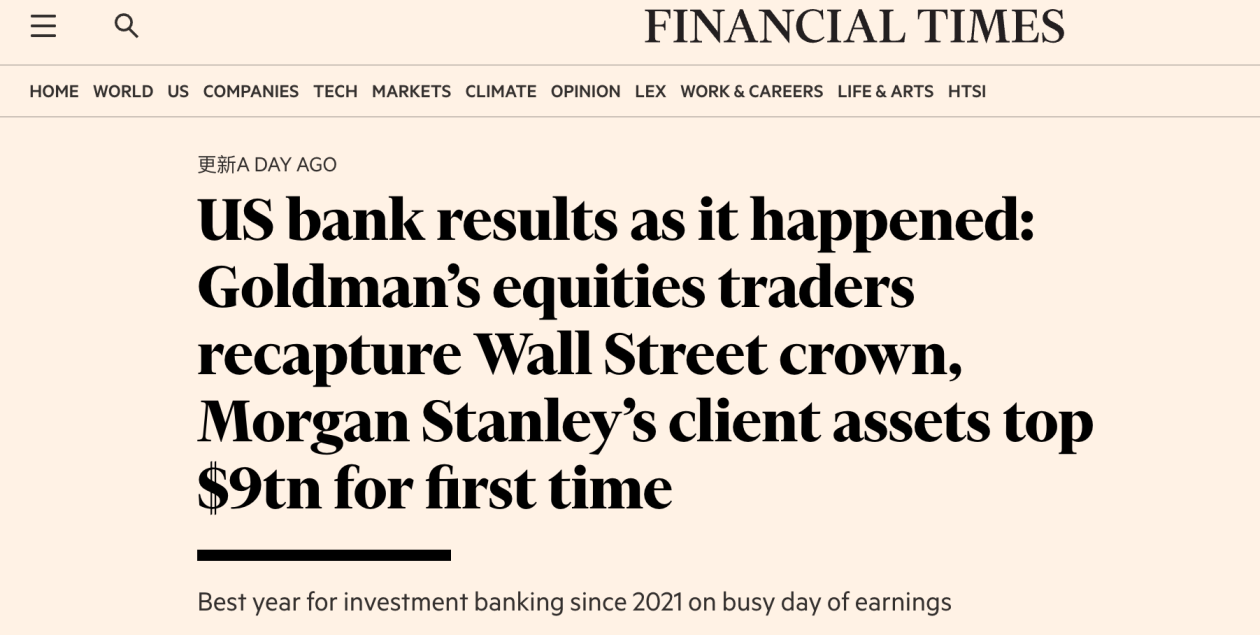
Core Insights - The Q4 earnings season for major U.S. banks began positively, driven by strong quarterly results from Goldman Sachs and Morgan Stanley, alongside impressive reports from top investment management firms like BlackRock [1] Group 1: Financial Performance - Goldman Sachs reported a Q4 net income of $4.62 billion, a 12% increase year over year, with adjusted EPS of $14.01, surpassing expectations by 19% [2] - Morgan Stanley's Q4 net income reached $4.4 billion, up 19% year over year, with EPS of $2.68, exceeding estimates by 11% [3] - BlackRock's Q4 EPS increased by 10% to $13.16, beating estimates by 6%, although net income fell 32% to $1.13 billion due to higher expenses [4] Group 2: Investment Assets - BlackRock experienced inflows of $342 billion, raising its assets under management (AUM) by 21% year over year to a record $14.04 trillion [7] - Morgan Stanley reported net new assets of $122 billion, with total client assets (TCA) increasing 26% to a peak of $9.3 trillion [7] - Goldman Sachs' assets under supervision (AUS) increased by $469 billion, a 15% rise to a record $3.61 trillion [7] Group 3: Stock Performance and Valuation - Goldman Sachs and Morgan Stanley stocks have outperformed the broader market, rising 53% and 39% respectively over the last year, while BlackRock shares increased by 17% but are down 4% from their all-time high [8] - Goldman and Morgan Stanley stocks are trading at under 19X forward earnings, offering a discount compared to BlackRock's 21X [9] - Morgan Stanley has a dividend yield of 2.09%, higher than BlackRock's 1.8% and Goldman's 1.64% [13] Group 4: Conclusion and Outlook - Morgan Stanley is currently favored due to its attractive stock price under $200 and better performance metrics compared to Goldman Sachs and BlackRock, which trade over $900 per share [15] - EPS revisions for FY26 and FY27 have been more favorable for Morgan Stanley, which holds a Zacks Rank 2 (Buy), while Goldman and BlackRock are at Zacks Rank 3 (Hold) [15]

Morgan Stanley Is A Hard-To-Replicate Franchise, Says Analyst
Benzinga· 2026-01-16 18:18
Core Insights - Morgan Stanley reported fourth-quarter 2025 earnings of $2.68, surpassing the previous year's $2.22 and beating the consensus estimate of $2.41, with net earnings increasing 18% year over year to $4.397 billion [1] - Bank of America Securities analyst Ebrahim H. Poonawala reiterated a Buy rating and raised the price target from $210 to $220, noting that the stock reached a record high following the earnings report [1][2] Financial Performance - Wealth Management segment generated $122 billion in net new assets, a significant increase from $57 billion a year earlier, contributing to investor confidence [2] - Pre-tax margins improved by 400 basis points to 31%, indicating strong operational efficiency [2] - Management has not raised long-term targets but indicated stronger profitability potential [2] Strategic Insights - CEO Ted Pick mentioned favorable conditions that could help meet or exceed firmwide goals, highlighting a balance between discipline and confidence during the earnings call [3] - Morgan Stanley's integrated business model, which combines global capital markets, U.S. wealth management, and the E*TRADE platform, remains difficult to replicate [3] Future Projections - Management is focusing on franchise synergies and advisory asset conversion, with AI-driven productivity gains expected to support margin expansion [4] - Fiscal 2026 earnings estimates have been raised by 4.5% to $11.45, with a forecasted return on tangible common equity at 21.9% [4][5] - Investment banking revenue is projected to grow by 14% in fiscal 2026, while trading revenue is expected to rise by 2% year over year [6] Market Performance - Morgan Stanley shares were up 0.54% at $192.26, trading at a new 52-week high [7]
ASML hits record high on AI boost — and analysts see plenty of room to run
CNBC· 2026-01-16 16:06
Core Viewpoint - ASML Holding NV has reached record highs in its stock price, driven by strong earnings from TSMC, indicating robust demand for advanced semiconductor manufacturing equipment [2][4]. Group 1: Company Performance - ASML's shares have increased approximately 7% following TSMC's earnings report, contributing to a market capitalization of around 450 billion euros ($522 billion) [2]. - The stock has rallied 25% year-to-date in 2026, marking significant growth for the company [2]. Group 2: Market Outlook - Morgan Stanley projects a potential 70% surge in ASML's stock price, estimating it could reach up to 2,000 euros if tech valuations continue to rise and profits exceed expectations [3]. - The price target set by Morgan Stanley for ASML is 1,400 euros, reflecting a bullish outlook on the company's future performance [3]. Group 3: Industry Demand - Increased capital expenditures (capex) for foundries and memory, along with better-than-expected demand from China, are expected to drive higher earnings for ASML in FY27 [4]. - TSMC's capex guidance has significantly surpassed prior expectations, suggesting near-term upside for ASML as advanced manufacturing tools become essential for efficiency [4].



Goldman Sachs and Morgan Stanley see double-digit profit jumps
Fastcompany· 2026-01-16 15:51
Financial Performance - Goldman Sachs reported a net earnings increase of 12% year-over-year, achieving a profit of $4.62 billion, or $14.01 per share [1] - Morgan Stanley's earnings reached $4.4 billion, or $2.68 per share, compared to $3.71 billion, or $2.22 per share from the previous year [1] Investment Banking Trends - Goldman Sachs experienced a 25% year-over-year increase in investment fee revenues, while Morgan Stanley saw a 47% increase in its investment banking division [3] - Both banks indicated a significant increase in their investment fee backlog, suggesting a rise in pending deal-making activity [3] Market Environment - The Trump administration's deregulatory policies have positively impacted Wall Street, encouraging corporations to pursue mergers and acquisitions [2] - There has been a notable surge in investor interest in artificial intelligence companies and those benefiting from technologies like ChatGPT [2]

一周热榜精选:特朗普暂缓对伊动武,金银比跌至危险区间
Jin Shi Shu Ju· 2026-01-16 14:19
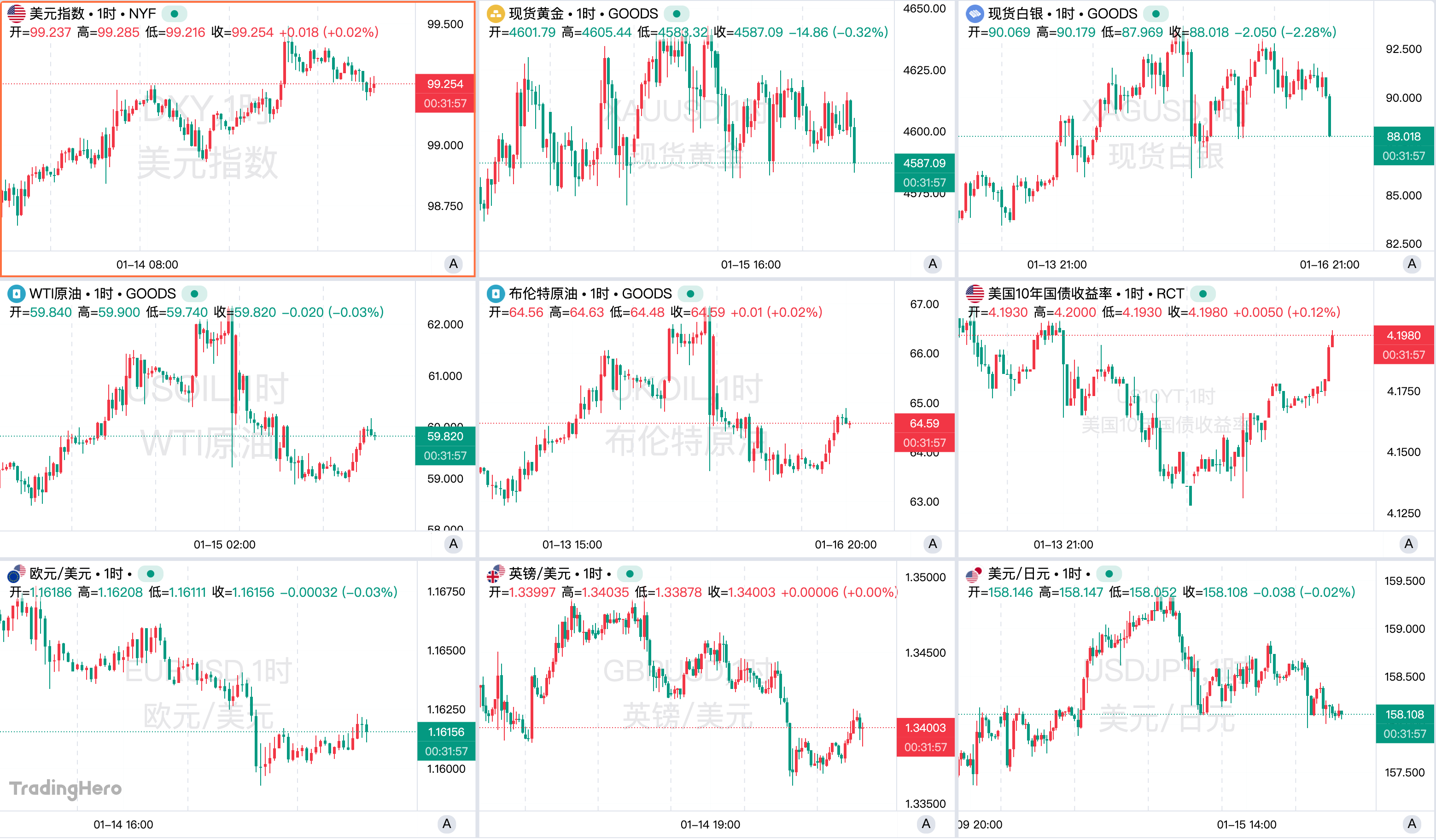
Market Overview - The market this week was driven by two main themes: the investigation rumors surrounding Federal Reserve Chairman Jerome Powell and the fluctuating geopolitical situation regarding Iran, impacting gold, silver, and oil prices [2][3] - The US dollar index faced initial pressure due to political uncertainty but later strengthened, supported by better-than-expected economic data and reduced rate cut expectations, aiming for a third consecutive week of gains [2] - Gold prices reached a historical high of $4642.85 per ounce before settling at $4583 per ounce, while silver peaked at nearly $93.70 per ounce, marking a nearly 30% increase this year [3] Federal Reserve Insights - Concerns over the independence of the Federal Reserve have led to speculation that it may adopt a more hawkish stance, as indicated by various financial institutions [5] - Multiple Federal Reserve officials emphasized the need to maintain independence and base decisions on data rather than political pressure, with some suggesting that current economic data does not support immediate rate cuts [12][13] Geopolitical Developments - The geopolitical situation in Iran has seen a temporary easing, with the US indicating a reduced likelihood of large-scale military action, although military readiness remains [14][15] - Diplomatic efforts from Middle Eastern countries have contributed to the de-escalation of tensions, with the US maintaining a stance of observing Iran's actions closely [15] Investment Strategies - The introduction of dynamic margin requirements for precious metals by CME is expected to increase market volatility, particularly affecting high-leverage traders [16] - The National Grid of China plans to invest 4 trillion yuan in the construction of a new power system during the 14th Five-Year Plan, marking a 40% increase from the previous plan [21] Corporate Earnings - Major banks such as Goldman Sachs and Morgan Stanley reported strong quarterly earnings, driven by a rebound in investment banking activities and robust trading revenues [27] - TSMC reported a record net profit of NT$505.7 billion (approximately $16 billion) for Q4 2025, with a 35% year-on-year increase, attributed to strong demand for AI-related chips [24]




U.S. Stock Futures Edge Higher on AI Optimism and Strong Bank Earnings
Stock Market News· 2026-01-16 14:07
Market Overview - U.S. stock futures are showing a positive trajectory, with major indexes expected to gain at the open due to strong corporate earnings and optimism in the AI sector [1][2] - The S&P 500 futures are up approximately 0.2% to 0.4%, Nasdaq 100 futures are leading with gains of around 0.5% to 0.6%, and Dow Jones futures are slightly higher, indicating a positive sentiment in the market [2] Oil and Treasury Yields - Oil prices have rebounded, with U.S. crude (WTI) trading around $59.95 per barrel and Brent crude at approximately $64.69 per barrel, both up around 1.5% following easing tensions in Iran [3] - U.S. Treasury yields are mixed, with the benchmark 10-year Treasury yield steady near 4.17% [3] Recent Trading Performance - Major U.S. indexes closed positively on Thursday, with the S&P 500 climbing approximately 0.3% to 6,944.47 points, Nasdaq Composite advancing around 0.2% to 23,530.02 points, and Dow Jones gaining about 0.6% to 49,442.44 points [4] - Despite recent gains, the major indexes are on track for weekly losses, with the S&P 500 down roughly 0.3%, Nasdaq off about 0.6%, and Dow Jones seeing a modest decline of approximately 0.1% [5] Upcoming Earnings Reports - The fourth-quarter earnings season is concluding, with several regional U.S. banks, including PNC Financial Services Group, M&T Bank, and State Street, set to report their quarterly results [6] Economic Data Releases - China is expected to report its 2025 economic growth data on Monday, forecasting an annual pace of around 4.5% [7] - U.S. inflation figures for December, including CPI and Core CPI, are scheduled for release next Tuesday, along with Industrial Production and Capacity Utilization data [7] AI Sector Developments - The AI sector is a significant market driver, with chip stocks like Nvidia and AMD seeing gains due to strong demand [8] - Taiwan Semiconductor Manufacturing's shares jumped over 4% following robust fourth-quarter results, further boosting optimism around AI [8] Banking Sector Performance - PNC Financial Services Group surged 3.2% to 3.5% in premarket trading after exceeding fourth-quarter targets, driven by higher interest income and fees [9] - M&T Bank also rose 1% after surpassing analyst forecasts, while Goldman Sachs and Morgan Stanley reported strong quarterly results, with shares surging over 4% and nearly 6%, respectively [10] Corporate News - Mitsubishi Corporation announced its acquisition of Aethon for approximately $5.2 billion [12] - Chevron Corporation reached a Final Investment Decision to expand production capacity at the Leviathan natural gas reservoir offshore Israel [12] - A U.S.-Taiwan trade deal involves $250 billion in new investments by Taiwanese semiconductor and tech companies in the U.S., aimed at strengthening the semiconductor supply chain [13]



一周热榜精选:特朗普暂缓对伊动武,鲍威尔获美欧央行集体护驾
Jin Shi Shu Ju· 2026-01-16 13:33
Market Overview - The market this week was influenced by two main themes: the investigation rumors surrounding Federal Reserve Chairman Jerome Powell and concerns over the "independence of the Federal Reserve," impacting the dollar and interest rate expectations; and fluctuating geopolitical news related to Iran, leading to volatility in gold and oil prices [1] - The dollar index faced pressure early in the week due to political uncertainty but later strengthened supported by better-than-expected U.S. economic data and reduced expectations for recent rate cuts, aiming for a third consecutive week of gains [1] - Gold prices initially surged to a historical high of $4642.85 per ounce due to geopolitical tensions and uncertainty regarding Federal Reserve policies, but later entered a consolidation phase, closing at $4583 per ounce [1] - Silver saw a significant increase, peaking at nearly $93.70 per ounce, with a year-to-date rise of nearly 30%, although it experienced extreme volatility [1] Non-U.S. Currencies - The "high market trading" led to the Japanese yen falling below the 159 mark against the dollar, reaching its weakest level since July 2024; the euro and pound showed slight weakness while the Australian dollar remained relatively stable [2] - Oil prices were primarily driven by news related to Iran, initially rising due to concerns over internal unrest but later retracing gains as U.S. political statements eased tensions [2] Investment Bank Insights - Lloyds Bank suggested that the Federal Reserve might become a scapegoat for the weak U.S. job market; UBS indicated that concerns over the Fed's independence could lead to a more hawkish stance [5] - Goldman Sachs noted that the Fed would continue to make decisions based on data, unaffected by investigation pressures; Morgan Stanley stated that inflation remains above target, insufficient to support a rate cut in January [5] Major Events - Trump criticized Powell again, claiming he is either incompetent or corrupt, amidst a backdrop of a criminal investigation into Powell, which has drawn support for him from global central bank leaders [6] - The Senate Majority Leader questioned the investigation's legitimacy, emphasizing the importance of the Fed's independence [7] - The December CPI data indicated a strong signal of cooling inflation, leading to increased market bets on early rate cuts, although Fed officials warned against premature easing [8] Corporate Developments - TSMC reported a record net profit of NT$505.7 billion (approximately $16 billion) for Q4 2025, a 35% year-on-year increase, driven by strong demand for AI-related chips [24] - Apple and Google reached a potential $5 billion AI partnership, opting for Google's Gemini model over OpenAI, impacting the competitive landscape in AI technology [26] - Tesla announced a shift from a one-time purchase model for its Full Self-Driving (FSD) feature to a subscription model, aiming to create a more stable revenue stream and lower entry barriers for consumers [28]