
Morgan Stanley(MS)

Search documents
一周热榜精选:特朗普暂缓对伊动武,金银比跌至危险区间
Jin Shi Shu Ju· 2026-01-16 14:19
Market Overview - The market this week was driven by two main themes: the investigation rumors surrounding Federal Reserve Chairman Jerome Powell and the fluctuating geopolitical situation regarding Iran, impacting gold, silver, and oil prices [2][3] - The US dollar index faced initial pressure due to political uncertainty but later strengthened, supported by better-than-expected economic data and reduced rate cut expectations, aiming for a third consecutive week of gains [2] - Gold prices reached a historical high of $4642.85 per ounce before settling at $4583 per ounce, while silver peaked at nearly $93.70 per ounce, marking a nearly 30% increase this year [3] Federal Reserve Insights - Concerns over the independence of the Federal Reserve have led to speculation that it may adopt a more hawkish stance, as indicated by various financial institutions [5] - Multiple Federal Reserve officials emphasized the need to maintain independence and base decisions on data rather than political pressure, with some suggesting that current economic data does not support immediate rate cuts [12][13] Geopolitical Developments - The geopolitical situation in Iran has seen a temporary easing, with the US indicating a reduced likelihood of large-scale military action, although military readiness remains [14][15] - Diplomatic efforts from Middle Eastern countries have contributed to the de-escalation of tensions, with the US maintaining a stance of observing Iran's actions closely [15] Investment Strategies - The introduction of dynamic margin requirements for precious metals by CME is expected to increase market volatility, particularly affecting high-leverage traders [16] - The National Grid of China plans to invest 4 trillion yuan in the construction of a new power system during the 14th Five-Year Plan, marking a 40% increase from the previous plan [21] Corporate Earnings - Major banks such as Goldman Sachs and Morgan Stanley reported strong quarterly earnings, driven by a rebound in investment banking activities and robust trading revenues [27] - TSMC reported a record net profit of NT$505.7 billion (approximately $16 billion) for Q4 2025, with a 35% year-on-year increase, attributed to strong demand for AI-related chips [24]






U.S. Stock Futures Edge Higher on AI Optimism and Strong Bank Earnings
Stock Market News· 2026-01-16 14:07
Market Overview - U.S. stock futures are showing a positive trajectory, with major indexes expected to gain at the open due to strong corporate earnings and optimism in the AI sector [1][2] - The S&P 500 futures are up approximately 0.2% to 0.4%, Nasdaq 100 futures are leading with gains of around 0.5% to 0.6%, and Dow Jones futures are slightly higher, indicating a positive sentiment in the market [2] Oil and Treasury Yields - Oil prices have rebounded, with U.S. crude (WTI) trading around $59.95 per barrel and Brent crude at approximately $64.69 per barrel, both up around 1.5% following easing tensions in Iran [3] - U.S. Treasury yields are mixed, with the benchmark 10-year Treasury yield steady near 4.17% [3] Recent Trading Performance - Major U.S. indexes closed positively on Thursday, with the S&P 500 climbing approximately 0.3% to 6,944.47 points, Nasdaq Composite advancing around 0.2% to 23,530.02 points, and Dow Jones gaining about 0.6% to 49,442.44 points [4] - Despite recent gains, the major indexes are on track for weekly losses, with the S&P 500 down roughly 0.3%, Nasdaq off about 0.6%, and Dow Jones seeing a modest decline of approximately 0.1% [5] Upcoming Earnings Reports - The fourth-quarter earnings season is concluding, with several regional U.S. banks, including PNC Financial Services Group, M&T Bank, and State Street, set to report their quarterly results [6] Economic Data Releases - China is expected to report its 2025 economic growth data on Monday, forecasting an annual pace of around 4.5% [7] - U.S. inflation figures for December, including CPI and Core CPI, are scheduled for release next Tuesday, along with Industrial Production and Capacity Utilization data [7] AI Sector Developments - The AI sector is a significant market driver, with chip stocks like Nvidia and AMD seeing gains due to strong demand [8] - Taiwan Semiconductor Manufacturing's shares jumped over 4% following robust fourth-quarter results, further boosting optimism around AI [8] Banking Sector Performance - PNC Financial Services Group surged 3.2% to 3.5% in premarket trading after exceeding fourth-quarter targets, driven by higher interest income and fees [9] - M&T Bank also rose 1% after surpassing analyst forecasts, while Goldman Sachs and Morgan Stanley reported strong quarterly results, with shares surging over 4% and nearly 6%, respectively [10] Corporate News - Mitsubishi Corporation announced its acquisition of Aethon for approximately $5.2 billion [12] - Chevron Corporation reached a Final Investment Decision to expand production capacity at the Leviathan natural gas reservoir offshore Israel [12] - A U.S.-Taiwan trade deal involves $250 billion in new investments by Taiwanese semiconductor and tech companies in the U.S., aimed at strengthening the semiconductor supply chain [13]



一周热榜精选:特朗普暂缓对伊动武,鲍威尔获美欧央行集体护驾
Jin Shi Shu Ju· 2026-01-16 13:33
Market Overview - The market this week was influenced by two main themes: the investigation rumors surrounding Federal Reserve Chairman Jerome Powell and concerns over the "independence of the Federal Reserve," impacting the dollar and interest rate expectations; and fluctuating geopolitical news related to Iran, leading to volatility in gold and oil prices [1] - The dollar index faced pressure early in the week due to political uncertainty but later strengthened supported by better-than-expected U.S. economic data and reduced expectations for recent rate cuts, aiming for a third consecutive week of gains [1] - Gold prices initially surged to a historical high of $4642.85 per ounce due to geopolitical tensions and uncertainty regarding Federal Reserve policies, but later entered a consolidation phase, closing at $4583 per ounce [1] - Silver saw a significant increase, peaking at nearly $93.70 per ounce, with a year-to-date rise of nearly 30%, although it experienced extreme volatility [1] Non-U.S. Currencies - The "high market trading" led to the Japanese yen falling below the 159 mark against the dollar, reaching its weakest level since July 2024; the euro and pound showed slight weakness while the Australian dollar remained relatively stable [2] - Oil prices were primarily driven by news related to Iran, initially rising due to concerns over internal unrest but later retracing gains as U.S. political statements eased tensions [2] Investment Bank Insights - Lloyds Bank suggested that the Federal Reserve might become a scapegoat for the weak U.S. job market; UBS indicated that concerns over the Fed's independence could lead to a more hawkish stance [5] - Goldman Sachs noted that the Fed would continue to make decisions based on data, unaffected by investigation pressures; Morgan Stanley stated that inflation remains above target, insufficient to support a rate cut in January [5] Major Events - Trump criticized Powell again, claiming he is either incompetent or corrupt, amidst a backdrop of a criminal investigation into Powell, which has drawn support for him from global central bank leaders [6] - The Senate Majority Leader questioned the investigation's legitimacy, emphasizing the importance of the Fed's independence [7] - The December CPI data indicated a strong signal of cooling inflation, leading to increased market bets on early rate cuts, although Fed officials warned against premature easing [8] Corporate Developments - TSMC reported a record net profit of NT$505.7 billion (approximately $16 billion) for Q4 2025, a 35% year-on-year increase, driven by strong demand for AI-related chips [24] - Apple and Google reached a potential $5 billion AI partnership, opting for Google's Gemini model over OpenAI, impacting the competitive landscape in AI technology [26] - Tesla announced a shift from a one-time purchase model for its Full Self-Driving (FSD) feature to a subscription model, aiming to create a more stable revenue stream and lower entry barriers for consumers [28]

大摩2026全球展望:美国强经济推迟降息,日央行全年按兵不动,中国出口持续扩大……
Sou Hu Cai Jing· 2026-01-16 11:28
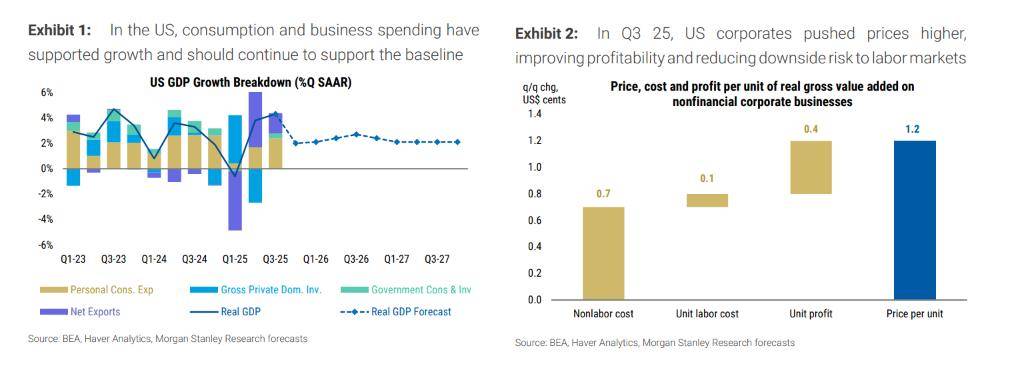
这意味着,2024年上半年全球资本市场将继续在"高利率、强美元"的货币环境中运行,依赖经济数据的起伏寻找方向。在此背景下,资产价格的 波动性可能再度攀升,重现2023年第四季度般的剧烈震荡。 对于投资者而言,最关键的风险在于重新定价。一方面,美国经济的韧性使得通胀(尤其是关税传导带来的通胀)成为比衰退更紧迫的威胁;另 一方面,非美经济体如欧元区和中国面临的增长压力,使得全球货币政策难以协调。 特别值得注意的是,大摩对日本央行的判断与市场主流预期截然相反—— 市场还在押注加息,而大摩认为日本央行全年都将按兵不动。这种预期 的巨大偏差,极可能在日元和日本国债市场上引发剧烈的重新定价风险。 摩根士丹利指出,全球经济正站在一个高度分化的十字路口,而市场对于流动性宽松的预期可能再次偏离现实。 据追风交易台,摩根士丹利在1月15日发布的全球经济简报中,为那些押注全球央行将同步、快速转向宽松政策的投资者敲响了警钟。该机构强 调,此前市场普遍期待的美联储年初降息已基本落空——强劲的美国消费数据迫使大摩将首次降息预期大幅推迟至今年年中。 美国经济:强劲消费与关税通胀迫使美联储按兵不动 美国经济目前呈现出一种令人困惑但强韧的背离 ...

大摩2026全球展望:美国强经济推迟降息,日央行全年按兵不动,中国出口持续扩大...
Hua Er Jie Jian Wen· 2026-01-16 11:08
Core Viewpoint - Morgan Stanley indicates that the global economy is at a highly differentiated crossroads, with market expectations for liquidity easing potentially diverging from reality [1] Group 1: US Economic Outlook - The US economy shows a confusing yet resilient divergence, with strong consumer spending growth at an annualized rate of 3.5% despite signs of labor market weakness [2][5] - The Federal Reserve's path has been altered due to strong demand and tariff-induced inflation, leading to a significant delay in interest rate cuts to mid-2026 [5] - The resilience of the US economy poses inflation as a more pressing threat than recession, with the Fed expected to maintain restrictive rates until a clear downward trend in inflation is confirmed [1][5] Group 2: Eurozone and UK Economic Conditions - The Eurozone is experiencing stagnation, with a composite PMI decline from 52.8 to 51.9, indicating a loss of growth momentum [6] - Core inflation in the Eurozone has dropped to 2.3%, supporting the case for potential rate cuts by the European Central Bank in June and September [8] - The UK economy remains weak, with labor demand softening, and the Bank of England is likely to cut rates in February as inflation is expected to return to target levels by April 2026 [8] Group 3: Japan's Monetary Policy - Morgan Stanley's view on Japan's monetary policy contrasts with market expectations, predicting that the Bank of Japan will keep rates unchanged throughout 2026 despite prior rate hikes [9][10] - A projected decline in core CPI from 3% to 2% and political uncertainties are cited as reasons for the lack of tightening [10] Group 4: China's Economic Strategy - China is expected to increase its global export market share from 15% to 16.5% by 2030, supported by fiscal policy continuity and a rebound in PMI data [11][13] - The economy's recovery from deflation is anticipated to be slow, relying more on commodity prices than broad demand recovery [13] Group 5: Emerging Markets Dynamics - India is projected to grow at 7.4% in FY2026, driven by policy easing and strong demand, while the current rate cut cycle is seen as nearing its end [16] - Latin America is poised for a policy shift towards more market-friendly approaches, with Brazil expected to cut rates significantly while facing moderate economic slowdown [16]
2025年香港IPO中介机构排行榜
梧桐树下V· 2026-01-16 09:40
Core Insights - In 2025, a total of 119 companies listed on the Hong Kong Stock Exchange, with 114 through IPOs, 2 via SPACs, 2 GEM to main board transfers, and 1 through introduction [1] - The leading underwriter for the IPOs was CICC, with 41 deals, followed by CITIC Securities (Hong Kong) with 32 deals [2][3] Underwriter Performance Rankings - The top five underwriters for the 114 Hong Kong IPOs were: 1. CICC: 41 deals 2. CITIC Securities (Hong Kong): 32 deals 3. Huatai International: 22 deals 4. Guotai Junan: 13 deals 5. Morgan Stanley and China Merchants International: 12 deals each [2][3] Hong Kong Legal Advisors Performance Rankings - A total of 39 Hong Kong legal advisors provided services for the IPOs, with the top five being: 1. Davis Polk & Wardwell and King & Wood Mallesons: 16 deals each 3. Conyers Dill & Pearman: 9 deals 4. Various firms including Farrer & Co, K&L Gates, and others: 5 deals each [5][6] Chinese Legal Advisors Performance Rankings - Among 33 Chinese legal advisors, the top five were: 1. Commerce & Finance Law Offices: 19 deals 2. Jingtian & Gongcheng: 17 deals 3. Zhong Lun Law Firm: 10 deals 4. DeHeng Law Offices: 8 deals 5. Guo Feng Law Firm: 7 deals [7][8] Accounting Firms Performance Rankings - Nine accounting firms provided audit services for the IPOs, with the top five being: 1. Ernst & Young: 41 deals 2. KPMG: 25 deals 3. Deloitte: 21 deals 4. PricewaterhouseCoopers: 13 deals 5. Hong Kong Lixin and Crowe (Hong Kong): 4 deals each [11][12]

大行评级|花旗:上调摩根士丹利未来三年盈利预测 评级“中性”
Ge Long Hui· 2026-01-16 08:21
Core Viewpoint - Citigroup's research report indicates that Morgan Stanley's stock rose approximately 5.8%, significantly outperforming the market, reflecting better-than-expected salary expenses and banking fee income [1] Group 1: Financial Performance - Morgan Stanley's wealth management business shows strong growth, with a projected pre-tax profit margin of 33% and an efficiency ratio of 68% during the economic cycle [1] - The tangible common equity return on tangible common equity (ROTCE) is expected to exceed the 22% target sustainably [1] Group 2: Earnings Forecast - Citigroup raised Morgan Stanley's earnings per share (EPS) forecast for this year by $0.55 to $11.55 [1] - The EPS forecast for next year was increased by $0.65 to $11.90 [1] - The EPS forecast for 2028 was adjusted upward by $0.90 to $12.85 [1] Group 3: Rating and Target Price - Citigroup maintains a "neutral" rating on Morgan Stanley with a target price set at $170 [1]
金价,跌了
中国能源报· 2026-01-16 07:23
Economic Data and Market Reactions - Recent economic data and statements from several Federal Reserve officials indicating a lack of urgency to cut interest rates have dampened market optimism regarding multiple rate cuts this year, leading to profit-taking in the gold market and a noticeable decline in international gold prices [1] - The latest data shows that the number of first-time unemployment claims in the U.S. was lower than expected, and the New York Fed manufacturing index for January significantly exceeded expectations, reflecting the resilience of the U.S. economy [5] - As a result of strong earnings reports from major banks and chip companies, investor sentiment was boosted, leading to a collective rise in the three major U.S. stock indices on the same day [5] Gold and Silver Market - International gold prices fell on January 15, with February futures closing at $4,623.70 per ounce, a decrease of 0.26% [8] - In contrast, silver prices experienced slight gains, with March futures closing at $92.347 per ounce, up by 1.05%, following the White House's announcement to delay tariffs on key minerals, including silver [8] Performance of Major Banks - Morgan Stanley and Goldman Sachs reported impressive fourth-quarter earnings for the 2025 fiscal year, with both companies achieving double-digit growth in net revenue and earnings per share [11] - Morgan Stanley's revenue growth was bolstered by increased income from AI-related bond underwriting and financing, while Goldman Sachs reported record stock trading revenue of $4.31 billion, the highest in Wall Street history for a single quarter [11] - Following these strong earnings, Morgan Stanley's stock rose by 5.78% and Goldman Sachs by 4.63%, both reaching historical highs, which also positively impacted other bank stocks [11] European Market Performance - Recent data indicated that Germany's GDP grew by 0.2% in 2025, ending two consecutive years of contraction, which helped boost investor confidence [14] - The performance of European stock indices was mixed, with the UK market rising by 0.54%, while France and Germany saw slight declines of 0.21% and an increase of 0.26%, respectively [14] Oil Market Trends - International oil prices saw a significant decline, with light crude oil futures for February closing at $59.19 per barrel, down by 4.56%, and Brent crude for March at $63.76 per barrel, down by 4.15% [17] - This drop was attributed to a combination of factors, including increased U.S. commercial crude oil inventories and a statement from President Trump indicating a wait-and-see approach regarding the situation in Iran, which alleviated investor concerns [17]

Goldman Sachs, Morgan Stanley Riding High on Dealmaking Wave
Yahoo Finance· 2026-01-16 05:01
Seems like Wall Street saved the best for last. Goldman Sachs capped off a week of big bank earnings calls with a blockbuster report on Thursday that made Wall Street history. Joining the investment bank was rival Morgan Stanley, which similarly reported gangbuster earnings. Big banks are officially playing offense once again. Some of them, anyway. JPMorgan Chase, Bank of America and Citi, which reported their quarterly performance earlier in the week, didn’t fare as well. SUBSCRIBE: Receive more of ou ...
摩根士丹利邢自强:预计财政扩张将更加温和
Zheng Quan Shi Bao Wang· 2026-01-16 04:37
Core Viewpoint - The 2026 Bond Market Annual Forum highlighted expectations for a gradual fiscal expansion in 2026-2027, with a focus on supply-side policies in 2026 and a shift towards consumption-side policies in 2027 [1] Group 1 - The forum was co-hosted by First Capital and the National Financial and Development Laboratory, with the Shenzhen First Capital Bond Research Institute as the organizer [1] - Morgan Stanley's Chief Economist for China, Xing Ziqiang, provided insights on the anticipated fiscal policies for the upcoming years [1]