Morgan Stanley(MS)

Search documents
美国政府关门即将结束 大摩制定了一张数据回归时间表
Hua Er Jie Jian Wen· 2025-11-12 09:34
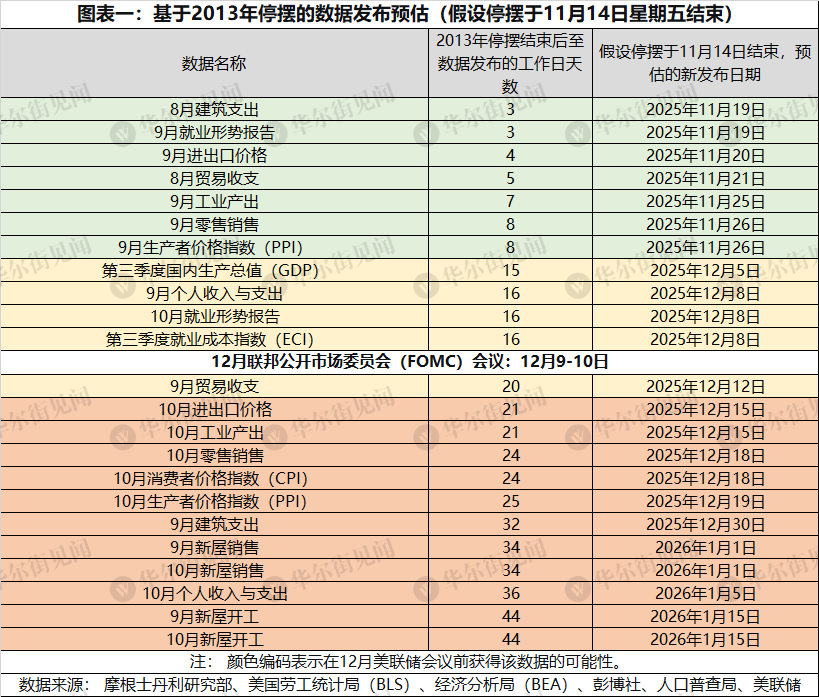
Core Viewpoint - The focus of the market is shifting from the political deadlock to the release of delayed economic data and its impact on the Federal Reserve's interest rate decision in December, following the anticipated end of the U.S. government shutdown [1]. Economic Data Release Timeline - Morgan Stanley predicts that once the government resumes operations, delayed economic data will begin to be released, with significant delays expected due to the shutdown covering the entire month of October [1][5]. - Key data such as September employment and inflation (PCE), retail sales, and some trade and manufacturing indicators are expected to be available before the Federal Reserve's meeting on December 9-10 [5][6]. - The September employment report is anticipated to be released on November 19, followed by September retail sales and PPI on November 26, and the third-quarter GDP on December 5 [3][4]. Federal Reserve's Interest Rate Decision - Despite the data delays, Morgan Stanley maintains its core view that the Federal Reserve will cut rates by 25 basis points in December, driven by weak labor demand and rising unemployment [6]. - The report forecasts that non-farm payrolls will increase by only 50,000 in September, with the unemployment rate remaining at 4.3%, and expected to rise to 4.5% in October and November [6]. Market Risks and Reactions - Investors face asymmetric risks where "good news" could turn into "bad news" for the market, as the Federal Reserve will rely heavily on incoming data to guide its decisions [7]. - If economic data is weak, it may not lead to significant market volatility unless there is a sharp economic downturn [8]. - Conversely, strong employment data could challenge the prevailing narrative of rate cuts, prompting a reassessment of the Federal Reserve's policy path and potentially pressuring risk assets [8].

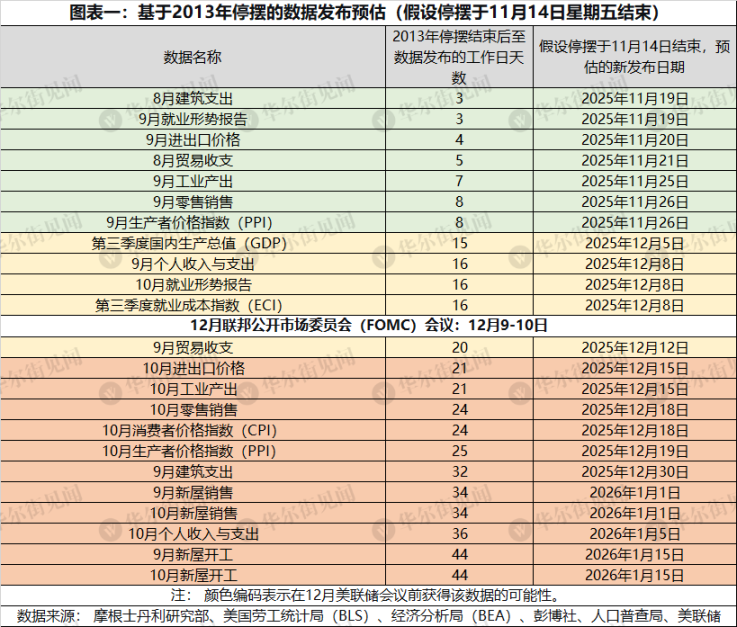
美国政府关门即将结束,大摩制定了一张数据回归时间表
Hua Er Jie Jian Wen· 2025-11-12 01:52
Core Insights - The focus of the market is shifting from the political deadlock of the U.S. government shutdown to the release of delayed economic data and its implications for the Federal Reserve's interest rate decision in December [1][5]. Economic Data Release Timeline - Morgan Stanley predicts that once the government resumes operations, delayed economic data will be released, with significant delays expected due to the shutdown covering the entire month of October [1][2]. - Key data releases are projected as follows: - September Employment Report: November 19, 2025 [3][4]. - September Retail Sales and PPI: November 26, 2025 [3][4]. - Q3 GDP: December 5, 2025 [3][4]. - October Employment Report: December 8, 2025 [3][4]. Federal Reserve's December Meeting - The Federal Reserve is expected to have access to critical data, including September employment, inflation (PCE), and retail sales, before its meeting on December 9-10 [5]. - Despite data delays, Morgan Stanley maintains its forecast for a 25 basis point rate cut in December, driven by weak labor demand and rising unemployment [6]. Asymmetric Risks for Investors - Investors face asymmetric risks where "good news" could turn into "bad news" for the market, particularly if strong economic data challenges the prevailing narrative of rate cuts [7]. - If employment data unexpectedly improves, it may force a reevaluation of the Fed's interest rate path, potentially leading to market adjustments [7].
Morgan Stanley joins rivals in rolling out private company research, memo shows
Reuters· 2025-11-11 15:55
Core Insights - Morgan Stanley has launched a dedicated private company research page to cater to the rising interest of investors in high-growth startups [1] Company Developments - The initiative reflects a strategic move by Morgan Stanley to enhance its research capabilities in the private company sector [1] - This launch is indicative of a broader trend where investment firms are increasingly focusing on private companies due to their growth potential [1]

大摩设立私人公司研究部门 发掘未上市公司对传统范式的颠覆潜力
Ge Long Hui A P P· 2025-11-11 14:22
Core Insights - Morgan Stanley has launched a dedicated research product focused on private companies to address the growing interest from investors in unlisted startups [1] - The new page on the research portal will feature reports discussing the impact of private companies on their public market competitors and individual company research [1] - The initiative is part of a strategic need to enhance private company coverage and expand thematic leadership within the research department, which is a top priority for the upcoming year [1] Summary by Categories Company Strategy - Morgan Stanley aims to enhance its focus on private companies as a strategic necessity, indicating a shift in research priorities [1] - The bank plans to recruit based on these strategic priorities to strengthen its research capabilities [1] Market Trends - There is an increasing interest from investors in private companies, particularly in the context of venture capital activities [1] - The new research product will include multimedia content and a series focused on venture capital activities, reflecting current market trends [1] Competitive Landscape - Morgan Stanley joins competitors like JPMorgan and Citigroup in providing research on private companies, highlighting the competitive nature of this segment [1] - The initiative underscores the importance of understanding the dynamics between private and public companies in the current investment landscape [1]
X @Bloomberg
Bloomberg· 2025-11-11 11:30
Strategic Initiatives - Morgan Stanley is adopting technology backed by KKR [1] - The technology aims to facilitate transactions for alternative asset managers [1] - The goal is to expand access to high-net-worth individuals [1]
每日机构分析:11月11日
Xin Hua Cai Jing· 2025-11-11 08:44
Group 1 - Deutsche Bank's Chief Investment Officer for emerging markets indicates that the dollar remains attractive for arbitrage due to the Federal Reserve's cautious approach to interest rate cuts, but there is uncertainty regarding the policy path next year, especially if the new Fed chair adjusts the rate cut pace [2] - Goldman Sachs warns that the onset of a Fed rate cut cycle may fuel asset bubbles, with credit spreads recently widening from 2.76% to 3.15%, reflecting a decrease in risk appetite. Tech investment spending is nearing its peak, with the five major tech companies expected to spend $349 billion in capital expenditures by 2025 [2] - The Committee for a Responsible Federal Budget (CRFB) cautions that President Trump's proposed "tariff dividend" of at least $2,000 per person will significantly increase the deficit, potentially adding $6 trillion over ten years, which is double the expected tariff revenue during the same period [2] Group 2 - Morgan Stanley notes that the end of quantitative tightening (QT) by the Fed does not equate to a restart of quantitative easing (QE), as it involves optimizing asset structure without expanding the balance sheet. The key factor affecting market duration and liquidity is the U.S. Treasury's debt issuance strategy, not the Fed's bond-buying actions [1] - Bank of America highlights that the surge in AI capital expenditures and off-balance-sheet financing is masking future profit pressures, with the actual lifespan of AI hardware being only 3-5 years, posing a depreciation risk that may impact financial reports post-2026 [1] - JPMorgan warns that global investment in AI data centers will require at least $5 trillion over the next five years, far exceeding the capacity of any single financing channel. The investment-grade bond market can provide $1.5 trillion, while there remains a $1.4 trillion gap that will need to be filled by private credit and government funding [1]


大摩:美联储结束QT ≠ 重启QE,未来扩表也非宽松,财政部的发债策略才是关键!
Sou Hu Cai Jing· 2025-11-11 06:32
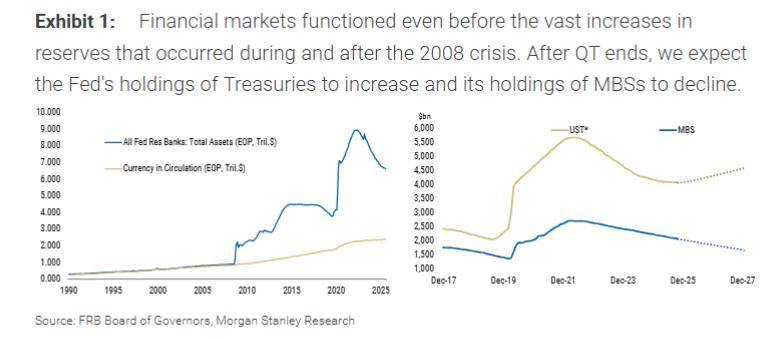
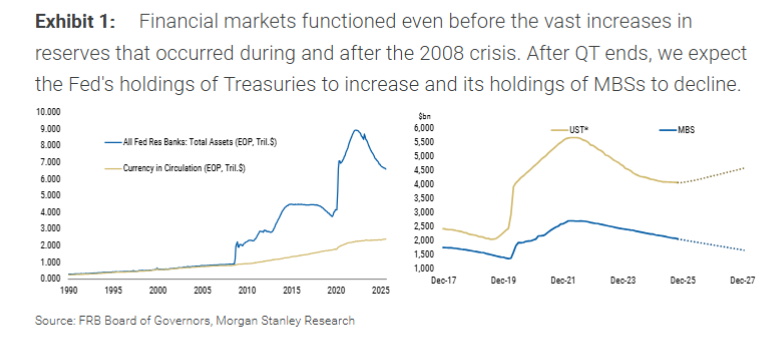
Core Insights - The Federal Reserve's decision to end quantitative tightening (QT) has sparked discussions about a potential policy shift, but it should not be equated with the start of a new easing cycle [1][2] - The Fed will stop reducing its Treasury holdings but will continue to let approximately $15 billion of mortgage-backed securities (MBS) mature each month, replacing them with short-term Treasury bills [1][3] - This operation is characterized as an asset swap rather than an increase in reserves, focusing on changing the composition of the balance sheet rather than expanding its size [1][4] Summary by Sections End of QT vs. Restart of QE - The current Fed operation is fundamentally different from quantitative easing (QE), which aims to inject liquidity into the financial system through large asset purchases [2][4] - The Fed's plan involves an internal adjustment of its asset portfolio, with no increase in bank reserves, making it a misunderstanding to interpret this as a restart of QE [2][3] Future Balance Sheet Expansion - Future expansion of the Fed's balance sheet is expected only in extreme situations, such as a severe recession or financial crisis, primarily to hedge against cash demand [3][4] - The Fed may begin purchasing Treasury bonds to maintain stable reserve levels, potentially increasing its buying by $10 billion to $15 billion monthly to match cash growth [3][4] Focus on Treasury Issuance Strategy - The key focus for asset markets should shift from the Fed to the U.S. Treasury, which plays a crucial role in determining how much duration risk the market needs to absorb [5][14] - The Treasury's recent strategy has leaned towards increasing short-term bond issuance, and the Fed's purchase of short-term Treasuries may facilitate this, depending on the Treasury's final decisions [5][14]
大摩:美联储结束QT ≠ 重启QE,未来扩表也非宽松,财政部的发债策略才是关键 !
Hua Er Jie Jian Wen· 2025-11-11 06:02
Core Viewpoint - The Federal Reserve's decision to end quantitative tightening (QT) has sparked discussions about a potential policy shift, but it should not be interpreted as the beginning of a new easing cycle [1][2]. Group 1: Federal Reserve's Actions - The Federal Reserve announced it will end QT on December 1, which is about six months earlier than previously expected [1]. - The Fed will stop reducing its Treasury holdings but will continue to let approximately $15 billion of mortgage-backed securities (MBS) mature each month, replacing them with an equal amount of short-term Treasury bills (T-bills) [1]. - This operation is characterized as an asset swap rather than an increase in reserves, focusing on changing the composition of the balance sheet rather than expanding its size [1]. Group 2: Distinction from Quantitative Easing (QE) - It is crucial to distinguish this operation from quantitative easing (QE), which involves large-scale asset purchases to inject liquidity into the financial system [2]. - The Fed's current plan is merely an internal adjustment of its asset portfolio, not an increase in bank reserves, thus misinterpreting it as a restart of QE is incorrect [2]. - The cumulative impact of stopping the $5 billion monthly reduction in Treasury holdings is relatively minor, amounting to only $30 billion in the context of the Fed's large portfolio [2]. Group 3: Future Balance Sheet Expansion - Future expansion of the Fed's balance sheet is expected to occur only under extreme conditions, such as a severe recession or financial crisis, primarily for technical reasons to hedge against cash demand [3]. - The Fed may need to purchase additional Treasury securities to maintain stable reserve levels, potentially increasing its monthly purchases by $10 billion to $15 billion to match cash growth [3]. - This buying behavior is aimed at preventing a decline in reserves rather than increasing them, and should not be overinterpreted as a signal of monetary easing [3]. Group 4: Focus on Treasury's Issuance Strategy - The real focus for asset markets should shift from the Federal Reserve to the U.S. Treasury, which plays a key role in determining how much duration risk the market needs to absorb [4]. - The Treasury's recent strategy has leaned towards increasing the issuance of short-term bonds, and the Fed's purchase of short-term Treasuries may facilitate further short-term bond issuance by the Treasury [4]. - Ultimately, the Treasury's decisions will significantly influence market liquidity and interest rate trends, making it a core variable in market direction [12].
摩根士丹利:政府停摆致数据延迟 美联储12月仍有望降息
Sou Hu Cai Jing· 2025-11-11 04:03
Core Viewpoint - Despite the U.S. federal government shutdown causing significant delays in the release of key economic data, Morgan Stanley's latest analysis suggests that the Federal Reserve may still have sufficient grounds to implement interest rate cuts at the December monetary policy meeting [1] Economic Data Delays - The September non-farm payroll data is expected to be released within three working days after the government shutdown ends, while most other monthly economic indicators may take one to two weeks to resume publication [1] - The delay in the release of October economic data is likely to extend further, potentially preventing a complete presentation before the December Federal Open Market Committee (FOMC) meeting [1] Monetary Policy Outlook - Morgan Stanley economists believe that despite the "data vacuum" challenge, existing signs of economic slowdown and some available limited information provide a reasonable basis for the Federal Reserve to continue pursuing an accommodative policy [1] - This assessment supports market expectations for a potential interest rate cut in December [1] Market Sentiment - There is a divergence in the market regarding whether the Federal Reserve will cut rates in December, with some officials emphasizing the need for clearer signals of inflation decline [1] - Institutions, including Morgan Stanley, argue that even with data delays, the trend of weakening economic momentum is significant enough to warrant further policy adjustments [1]
Final Trades: Morgan Stanley, Cisco Systems, Illumina and FTAI Aviation



CNBC Television· 2025-11-10 18:16
Market Trends - NASDAQ is up almost 2%, indicating a positive market movement, particularly in AI stocks [1][3] - Capital markets are opening up, suggesting a favorable environment for wealth management businesses [1] Stock Recommendations - Morgan Stanley is recommended due to the opening up of capital markets and its wealth management business [1] - Cisco Systems is highlighted for its momentum, outperforming the S&P 500 with twice the return in the last month, despite approaching earnings [2] - Aluminina is suggested based on past earnings performance and anticipated future growth [3] - FTI is considered a good opportunity for investment after a 15% correction with the market, deemed not fundamentally driven [3] Sentiment Analysis - Sentiment is clearly positive towards Cisco Systems, justifying its fundamentals [2]