
Nvidia(NVDA)

Search documents
Asian shares decline as oil prices soar amid the war in Iran, echoing last week's Wall Street drop
ABC News· 2026-03-30 06:48
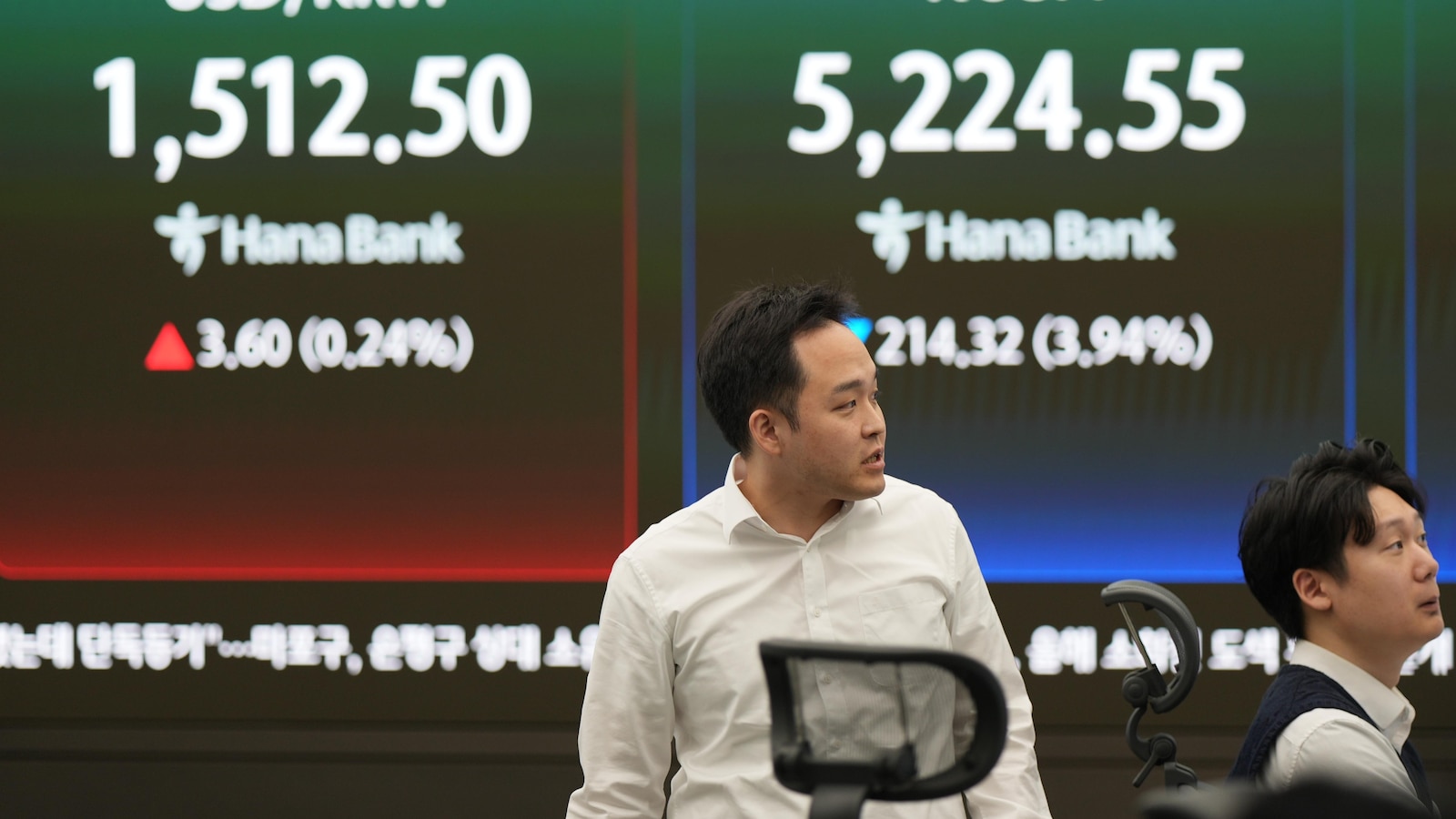
Market Overview - Asian shares are mostly declining due to concerns over rising oil prices and the potential escalation of the U.S. war with Iran [1] - The declines in Asia follow significant drops on Wall Street, marking the longest losing streak in nearly four years [2] Regional Market Performance - Japan's Nikkei 225 fell 4.5% to 50,979.54, while Australia's S&P/ASX 200 lost 1.2% to 8,417.00 [2] - South Korea's Kospi dropped 3.2% to 5,264.32, Hong Kong's Hang Seng decreased by 1.7% to 24,519.63, and the Shanghai Composite fell 0.7% to 3,884.57 [2] Oil Prices and Economic Impact - Concerns in Asia regarding access to the Strait of Hormuz have intensified, as the region heavily relies on this route for oil shipments [3] - U.S. crude oil prices increased by $2.28 to $101.92 per barrel, while Brent crude rose by $2.88 to $115.45 per barrel, up from approximately $70 before the war [3] - Investors are preparing for a prolonged conflict, which could lead to inflation in global markets and potentially hinder economic growth in Asia [4] U.S. Market Performance - The S&P 500 fell 1.7%, marking its worst week since the onset of the war with Iran, while the Dow Jones Industrial Average lost 793 points, or 1.7% [5] - The S&P 500 is currently 8.7% below its all-time high set in January, with significant declines in major tech stocks like Amazon and Nvidia [5] Bond and Currency Markets - The yield for the 10-year Treasury rose to 4.48% before settling at 4.43%, an increase from 3.97% prior to the war [6] - In currency trading, the U.S. dollar decreased to 159.97 Japanese yen from 160.32 yen, and the euro fell to $1.1505 from $1.1510 [6]


Week Ahead: Geopolitics, Oil, and Big Tech Set the Tone for US Stocks
Investing· 2026-03-30 06:48
Geopolitics - Geopolitical tensions, particularly between the United States and Iran, are creating volatility in the markets [3][4]. - The situation remains fragile, with the potential for escalation impacting market sentiment [4][12]. Oil Prices - Oil prices have surged to over $115 per barrel, significantly influencing market dynamics [20]. - Higher oil prices are expected to drive market sentiment, with energy stocks potentially leading the market if prices continue to rise [5][8]. Big Tech - Mega-cap technology stocks are crucial in anchoring the market despite rising geopolitical risks [6][12]. - Key players include Nvidia, Microsoft, and Apple, which are essential for the performance of major indices like the S&P 500 and Nasdaq Composite [9][12]. Sector Rotation - Investors may shift towards defensive sectors if geopolitical risks escalate, indicating a potential rotation in market focus [6][12]. - Sectors to monitor include utilities, healthcare, and consumer staples, alongside defense-related companies like Lockheed Martin [10][13]. Interest Rates - Interest rate expectations remain a significant underlying driver for market performance, with higher rates potentially pressuring growth stocks [11][12]. - The interaction of geopolitical developments, oil prices, and tech leadership will shape market direction in the coming week [12].

中东战争对全球人工智能产业的未来影响
2026-03-30 05:15
Summary of Conference Call on the Impact of Middle East Conflict on Global AI Industry Industry Overview - The conference call discusses the implications of the ongoing Middle East conflict on the global artificial intelligence (AI) industry, focusing on energy, computing power, and materials supply chains [1][2]. Key Points and Arguments 1. Increased AI Operational Costs - The conflict has led to a rise in global AI operational costs, with AI training costs expected to increase by 20%-30% due to disruptions in energy and specialty gas supplies [1][6]. 2. Shift in Computing Power Landscape - The anticipated computing power share from the Middle East is facing a gap, with 15% of expected capacity at risk. Companies like Microsoft and Google are relocating non-critical AI inference tasks to regions such as India and Northern Europe [1][5]. 3. Delayed AI Model Releases - The U.S. AI industry is constrained by rigid energy and hardware supply issues, leading to a projected delay of 6 months in the release cycle for large models, with projects initially set for 2027 potentially pushed to 2028-2029 [1][8]. 4. China's Competitive Advantage - China's AI sector is leveraging engineering innovations and low electricity prices to achieve significant operational cost advantages, with companies like DeepSeek demonstrating cost efficiencies up to 27 times that of GPT-4 [1][10]. 5. Supply Chain Resilience Shift - The supply chain paradigm is shifting from Just-in-Time (JIT) to Just-in-Case (JIC), with Chinese companies diversifying procurement strategies to mitigate risks and capture growth in non-U.S. technology markets [1][2]. 6. Geopolitical Investment Dynamics - The geopolitical landscape is reshaping investment flows, with Middle Eastern sovereign funds potentially withdrawing from Silicon Valley investments and seeking partnerships with China in AI technology and energy [1][2]. 7. Energy and Material Supply Vulnerabilities - The reliance on specific regions for materials like helium and bromine poses vulnerabilities in the semiconductor supply chain, with Qatar and Israel/Jordan controlling significant global production [2][6]. 8. Dual Computing Power Centers - A potential long-term outcome of the conflict could be the emergence of two computing power centers: one in North America and another in Asia, with the Middle East's role diminishing [6][8]. 9. Domestic AI Companies' Global Expansion - Chinese AI companies are exploring global markets through various strategies, including API services and localized deployments, capitalizing on their cost advantages and technological innovations [9][10][11]. 10. Market Opportunities Amid Geopolitical Tensions - The ongoing geopolitical tensions may create opportunities for Chinese companies as Western firms potentially withdraw from high-risk regions, allowing for a "lock-in ecosystem" for Chinese enterprises [15]. Other Important Insights - The conference highlighted the importance of energy efficiency in data centers, noting that AI data centers consume 3 to 5 times more energy than traditional ones, which could exacerbate operational costs amid rising energy prices [2][6]. - The call also discussed the potential for a shift in global capital flows towards non-U.S. technology allies, as Middle Eastern sovereign funds reassess their investment strategies in light of geopolitical risks [12][13]. This summary encapsulates the critical insights from the conference call regarding the impact of the Middle East conflict on the global AI industry, emphasizing the interplay between geopolitical dynamics, operational costs, and market opportunities.




英伟达 GTC 大会落幕:对科技供应链的启示-NVIDIA‘s GTC conclusion_ Implications for the Tech Supply Chain
2026-03-30 05:15
Summary of NVIDIA's GTC Conference Insights Industry Overview - **Industry**: Technology Supply Chain, specifically focusing on AI infrastructure and data centers - **Event**: NVIDIA's 16th GTC held from March 16-19, 2026, in San Jose with 30,000 in-person and 300,000 virtual attendees across 1,000 sessions and 450+ exhibits [1] Key Insights Demand and Supply Dynamics - **Demand Surge**: NVIDIA's keynote revealed that orders for the Blackwell and Rubin architectures have surged to US$1 trillion, up from US$500 billion previously anticipated for 2025-26 [2] - **Supply Constraints**: Supply bottlenecks, particularly in memory, optics, PCB/substrate, and advanced wafers, are more concerning than demand, leading to increased rack pricing to US$6-7 million for VR200 [2] - **Geopolitical Risks**: The US-Iran conflict has raised procurement concerns, causing delays in Middle East project deliveries [2] Hardware Assembly and Production - **Automation Improvements**: Hardware ODMs reported a significant reduction in assembly time for compute trays from 2 hours to 5 minutes, and rack assembly time reduced from 4-6 weeks to 2-3 days [3] - **Production Timeline**: Mass production of VR200 racks is expected to begin in August 2026, with confidence in AMD Helios production timelines being lower [3] Component Standardization - **MGX Ecosystem**: NVIDIA's MGX ecosystem aims to standardize components to streamline hardware assembly and improve supply chain resilience, although concerns about commoditization persist [4] Power Supply Innovations - **Power Capacity Increase**: The power supply for VR200 racks is being upgraded to support 440kW, with a 50%+ content gain for power supply units (PSUs) [7] - **Competitive Landscape**: Mid-term risks include competition from Chinese suppliers like Megmeet, which is shifting production to Thailand [7] Cooling Technologies - **Liquid Cooling Advancements**: The cooling architecture has transitioned to 100% liquid cooling for active components, enhancing efficiency and reducing reliance on air cooling [9] - **Future Cooling Solutions**: New cooling solutions are being developed to support higher power densities, with Delta and other vendors leading in market share [9] Memory and AI Workloads - **Memory Demand**: The rising importance of memory for AI workloads is highlighted, with NVIDIA indicating that top customers could drive 25% of traffic to a 220kW LPU server [10][11] CPU and GPU Integration - **CPU Demand Growth**: A new CPU rack server was introduced to handle increasing compute demands, with suppliers like Aspeed revising guidance upwards due to rising CPU demand [12] Future Rack Designs - **Rubin Ultra Architecture**: The Rubin Ultra architecture has been modified to accommodate higher power densities, with expectations for significant power upgrades [13] Stock Outlook - **Positive Sentiment**: The AI supply chain outlook remains positive, with a preference for semiconductors and supply chain components over hardware brands due to rising prices and tight supply [14] Additional Insights - **Solid State Transformers**: The introduction of solid state transformers is anticipated to disrupt traditional power distribution methods in data centers [8] - **Modular Data Center Solutions**: Delta and other companies are focusing on modular designs to streamline power and cooling integration in data centers [40] - **Vendor Collaborations**: Various vendors, including LiteOn and Schneider, are developing power solutions tailored for NVIDIA's architectures, indicating a collaborative approach to meet future demands [41][45] This summary encapsulates the critical insights from NVIDIA's GTC conference, highlighting the evolving landscape of the technology supply chain, particularly in AI infrastructure and data center solutions.
科技未来-AI 数据中心将推动固态技术变革-Future of Tech_ AI Data Centers to unlock Solid-State Transformation
2026-03-30 05:15
Summary of Key Points from the Conference Call Industry Overview - The report focuses on the **European Capital Goods** sector, particularly the **Solid-State Transformer (SST)** technology and its implications for the power systems industry, driven by the demand from **AI data centers** [2][3]. Core Insights and Arguments - **SST Adoption**: The adoption of SSTs is being accelerated due to the increasing power and efficiency demands driven by AI data centers, which are reshaping power systems and exposing the limitations of legacy technologies [3]. - **Technological Advantages**: SSTs utilize semiconductor-based power electronics, offering significant improvements in efficiency, control, and compactness compared to traditional transformers. They can reduce the footprint of power distribution equipment by up to **80%** [4]. - **Market Potential**: The SST market is projected to reach **$3 billion** in the US by **2030**, with a potential blue-sky scenario estimating it could grow to **$10 billion** if AI data centers drive rapid adoption [6]. - **Commercialization Timeline**: Key milestones for SST commercialization include pilot projects in **2026**, full commercialization in **2027**, and industrialization from **2028 to 2029**. Companies like Eaton and Heron Power are already preparing for this transition [5]. Challenges to Adoption - **Historical Constraints**: SSTs have faced challenges related to cost, size, and reliability, but advancements in semiconductor technology are addressing these issues. However, systems integration remains a critical focus [5]. - **Lead Times for Conventional Transformers**: The lead times for medium-voltage transformers have increased by **60%** since **2019**, creating a bottleneck that SSTs could help alleviate [10][19]. Investment Implications - **Opportunities for Major Players**: Companies like **Eaton**, **ABB**, **Schneider**, and **Siemens** stand to benefit from SST adoption, while companies like **Legrand**, which are not actively exploring SST technology, may face risks if SSTs scale rapidly [8]. - **Energy Efficiency Gains**: SSTs could unlock significant energy cost savings, estimated at **$0.7 billion per GW** for hyperscale data centers, enhancing the pricing power of vendors involved in SST technology [108]. Additional Important Insights - **AI's Role in Power Demand**: The rapid growth of AI and data centers is driving unprecedented electricity demand, influencing energy investment decisions across the power infrastructure spectrum [9]. - **Grid Connection Delays**: Approximately **20%** of the global data center buildout from **2025 to 2030** is at risk due to grid connection delays, which SSTs could help mitigate by improving grid capacity and visibility [21][30]. - **Technological Evolution**: The transition from conventional transformers to SSTs represents a significant shift in power distribution, with SSTs offering enhanced controllability, integration of backup power, and improved efficiency [32]. Conclusion - The SST technology is positioned to revolutionize the power systems industry, particularly in the context of AI-driven data centers. The potential market size, coupled with the urgency created by increasing power demands and supply chain constraints, presents a compelling investment opportunity for key players in the European Capital Goods sector.

全球科技-“落袋为安”:1.3 万亿美元及更多可支配资金-Global Tech_ Cash me if you can_ USD1.3trn and more to spend
2026-03-30 05:15
Summary of Key Points from the Conference Call Industry Overview - The report focuses on the "Tech-7" group, which includes major companies: Alphabet (GOOGL), Amazon (AMZN), Apple (AAPL), Meta Platforms (META), Microsoft (MSFT), NVIDIA (NVDA), and Oracle (ORCL) [2][19][29]. Core Insights and Arguments - **Operating Cash Flow (OCF) Growth**: The Tech-7 is expected to generate USD1.3 trillion in OCF in 2026, an increase of approximately USD300 billion from 2025, driven by nearly USD500 billion in additional revenue [14][39]. - **Capital Expenditure (Capex) Allocation**: In 2026, 62% of non-operating cash expenses will be allocated to capex and investments, up from 52% in 2025. Shareholder returns (buybacks and dividends) are expected to decrease as a percentage but may increase in absolute terms [2][14][27]. - **Revenue Growth**: Tech-7 revenue is projected to grow by 21.5% in 2026, reaching USD2.8 trillion, compared to 16.5% growth in 2025 [30][22]. - **AI Impact**: The AI megacycle is driving demand for compute capacity, benefiting companies like NVIDIA and Microsoft, which are well-positioned due to their infrastructure and compute exposure [4][13][20]. Financial Health and Flexibility - **Cash Reserves**: By the end of 2026, Tech-7 is expected to have a cash balance of USD196 billion, down from USD204 billion in 2025, despite a significant increase in capex [15][39]. - **Debt Management**: The Tech-7 group has identified USD126 billion in off-balance sheet Special Purpose Vehicle (SPV) debt, which provides flexibility in financing [3][20]. - **Shareholder Returns**: Buybacks are still 2.3 times higher than necessary to offset dilution from share-based compensation, indicating strong cash management [3][39]. Company-Specific Insights - **Alphabet (GOOGL)**: Expected OCF of USD186 billion in 2026, driven by cloud and AI revenue growth. Capex is projected to increase significantly, reducing cash available for shareholder distribution [51][52]. - **Amazon (AMZN)**: Anticipated OCF of USD178 billion in 2026, with a capex budget of USD200 billion, primarily for AWS. Amazon does not pay dividends, focusing on long-term growth [57][58][59]. - **Apple (AAPL)**: Expected OCF of USD149 billion in 2026, with a high shareholder return through buybacks and dividends. Capex remains low compared to peers [64][66]. - **Meta (META)**: Projected OCF of USD132 billion in 2026, with a significant increase in capex due to AI investments. Share buybacks are expected to decrease [72][74]. Additional Important Points - **Market Sentiment**: Despite strong performance in 2024 and 2025, there are concerns about rising capex budgets and debt levels, as AI monetization is still in early stages [17][18]. - **Long-term Growth Strategy**: Companies are adopting a "re-invest first" philosophy, focusing on internal growth and capacity expansion rather than immediate shareholder returns [58][60]. This summary encapsulates the key insights and financial projections for the Tech-7 companies, highlighting their strategies and market positioning in the evolving tech landscape.



科技未来 -具身智能,架起工业机器人与人形机器人的桥梁_ Future of Tech_ Physical AI -- Bridging industrial and humanoid robotics
2026-03-30 05:15
Summary of Key Points from the Conference Call Industry Overview - The report focuses on the **robotics industry**, specifically **industrial robotics** and **humanoid robotics**, highlighting the impact of **Physical AI** on both segments [1][2]. Core Insights - **Physical AI Framework**: The common framework consists of "body-cerebrum-brain-skills-world", which helps in understanding the business models of industry players [2]. - **Challenges**: - **Industrial Robots**: Require high precision and speed, with hardware and motion control being critical differentiators [3]. - **Humanoid Robots**: Face challenges in task generalization and complex physical interactions, making brain and world models essential [3]. Market Projections - In 2025, only **4%** of humanoid robot shipments are expected to be for industrial applications, with total shipments around **20K units**. This percentage is projected to rise to **50-60%** as the market grows to **1-10 million units annually**, before declining to **~10%** in the distant future [4][6]. Competitive Landscape - **Industrial Robotics**: - **FANUC** is a leader, excelling in technology and ecosystem ownership, with a broad robotic portfolio and superior motion control capabilities [5]. - **Mech-Mind** holds a **~30%** market share in robotic path planning, indicating strong competitive positioning [5]. - **Humanoid Robotics**: - **Unitree** commands a **~25%** global market share and is becoming a key platform for robotic research and applications [5]. - Other players like **Figure AI** and **LimX** are also making strides in technology breakthroughs [5]. Financial Performance - **Unitree's Revenue Growth**: Projected revenue growth from humanoid robots shows significant increases, with revenues expected to rise from **RMB 3 million** in 2023 to **RMB 595.2 million** by 2025 [39]. - **Gross Margin Trends**: Unitree's gross margins are superior compared to peers, indicating strong financial health [36]. Investment Recommendations - **Outperform Ratings**: Recommended for **FANUC**, **Inovance**, **Keyence**, **Cognex**, and **Harmonic Drive**. - **Underperform Rating**: Assigned to **Leader Harmonious Drive** [37]. Risks and Considerations - **Macro Economic Risks**: The robotics industry is sensitive to global economic conditions, including industrial capex cycles and currency fluctuations [55][56][57][58][60]. - **Market Demand**: Potential risks include weaker than expected global automation demand and competition affecting market share [57][58]. Additional Insights - The report emphasizes the minimal application overlap between industrial and humanoid robots, suggesting distinct market paths for each segment [17]. This summary encapsulates the critical aspects of the conference call, providing a comprehensive overview of the robotics industry, competitive dynamics, market projections, and investment implications.




机器人技术:当工厂化身机器人-Robotics-When Factory = Robot
2026-03-30 05:15
Summary of Key Points from the Conference Call Industry Overview - **Industry Focus**: Robotics and Manufacturing in North America - **Core Theme**: The integration of Generative AI (Gen-AI) is leading to a significant transformation in manufacturing processes, referred to as a 'Cambrian explosion' of robots aimed at replacing human tasks in factories [1][3] Core Insights - **Rethinking Manufacturing**: There is a call for a fundamental re-evaluation of manufacturing processes, suggesting that factories could be designed as a single interconnected robot, minimizing human intervention [1][3] - **Elon Musk's Design Philosophy**: Musk emphasizes that automation should not be a substitute for well-designed manufacturing processes. He advocates for questioning requirements and simplifying processes before introducing robots [5][13] - **Historical Context**: The manufacturing sector has not seen significant transformation since the introduction of the assembly line by Henry Ford in 1913, indicating a need for innovation [5][20] - **China's Dominance**: In 2024, China accounted for 54% of all industrial robots installed globally, with over 90% of critical components in the supply chain controlled by China, highlighting the competitive landscape [5][21] Future Manufacturing Vision - **Agentic Manufacturing**: The concept of a fully AI-managed manufacturing system is gaining traction, where every machine is interconnected, allowing for autonomous adjustments in response to bottlenecks or inventory needs [6][22] - **Manufacturing as a Service (MaaS)**: Future manufacturing could involve AI-driven networks that dynamically route demand to production capacities, enabling self-configuring supply chains [23][84] Key Players and Startups - **Notable Startups**: - **Project Prometheus**: Led by Jeff Bezos, focusing on AI for engineering and manufacturing with reported funding of $6.2 billion [8] - **Arda**: A startup aiming to create a software platform for autonomous factories, raising $70 million at a $700 million valuation [8] - **Mind Robotics**: Founded by Rivian's CEO, focusing on AI models for factory automation, valued at $2 billion [8] - **Atoms**: Founded by Travis Kalanick, aiming to build specialized robotics systems across various industries [8] Public Market Insights - **Key Public Companies**: Companies like Palantir and NVIDIA are highlighted for their roles in enabling agentic operations and digital twins in manufacturing [9][12] - **Reshoring Opportunity**: The US is entering a phase of re-industrialization, with a potential $10 trillion opportunity to restore growth in the industrial economy, driven by technological advancements and operational resiliency [38][40] Manufacturing Trends - **Declining Manufacturing Share**: US manufacturing as a percentage of GDP has decreased from approximately 30% in the 1950s to less than 10% today, indicating a significant shift in the industrial landscape [20][29] - **Investment Trends**: There has been a surge in US manufacturing construction, with project starts stabilizing at three times pre-COVID levels, suggesting a renewed focus on domestic production [39][40] Conclusion - The conference call emphasizes a transformative period in manufacturing driven by AI and robotics, with significant implications for the industry landscape, competitive dynamics, and investment opportunities. The focus on reshoring and innovative manufacturing processes presents a multi-decade opportunity for growth and development in the sector [38][40]


CPO产业加速-重视光通信投资机遇
2026-03-30 05:15
Summary of Conference Call Notes Industry Overview - The CPO (Co-Packaged Optics) industry is accelerating, with significant investment opportunities in optical communication expected by 2027 [1] - The GPU shipment forecast for 2027 has been revised upwards to 50-60 million units, driving the expected shipment of 1.6T optical modules to over 75 million units, with 3.2T entering trial production [1][2] Key Insights and Arguments - TSMC's CoWoS capacity is increasingly directed towards NVIDIA and Google, with supply expected to rise to 1-1.2 million wafers for NVIDIA and 500,000-600,000 wafers for Google by 2027 [1][2] - The valuation of Zhongji Xuchuang and Xinyi Sheng is projected to be around 10 times, with performance growth outpacing stock price increases, indicating a favorable cost-performance ratio for investment [1][3] - CPO packaging yield has reached 90%, but overall yield remains at 50%-60% due to micro-ring process and thermal management limitations, with large-scale production expected to commence in 2027 [1][4] Market Dynamics - The short-term target for CPO is to replace traditional copper cables in the scale-up layer, while the scale-out layer remains focused on pluggable optical module applications, indicating no immediate threat to traditional optical module manufacturers [1][5] - Google's AI investment strategy has shifted to aggressive spending, with OCS (Optical Circuit Switching) demand expected to rise significantly, projecting OCS shipments of 50,000-60,000 units in 2027, with potential for further upward revision [1][5] Investment Opportunities - Core targets in the CPO sector include Tianfu Communication and Juguang Technology, while OCS focuses on Tengjing Technology and Fuzhijing Technology, with Zhongji Xuchuang and Xinyi Sheng maintaining strong positions in the traditional market [1][6][7] - The development of CPO technology is not expected to significantly impact traditional pluggable optical module markets in the near term, as the core incremental market for CPO is distinct from that of traditional modules [1][5] Additional Considerations - The anticipated growth in GPU shipments is directly linked to the demand for supporting optical modules, highlighting the interconnectedness of these technologies [2] - The successful resolution of remaining technical challenges in CPO production will be crucial for its large-scale adoption, with 2027 being a pivotal year for the industry [4]


大厂液冷专家分享
2026-03-30 05:15
Summary of Key Points from the Conference Call Company and Industry Overview - The conference call discusses advancements in liquid cooling technology, specifically focusing on NVIDIA's Vellum Ruby solution and its implications for the data center cooling industry. Core Insights and Arguments 1. **Power Density Increase**: The Vellum Ruby cabinet achieves a power density of 220kW, nearly double that of the previous GB200 model, with CPU power consumption rising to 2.3kW [1][2][3]. 2. **Liquid Cooling System Enhancements**: The liquid cooling system now covers nearly 100% of heat-generating components, with cooling plate capacity increasing from approximately 3kW to over 5kW [1][2][3]. 3. **Cost Implications**: The cost of the liquid cooling system for the Vellum Ruby is expected to rise by 15%-25%, with a median increase of about 20% compared to the GB200 [1][4]. 4. **Market Dynamics**: The domestic liquid cooling market has a high localization rate, with key components like CDU being priced at only 1/3 to 1/2 of their overseas counterparts [1][2]. 5. **CDU Supply Constraints**: There is a continuous shortage of CDU capacity, with lead times exceeding six months for top manufacturers in 2025, although this is expected to ease in 2026 as capacity is released [1][15]. Additional Important Content 1. **Technological Evolution**: The evolution of liquid cooling technology is expected to follow a path from optimizing flow channel cooling plates in the short term to potentially adopting two-phase liquid cooling systems in the long term, which could increase BOM costs by at least 30% [1][8][10]. 2. **Customization in System Design**: Different users, such as NVIDIA and Google, have varying system architecture designs, impacting the overall cost and efficiency of the liquid cooling systems [5][6]. 3. **Domestic vs. International Market**: The domestic market shows a high degree of localization, with significant competition among local manufacturers, while the international market remains dominated by established foreign brands [12][13]. 4. **Future Trends in Cooling Technology**: The industry is exploring the use of microchannel cooling plates and two-phase cooling systems, which could significantly enhance cooling efficiency for high-power chips [7][8][16]. 5. **Component Cost Structure**: The cost structure of liquid cooling systems indicates that CDU and cooling plates constitute a significant portion of the overall BOM, with variations based on user-specific configurations [9][10]. This summary encapsulates the key points discussed in the conference call, highlighting the advancements in liquid cooling technology, market dynamics, and future trends in the industry.