PDD(PDD)

Search documents
本周外盘看点丨美国PCE是否影响降息前景,英伟达财报将亮相
Di Yi Cai Jing· 2025-08-24 04:57
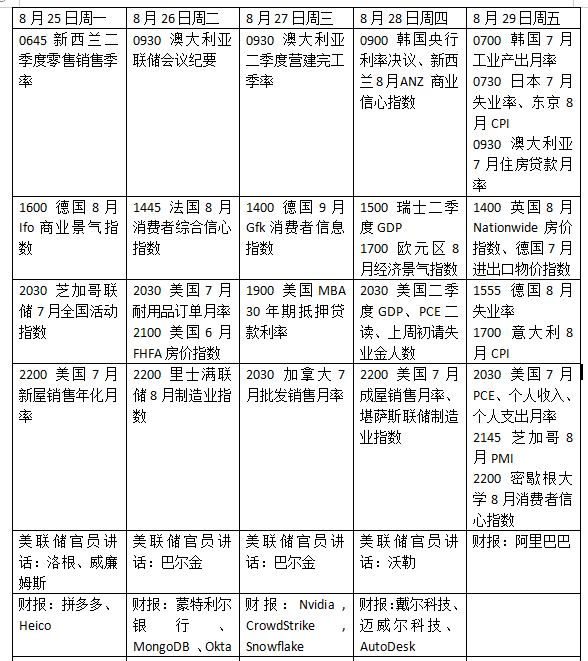
Group 1: Market Overview - Alibaba and Pinduoduo, among other Chinese concept stocks, are set to announce their earnings [1] - The U.S. stock market experienced mixed results, with the Dow Jones increasing by 1.53% and the Nasdaq decreasing by 0.58% [1] - Key economic indicators to watch include the U.S. Personal Consumption Expenditures (PCE) for July, which will influence future interest rate decisions by the Federal Reserve [1][2] Group 2: Economic Indicators - The U.S. monetary market anticipates a 89% chance of a rate cut in September following Powell's remarks on the labor market [2] - Upcoming data releases, including July durable goods orders and August consumer confidence surveys, will provide insights into the U.S. economic situation [3] - HSBC economists predict a revision of the second-quarter GDP growth rate from 3.0% to 3.2% [3] Group 3: Commodity Prices - International oil prices saw their first weekly increase in three weeks, with WTI crude rising by 2.71% to $63.66 per barrel and Brent crude increasing by 2.85% to $67.73 per barrel [4] - Gold prices rebounded, with COMEX gold futures for August rising by 1.15% to $3374.40 per ounce, driven by increased expectations for a rate cut [5] Group 4: European Economic Outlook - ECB President Lagarde expressed growing concerns about the EU's economic outlook, despite first-quarter growth exceeding expectations [6] - Upcoming German Ifo business climate index and other consumer confidence surveys will provide further insights into the European economy [6][7] - The UK reported a 3.8% inflation rate in July, the fastest increase in a year and a half, raising concerns about potential monetary policy adjustments [7]


正式启动!覆盖拼多多、抖音、京东等平台
Yang Shi Xin Wen· 2025-08-23 06:59
Core Viewpoint - The State Administration for Market Regulation has launched a pilot program for quality safety coding verification of key online products, aiming to enhance consumer trust and product traceability through a digital "code" system [1][2] Group 1: Pilot Program Details - The pilot program, referred to as "Code Action," will implement a traceability mechanism for 10 types of products closely related to consumer safety, including safety helmets, electric bicycles, and gas stoves [1] - The program will cover major e-commerce platforms such as Taobao, Kuaishou, Pinduoduo, Douyin, JD.com, Suning, Xiaohongshu, Dewu, Vipshop, and Tencent [1] Group 2: Implementation Requirements - E-commerce platforms are required to strictly verify the coding information of products and promote dynamic code verification [2] - Manufacturers must ensure accurate and complete coding from the source to maintain product information integrity [2] - Local market regulatory authorities will enhance supervision and conduct random checks, as well as enforce legal actions against violations [2]




昨夜全球资本市场狂欢!美股、中概股、黄金集体暴动,释放啥信号
Sou Hu Cai Jing· 2025-08-23 05:48
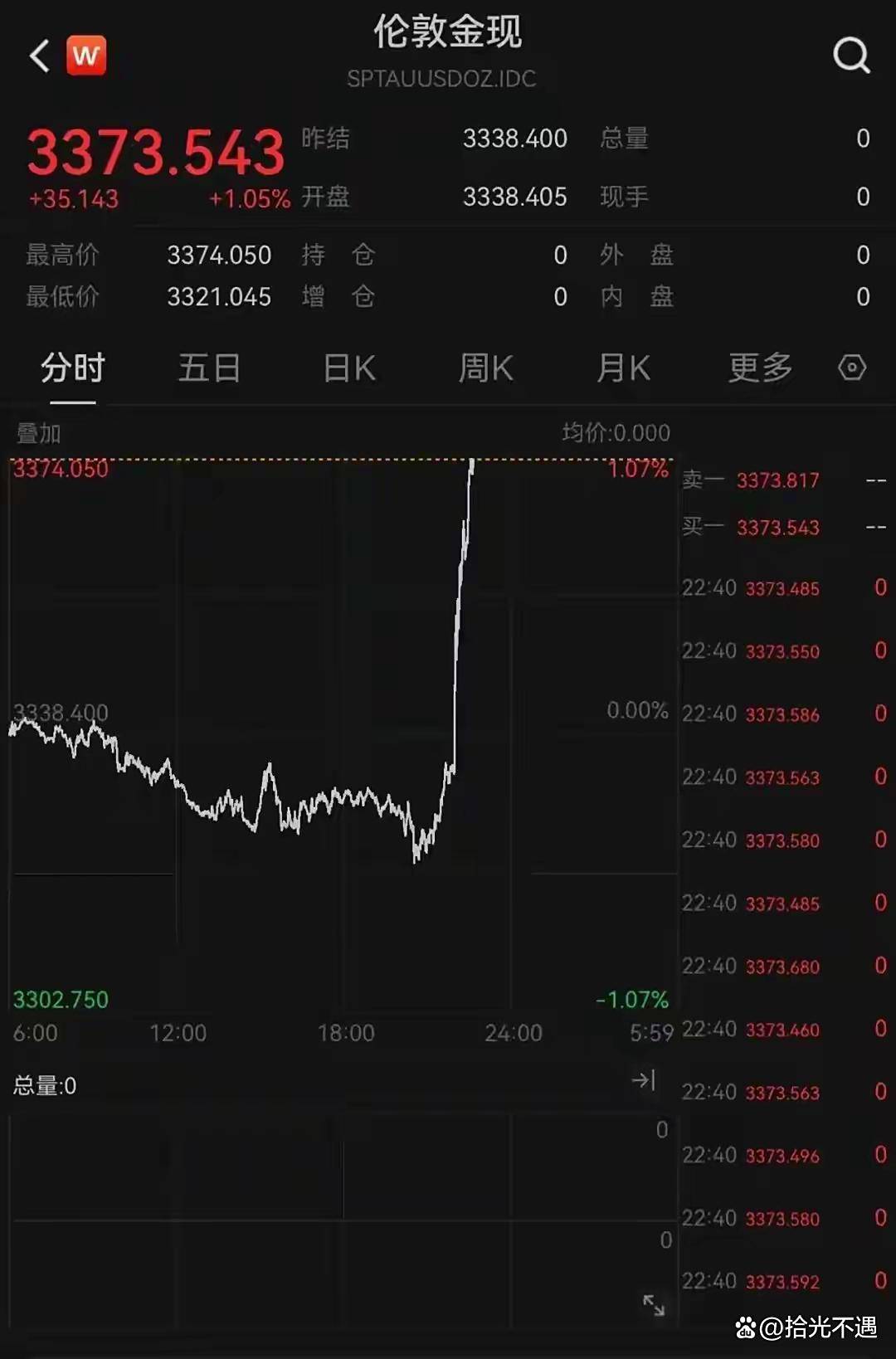
Market Performance - On August 22, the US stock market experienced a significant rally, with the Dow Jones Industrial Average soaring by 846 points, or 1.89%, reaching a historic high of 45631 points [2] - The Nasdaq and S&P 500 indices also saw gains of 1.88% and 1.52%, respectively, indicating a broad market uptrend [2] - Semiconductor stocks led the charge, with Intel rising over 5% and ON Semiconductor increasing by 6%, while the Philadelphia Semiconductor Index surged by 2.7% [2] Policy Impact - The rally was triggered by Federal Reserve Chairman Jerome Powell's dovish remarks at the Jackson Hole Global Central Bank Conference, which indicated a reassessment of policy due to rising employment risks [2][8] - Market expectations for a 25 basis point rate cut in September jumped from 75% to 89% following Powell's comments, fueling enthusiasm in technology stocks [2] Chinese Market Response - Chinese stocks also rebounded, with the Nasdaq Golden Dragon China Index rising by 2.1%, driven by strong earnings reports from companies like Miniso and NIO [5] - Miniso's stock surged by 15% after reporting a net profit that exceeded expectations by 14%, while NIO's stock rose nearly 14% following the launch of its new ES8 model [5] Gold Market Dynamics - Gold prices surged, with COMEX gold futures rising by 1.05% to $3417 per ounce, and London spot gold breaking through $3370, marking a three-month high [6] - This increase was attributed to multiple factors, including a significant drop in the US dollar index and heightened market concerns over stagflation [6] Global Central Bank Strategies - The core of the market rally is linked to the strategic maneuvers of global central banks, particularly the Federal Reserve's balancing act between inflation and employment risks [8] - China's central bank has also indicated a commitment to maintaining a supportive monetary policy, with expectations of potential rate cuts in the fourth quarter [8] Future Outlook - The market is currently in a sensitive phase driven by policy changes, with the Dow Jones index showing signs of being overbought, which may lead to short-term volatility [10] - Despite potential short-term corrections, the long-term outlook remains positive due to ongoing expectations of rate cuts from the Federal Reserve and the Chinese central bank [10]


2025年最新世界500强公布,美国独占138家,日本跌至38家,中国呢
Sou Hu Cai Jing· 2025-08-23 05:37
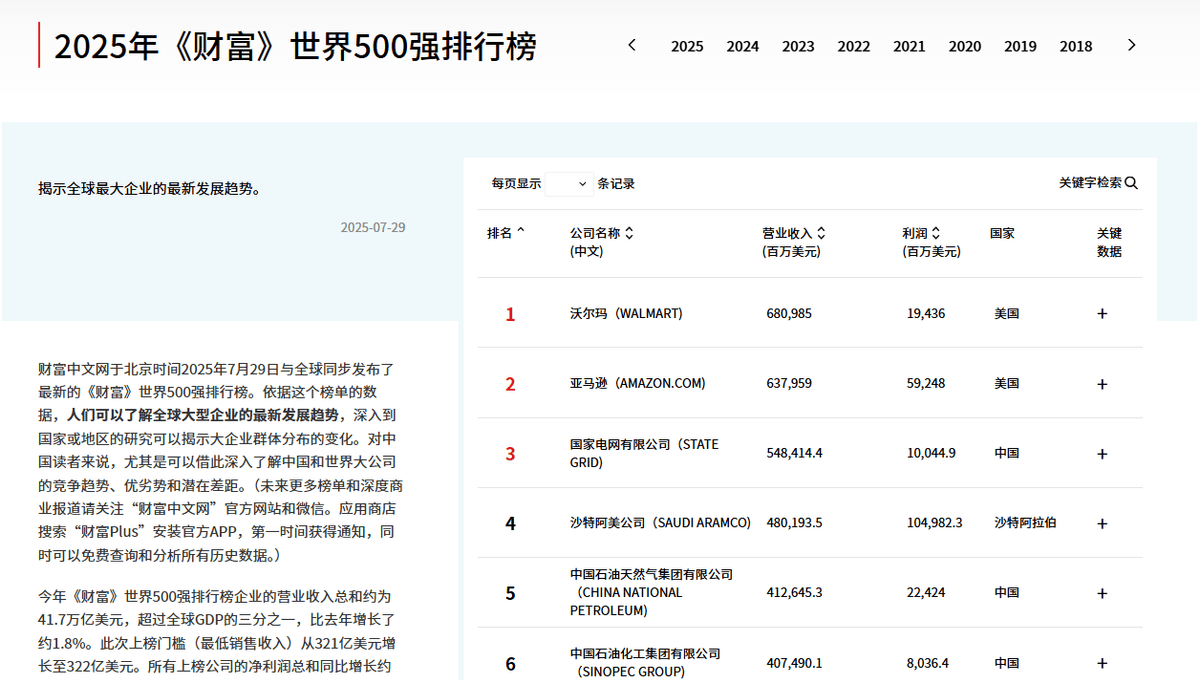
Group 1 - The latest Fortune Global 500 list reveals the economic strength of various countries, with a total revenue of approximately $41.7 trillion, accounting for over one-third of global GDP, and a year-on-year growth of about 1.8% [2][11] - Walmart leads the list with revenues of $680.985 billion and profits of $19.436 billion, followed by Amazon with $637.959 billion in revenue and $59.248 billion in profit [2] - The threshold for inclusion in the list increased from $32.1 billion to $32.2 billion in sales revenue [2] Group 2 - American companies dominate the list, accounting for 44% of the total, with an average sales figure of $121.7 billion and net profits of $31 billion, reflecting a year-on-year increase of 19% and 31% respectively [8][11] - In contrast, Chinese companies, totaling 130, generated $10.7 trillion in revenue but had an average net profit of only $4.2 billion, less than half of their American counterparts [11][18] - Japanese companies have seen a significant decline, dropping from 149 to 38 on the list, with an average net profit of only $3.13 billion, highlighting a stagnation in their business models [20][22] Group 3 - High-tech companies are showing strong performance, with 34 global high-tech firms averaging $96.7 billion in revenue and $18.1 billion in net profit, marking increases of 9.6% and 24% year-on-year [5][11] - Notable examples include Nvidia, which boasts a 55% net profit margin, and other tech giants like Microsoft and Google, which have established significant revenue streams through advanced technologies [8][10] - The rise of companies like BYD and Chery illustrates China's shift from scale to efficiency, with BYD surpassing Tesla and Chery achieving significant export growth [13][14][15] Group 4 - Pinduoduo's revenue reached $54.736 billion with a profit of $15.626 billion, showcasing a remarkable efficiency in its operations, particularly in agricultural product sales [17] - The contrasting business models of the U.S., China, and Japan highlight different paths to economic success, with the U.S. focusing on technology, China on efficiency, and Japan struggling with outdated practices [24]



10类产品将“一码溯源” 覆盖拼多多、京东等10家电商平台
Yang Shi Xin Wen· 2025-08-22 15:19
Core Viewpoint - The State Administration for Market Regulation has launched a pilot program for quality safety coding verification of key online products, aiming to enhance consumer trust and product traceability through a "one code traceability" mechanism [1]. Group 1: Pilot Program Details - The pilot program, referred to as "Code Action," will implement a full-chain regulation system using digital technology, allowing consumers to scan codes to access product images, manufacturer names, standards, and inspection reports [1]. - The program will cover ten categories of products closely related to consumer safety, including safety helmets, electric bicycles, and gas stoves [1]. Group 2: E-commerce Platform Involvement - Ten major e-commerce platforms, including Taobao, Kuaishou, Pinduoduo, Douyin, JD.com, Suning, Xiaohongshu, Dewu, Vipshop, and Tencent, will participate in the pilot [1]. - E-commerce platforms are required to strictly verify the coding information of products and promote dynamic code verification [1]. Group 3: Responsibilities and Oversight - Manufacturers must assign codes from the source to ensure the authenticity and completeness of information [1]. - Local market regulation departments will enhance supervision, conduct random checks, and enforce recalls for defective products, taking legal action against violations [1].
美股异动 | 热门中概股集体冲高 名创优品(MNSO.US)大涨12%
Zhi Tong Cai Jing· 2025-08-22 13:52
智通财经APP获悉,周五,热门中概股集体冲高,名创优品(MNSO.US)大涨12%,蔚来(NIO.US)涨逾 7%,金山云(KC.US)涨逾5%,拼多多(PDD.US)、阿里巴巴(BABA.US)涨逾3%,小鹏汽车(XPEV.US)涨 逾2%。 ...

拼多多上涨4.56%,报128.57美元/股,总市值1825.24亿美元
Jin Rong Jie· 2025-08-22 13:52
Core Viewpoint - Pinduoduo (PDD) has shown a significant increase in stock price and is set to release its mid-year financial report for FY2025, highlighting both revenue growth and a decline in net profit [1][2]. Financial Performance - As of March 31, 2025, Pinduoduo reported total revenue of 95.672 billion RMB, representing a year-on-year growth of 10.21% [1]. - The company's net profit attributable to shareholders was 14.742 billion RMB, which reflects a year-on-year decrease of 47.35% [1]. Upcoming Events - Pinduoduo is scheduled to disclose its FY2025 mid-year report on August 25, 2023, before the market opens in the Eastern Time Zone [2]. Company Background - Pinduoduo was established on April 20, 2015, in the Cayman Islands and operates through its domestic company, Shanghai Xunmeng Information Technology Co., Ltd., which was founded in 2014 [2]. - The company focuses on a unique social group-buying model, emphasizing large subsidies, agricultural product promotion, and high-quality goods from production areas [2]. - Pinduoduo's operational philosophy is centered around providing consumers with affordable, high-quality products, including heavily subsidized brand-name goods and original agricultural products [2].
10类产品将推行“一码溯源” 覆盖拼多多、京东等10家电商平台
Yang Shi Xin Wen Ke Hu Duan· 2025-08-22 13:48
Core Viewpoint - The State Administration for Market Regulation has launched a pilot program for quality safety coding verification of key online products, aiming to enhance consumer trust and product safety through a traceability mechanism [1]. Group 1: Pilot Program Details - The pilot program, referred to as "Code Action," will implement a traceability mechanism for ten categories of products closely related to consumer safety, including safety helmets, electric bicycles, and gas stoves [1]. - The initiative utilizes digital technology to ensure full-chain regulation from production coding, platform verification, to consumer usage [1]. Group 2: Consumer Benefits - Consumers will be able to scan codes to access real product images, manufacturer names, standards, and inspection reports, promoting informed and safe consumption [1]. Group 3: E-commerce Platform Involvement - The pilot will cover ten major e-commerce platforms, including Taobao, Kuaishou, Pinduoduo, Douyin, JD.com, Suning, Xiaohongshu, Dewu, Vipshop, and Tencent [1]. - E-commerce platforms are required to strictly verify the coding information of products and promote dynamic verification [1]. Group 4: Regulatory Oversight - Local market regulatory authorities will enhance supervision, conduct random checks, and enforce recalls for defective products, ensuring compliance with the new coding system [1]. - Major e-commerce platforms are currently working on technical integration and merchant mobilization for the rollout of coded products [1].
网售重点产品质量安全赋码核验试点工作正式启动
Zheng Quan Shi Bao Wang· 2025-08-22 13:38
Core Viewpoint - The "Code Verification Initiative for Quality Safety of Online Products" has officially launched, marking the start of a pilot program for quality safety verification of key online products [1] Group 1: Event Details - The initiative was held on August 22 in Beijing, with key officials from the State Administration for Market Regulation and the National Standardization Administration present [1] - The event was hosted by Liu Min, the Chief Engineer of the National Standardization Administration [1] Group 2: Participating Platforms - Ten major platforms including Taobao, Kuaishou, Pinduoduo, Douyin, JD.com, Suning, Xiaohongshu, Dewu, Vipshop, and Tencent have jointly issued a commitment to fulfill their responsibilities in code verification [1] - These platforms aim to ensure rigorous product entry audits to create a safe and trustworthy online shopping environment [1]
美股前瞻 | 三大股指期货齐涨 鲍威尔讲话重磅来袭
智通财经网· 2025-08-22 11:22
Market Movements - US stock index futures are all up, with Dow futures rising by 0.33%, S&P 500 futures by 0.28%, and Nasdaq futures by 0.22% [1] - European indices also show positive movement, with Germany's DAX up 0.08%, UK's FTSE 100 up 0.05%, France's CAC40 up 0.25%, and the Euro Stoxx 50 up 0.30% [2][3] - WTI crude oil increased by 0.31% to $63.72 per barrel, while Brent crude oil rose by 0.19% to $67.80 per barrel [4] Federal Reserve Insights - Market is focused on Jerome Powell's upcoming speech at the Jackson Hole Economic Symposium, which is anticipated to be a pivotal moment for future Fed monetary policy [5] - According to CME FedWatch, traders are betting on a 73.5% probability of a 25 basis point rate cut at the Fed's September meeting, with at least one more cut expected this year [5] - Analysts warn that if Powell does not confirm or suggest a rate cut, it could lead to significant repricing of bond yields and risk assets [5] Company Performance - Goldman Sachs predicts Powell will not explicitly signal a rate cut in his speech, while Yardeni Research estimates the probability of a September cut at only 40% [6] - HSBC suggests that despite tariffs impacting US corporate profit margins, the rapid adoption of AI could help reduce operational costs by 1%, potentially offsetting 25% of the cost increase from tariffs [6] - UBS indicates that the effective tariff rate in the US has exceeded 18%, with expectations of a stabilization around 15% by mid-2026, suggesting that companies are beginning to pass on tariff costs to consumers [6] Individual Company News - Gold Fields (GFI.US) reported a net profit of $1.02 billion for the first half of the year, doubling from $389 million year-over-year, and announced an interim dividend of 7 Rand ($0.3948) per share [8] - Zoom (ZM.US) achieved its strongest growth in 11 quarters, with enterprise sales up 7% to $730.7 million, exceeding analyst expectations [9] - Ross Stores (ROST.US) reported sales of $5.53 billion for the quarter, a 2% increase year-over-year, and adjusted EPS of $1.56, surpassing market expectations [9] - Chinese stocks are mostly up in pre-market trading, with notable gains for Miniso (MNSO.US) up over 8%, NIO (NIO.US) up over 5%, and Pinduoduo (PDD.US) up over 4% [10]