Rio Tinto(RIO)

Search documents
Rio Tinto (RIO): Valuation Full As Merger Noise With Glencore Clouds The Standalone Case
Seeking Alpha· 2026-01-12 05:43
Core Viewpoint - The recent downgrade of Glencore to Neutral prompts a reevaluation of Rio Tinto, highlighting the increasing correlation between the two companies [1]. Group 1: Company Analysis - Glencore has been downgraded to a Neutral rating, indicating a shift in investment sentiment [1]. - The relationship between Glencore and Rio Tinto is emphasized, suggesting that developments in one may impact the other [1]. Group 2: Market Context - The analysis reflects a broader trend among buy-side hedge professionals who are focusing on fundamental, income-oriented, long-term analysis across various sectors in developed markets [1].



综合晨报:美方对伊朗相关应对方案的商讨已启动-20260112
Dong Zheng Qi Huo· 2026-01-12 00:12
Report Industry Investment Ratings No relevant content provided. Core Views of the Report - The US non - farm payrolls in December increased by 50,000, falling short of expectations, but the labor market maintained resilience. The market's risk appetite remained high, and there is a high probability of a pause in interest rate cuts in January [1]. - The Shanghai Composite Index reached 4,100 points, hitting a 10 - year high. Despite regulatory intentions to cool the market, the stock market showed strong momentum, and there is still upward momentum in the short term [2]. - Gold prices fluctuated and closed higher on Friday. The US non - farm payroll data in December was mixed, and the market's expectations for the Fed's interest rate cuts changed little. Geopolitical risks are favorable for precious metals, but the adjustment of the Bloomberg commodity index is not yet over [3]. - Indian sugar mills have signed contracts to export about 180,000 tons of sugar this season. Due to domestic price adjustments and the weakening of the rupee, the actual total export volume is expected to be difficult to reach the official quota [4]. - After the potential merger of Rio Tinto and Glencore, they will dominate the global copper supply. The macro - optimistic sentiment has returned, pushing up copper prices, but the short - term fundamentals are relatively weak, which may limit the increase [5]. - The number of US oil rigs has decreased, and oil prices have maintained a rebound trend. Concerns about Iranian supply have led to an increase in risk premiums [6]. Summary by Directory 1. Financial News and Comments 1.1 Macro Strategy (Gold) - The US is discussing response plans for Iran. Trump will hear a report on Iran - related response plans on Tuesday [11]. - The US added 50,000 non - farm jobs in December 2025, lower than the expected 65,000. The unemployment rate was 4.4%, and hourly wages rose. The gold price was strong on Friday. The non - farm data was mixed, and the market's expectations for Fed rate cuts changed little. Geopolitical risks made precious metals stronger, and short - term market volatility increased [12]. - Investment advice: Pay attention to the callback risk of precious metals in the short term [13]. 1.2 Macro Strategy (Foreign Exchange Futures - US Dollar Index) - Trump threatened Cuba to reach an agreement with the US quickly [14]. - Trump is considering multiple options to interfere in Iran, including sending a carrier strike group and launching cyber and information warfare [15]. - The non - farm data in December 2025 was below expectations. The market risk appetite rebounded, and the US dollar continued to fluctuate. The labor market situation is conducive to the rise of market risk appetite, and the US dollar will maintain a short - term oscillatory trend [17]. - Investment advice: The US dollar will oscillate in the short term [19]. 1.3 Macro Strategy (US Stock Index Futures) - Trump is considering multiple options to interfere in Iran [20]. - The US consumer confidence index in January reached a four - month high, and inflation expectations were relatively stable [21]. - The US added only 50,000 non - farm jobs in December, lower than expected. Although geopolitical risks are rising, they have not affected the risk appetite of the US stock market. The economic data is mixed, and the expectation of interest rate cuts remains restrained. It is expected that the US stock market will still operate in a volatile and slightly stronger manner, but market volatility will increase [22]. - Investment advice: Expect the US stock market to experience increased volatility but maintain a bullish view [23]. 1.4 Macro Strategy (Stock Index Futures) - The Shanghai Composite Index reached 4,100 points, hitting a 10 - year high. The A - share market had heavy trading volume on Friday [24]. - The State Council deployed fiscal and financial policies to promote domestic demand. Although there are regulatory intentions to cool the market, the stock market is strong, and there is still upward momentum in the short term. Whether the regulatory authorities will introduce more powerful cooling measures is an important indicator [25]. - Investment advice: The long - holding strategy for stock indices is still dominant, and each index should be evenly allocated [26]. 1.5 Macro Strategy (Treasury Bond Futures) - The central bank conducted 34 billion yuan of 7 - day reverse repurchase operations on January 9, with a net investment of 34 billion yuan [27]. - The inflation data in December slightly exceeded market expectations. Domestic policies are actively addressing the supply - demand gap, and inflation is expected to rise. In an environment of rising inflation, the bond market is generally weak. It is not advisable to chase the high price, and short - selling hedging strategies can be considered [29]. - Investment advice: Be cautious when chasing the high price; consider short - selling opportunities during rebounds [30]. 2. Commodity News and Comments 2.1 Black Metal (Steam Coal) - The price of low - calorie steam coal in Indonesia remained stable on January 9. The Indonesian government plans to cut coal production by about 17.2% in 2026. The supply tightening expectation makes miners reluctant to lower prices. However, the daily consumption is not good, and it is expected that the coal price will remain in a low - level oscillatory state in January [31]. - Investment advice: The coal price is expected to maintain a low - level oscillatory state in January, and a continuous rebound is unlikely [32]. 2.2 Black Metal (Iron Ore) - Rio Tinto and Glencore are in preliminary discussions about a potential merger [33]. - In January, the downstream steel mills' demand for raw material replenishment has increased. It is expected that the molten iron output will increase by 10,000 - 20,000 tons per week in the next two weeks [33]. - Investment advice: The raw materials are expected to remain in a relatively strong oscillatory state before the Spring Festival. Pay attention to policy changes. The inventory of finished products is at a moderate level, which restricts the upward space [34]. 2.3 Black Metal (Rebar/Hot - Rolled Coil) - The average daily molten iron output of 247 steel mills has rebounded to 2.295 million tons. The blast furnace operating rate and capacity utilization rate have increased, while the profit rate has decreased [35]. - In 2025, China's new ship orders were 1,421, and the sales volume of excavators was 235,300. After the New Year's Day, the five major varieties of steel products began to accumulate inventory. The demand for rebar has decreased seasonally, and the demand for hot - rolled coils has remained resilient, but the inventory pressure is relatively high. The steel price trend is not clear in the short term [38]. - Investment advice: Adopt an oscillatory approach to steel prices in the short term [39]. 2.4 Agricultural Products (Sugar) - Thailand's sugar production in the 2025/26 season is expected to reach 10.3 million tons and may decrease to 10 million tons next year. As of January 7, Thailand's sugar production was 1.5309 million tons, a year - on - year decrease [40]. - Indian sugar mills have signed contracts to export about 180,000 tons of sugar this season. Due to price and exchange - rate factors, some sugar mills are exporting at a loss. It is expected that India's actual sugar export volume will be difficult to reach the official quota. The upside of the external market is limited [42]. - Investment advice: In Guangxi, the sugar - pressing season is in full swing, and the new sugar supply is increasing. The upside of the futures market is limited. Pay attention to the actual stocking demand before the Spring Festival [43]. 2.5 Agricultural Products (Cotton) - Vietnam's textile and clothing exports increased by 5.6% in 2025, but slightly missed the target [44]. - As of January 8, the national cotton processing rate was 94.5%, and the sales rate was 55.6%. The US cotton export signing rate is still lagging. It is expected that the external market will remain in a low - level oscillatory state in the short term [45]. - Investment advice: Xinjiang's cotton - ginning factories are reluctant to sell at low prices. The downstream textile enterprises' demand for raw materials provides support for cotton prices, but the subsequent restocking demand is not strong. It is expected that Zhengzhou cotton will oscillate before the Spring Festival, with limited downside. The long - term outlook remains bullish [47]. 2.6 Agricultural Products (Soybean Oil/Rapeseed Oil/Palm Oil) - In the second week of 2026, the actual soybean crushing volume of domestic oil mills was 1.7658 million tons, and the estimated crushing volume in the third week is 2.082 million tons [48]. - The oil market continued to oscillate, and palm oil rebounded slightly. The market is waiting for the MPOB report. The situation of the China - Canada talks is uncertain [48]. - Investment advice: The palm oil price is expected to continue an oscillatory and slightly stronger trend. Pay attention to the January high - frequency data and Indonesia's palm oil export tax increase news [49]. 2.7 Agricultural Products (Soybean Meal) - In the second week of 2026, the actual soybean crushing volume of domestic oil mills was 1.7658 million tons, and the estimated crushing volume in the third week is 2.082 million tons. An auction of 1.1396 million tons of imported soybeans will be held on January 13 [50]. - The soybean meal futures price rose first and then fell. Pay attention to the USDA monthly supply - demand report and quarterly inventory report on January 12 [51]. - Investment advice: Continue to pay attention to the state reserve and customs policies. The supply - demand situation does not support a significant increase in the May contract of soybean meal unless there is a major abnormal reduction in South American production [51]. 2.8 Non - ferrous Metals (Copper) - Rio Tinto and Glencore are in preliminary discussions about a potential merger, which may create a diversified mining giant and dominate the global copper supply. Recent copper prices have soared due to supply shortages [53]. - Chile's national copper production in November decreased by 3%. The production of some major mines also changed. The macro - optimistic sentiment is pushing up copper prices, but the short - term fundamentals are relatively weak, which may limit the increase [54]. - Investment advice: From a unilateral perspective, continue to recommend buying on dips. From an arbitrage perspective, it is advisable to wait and see [56]. 2.9 Non - ferrous Metals (Polysilicon) - The export tax rebate policy for photovoltaic and other products will be adjusted. It is expected that there will be a wave of rush - to - export in Q1 2026, but it is negative for demand in the whole year. The price of polysilicon may oscillate between 50,000 - 55,000 yuan/ton in the short term [57]. - Investment advice: During the rush - to - export period, the polysilicon price may remain stable if the alliance exists. After the rush - to - export, the price may face pressure again [58]. 2.10 Non - ferrous Metals (Industrial Silicon) - The national photovoltaic power generation utilization rate in November 2025 was 93.7%. The supply and demand of industrial silicon need to pay attention to the demand side. The supply and demand are in a tight balance in January - February, and there may be significant inventory accumulation after March [59]. - Investment advice: The short - term supply - demand contradiction of industrial silicon is not significant. It is expected to oscillate between 8,000 - 9,200 yuan/ton. Pay attention to range - trading opportunities [60]. 2.11 Non - ferrous Metals (Lithium Carbonate) - The export tax rebate policy for battery products will be adjusted. It is expected to lead to a short - term rush - to - export, which is beneficial to lithium carbonate. The lithium salt price is expected to continue to rise. The inventory is accumulating in the off - season, but the demand is not weak [61]. - Investment advice: Hold the previous long positions, and be cautious when opening new long positions [62]. 2.12 Non - ferrous Metals (Nickel) - Lunnon Metals has obtained the final approval for the Lady Herial gold - nickel open - pit mine. The futures market shows increased competition between industrial and speculative funds. The export tax rebate policy adjustment is beneficial to short - term nickel consumption. The overall price is likely to rise, and there may be a structural shortage of intermediates [63]. - Investment advice: Consider buying on dips. Continue to hold the positions of selling out - of - the - money put options and buying deep - out - of - the - money call options. Be cautious when chasing the high price, and closely monitor the quota release [64]. 2.13 Non - ferrous Metals (Lead) - On January 8, the LME0 - 3 lead was at a discount of $43.39/ton. The primary lead smelting operation was oscillating, and the secondary lead refinery's inventory reached a high level. The demand is weak, and the social inventory is expected to rise. There is a risk of short - term price increase due to low inventory [66]. - Investment advice: Wait for opportunities to short on rallies. It is advisable to wait and see for arbitrage [67]. 2.14 Non - ferrous Metals (Zinc) - On January 8, the LME0 - 3 zinc was at a discount of $42.57/ton. The Venezuela event may expand, and the zinc concentrate TC is expected to remain weak. The zinc demand is weak, and the social inventory is expected to rise. The zinc price is expected to maintain a high - level oscillation [68]. - Investment advice: Consider buying on dips in the short term. Wait and see for the month - spread arbitrage. The internal - external positive arbitrage has a good risk - return ratio, but it depends on the inflow of bonded - area inventory [69]. 2.15 Non - ferrous Metals (Tin) - In 2025, Shanghai's sales volume of trade - in goods exceeded 121.2 billion yuan. The market supervision department will accelerate the formulation of relevant national standards. The global tin inventory decreased last week, and the supply is uncertain. The demand is weak, and the high price suppresses consumption [70]. - Investment advice: It is expected that the tin price will continue to oscillate strongly. Pay attention to the December customs data and the recovery of the consumption side [74]. 2.16 Energy Chemical (Carbon Emissions) - On January 9, the closing price of the EUA main contract was 89.56 euros/ton, up 1.55% from the previous day. The EU carbon price continued to oscillate last week. There are both positive and negative factors in the market, and the short - term sentiment is still cautious [75]. - Investment advice: The EU carbon price will oscillate strongly in the short term [76]. 2.17 Energy Chemical (Crude Oil) - The number of US oil rigs decreased to 409 as of January 9. Oil prices rose in the second half of last week. The market is not overly worried about Venezuela's supply disruption, but concerns about Iran's supply have increased. Geopolitical risks may lead to a short - term increase in risk premiums, but the high export volume and potential inventory accumulation may suppress oil prices [77]. - Investment advice: Pay attention to the impact of geopolitical conflicts on the risk premium of oil prices in the short term [78].

铜争夺加剧,矿业“巨无霸”或诞生?
Huan Qiu Shi Bao· 2026-01-11 22:46
"未来全球铜需求将出现结构性跃升",标普最新报告预测,到2040年,全球铜需求量可能增长50%。而 按照目前的趋势,全球铜产量将在2030年达到峰值,之后即使需求持续增长,产量也会再次下降。许多 铜矿正在老化,生产效率下降,而寻找和新建矿山可能需要数年时间和巨额投资。标普指出,如果铜供 应未能实现"有意义的扩张",到2040年,全球铜供应的缺口预计将扩大到1000万吨。 铜是清洁能源和科技产业所需的关键金属,也是业界公认的成本效率最高的导电金属材料。过去一年, 受部分矿山停产及美国政府可能对铜征收关税所造成的不确定性影响,国际铜价持续走高。高盛分析师 在报告中表示:"由于市场预期美国将对铜征收关税,导致铜被吸引至美国国内,在除美国以外地区库 存较低的情况下,投机资本的涌入进一步推高了铜的稀缺性溢价。"目前,铜价已从4月份每吨8000美元 飙升至超过1.3万美元,创下历史最高纪录。瑞士摩科瑞能源集团金属业务主管科斯塔斯·宾塔斯警告 称,美国的进口激增将加剧世界其他地区铜供应短缺。 而随着各国竞逐人工智能发展的领先优势,获得铜资源对于人工智能的蓬勃发展和数据中心的建设至关 重要。标普补充道,铜供应短缺将对全球产业 ...
力拓与嘉能可合并后将主导全球铜供应
Wen Hua Cai Jing· 2026-01-10 11:43
Core Viewpoint - Rio Tinto and Glencore are in preliminary talks for a potential mega-merger, aiming to create a diversified mining giant amid rising demand for key minerals [2] Group 1: Company Overview - Rio Tinto confirmed the possibility of merging part or all of its business with Glencore, with a deadline to submit a formal offer by February 5 [2] - Rio Tinto is a major iron ore producer, expected to produce 298.1 million tons in 2024, accounting for 12% of global supply [3] - Rio Tinto ranks seventh in global copper production with an output of 649,720 tons in 2024 [4] - Glencore is the fourth-largest copper producer, with an estimated production of around 1 million tons in 2024 [6] - Glencore is also a significant producer of cobalt, ranking second globally with a production of 32,712 tons in 2024 [7] Group 2: Market Position and Synergies - The merger would position the combined entity as a leader in the global copper market, with a total copper output of approximately 1.7 million tons in 2024, surpassing BHP and Codelco [9] - Rio Tinto holds a 30% stake in the Escondida mine, the largest copper mine globally, which is expected to produce 5.5% of the world's copper in 2024 [9] - Glencore owns 44% of the Collahuasi mine, the third-largest copper mine in 2024 [9] Group 3: Copper Market Outlook - The potential merger coincides with a growing global demand for copper, projected to reach a supply gap of 10 million tons by 2040, with demand increasing by 50% to 42 million tons [10] - The copper market is experiencing tight conditions, as indicated by the recent surge in copper prices, with LME copper reaching a high of $13,240.98 per ton on January 6 [12]

美SEC撤销针对力拓前首席财务官的煤炭资产案民事诉讼
Xin Lang Cai Jing· 2026-01-09 23:21
来源:环球市场播报 美国证券交易委员会(SEC)表示,已永久性撤销其针对力拓(Rio Tinto)前首席财务官盖伊·埃利奥特(Guy Elliott)的民事诉讼,该诉讼涉及夸大煤炭资产价值。该监管机构在2017年指控这家矿业公司以及埃利奥 特和前首席执行官托马斯·阿尔巴尼斯(Thomas Albanese)欺诈,称其夸大了煤炭资产的价值,力拓以37 亿美元收购了这些资产,几年后以5,000万美元的价格将其出售。SEC称,力拓和上述两名高管未能遵 守会计准则以准确评估其资产价值。SEC表示,他们还试图隐瞒或推迟披露这些资产存在的问题。2023 年,力拓在既不承认也不否认相关指控的情况下,同意了SEC的一项最终判决。该最终判决责令该公司 支付2,800万美元的民事罚款,并要求其聘请一名顾问来审查其对会计准则的遵守情况。阿尔巴尼斯同 意支付5万美元的罚款,而针对埃利奥特的诉讼在2023年的判决后仍在继续。 ...
1月10日隔夜要闻:美股收高 金价上涨 英特尔涨超10% 特朗普泄露就业数据 委称与美启动探索性外交
Xin Lang Cai Jing· 2026-01-09 22:32
Company - Nvidia is recruiting executives from Google Cloud to strengthen its position in the market [8] - Chevron could see an annual revenue increase of up to $700 million due to its operations in Venezuela [8] - Stellantis has canceled its sales plan for plug-in hybrid vehicles in the U.S. due to weak demand [8] - Glencore and Rio Tinto are in negotiations to potentially create the world's largest mining company [8] - xAI plans to invest $20 billion in building a data center in Mississippi [8] - Hyundai will fully deploy humanoid robots starting in 2028 [8] - Paramount reiterated its all-cash offer of $30 per share for WBD [8] - General Motors will account for $7.1 billion in expenses in the fourth quarter [8] - Johnson & Johnson is lowering drug prices in the U.S. in exchange for tariff reductions, but experts say savings for insured individuals will be limited [8] Industry - The U.S. added 584,000 jobs in 2025, marking the lowest growth rate in a non-recession period since 2003 [8] - U.S. household wealth has reached a record high, benefiting from the rise in the stock market [8] - The EU is expected to sign a historic trade agreement with South America despite opposition from France [8] - The WTI crude oil price has risen for the third consecutive week [9] - The U.S. debt market shows mixed results, with a flattening yield curve and mixed non-farm payroll data [9] - The dollar is rising alongside U.S. Treasury yields as traders reduce bets on Federal Reserve rate cuts [9]


Wall Street jostles to advise on Rio-Glencore, eyes $100 million prize
Reuters· 2026-01-09 18:01
Rio Tinto's ambition to acquire Glencore and create the world's largest mining company worth more than $200 billion could see Wall Street advisers share more than $100 million in fees. ...

Rio Tinto Continues to Ramp Up Copper Output: What's the Road Ahead?
ZACKS· 2026-01-09 17:10
Core Insights - Rio Tinto Group (RIO) is experiencing growth in copper production, with a 10% year-over-year increase in Q3 2025, driven by strong asset performance [1][8] Group 1: Production and Technology - The company produced its first copper from the Johnson Camp mine in Arizona in December 2025, utilizing Nuton Technology for cleaner and more efficient production [2][3] - The deployment at the Johnson Camp mine aims for approximately 30,000 tons of refined copper production over a four-year demonstration period, focusing on achieving the lowest carbon footprint in the U.S. [3] - Rio Tinto's total copper production for 2025 is projected to reach the higher end of its guidance, between 780,000 and 850,000 tons, supported by strong performance at the Oyu Tolgoi site and Kennecott mine [4][8] Group 2: Peer Comparison - Southern Copper Corporation (SCCO) has the largest copper reserves in the industry and targets a production of 958,800 tons for 2025, with significant contributions expected from its Pilares project [5] - BHP Group (BHP) reported record copper output of 2,017,000 tons for fiscal 2025, an 8% increase year-over-year, and anticipates production between 1,800,000 and 2,000,000 tons for fiscal 2026 [6] Group 3: Financial Performance and Valuation - Rio Tinto's shares have increased by 43.1% over the past year, slightly below the industry's growth of 44.8% [7] - The company is trading at a forward price-to-earnings ratio of 11.90X, which is below the industry's average of 17.20X, and holds a Value Score of B [10] - The Zacks Consensus Estimate for Rio Tinto's 2025 earnings has been rising over the past 60 days, indicating positive sentiment [11]

美股异动 | 与嘉能可重启合并谈判 力拓(RIO.US)开盘跌超4%
智通财经网· 2026-01-09 14:54
Core Viewpoint - Rio Tinto (RIO.US) is in talks to acquire Glencore, aiming to create the world's largest mining company with a combined market value exceeding $200 billion, marking a potential record deal in the industry [1] Group 1: Acquisition Details - The negotiations between Rio Tinto and Glencore have resumed after previously breaking down over a year ago [1] - Both companies have issued statements indicating discussions about merging part or all of their businesses, including a potential all-stock acquisition [1] Group 2: Strategic Implications - A successful agreement with Glencore would significantly increase Rio Tinto's copper production and provide access to the coveted Collahuasi copper mine in Chile, one of the richest deposits globally [1] - Despite Rio Tinto's substantial copper assets, it, along with larger competitor BHP, still relies heavily on iron ore for revenue, which faces uncertain demand as China's construction boom comes to an end [1]
一周热榜精选:非农关闭本月降息大门!特朗普中期选举前发力?
Jin Shi Shu Ju· 2026-01-09 14:11
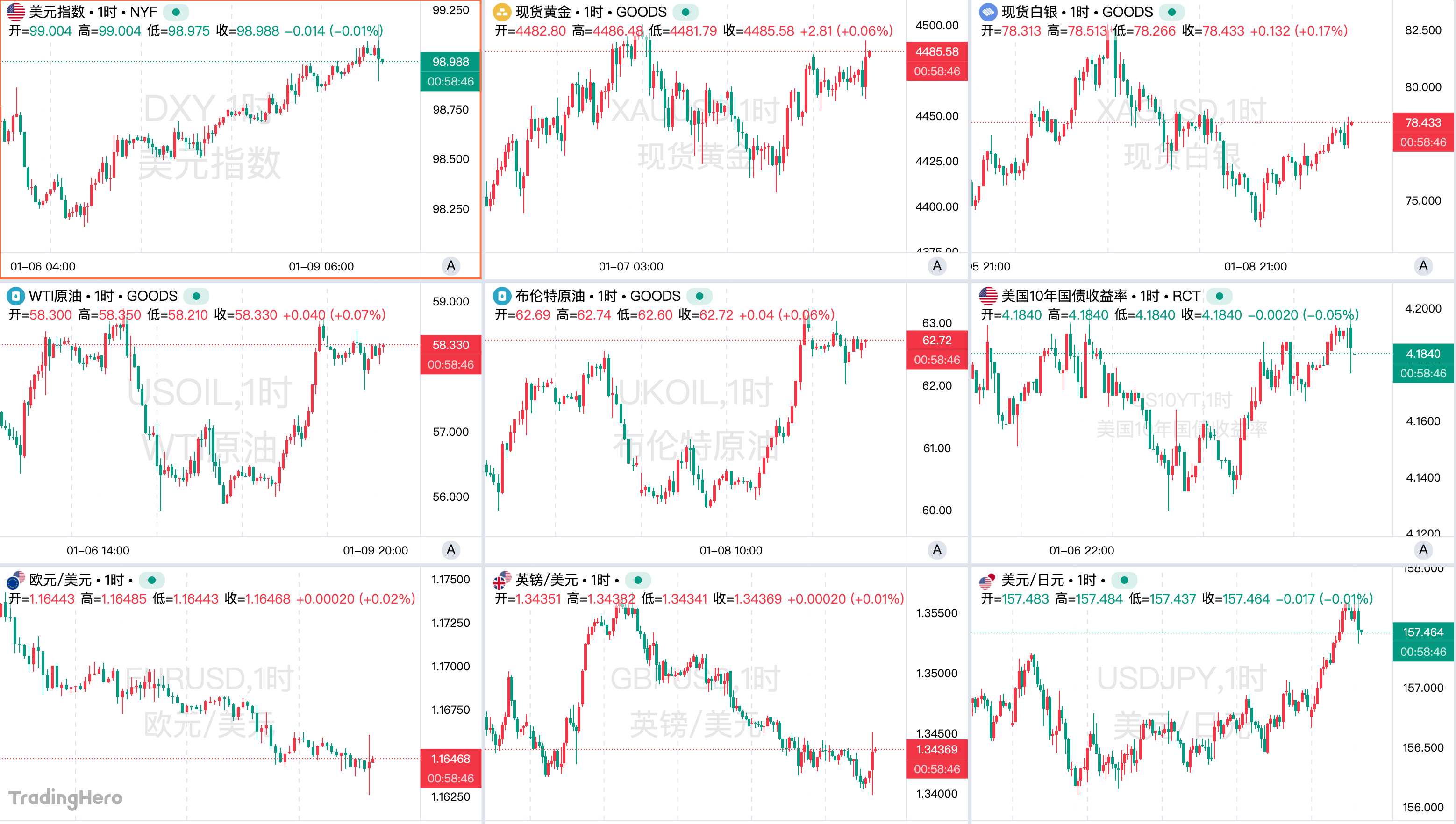
Group 1: Currency and Commodity Markets - The US dollar index has risen for four consecutive days, reaching a near one-month high above the 99 mark, supported by rising US Treasury yields and increased demand due to heightened risk aversion [1] - Gold prices experienced volatility, initially rising due to safe-haven demand from the Venezuela situation, peaking at $4500 per ounce before retreating, while silver showed even greater fluctuations [1] - The CME will raise margin requirements for gold, silver, platinum, and palladium futures on January 9, marking the third adjustment in a month, aimed at curbing speculation in the silver futures market [1] - Non-US currencies weakened overall, influenced by the stabilization of the dollar and market caution, with the euro and pound declining against the dollar for four consecutive days [1] Group 2: Oil Market Dynamics - International oil prices fluctuated significantly, initially rising due to uncertainty over supply from Venezuela, but later falling as Trump announced a deal with Venezuela, raising concerns over oversupply [2] - Oil prices rebounded on Thursday amid geopolitical crises raising supply disruption fears [2] Group 3: Investment Bank Predictions - Bank of America predicts the average gold price will reach $4538 per ounce by 2026, while silver could soar to between $135 and $309 per ounce [5] - Citigroup expects copper prices to potentially exceed $14,000 per ton in January [5] - Deutsche Bank suggests the energy sector may benefit the most from the BCOM index's annual rebalancing [5] Group 4: Economic Indicators and Employment Data - The US non-farm payroll report showed mixed results, with December adding 50,000 jobs, below the expected 60,000, while the unemployment rate fell to 4.4% [10] - The market perceives the drop in unemployment as closing the door on potential Fed rate cuts in January, with traders now pricing in a slower pace of rate reductions [11] Group 5: Commodity Index Rebalancing - The Bloomberg Commodity Index (BCOM) is undergoing annual rebalancing, with gold and silver facing significant sell-off pressures, estimated at $141 billion combined [13] - Gold's weight in the index will decrease from 20.4% to 14.9%, leading to a sell-off of approximately 2.4 million ounces of gold [13] Group 6: Geopolitical Events Impacting Markets - The situation in Venezuela has led to significant geopolitical tensions, with the US taking military action and controlling oil sales, which may impact global oil prices [6][7] - The ongoing protests in Iran, driven by economic hardships, have escalated, with significant implications for regional stability and potential international responses [18]