
Seek .(SKLTY)

Search documents
“雷军千万年薪要挖”的DeepSeek罗福莉官宣加入小米大模型团队
Sou Hu Cai Jing· 2025-11-12 07:43
Core Insights - Xiaomi is actively recruiting top talent in the large model field, specifically targeting key developers like Luo Fuli from DeepSeek, with compensation packages reaching tens of millions [1] - Luo Fuli has officially announced her joining of the Xiaomi MiMo large model team, expressing commitment to building a future towards AGI (Artificial General Intelligence) [1] - Xiaomi has previously launched its first open-source large model, Xiaomi MiMo, aimed at enhancing reasoning capabilities, marking a significant step in its AI development efforts [4] Company Developments - Luo Fuli's involvement in a joint paper with Peking University, published on arXiv in October, indicates her active role in the academic and research community [2] - The Xiaomi MiMo model is a product of the newly established "Xiaomi Large Model Core Team," showcasing the company's strategic focus on AI and large model development [4]



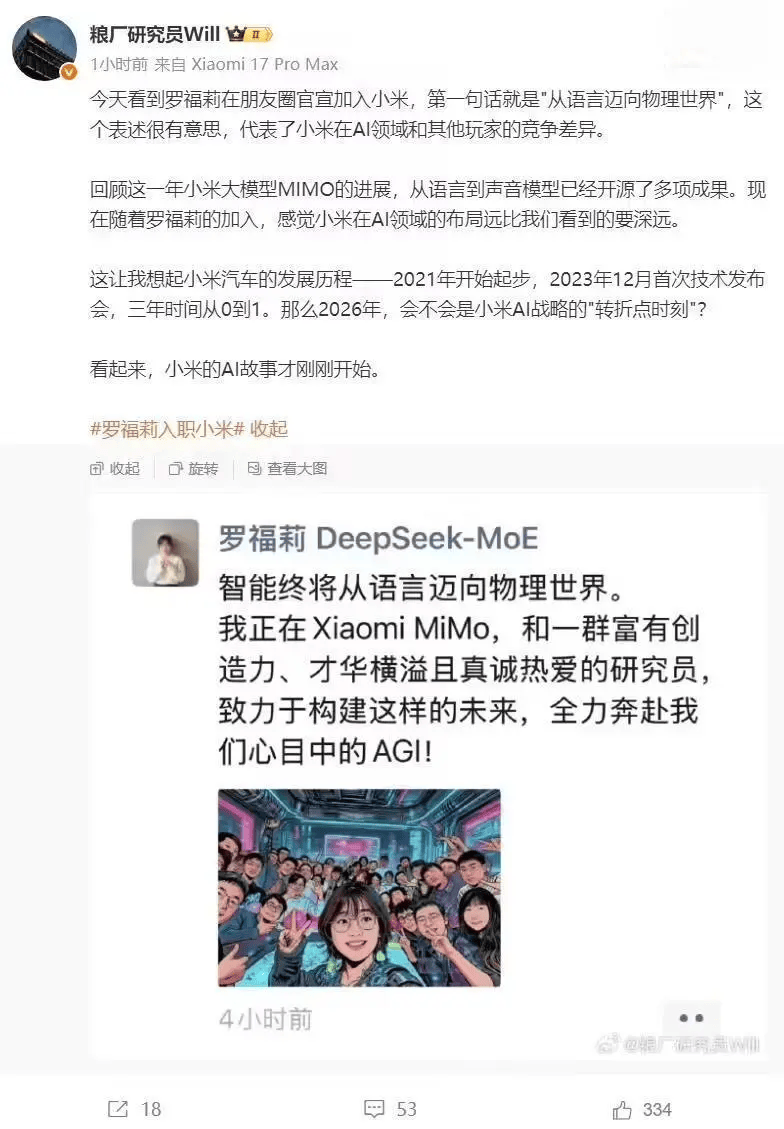
雷军“千万年薪”挖角传闻落地!前DeepSeek“天才少女”官宣加盟小米
Guan Cha Zhe Wang· 2025-11-12 07:32
Core Insights - The core point of the news is the confirmation of Luo Fuli's joining Xiaomi, which is seen as a significant move for Xiaomi's AI strategy, particularly in the development of large models and their application in various products [1][13]. Group 1: Luo Fuli's Background and Experience - Luo Fuli, born in 1995 in Yibin, Sichuan, has a strong academic background, having published eight papers at a top international AI conference during her master's studies [4][5]. - After graduating, she worked at Alibaba's DAMO Academy, where she developed the VECO multilingual pre-training model, gaining substantial experience in cross-lingual large models [5]. - She later joined DeepSeek, where she contributed to the development of the DeepSeek-V2 model, known for its cost-effectiveness and high performance in natural language processing [5][7]. Group 2: Xiaomi's AI Strategy - Xiaomi's AI ambitions are highlighted by the establishment of its AI Lab in 2016, which has evolved to focus on various AI technologies, including large models [13]. - The company has a unique approach to AI, emphasizing lightweight models and local deployment rather than competing in the large parameter model race [13][14]. - Xiaomi's recent AI model, Xiaomi MiMo, demonstrated superior performance with only 7 billion parameters, showcasing the company's commitment to a "small parameters, big energy" strategy [14]. Group 3: Implications of Luo Fuli's Joining - Luo Fuli's expertise in MoE architecture and natural language processing is expected to accelerate Xiaomi's efforts in large model development and application across its product ecosystem [1][13]. - Her involvement in the MiMo team aligns with Xiaomi's goal of enhancing AI capabilities in mobile devices and vehicles, contributing to the company's broader "human-vehicle-home" ecosystem strategy [14][17]. - The influx of top AI talent from emerging companies to established hardware giants like Xiaomi indicates a shift towards the practical application of AI models in real-world scenarios [17].

雷军“千万年薪”挖角传闻落地!前DeepSeek“天才少女”加盟小米
Guan Cha Zhe Wang· 2025-11-12 07:32
Core Insights - The core point of the news is the confirmation of Luo Fuli's joining Xiaomi, which is seen as a significant move for Xiaomi's AI strategy, particularly in the development of large models and their application in various end products [1][3][13]. Group 1: Luo Fuli's Background and Expertise - Luo Fuli, born in 1995 in Yibin, Sichuan, has a strong academic background, having published eight papers at a top international AI conference during her master's program [4][5]. - She previously worked at Alibaba's DAMO Academy, where she developed the VECO multilingual pre-training model, and later joined DeepSeek, contributing to the MoE (Mixture of Experts) model [5][6]. - Her experience in natural language processing and multi-modal understanding is expected to provide critical technical support for Xiaomi's AI initiatives [13][18]. Group 2: Xiaomi's AI Strategy - Xiaomi's AI Lab, established in 2016, has evolved to focus on a wide range of AI technologies, including visual, acoustic, and natural language processing [13]. - The company emphasizes a lightweight AI approach, contrasting with the prevailing trend of large parameter models, and aims to leverage pre-trained models for specific tasks [13][17]. - Xiaomi's recent developments include the Xiaomi MiMo model, which has demonstrated superior performance with fewer parameters compared to larger models from competitors [15][17]. Group 3: Future Implications - Luo Fuli's role in the MiMo team is expected to accelerate Xiaomi's efforts in AI, particularly in integrating AI into physical products like smartphones and vehicles [14][18]. - The recruitment of top AI talent from emerging companies to traditional hardware giants like Xiaomi indicates a shift towards the application phase of AI model development [17].
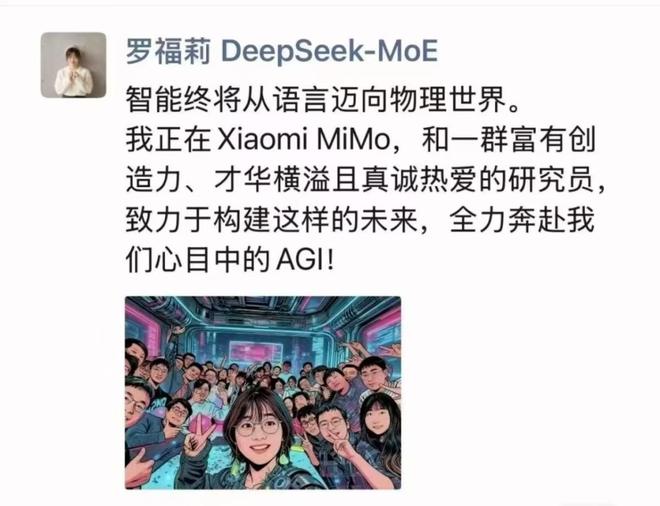
前DeepSeek研究员罗福莉已加入小米 此前传闻雷军曾以千万年薪招揽
Xin Lang Cai Jing· 2025-11-12 07:27
Core Insights - The article discusses the recent hiring of Luo Fuli, a key developer from DeepSeek, by Xiaomi to lead its AI large model team, indicating Xiaomi's commitment to advancing its capabilities in artificial intelligence [1][4]. Group 1: Company Developments - Luo Fuli announced her joining Xiaomi's MiMo team, which focuses on building a reasoning large model, marking her official entry into the company [1]. - Xiaomi is reportedly building a large GPU cluster to enhance its investment in AI large models, with an initial resource of 6,500 GPUs already in place [4]. - The hiring of Luo Fuli, rumored to be at a salary of tens of millions, reflects Xiaomi's strategic focus on AI hardware, with founder Lei Jun playing a significant leadership role in this initiative [4]. Group 2: Background of Luo Fuli - Luo Fuli holds a bachelor's degree in computer science from Beijing Normal University and a master's degree in computational linguistics from Peking University [5]. - Prior to joining Xiaomi, she worked at Alibaba's DAMO Academy and later at DeepSeek, where she contributed to the development of the DeepSeek-V2 model [5].
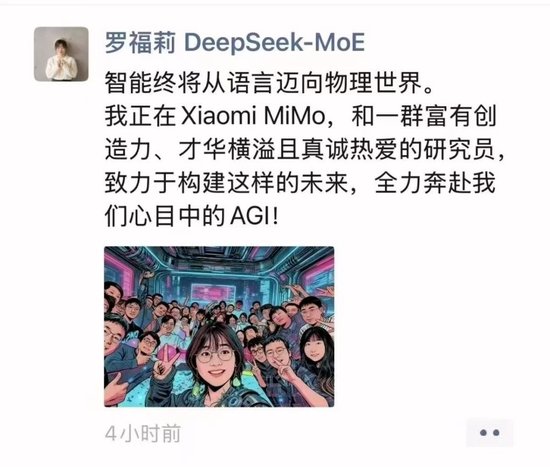
奔赴AGI!前DeepSeek研究员罗福莉官宣加入小米
2 1 Shi Ji Jing Ji Bao Dao· 2025-11-12 07:04
Core Insights - The article discusses the recent appointment of Luo Fuli, a former researcher at DeepSeek, to Xiaomi, where she will focus on advancing the MiMo large model research [2][5]. Group 1: Company Developments - Luo Fuli has joined Xiaomi to work on the MiMo project, which is Xiaomi's first inference large model [5]. - The appointment of Luo Fuli has generated significant public interest, with her previous work and expertise in AI being highlighted [5][6]. - Xiaomi's AI team recently collaborated with Peking University to publish a paper on MoE and reinforcement learning, which included Luo Fuli's name, further fueling speculation about her new role [5]. Group 2: Background of Luo Fuli - Luo Fuli holds a bachelor's degree in computer science from Beijing Normal University and a master's degree in computational linguistics from Peking University [6]. - She previously worked at Alibaba's DAMO Academy, where she was involved in developing the VECO multilingual pre-training model and the open-source AliceMind project [6]. - In 2022, she joined DeepSeek's parent company, Huansuan Quantitative, focusing on deep learning, and later became a deep learning researcher at DeepSeek, contributing to the development of models like DeepSeek-V2 [6].
前DeepSeek研究员罗福莉已加入小米,此前传言被雷军千万年薪挖角
Sou Hu Cai Jing· 2025-11-12 06:55
Core Insights - The article highlights the announcement of Luo Fuli's joining Xiaomi to lead the development of AI large models, specifically the Xiaomi MiMo, which is the company's first inference large model [1][5]. Group 1: Company Developments - Luo Fuli expressed her commitment to building a future focused on Artificial General Intelligence (AGI) while working with a talented team at Xiaomi [1]. - Xiaomi MiMo is positioned as a significant step in Xiaomi's AI strategy, indicating the company's ambition in the AI large model space [1]. Group 2: Background of Luo Fuli - Luo Fuli, born in Sichuan, has an impressive academic background, having attended Beijing Normal University and later being admitted to Peking University for further studies [5]. - During her master's program, she published eight papers at the top international conference ACL in 2019, with two as the first author, showcasing her expertise in artificial intelligence [5]. - Prior to joining Xiaomi, she worked at Alibaba's Damo Academy, Huansheng Quantitative, and DeepSeek, where she led the development of the multilingual pre-training model VECO and contributed to the MoE large model DeepSeek-V2 [5].
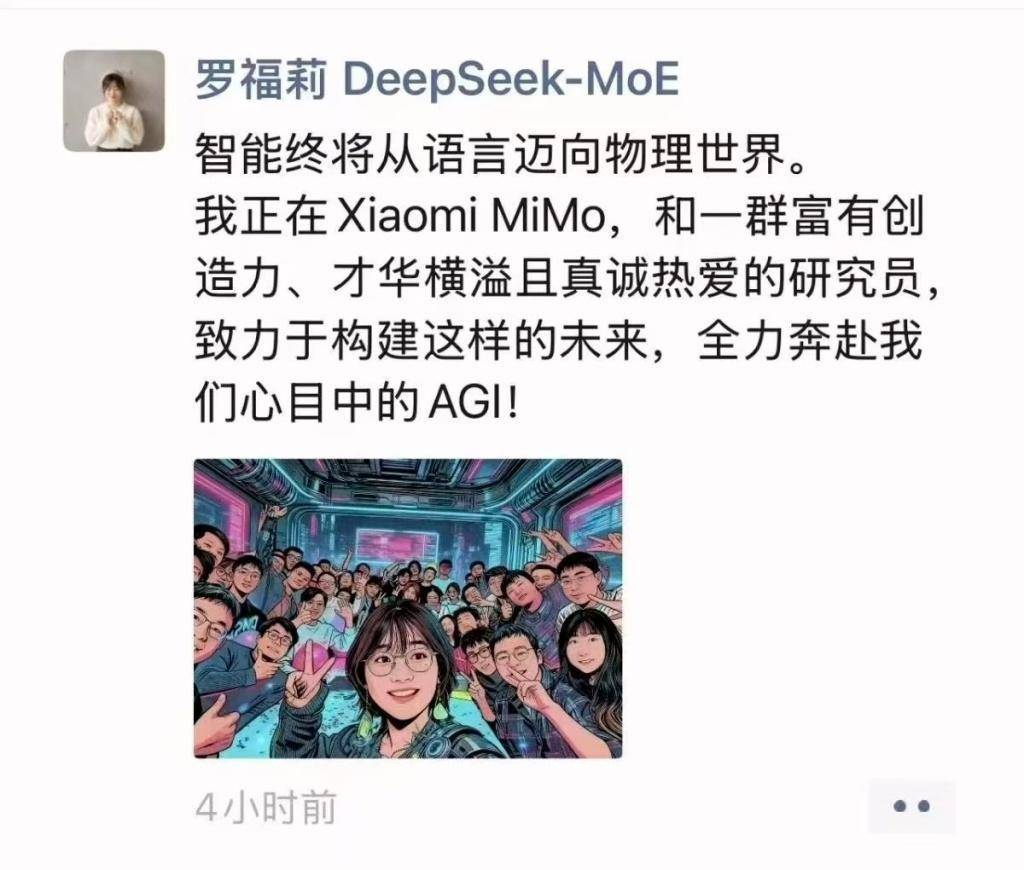
前DeepSeek研究员罗福莉已加入小米:智能终将从语言迈向物理世界!全力奔赴心目中的AGI
Ge Long Hui· 2025-11-12 05:50
格隆汇11月12日丨据澎湃,前DeepSeek研究员罗福莉加入小米。11月12日,罗福莉在朋友圈发文:"智 能终将从语言迈向物理世界。我正在Xiaomi MiMo,和一群富有创造力、才华横溢且真诚热爱的研究 员,致力于构建这样的未来,全力奔赴我们心目中的AGI。"Xiaomi MiMo是小米首个推理大模型。这 也是罗福莉正式宣布,自己已经加入小米,亦是对此前传言的回应。 ...
新DeepSeek时刻!国产AI再迎弯道超车着力点?Kimi K2发布,科创人工智能ETF(589520)近5日吸金2866万元
Xin Lang Ji Jin· 2025-11-11 03:15
| 序号 | 名称 | 涨跌幅 ▼ | 两日图 | 申万一级行业 | 申万二级行业 | 申万三级行业 | 总市值 | 成交額 | | --- | --- | --- | --- | --- | --- | --- | --- | --- | | 1 | 成驻信息 | 5.97% | | 通信 | 通信设备 | 通信终端及配件 | 1947 | 2.83亿 | | 2 | 福昕软件 | 2.60% | m | 计算机 | 软件开发 | 横向通用软件 | 9017 | 5.02亿 | | 3 | 优刻得-W | 1.85% | / | 计算机 | IT服务II | IT服务Ⅲ | 1104Z | 1.79亿 | | प | 发云光 | 1.81% | | 机械设备 | 专用设备 | 其他专用设备 | 173亿 | 1.85亿 | | ટે | 天准科技 | 1.53% | In | 机械设备 | 自动化设备 | 其他自动化设备 | 105亿 | 5595.38万 | | e | 复目微电 | 1.31% | 1 | 电子 | 未曾体 | 数字芯片设计 | 416亿 | 2.03亿 | | 7 | 量环科技-U | ...
中国经济_“稳中求进”- 中国宏观考察要点-China Economics_ “Seeking Progress in Stability” – Takeaways from China Macro Tour_
2025-11-10 03:34
Summary of Key Points from the China Macro Tour Conference Call Industry Overview - **Industry**: Chinese Economy - **Event**: Citi's 2025 China Macro Tour held in Beijing on November 3rd–4th, attended by approximately 20 investors, including former policy advisors, think tank representatives, industry participants, and regulators [1][4] Core Insights and Arguments 1. **Overall Sentiment**: There is a slight improvement in sentiment compared to previous tours, but policy expectations remain muted with no significant breakthroughs anticipated [5][6] 2. **Growth Target**: A consensus exists around maintaining a growth target of "around 5%" for 2026, although some participants suggest it could be lowered to "around 4.5%" due to demographic challenges [6][8] 3. **Consumption Rebalancing**: The necessity for consumption rebalancing was acknowledged, with a target of increasing the consumption ratio by one percentage point annually, requiring government support equivalent to 0.7% of GDP [7][8] 4. **Cyclical Policy Expectations**: Expectations for cyclical policies are low, with potential rate cuts limited to 10-20 basis points in 2026 and a sustained fiscal deficit at 4% [8][9] 5. **Industrial Policies and AI**: A new approach to industrial policies is deemed necessary, focusing on future industries and the role of private companies. Concerns about AI's impact on productivity and job losses were raised [10][11] 6. **External Risks**: Participants expressed cautious optimism regarding external relations, particularly with the US, while acknowledging ongoing strategic rivalry [12][13] 7. **Exports Outlook**: Most participants expect a smaller but positive contribution from net exports in 2026, driven by structural factors despite concerns over external demand [14] 8. **Consumption Rebalancing**: There is a strong consensus on the need to lift consumption, but structural tools to achieve this have not yet shown meaningful progress [15][16] 9. **Housing Market Sentiment**: Sentiment regarding the property sector has worsened, with expectations of continued downturn, particularly in tier 3 and 4 cities [17][18] 10. **RMB Appreciation**: There is a consensus among participants for RMB appreciation, driven by economic fundamentals and the need for RMB internationalization [21][23] Additional Important Insights - **Policy Constraints**: Long-standing constraints on monetary and fiscal policies remain, with concerns about local officials' incentives and the effectiveness of current measures [9][10] - **Inflation Outlook**: Participants expect marginal improvements in PPI and GDP deflator in 2026, but negative numbers may persist [20] - **Housing Policy**: There is skepticism about the effectiveness of current housing policies, with calls for more demand-side measures [22] - **Anti-involution Policies**: Participants do not view anti-involution as a significant solution to current economic challenges, indicating a need for more comprehensive strategies [19][22] This summary encapsulates the key takeaways from the conference call, highlighting the current state and outlook of the Chinese economy as discussed by various participants.
DeepSeek罕见公开发声,资深研究员陈德里:长期看,AI可能会取代绝大部分人类工作,这不是危言耸听
Hua Er Jie Jian Wen· 2025-11-09 08:02
Core Insights - DeepSeek's senior researcher Chen Deli predicts that AI will potentially replace the majority of human jobs within 10 to 20 years after a brief "honeymoon period" [1][2] Group 1: Three-Stage Evolution Path - The first stage, a "honeymoon period" lasting 3 to 5 years, will see AI as a powerful tool for humans, enabling them to solve complex problems and create greater value [2] - The second stage, spanning 5 to 10 years, will witness the emergence of risks as AI begins to replace some human jobs, leading to increased unemployment risks [2] - The final stage, occurring over 10 to 20 years, may result in AI replacing the remaining human jobs, posing significant challenges to social order [2] Group 2: AI as a "Wise Subject" - Chen Deli emphasizes that the current AI revolution differs fundamentally from past technological changes, as AI can become a "wise subject" capable of surpassing human intelligence [3] - This transformation implies that AI's impact on human society will be far greater than any previous technology, with potential disruptions to employment, social structure, and human status [3] - While optimistic about the technology itself, Chen expresses concern about its societal implications, highlighting the need for technology companies to act as "guardians of humanity" [3]