Toyota(TM)

Search documents
Toyota Releases 2025 North American Environmental Sustainability Report
Prnewswire· 2025-12-03 14:00
Core Viewpoint - Toyota Motor North America has published its 2025 North American Environmental Sustainability Report, highlighting its commitment to environmental sustainability and progress towards carbon neutrality by 2050 [1] Carbon - 83% of Toyota and Lexus models available in North America now have an electrified option, with more options expected [1] - There has been a 32% reduction in Scope 1 & 2 greenhouse gas emissions compared to FY2019 [1] - By the end of FY2025, 114 dealerships participated in the dealer engagement program, achieving a 20% reduction in electricity use from non-renewable sources [1] Circular Economy - Single-use plastics at on-site food service have been reduced by over 75% as of FY2025, meeting the five-year target [1] - The use of single-use packaging materials has decreased by almost 31% compared to FY2018, exceeding the five-year target of 25% [1] Water - Water withdrawal per vehicle manufactured decreased by 6.7% compared to FY2021 [1] - Water consumption decreased by 15% in FY2025 compared to FY2024, and by 40% compared to FY2020 [1] Biodiversity - An additional 6,185 acres of pollinator habitat were developed in FY2025, bringing the total to 20,616 acres since 2022 [1] - Conservation programs at 17 sites covering over 640 acres have achieved Wildlife Habitat Council Conservation Certification [1] Future Commitments - Toyota is committed to achieving carbon neutrality by 2050 and will implement its 8th Environmental Action Plan in FY2027, focusing on carbon neutrality, circular economy, and nature-positive activities [1]



安世断供?汽车业停摆的底层逻辑
3 6 Ke· 2025-12-03 10:50
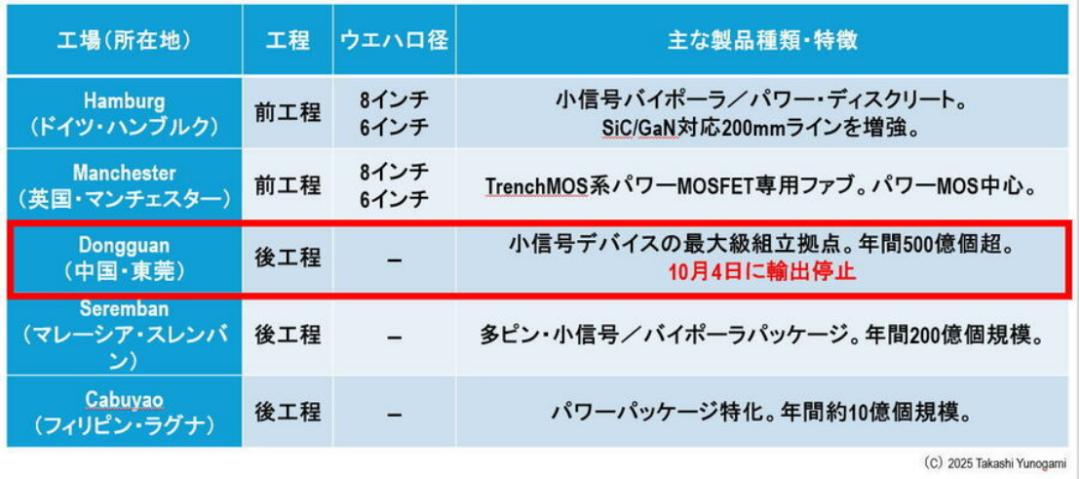
Core Points - Ansem Semiconductor is facing supply chain disruptions that significantly impact global automotive manufacturers, leading to production halts at companies like Honda, Nissan, Volkswagen, and Bosch [1][3][7] - The company produces a large volume of discrete semiconductors, primarily used in automotive applications, which are critical for various vehicle systems [1][6] - Ansem Semiconductor's global market share in automotive semiconductors is around 2%-3%, but it holds a significant 40% share in discrete semiconductor usage within hybrid and electric vehicles [3][7] Group 1: Company Overview - Ansem Semiconductor has front-end factories in Hamburg, Germany, and Manchester, UK, producing discrete, power, analog, and logic semiconductors [1][2] - The back-end factories located in Dongguan, China, Seremban, Malaysia, and Cabuyao, Philippines, are responsible for packaging and testing, with Dongguan alone shipping over 50 billion semiconductors annually [2][3] Group 2: Impact on Automotive Industry - The disruption in semiconductor supply has forced major automotive manufacturers to reduce production, with Honda halting operations in North America and Nissan cutting output in Japan [1][3] - The reliance on Ansem's semiconductors is particularly high for hybrid and electric vehicles, which require more discrete components compared to traditional gasoline vehicles [6][7] Group 3: Historical Context - Previous semiconductor shortages, such as those caused by the 2011 Japan earthquake and the 2021 pandemic, have shown that the automotive industry is vulnerable to supply chain disruptions [8][13][18] - The industry's just-in-time production model has been identified as a critical factor in these vulnerabilities, as it minimizes inventory but increases the risk of production halts during supply interruptions [18]

跨国车企三季报座次大洗牌
Zhong Guo Qi Che Bao Wang· 2025-12-03 09:17
Core Insights - The global automotive industry is facing significant challenges due to tariff impacts, transformation pains, and market differentiation, leading to a reshuffling of performance rankings among major multinational car manufacturers [1] Toyota - Net profit reached $6 billion, a year-on-year increase of 62% [2][6] - Operating profit decreased by 18.6% to 2 trillion yen due to a 25% tariff on U.S. imports, with a significant cost increase of 900 billion yen [2][3] - Retail sales in China for Toyota and Lexus brands grew by 1.8% to 464,000 units [3] Ford - Net profit was $2.4 billion, a year-on-year increase of 174% [5][6] - Revenue for the third quarter reached $50.5 billion, a historical high, with a 9.3% year-on-year growth [7] - Ford's adjusted EBIT for the year is now expected to be between $6 billion and $6.5 billion, down from previous estimates [7][8] BMW - Net profit was $2 billion, a year-on-year increase of 257% [9][6] - Revenue for the third quarter was €32.314 billion, a slight decrease of 0.3% [9] - The company faced a 1.8 percentage point reduction in profit margins due to tariffs [10] Hyundai - Net profit was $1.7 billion, a year-on-year decrease of 20.5% [12][6] - Revenue reached 46.7 trillion won, an 8.8% year-on-year increase [13] - The company plans to launch a new hybrid SUV in the U.S. and increase production capacity [14] Mercedes-Benz - Net profit was $1.4 billion, a year-on-year decrease of 31% [16][6] - Revenue fell by 7% to €32.147 billion [17] - The company is implementing a restructuring plan aimed at saving €5 billion by 2027 [17] General Motors - Net profit was $1.3 billion, a year-on-year decrease of 57% [19][6] - Revenue for the third quarter was $48.59 billion, a slight decline of 0.34% [19] - The company has raised its full-year earnings forecast based on strong performance in both the U.S. and Chinese markets [19] Honda - Net profit was $780 million, a year-on-year increase of 16.5% [20][6] - Operating profit dropped by 41% to 438.1 billion yen [21] - The company has revised its profit expectations downward for the fiscal year [21] Nissan - Net loss was $700 million, a year-on-year decrease of 1042% [22][6] - Revenue for the first half of the fiscal year was 55.787 trillion yen, a 6.8% decline [23] - The company is undergoing a restructuring plan to cut costs and improve profitability [23][24] Volkswagen Group - Net loss was $1.2 billion, a year-on-year decrease of 169% [25][6] - Revenue for the third quarter was €80.3 billion, a 2.3% increase [25] - The group is facing significant challenges due to tariffs and restructuring costs [27] Stellantis - Net revenue for the third quarter was €37.2 billion, a year-on-year increase of 13% [28] - The company plans to invest $13 billion in the U.S. over the next four years [28] - Stellantis is gradually recovering under new leadership, focusing resources on the North American market [29]



日本制造黄金时代落幕:系统性崩塌背后的多重危机
Sou Hu Cai Jing· 2025-12-02 23:40
Core Insights - Japan's manufacturing sector is experiencing a systemic collapse, with the Purchasing Managers' Index (PMI) remaining below the neutral line for five consecutive months, indicating ongoing contraction in manufacturing activity [1][3] - The Japanese economy has entered a negative growth phase, with a reported annualized decline of 1.8% in Q3 2023, marking the first negative growth since Q1 2024 [1][11] - Japan's exports to the U.S. have seen a continuous decline for seven months, further exacerbating economic challenges [1][11] Group 1: Credibility Crisis - Japan's manufacturing industry is facing an unprecedented trust crisis, with multiple long-standing data falsification scandals across various sectors, including automotive and steel [3] - Major companies like Kobe Steel and Mitsubishi Electric have been implicated in decades-long data manipulation, undermining the credibility of Japanese manufacturing [3] - The recent scandal involving Kobayashi Pharmaceutical, which resulted in over a hundred deaths, has intensified the crisis of confidence in Japanese products [3] Group 2: Market Setbacks - Japanese brands are losing significant market share to Chinese competitors, particularly in the home appliance sector, where domestic brands hold 72% of the market compared to less than 8% for Japanese brands [5] - The market share of Japanese cars in China has plummeted to 10.8% in the first ten months of 2025, down from 24.1% in 2020, while domestic brands have surged to a 58.3% market share [5] - In Japan, 70% of home appliances are now manufactured in China, with brands like Hisense and TCL dominating the market [5] Group 3: Transformation Challenges - Japanese automakers are struggling to adapt to the global shift towards electric and smart vehicles, with domestic brands capturing nearly 90% of the new energy vehicle market in China, while Japanese brands account for less than 2% [7] - The focus on hydrogen fuel technology has caused Japanese manufacturers to miss the lithium-ion battery opportunity, leading to a slow transition to electric vehicles [7] - Japanese car manufacturers are adopting a defensive multi-path strategy, which has delayed their transition to electric vehicles and caused a disconnect with market demands for smart features [7] Group 4: External Pressures - U.S. tariff policies have severely impacted Japanese manufacturers, with the seven major automakers facing a combined profit loss of approximately 1.5 trillion yen (around 10 billion USD) between April and September 2025 [9] - The automotive sector's profit margins are now only 7%-8%, leading to a situation where all seven major automakers reported declining profits for the first time since the COVID-19 pandemic began [9] - The decline in automotive exports is negatively affecting Japan's GDP growth and impacting related industries such as electronics and steel [9] Group 5: Economic Dilemma - Japan's economy is facing significant internal and external challenges, with a sharp contraction in external demand contributing to the negative growth in Q3 2023 [11] - The impact of U.S. tariffs has led to a 1.2% decline in goods and services exports, contributing negatively to economic growth [11] - Domestic consumption is also weak, with only a marginal increase of 0.1% in personal consumption, which constitutes over half of Japan's economy [11] Group 6: Policy Response - In response to the economic challenges, the Japanese government has introduced a 21.3 trillion yen economic stimulus plan, though experts question its effectiveness [13] - Concerns regarding fiscal sustainability are prominent, as Japan's government debt is approximately 263% of GDP, raising questions about the long-term viability of increased spending [13] - The current government is also focusing on military expansion, which contrasts with public demand for improved living standards and tax relief [15]
6年砸进上百亿,丰田章男造城烂尾了吗
汽车商业评论· 2025-12-02 23:07
Core Viewpoint - Toyota's Woven City project represents a bold initiative to create a living laboratory for future mobility and urban living, aiming to test and develop next-generation transportation technologies and sustainable urban infrastructure [4][12][18] Group 1: Project Overview - Woven City is located at the base of Mount Fuji and is designed as a city for mobility and innovation, allowing for various transportation experiments without public road regulations [6][10] - The project is a significant investment of $10 billion, utilizing the site of a former Toyota factory that closed in 2018 [6][8] - The first phase will accommodate 360 residents, primarily employees from Toyota and its subsidiary Woven by Toyota [4][8] Group 2: Purpose and Goals - The primary motivation for building Woven City is to facilitate Toyota's transformation from a traditional automaker to a modern mobility company, especially in the fields of software and autonomous vehicles [8][18] - Woven City aims to serve as a testing ground for various mobility solutions, including the e-Palette autonomous vehicle concept and other innovative transportation technologies [9][10] Group 3: Community and Collaboration - The city will host two main participant groups: "Weavers," who are passionate about expanding mobility options, and "Inventors," including startups and researchers developing new products and services [14][16] - The concept of "kakezan" (multiplicative effect) is emphasized, where diverse fields and cultures intersect to generate new ideas and value [16] Group 4: Future Implications - Woven City is envisioned as a model for future smart cities, influencing aspects from autonomous driving to sustainable infrastructure [18] - The project reflects Toyota's ambition to lead in future mobility and human-centered design, starting from the foothills of Mount Fuji [18][19]

宇科创新为丰田系企业提供燃料电池系统测试平台
势银能链· 2025-12-02 03:12
Core Insights - The article highlights the collaboration between Dalian Yuke Innovation Technology Co., Ltd. and the Toyota group, marking a significant achievement for the domestic hydrogen energy testing equipment industry in China [2][4][5]. Group 1: Collaboration Details - Dalian Yuke Innovation has been recognized as a domestic supplier for the Toyota group after passing rigorous evaluations, showcasing the international certification of China's fuel cell testing technology [2][4]. - The core product of this collaboration is the YK-EB40 fuel cell engine system testing platform, designed specifically for high-end fuel cell power systems, providing critical data support for Toyota's fuel cell engine technology iteration and quality control [5][6]. Group 2: Strategic Implications - This partnership not only strengthens Yuke Innovation's position in the international high-end market but also serves as a benchmark for domestic testing equipment companies entering top-tier global supply chains, promoting the independent and high-end development of China's hydrogen energy industry [5][6]. - Yuke Innovation plans to accelerate its global expansion based on this collaboration, transitioning from "product export" to "technology and service export," thereby providing reliable "Chinese equipment solutions" for the global hydrogen energy industry [6].

中国突施狠招,断供日本给变压器制造企业的启示
Xin Lang Cai Jing· 2025-12-01 21:38
Core Insights - The ongoing competition between China and Japan has escalated into a generational paradigm shift in industry, which poses significant implications for China's transformer manufacturing enterprises [1] - Japan's recent supply chain disruptions, triggered by China's export control measures, have led to partial production halts for 23 major companies, including Toyota and Sony [2] - The historical trade relationship between China and Japan has evolved dramatically, with China now controlling 80% of global production capacity for critical materials that were once monopolized by Japan [4] Group 1: Supply Chain Dynamics - Japan's manufacturing sector is facing a critical supply chain crisis, with a dependency on China for key materials exceeding 90%, particularly in the semiconductor industry [10] - The shift from a "world factory" to an "innovation hub" in China signifies a strategic transformation that poses long-term challenges for Japan's manufacturing capabilities [9][12] - China's advanced real-time data collaboration capabilities in supply chain management have outpaced Japan's traditional methods, highlighting a significant efficiency gap [7][8] Group 2: Technological Advancements - China's continuous investment in research and development has led to a reversal of roles, where Japanese companies are now seeking access to Chinese semiconductor patents [5] - The integration of 410,000 factories into a real-time collaborative network through industrial internet platforms represents a substantial leap in China's manufacturing capabilities [8] - The introduction of an "industrial chain resilience index" by China's Ministry of Industry and Information Technology aims to enhance the evaluation of local governments and solidify technological advancements [12] Group 3: Historical Context and Future Implications - The historical trajectory of China-Japan trade, from a $30 billion starting point in 1985 to a current reliance on critical materials, underscores the shifting power dynamics in the region [4] - The current crisis is not merely a temporary trade dispute but a strategic declaration of China's intent to reshape the global industrial landscape [9][12] - The lessons from this ongoing competition emphasize the importance of dynamic evolutionary capabilities over static technological barriers, as articulated in historical contexts [12]


Toyota Boshoku America, Inc. Acquires Full Ownership of TBDN Tennessee Company, Rebrands as Toyota Boshoku Jackson Tennessee, LLC
Businesswire· 2025-12-01 15:03
Core Insights - Toyota Boshoku America, Inc. has acquired full ownership of TBDN Tennessee Company, LLC, a joint venture with DENSO International America, Inc., and will rebrand it as Toyota Boshoku Jackson Tennessee, LLC [1][2][3] Company Overview - TBDN Tennessee Company was originally established to manufacture automotive powertrain products, including air cleaners, air filters, oil filters, intake manifolds, oil mist separators, cylinder head covers, and cabin air filters [2] - The acquisition allows Toyota Boshoku America to streamline decision-making, accelerate innovation, and enhance service to customers and stakeholders [3] Strategic Implications - The transition to Toyota Boshoku Jackson Tennessee, LLC marks a new chapter for the company while honoring its 35-year legacy in the automotive filtration industry [3][4] - Production of DENSO branded products will continue, ensuring a seamless transition with no disruption to service [4] Community Commitment - The company emphasizes its commitment to the Jackson community and aims to cultivate meaningful partnerships that contribute to regional growth and long-term success [4] Milestone Celebration - To commemorate the acquisition and rebranding, Toyota Boshoku Jackson Tennessee will host a 35th Anniversary employee celebration in December [5]

盛唐保险经纪“改头换面” 丰田欲下场卖保险
Bei Jing Shang Bao· 2025-12-01 14:17
Core Insights - The automotive industry is entering a new phase of cross-industry competition, with Toyota's recent rebranding of Beijing Shengtang Insurance Brokerage to Toyota Insurance Brokerage marking a significant move into the insurance market [1][2] - This shift reflects a broader trend in the automotive sector towards service-oriented and ecosystem-based business models, where car manufacturers are increasingly looking to offer insurance services alongside vehicle sales [1][3] Company Developments - Toyota Insurance Brokerage, a national insurance brokerage approved by the National Financial Regulatory Administration, has established branches in eight provinces across China [2] - The company is a subsidiary of Toyota Financial Services (China) Co., Ltd., which is part of Toyota Financial Services Corporation [2] Industry Trends - The trend of automotive companies entering the insurance market is becoming mainstream, with many manufacturers acquiring existing insurance licenses or establishing new ones to enhance their service offerings [3][6] - The integration of insurance services into the automotive sales and after-sales process is seen as a key strategy for increasing customer loyalty and profitability [3][7] Strategic Advantages - Toyota Insurance Brokerage aims to leverage its parent company's resources and extensive dealer network to provide a diverse range of insurance products, including auto insurance and property insurance for inventory financing [4][5] - The ability to access vast amounts of customer data allows automotive companies to tailor insurance products, reduce customer acquisition costs, and improve risk management [5][8] Market Dynamics - The tightening of insurance license approvals has led many automotive companies to pursue acquisitions as a more efficient route to enter the insurance sector [6] - The automotive industry's transformation, driven by changing consumer demands and internal business needs, is pushing companies to explore new revenue streams through insurance services [7][8]
盛唐保险经纪“改头换面”,丰田欲下场卖保险
Bei Jing Shang Bao· 2025-12-01 13:51
Core Viewpoint - The automotive industry is entering a new phase of cross-industry competition, with Toyota's recent establishment of a national insurance brokerage as a strategic move to penetrate the insurance market, reflecting a broader trend of automotive companies transitioning towards service-oriented and ecosystem-based business models [1][3][12]. Group 1: Company Developments - Beijing Shengtang Insurance Brokerage has officially changed its name to Toyota Insurance Brokerage (Beijing) Co., Ltd., which will serve as a key to Toyota's entry into the insurance market [1][4]. - Toyota Insurance Brokerage is a wholly-owned subsidiary of Toyota Financial Services (China) Co., Ltd., which is part of Toyota Financial Services Corporation [6][9]. - The company aims to provide a diverse range of insurance products to Toyota and Lexus dealers, as well as retail and institutional customers, leveraging its extensive business network [9][10]. Group 2: Industry Trends - The integration of automotive and insurance services is seen as a necessary evolution, with automotive companies increasingly focusing on selling insurance and providing related services as a new growth avenue [3][12]. - The trend of automotive companies entering the insurance market has been accelerated by tightening regulations on insurance license approvals, leading many to acquire existing licenses as a more efficient entry strategy [7][12]. - The automotive sector's shift towards insurance services is driven by the need to enhance profitability, improve customer service, and leverage vast amounts of customer data for tailored insurance offerings [13][14]. Group 3: Strategic Implications - Toyota's entry into the insurance market is expected to enhance service quality, increase customer loyalty, and improve brand recognition, but it requires a strong internal control system and compliance awareness to deliver real value to customers [11][14]. - The ability to integrate insurance services into the entire customer journey, from vehicle purchase to after-sales, is crucial for increasing customer stickiness and maximizing the value of the automotive ecosystem [10][13]. - The successful transition from a "selling cars" mindset to a "service-oriented" approach is essential for automotive companies to thrive in the insurance sector, necessitating a fundamental shift in business strategy [14].