Toyota(TM)

Search documents
Head-to-Head: Here's How Ford and Toyota Stack Up in the Auto Space
ZACKS· 2025-06-10 14:46
Core Insights - Ford and Toyota are major competitors in the global auto industry, with Toyota holding a significant lead in global sales and market capitalization [1][2] - In the U.S. market, Toyota sold 2.33 million vehicles in 2024, a 3.7% increase, while Ford sold 2.07 million vehicles, up 4.2% year over year [1] - On a global scale, Toyota sold 10.8 million vehicles compared to Ford's 4.5 million, with Toyota's market cap at approximately $250 billion versus Ford's $40 billion [2] Ford's Position - Ford remains a key player in the U.S. auto market, with popular models like the F-Series trucks and a strong presence in the SUV and crossover segments [6] - The company's hybrid strategy is gaining traction as full EV adoption slows, appealing to consumers seeking better fuel efficiency [7] - Financially, Ford exited Q1 2025 with $27 billion in cash and $45 billion in liquidity, allowing for investments in digital innovation and electrification [8] - Ford's dividend yield is approximately 6%, significantly higher than the S&P 500 average, with plans to return 40-50% of free cash flow to shareholders [8] - The Ford Pro business, focused on commercial customers, is expected to drive earnings growth due to strong demand and successful product launches [10] - Challenges include declining sales in traditional gas-powered vehicles, significant losses in the EV division, and potential tariff impacts costing up to $2.5 billion [11][12] - The Zacks Consensus Estimate predicts a 7% decline in sales and a 40% decline in EPS for Ford in 2025 [13] Toyota's Position - Toyota is recognized for its reliability and has exceeded earnings expectations, projecting growth in revenues and vehicle volumes for fiscal 2026 [14] - The company anticipates a 21% decline in operating income due to rising material costs, currency headwinds, and potential tariff impacts [15] - Toyota expects to sell 9.8 million vehicles in fiscal 2026, an increase from 9.36 million in fiscal 2025, with a focus on hybrid and plug-in hybrid sales [16] - The hybrid-first strategy is exemplified by the RAV4, which will be sold exclusively as a hybrid or plug-in hybrid starting in 2026 [17] - Toyota raised its annual dividend to 90 yen per share for fiscal 2025 and plans to increase it to 95 yen for fiscal 2026 [18] - The Zacks Consensus Estimate indicates an 8% growth in sales for Toyota in fiscal 2026, while earnings are expected to decline by 21% [18] Capital Efficiency and Valuation - Toyota has a return on invested capital of 4.8%, significantly higher than Ford's 1.77%, indicating better capital efficiency [19] - On a valuation basis, Toyota trades at a more attractive EV/EBITDA multiple compared to Ford, suggesting a more reasonable stock price relative to earnings [21] Conclusion - Both Ford and Toyota are navigating challenges in the evolving auto industry, with Ford having strong brand recognition and a high dividend yield, while Toyota benefits from global scale and a cautious electrification strategy [23][24] - Toyota's stronger capital discipline and strategic positioning provide it with a slight edge over Ford in the current market landscape [25]



Intrado and Toyota Connected Deliver i3-Compliant Advanced Automatic Collision Notification Data Directly to PSAPs
GlobeNewswire News Room· 2025-06-10 12:00
Core Insights - Intrado Life & Safety, Inc. and Toyota Connected North America have announced a collaboration to provide Advanced Automatic Collision Notification (AACN) telematics data to public safety answering points (PSAPs) in an i3-compliant format, enhancing emergency response capabilities [1][2][3] Group 1: Collaboration and Technology - The AACN technology will be integrated into select model year 2026 Toyota and Lexus vehicles in the U.S., with plans for future vehicle inclusion [2] - The collaboration aims to improve emergency response by delivering critical telematics data, such as crash details and vehicle location, to 9-1-1 centers before a call is made [3][5] - Intrado's Emergency Data Broker will route telematics calls to the appropriate PSAP, providing vital information to first responders, thereby enhancing situational awareness [3][5] Group 2: Impact on Emergency Response - The AACN data includes various vehicle metrics such as speed, orientation, occupancy count, and seatbelt usage, which are crucial for timely and effective emergency response [3][4] - Toyota Connected has been an early adopter of the Emergency Data Broker, utilizing AACN data to assist emergency responders with detailed vehicle information [4] - The integration of this technology is expected to significantly improve emergency response outcomes by ensuring that the right resources are deployed quickly [5] Group 3: Company Backgrounds - Intrado is recognized as a leading global provider of emergency response solutions, dedicated to enhancing public safety outcomes through innovative technology [6] - Toyota has a long-standing presence in the U.S. automotive market, employing nearly 48,000 people and producing over 35 million vehicles, with a commitment to sustainable mobility [7][8]

丰田、戴姆勒卡车将于2026年4月前完成旗下卡车部门合并
news flash· 2025-06-10 10:37
丰田、戴姆勒卡车将于2026年4月前完成旗下卡车部门合并 智通财经6月10日电,丰田汽车与德国戴姆勒卡车已同意在2026年4月之前完成各自旗下卡车部门——日 野汽车与三菱扶桑卡客车株式会社——的合并。双方希望通过合并提高利润率并开发新技术。 ...
丰田退出本田“接棒”奥运,中国车企何时登上最高舞台?
3 6 Ke· 2025-06-09 04:58
Group 1 - The core viewpoint of the article highlights the contrasting Olympic marketing strategies of Japanese automakers Toyota and Honda, with Honda opting for a focused approach on the 2028 Los Angeles Olympics while Toyota withdraws from the TOP program [1][2][5] - Honda's partnership with the 2028 Olympics is valued at over $200 million, marking a significant investment in the North American market [1][3] - The article emphasizes the importance of these strategies for Chinese automakers as they expand internationally, suggesting that both the TOP program and single-event sponsorships offer valuable insights for their marketing approaches [2][8] Group 2 - Honda's strategy contrasts with Toyota's global TOP sponsorship, as Honda focuses on a single event to maximize its impact in the North American market [5][12] - The article discusses the potential for Chinese automakers to enter the TOP program, especially after Toyota's exit, but warns of the high costs and challenges associated with such a move [9][11] - It suggests that Chinese companies should consider targeting regional events or national teams to build brand recognition and market trust, rather than solely pursuing global sponsorships [14]


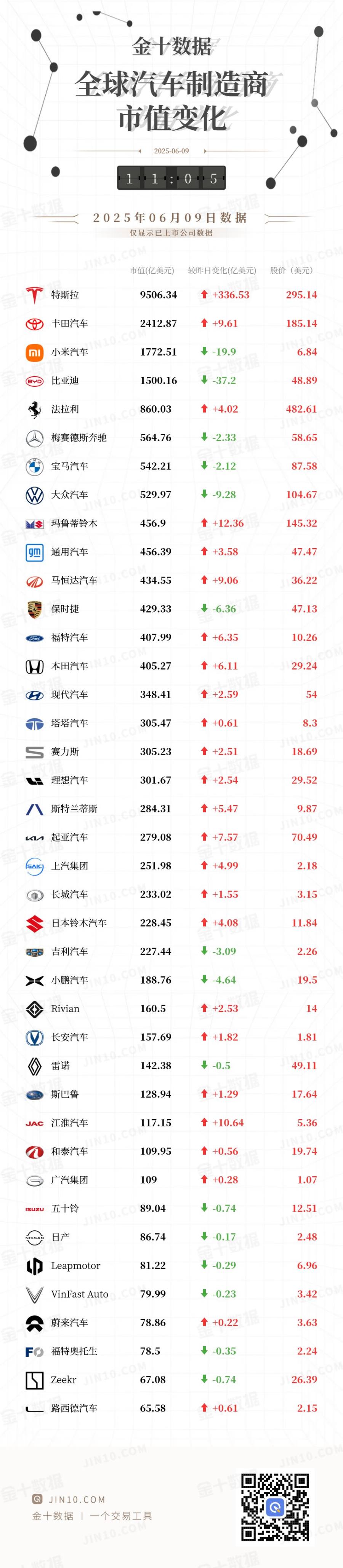
金十图示:2025年06月09日(周一)全球汽车制造商市值变化
news flash· 2025-06-09 03:12
金十图示:2025年06月09日(周一)全球汽车制造商市值变化 | | | 市值(亿美元) 较昨日变化(亿美元) | 股价(美元) | | --- | --- | --- | --- | | 特斯拉 | 9506.34 | + +336.53 | 295.14 | | (4) 丰田汽车 | 2412.87 | 1 +9.61 | 185.14 | | והו 小米汽车 | 1772.51 | + -19.9 | 6.84 | | 比亚迪 | 1500.16 | + -37.2 | 48.89 | | P 法拉利 | 860.03 | ↑ +4.02 | 482.61 | | 梅赛德斯奔驰 | 564.76 | + -2.33 | 58.65 | | 宝马汽车 | 542.21 | + -2.12 | 87.58 | | 入) 大众汽车 | 529.97 | + -9.28 | 104.67 | | --- | --- | --- | --- | | MS 玛鲁蒂铃木 | 456.9 | 1 +12.36 2 | 145.32 | | 通用汽车 gm | 456.39 | + +3.58 | 47.47 | | ...



废除“大漂亮”法案第899条“资本税”!全球大公司高管本周齐聚华盛顿游说美国国会
华尔街见闻· 2025-06-09 02:08
Core Viewpoint - A significant lobbying effort by multinational companies is underway to oppose Clause 899 of Trump's tax reform, which is perceived as a potential threat to millions of American jobs and could reshape international capital flows [1][4]. Group 1: Impact on Foreign Investment - Approximately 70 companies, including major firms like Shell, Toyota, SAP, and LVMH, are concerned about Clause 899, which could jeopardize the 8.4 million jobs these foreign companies provide in the U.S. [1] - The clause is expected to increase taxes on U.S. stock dividends and certain corporate bond interests by 5 percentage points annually over four years for foreign investors [3]. - The implementation of Clause 899 could lead to a significant reduction in foreign direct investment, as warned by industry leaders [4]. Group 2: Financial Market Implications - Foreign banks have underwritten over 70% of foreign corporate debt issuance in the U.S., accounting for nearly one-third of total dollar-denominated debt issuance [5]. - In 2023, these foreign banks lent over $1.3 trillion to U.S. companies, supporting $5.4 trillion in foreign direct investment and generating $270 billion in revenue [5]. Group 3: Legislative and Economic Considerations - Despite the potential for Clause 899 to raise $116 billion for the U.S. government over the next decade, it is projected to increase the national debt by $2.4 trillion by 2034 [6]. - There is growing momentum in the Senate to repeal Clause 899, as it contradicts the government's goal of attracting more investment to the U.S. [6]. - Concerns have been raised that foreign governments may retaliate by altering their laws in response to the U.S. tax changes, potentially leading to significant capital outflows from the U.S. [6].



废除“大漂亮”法案第899条“资本税”!全球大公司高管本周齐聚华盛顿游说美国国会
Hua Er Jie Jian Wen· 2025-06-09 01:21
Core Viewpoint - A significant lobbying effort by multinational companies is underway to oppose Clause 899 of Trump's tax reform, which is perceived as a potential threat to millions of American jobs and could reshape international capital flows [1][2]. Group 1: Impact on Employment and Investment - Approximately 840,000 jobs in the U.S. are provided by foreign companies, and the implementation of Clause 899 could directly threaten this substantial employment base [2]. - The lobbying effort involves around 70 company representatives, including major firms like Shell, Toyota, SAP, and LVMH, indicating widespread concern among foreign investors [1][2]. Group 2: Tax Implications of Clause 899 - Clause 899 is viewed as a "capital expulsion order" that would allow the U.S. to impose additional taxes on companies and investors from countries deemed to have "unfair foreign tax policies" [2][3]. - The clause would increase U.S. tax rates on stock dividends and certain corporate bond interests by 5 percentage points annually over four years, and it would also tax sovereign wealth funds' U.S. investment portfolios, which are currently exempt [3]. Group 3: Financial Market Concerns - The implementation of Clause 899 is expected to disrupt foreign direct investment and could lead to financial market volatility, as highlighted by the International Bankers Association [3]. - In 2023, foreign banks lent over $1.3 trillion to U.S. companies, supporting $5.4 trillion in foreign direct investment and generating $270 billion in revenue, underscoring the importance of foreign capital in the U.S. economy [3]. Group 4: Legislative Outlook - Despite the potential to raise $116 billion for the U.S. government over the next decade, there are concerns that the overall tax reform could increase U.S. debt by $2.4 trillion by 2034 [4]. - There is a growing momentum in the Senate to repeal Clause 899, as lawmakers recognize that it contradicts the government's goal of attracting more investment to the U.S. [4].
日系三杰需要“断舍离”
Xin Lang Cai Jing· 2025-06-07 01:54
Core Viewpoint - Japanese automakers are facing significant challenges in the Chinese market, with declining sales and increased competition from electric vehicles, leading to drastic price cuts and structural adjustments [5][6][9]. Group 1: Market Performance - Japanese cars held nearly a quarter of the Chinese market share in 2020, but by 2024, their overall market share has dropped by over 10 percentage points compared to 2020 [4][5]. - Nissan's sales in China for January to April 2023 were 167,600 units, a decline of 24.6% year-on-year, while Honda's sales were 202,000 units, down 28% [6][8]. - The new models from Nissan and Honda, such as the N7 and S7, have seen poor sales performance, with retail numbers of 665 and 373 units respectively in their first month [11]. Group 2: Strategic Adjustments - Nissan announced a global workforce reduction of 20,000 employees by the 2027 fiscal year, representing 15% of its total workforce, and plans to reduce its global factories from 17 to 10 [8]. - Honda has also initiated large-scale layoffs, affecting over a thousand employees, as part of its restructuring efforts [9]. - Toyota's sales in the same period were 530,100 units, a 7.7% increase, but this growth is seen as unsustainable due to heavy discounting on key models [9][10]. Group 3: Consumer Perception and Product Development - Consumers express dissatisfaction with Japanese cars, citing a lack of innovation and technology compared to domestic brands, which are perceived as more aligned with modern preferences [10][14]. - Japanese automakers are attempting to localize production and technology by partnering with Chinese companies like CATL and Huawei to enhance their electric vehicle offerings [15][16]. - Despite efforts to adapt, there is skepticism about the commitment to electric vehicle development, as seen in Honda's recent decision to cut its electric vehicle investment plan [16][17].


小小日本被美国拿捏了?石破茂改口,对美提出新关税方案
Sou Hu Cai Jing· 2025-06-06 12:47
Group 1 - Japan's trade negotiations with the US are currently in disarray, with key US officials unable to reach a consensus, leaving Japan's negotiating team confused about US demands [1][3] - Japanese Prime Minister Shigeru Ishiba initially demanded a complete removal of the 25% tariff on automobiles but has now proposed a phased reduction, starting with a decrease to 15% in the first year and 10% in the second year, in exchange for increased access for US agricultural products [3][4] - The Japanese automotive industry, which constitutes 8.3% of Japan's GDP and supports 7 million jobs, is facing severe challenges due to tariffs, with Toyota reporting losses of 180 billion yen (approximately 90 billion RMB) [5][4] Group 2 - Japan's military reliance on the US is significant, with the Japanese Self-Defense Forces depending on US satellite systems for missile warning and purchasing primarily American military equipment [7][4] - The US maintains over 50 military bases in Japan, housing 50,000 troops, with Japan covering 75% of the costs, effectively limiting Japan's military autonomy [7][4] - Japan holds $1.13 trillion in US Treasury bonds, which, while appearing to be a position of strength, actually constrains Japan's financial options and exposes it to risks associated with US debt fluctuations [7]