Toyota(TM)

Search documents
废除“大漂亮”法案第899条“资本税”!全球大公司高管本周齐聚华盛顿游说美国国会
华尔街见闻· 2025-06-09 02:08
Core Viewpoint - A significant lobbying effort by multinational companies is underway to oppose Clause 899 of Trump's tax reform, which is perceived as a potential threat to millions of American jobs and could reshape international capital flows [1][4]. Group 1: Impact on Foreign Investment - Approximately 70 companies, including major firms like Shell, Toyota, SAP, and LVMH, are concerned about Clause 899, which could jeopardize the 8.4 million jobs these foreign companies provide in the U.S. [1] - The clause is expected to increase taxes on U.S. stock dividends and certain corporate bond interests by 5 percentage points annually over four years for foreign investors [3]. - The implementation of Clause 899 could lead to a significant reduction in foreign direct investment, as warned by industry leaders [4]. Group 2: Financial Market Implications - Foreign banks have underwritten over 70% of foreign corporate debt issuance in the U.S., accounting for nearly one-third of total dollar-denominated debt issuance [5]. - In 2023, these foreign banks lent over $1.3 trillion to U.S. companies, supporting $5.4 trillion in foreign direct investment and generating $270 billion in revenue [5]. Group 3: Legislative and Economic Considerations - Despite the potential for Clause 899 to raise $116 billion for the U.S. government over the next decade, it is projected to increase the national debt by $2.4 trillion by 2034 [6]. - There is growing momentum in the Senate to repeal Clause 899, as it contradicts the government's goal of attracting more investment to the U.S. [6]. - Concerns have been raised that foreign governments may retaliate by altering their laws in response to the U.S. tax changes, potentially leading to significant capital outflows from the U.S. [6].



废除“大漂亮”法案第899条“资本税”!全球大公司高管本周齐聚华盛顿游说美国国会
Hua Er Jie Jian Wen· 2025-06-09 01:21
Core Viewpoint - A significant lobbying effort by multinational companies is underway to oppose Clause 899 of Trump's tax reform, which is perceived as a potential threat to millions of American jobs and could reshape international capital flows [1][2]. Group 1: Impact on Employment and Investment - Approximately 840,000 jobs in the U.S. are provided by foreign companies, and the implementation of Clause 899 could directly threaten this substantial employment base [2]. - The lobbying effort involves around 70 company representatives, including major firms like Shell, Toyota, SAP, and LVMH, indicating widespread concern among foreign investors [1][2]. Group 2: Tax Implications of Clause 899 - Clause 899 is viewed as a "capital expulsion order" that would allow the U.S. to impose additional taxes on companies and investors from countries deemed to have "unfair foreign tax policies" [2][3]. - The clause would increase U.S. tax rates on stock dividends and certain corporate bond interests by 5 percentage points annually over four years, and it would also tax sovereign wealth funds' U.S. investment portfolios, which are currently exempt [3]. Group 3: Financial Market Concerns - The implementation of Clause 899 is expected to disrupt foreign direct investment and could lead to financial market volatility, as highlighted by the International Bankers Association [3]. - In 2023, foreign banks lent over $1.3 trillion to U.S. companies, supporting $5.4 trillion in foreign direct investment and generating $270 billion in revenue, underscoring the importance of foreign capital in the U.S. economy [3]. Group 4: Legislative Outlook - Despite the potential to raise $116 billion for the U.S. government over the next decade, there are concerns that the overall tax reform could increase U.S. debt by $2.4 trillion by 2034 [4]. - There is a growing momentum in the Senate to repeal Clause 899, as lawmakers recognize that it contradicts the government's goal of attracting more investment to the U.S. [4].
日系三杰需要“断舍离”
Xin Lang Cai Jing· 2025-06-07 01:54
Core Viewpoint - Japanese automakers are facing significant challenges in the Chinese market, with declining sales and increased competition from electric vehicles, leading to drastic price cuts and structural adjustments [5][6][9]. Group 1: Market Performance - Japanese cars held nearly a quarter of the Chinese market share in 2020, but by 2024, their overall market share has dropped by over 10 percentage points compared to 2020 [4][5]. - Nissan's sales in China for January to April 2023 were 167,600 units, a decline of 24.6% year-on-year, while Honda's sales were 202,000 units, down 28% [6][8]. - The new models from Nissan and Honda, such as the N7 and S7, have seen poor sales performance, with retail numbers of 665 and 373 units respectively in their first month [11]. Group 2: Strategic Adjustments - Nissan announced a global workforce reduction of 20,000 employees by the 2027 fiscal year, representing 15% of its total workforce, and plans to reduce its global factories from 17 to 10 [8]. - Honda has also initiated large-scale layoffs, affecting over a thousand employees, as part of its restructuring efforts [9]. - Toyota's sales in the same period were 530,100 units, a 7.7% increase, but this growth is seen as unsustainable due to heavy discounting on key models [9][10]. Group 3: Consumer Perception and Product Development - Consumers express dissatisfaction with Japanese cars, citing a lack of innovation and technology compared to domestic brands, which are perceived as more aligned with modern preferences [10][14]. - Japanese automakers are attempting to localize production and technology by partnering with Chinese companies like CATL and Huawei to enhance their electric vehicle offerings [15][16]. - Despite efforts to adapt, there is skepticism about the commitment to electric vehicle development, as seen in Honda's recent decision to cut its electric vehicle investment plan [16][17].



小小日本被美国拿捏了?石破茂改口,对美提出新关税方案
Sou Hu Cai Jing· 2025-06-06 12:47
Group 1 - Japan's trade negotiations with the US are currently in disarray, with key US officials unable to reach a consensus, leaving Japan's negotiating team confused about US demands [1][3] - Japanese Prime Minister Shigeru Ishiba initially demanded a complete removal of the 25% tariff on automobiles but has now proposed a phased reduction, starting with a decrease to 15% in the first year and 10% in the second year, in exchange for increased access for US agricultural products [3][4] - The Japanese automotive industry, which constitutes 8.3% of Japan's GDP and supports 7 million jobs, is facing severe challenges due to tariffs, with Toyota reporting losses of 180 billion yen (approximately 90 billion RMB) [5][4] Group 2 - Japan's military reliance on the US is significant, with the Japanese Self-Defense Forces depending on US satellite systems for missile warning and purchasing primarily American military equipment [7][4] - The US maintains over 50 military bases in Japan, housing 50,000 troops, with Japan covering 75% of the costs, effectively limiting Japan's military autonomy [7][4] - Japan holds $1.13 trillion in US Treasury bonds, which, while appearing to be a position of strength, actually constrains Japan's financial options and exposes it to risks associated with US debt fluctuations [7]
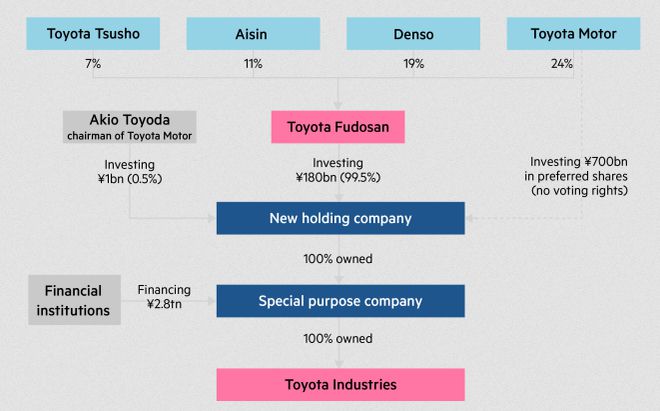
“让狐狸进入鸡舍”,丰田汽车因低价收购遭猛批
Guan Cha Zhe Wang· 2025-06-06 01:44
Core Viewpoint - Toyota's low privatization offer for Toyota Industries has faced significant backlash from shareholders, who argue that the bid undervalues their rights and the company's worth [1][3]. Group 1: Privatization Offer Details - Toyota's privatization bid for Toyota Industries is set at 4.7 trillion yen (approximately 235.1 billion yuan), which is criticized as being too low compared to the previously reported 6 trillion yen (approximately 302.2 billion yuan) offer [1][3]. - The offer price of 16,300 yen per share represents an 11% discount from Toyota Industries' closing price on the announcement day, although it is a 23% premium compared to the price before the privatization news [3][6]. - Following the announcement, Toyota Industries' stock price dropped by 12% on June 4 [3]. Group 2: Shareholder Reactions - Shareholders have expressed concerns regarding the fairness of the offer price and have requested more details on how the valuation was determined [3][4]. - Analysts suggest that a more appropriate offer would be in the range of 23,000 to 24,000 yen per share to reflect the full value of Toyota Industries, including its undervalued real estate assets [3][6]. Group 3: Corporate Governance and Historical Context - Toyota Industries was founded in 1926 and has maintained a close relationship with Toyota Motor Corporation through cross-shareholding and business collaborations [5][6]. - As of September 2024, Toyota Motor holds approximately 24% of Toyota Industries' shares, while Toyota Industries holds about 9% of Toyota Motor's shares [5]. - The recent push for corporate governance reform in Japan, including the issue of cross-shareholding, has led to Toyota Motor selling over 320 billion yen worth of cross-held shares, the highest among listed companies [6]. Group 4: Implications of the Offer - The low offer price has raised alarms among investors, who warn that it may hinder Japan's decade-long corporate governance reform efforts due to perceived unfair pricing and lack of transparency [6].
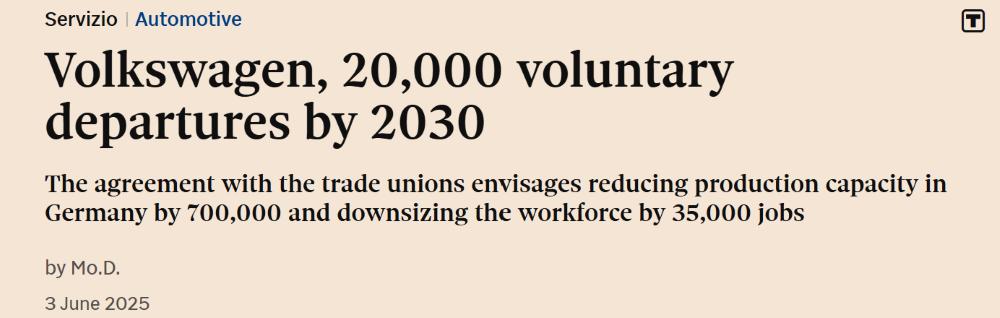
丰田“儿子变爹”,大众2万员工自愿离职,全球销量前二车企同时动刀
3 6 Ke· 2025-06-05 03:23
Group 1: Volkswagen Group Restructuring - Volkswagen Group plans to have approximately 20,000 employees voluntarily leave by 2030 as part of its restructuring efforts to address challenges in its German operations [3][5][19] - The company has made progress in controlling production costs at its Wolfsburg plant and is accelerating its transformation while responsibly reducing workforce numbers across its six German factories [3][5] - Volkswagen's restructuring includes a significant reduction in production capacity, with plans to cut over 700,000 units and lay off about 35,000 employees, which represents around 12% of the total workforce in Germany [7][19] Group 2: Toyota Group Restructuring - Toyota Industries Corporation has accepted a buyout proposal from the Toyota Motor-centered group, with the acquisition amount potentially reaching 300 billion RMB (approximately 60 trillion JPY) [4][12] - The restructuring aims to unify the shareholding structure within the Toyota group, eliminating cross-shareholdings with companies like Denso, Aisin, and Toyota Tsusho [12][19] - The new holding company will be funded through investments from Toyota Real Estate and loans from major Japanese banks, indicating a strategic move to enhance internal collaboration and streamline operations [18][19] Group 3: Industry-Wide Consolidation - The simultaneous restructuring efforts by Volkswagen and Toyota reflect the increasing pressure and anxiety faced by traditional automotive giants amid industry transformation [19] - The automotive sector is experiencing intensified competition, prompting a wave of consolidation among global car manufacturers, including domestic companies in China [4][19] - This trend suggests that the reshaping of the global automotive industry may just be beginning, as companies adapt to the challenges posed by electrification and digitalization [19]
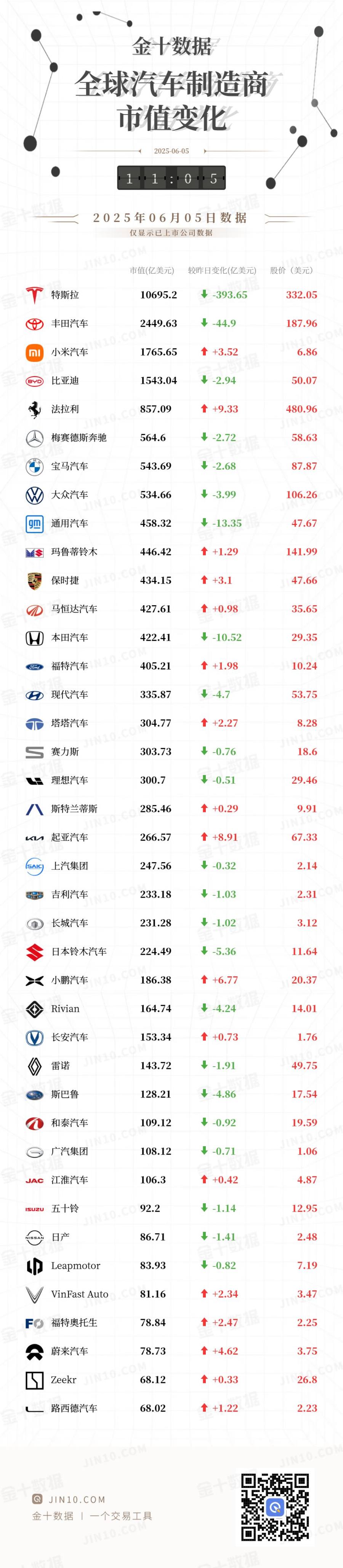
金十图示:2025年06月05日(周四)全球汽车制造商市值变化
news flash· 2025-06-05 03:12
Core Insights - The article presents the market capitalization changes of global automotive manufacturers as of June 5, 2025, highlighting significant fluctuations in values across various companies [1]. Group 1: Market Capitalization Changes - Tesla's market capitalization stands at $10,695.2 million, experiencing a decrease of $393.65 million [3]. - Toyota's market capitalization is $2,449.63 million, with a decline of $44.9 million [3]. - BYD's market capitalization is $1,543.04 million, showing a decrease of $2.94 million [3]. - General Motors has a market capitalization of $458.32 million, down by $13.35 million [4]. - Ford's market capitalization is $405.21 million, with an increase of $1.98 million [5]. Group 2: Notable Increases - Xiaomi Automotive shows a slight increase in market capitalization to $1,765.65 million, up by $3.52 million [3]. - Ferrari's market capitalization increased to $857.09 million, up by $9.33 million [3]. - Kia's market capitalization rose to $266.57 million, with an increase of $8.91 million [5]. - VinFast Auto's market capitalization is $81.16 million, increasing by $2.34 million [5]. Group 3: Other Companies - Mercedes-Benz has a market capitalization of $564.6 million, down by $2.72 million [3]. - Honda's market capitalization is $422.41 million, decreasing by $10.52 million [4]. - NISSAN's market capitalization is $86.71 million, down by $1.41 million [5].




价格降到“肉疼”、销量腰斩、员工“钱少事多”……合资车企,能否逆风翻盘?
第一财经· 2025-06-05 01:55
Core Viewpoint - The article discusses the significant challenges faced by joint venture automotive companies in China, highlighting the decline in market share and the impact of domestic electric vehicle brands on traditional players [3][20][32]. Group 1: Market Dynamics - As of 2024, joint venture automotive companies' market share in China has dropped to 35%, down from over 60% in 2020, primarily due to the rise of electric vehicles [3][4]. - The shift towards electric vehicles is expected to result in over 50% of new car sales in China being electric by 2024, which has eroded the competitive edge of traditional fuel vehicle brands [3][4]. - The decline in sales and profitability has led to significant operational challenges, including extended payment terms and workforce reductions [4][12]. Group 2: Financial Implications - The financial strain on joint venture companies has resulted in a cascading effect on their supply chains and dealership networks, with many dealers facing bankruptcy [11][12]. - By 2024, most joint venture companies have seen their sales drop by at least 50% compared to their peak years, indicating a collapse of the previous pricing structure [12][14]. Group 3: Internal Challenges - The internal culture within joint venture companies has shifted, with increased pressure on employees and a focus on strict attendance and performance metrics [15][29]. - The decision-making processes in joint ventures have been hampered by the need for consensus between foreign and local partners, which has slowed down responses to market changes [20][21]. Group 4: Strategic Responses - Some companies are beginning to adapt by consolidating operations and reducing production capacity in response to shrinking market demand [28]. - There is a growing recognition among joint venture companies of the need to align more closely with local market preferences, leading to increased local input in product development [29][30]. Group 5: Future Outlook - Despite the challenges, some joint venture companies are exploring partnerships with local electric vehicle manufacturers to enhance their competitive positioning [30][31]. - The survival of joint venture companies will depend on their ability to innovate and adapt to the rapidly changing automotive landscape in China [32].


合资车企逆风局
Di Yi Cai Jing· 2025-06-05 00:55
Group 1 - The core viewpoint of the articles highlights the significant decline of joint venture automotive companies in China, driven by the rise of domestic electric vehicle brands and changing consumer preferences [1][2][17] - Joint venture companies held over 60% market share in 2020, but this has dropped to 35% by 2024, indicating a major shift in the automotive landscape [2][21] - The decline in sales and profitability for joint venture companies has led to layoffs and operational challenges, with many companies struggling to adapt to the new market dynamics [2][8][12] Group 2 - The crisis for joint venture companies began around 2019, with a noticeable shift in financing practices as dealers sought better loan conditions from banks rather than automotive financial companies [7][8] - The pandemic exacerbated existing issues, as foreign executives were unable to gauge the rapidly changing Chinese market, leading to a lack of urgency in addressing the challenges [17][18] - The traditional decision-making structure of joint ventures, requiring consensus between foreign and local partners, has hindered their ability to respond quickly to market changes [18][19] Group 3 - The competitive landscape has shifted, with domestic brands like AITO and Li Auto gaining traction, prompting established brands to reconsider their strategies [1][27] - Joint venture companies are now exploring partnerships with local firms to leverage technology and adapt to the electric vehicle market, as seen with Audi and Toyota's recent collaborations [27][28] - The overall sentiment within the industry reflects a need for transformation, with some companies adopting a more aggressive and flexible approach to survive the current downturn [25][29]

GM vs. TM: How Do These Legacy Giants Stack Up in the Auto Space?
ZACKS· 2025-06-04 15:56
Core Insights - General Motors (GM) and Toyota Motor (TM) are major competitors in the global auto industry, with GM leading U.S. sales in 2024 at over 2.7 million vehicles, a 4% increase year-over-year, while Toyota sold 2.33 million units, a 3.7% increase [1][2] - Globally, Toyota outperformed GM, selling 10.8 million vehicles compared to GM's 6 million, reflecting a significant market value difference of approximately $255 billion for Toyota versus just under $50 billion for GM [2] General Motors Overview - GM has shown resilience by beating earnings expectations but faces a challenging near-term outlook due to tariff pressures and supply chain vulnerabilities [6][7] - The company revised its full-year adjusted EBIT outlook to $10 billion to $12.5 billion, down from $13.7 billion to $15.7 billion, and suspended its share buyback program, raising investor concerns [7][10] - GM anticipates a $2 billion impact from South Korean operations, which are critical to its sales, and its reliance on manufacturing in Mexico and Canada adds uncertainty [8] - Despite being the second-largest EV seller in the U.S., GM's electric vehicle ambitions are still uncertain, with heavy investments impacting free cash flow, which has been revised down to $7.5 billion to $10 billion [9][10] - The long-term sales and earnings estimates for GM indicate a year-over-year decline of 5.3% and 12%, respectively, reflecting a challenging outlook [11] Toyota Overview - Toyota continues to demonstrate strong performance, exceeding earnings expectations and forecasting growth in sales volumes and revenues for fiscal 2026, despite anticipated profit pressures [13][14] - The company expects a 21% drop in operating income for fiscal 2026 due to rising material costs and tariffs, but projects sales of 10.4 million vehicles, driven by a strong demand for electrified vehicles [14][15] - Toyota's hybrid-first strategy is resonating well with consumers, with significant sales expected from hybrids and plug-ins, and it is also expanding its hydrogen initiatives [16][17] - The company has consistently raised its dividends, with an increase to 90 yen per share in fiscal 2025 and an expected rise to 95 yen in fiscal 2026, indicating a stable financial strategy [17] - The consensus estimates for Toyota's sales imply a 6% growth year-over-year, although EPS estimates indicate a decline of 13.5% [18] Comparative Analysis - Both GM and Toyota are facing challenges from tariffs and rising costs, impacting profitability, but Toyota's global scale and disciplined strategy provide a stronger foundation [20] - GM is making progress in the EV sector but is hindered by near-term challenges and reduced financial forecasts, while Toyota maintains steady growth in electrified sales and dividends [20]