Venture(VEMLY)

Search documents
“青春经济”方兴未艾 上海市人大代表:降低创业门槛、入库培育有潜力品牌
Zhong Guo Xin Wen Wang· 2026-02-05 06:39
中新网上海2月5日电(记者陈静)5日举行的上海市十六届人大四次会议上,"青春经济"成为多位上海市 人大代表提及的"热词"。他们为更好地支持青年发展,激发上海消费新活力,系统引导青春经济蓬勃力 量建言献策。 "青春经济是以青年群体为创新创业主体和核心消费主体,聚焦满足青年成长发展需要和美好生活需 求,提供商品供给和服务体验的新兴经济形态。"上海市人大代表邬斌认为,青年群体是消费的"风向 标",在贯通供给与需求两端发挥着举足轻重的作用,其消费日益呈现出个性化、体验式、社交型等新 趋势,催生"情绪消费""种草消费""悦己消费"等新模式和增长点。 王芳则建议由政府部门牵头,制定《上海市青春经济高质量均衡发展行动方案》:明确中心城区为创新 策源与流量核心区,聚焦高能级首店、原创IP等;新城及远郊区为功能赋能转化区、特色场景体验区, 承接溢出效应并打造特色IP;实施"空间焕青"计划,盘活远郊老旧厂房、闲置楼宇等资源,通过政策资 金支持改造为创客中心、潮流文创街区等活力载体,形成青年生活圈。同时,推动市级重点青春文化活 动的部分内容定点导入远郊,开发联名产品或限定体验项目。这位上海市人大代表还建议设立上海青年 议事会、青年 ...

20cm速递|新能源板块回调,创业板新能源ETF国泰(159387)回调超4%,资金持续布局,近20日资金净流入超8亿元
Mei Ri Jing Ji Xin Wen· 2026-02-05 05:26
新能源板块回调,创业板新能源ETF国泰(159387)回调超4%,资金持续布局,近20日资金净流 入超8亿元。 创业板新能源ETF国泰(159387)跟踪的是创新能源指数(399266),单日涨跌幅限制达20%,该 指数从沪深市场中选取涉及太阳能、风能、电动汽车等清洁能源技术及相关产业链的上市公司证券作为 指数样本,以反映新能源领域在技术创新与可持续发展方面的整体表现。行业配置侧重于可再生能源及 相关产业链。 (责任编辑:董萍萍 ) 【免责声明】本文仅代表作者本人观点,与和讯网无关。和讯网站对文中陈述、观点判断保持中立,不对所包含内容 的准确性、可靠性或完整性提供任何明示或暗示的保证。请读者仅作参考,并请自行承担全部责任。邮箱: news_center@staff.hexun.com 相关机构表示,数据中心已成为电力设备行业核心增量应用场景,其发展趋势直接驱动电力设备需 求增长与技术迭代。2024年全球数据中心新增装机量约14GW,且单机柜功率密度大幅提升,对电力供 给的稳定性、能效性提出更高要求。行业景气度由下游资本开支直接驱动,2025年三季度海外大厂资本 开支总和达996.17亿美元,同比增80.39% ...
拌饭品类报告:24亿人次热捧,却是创业“修罗场”
3 6 Ke· 2026-02-05 03:47
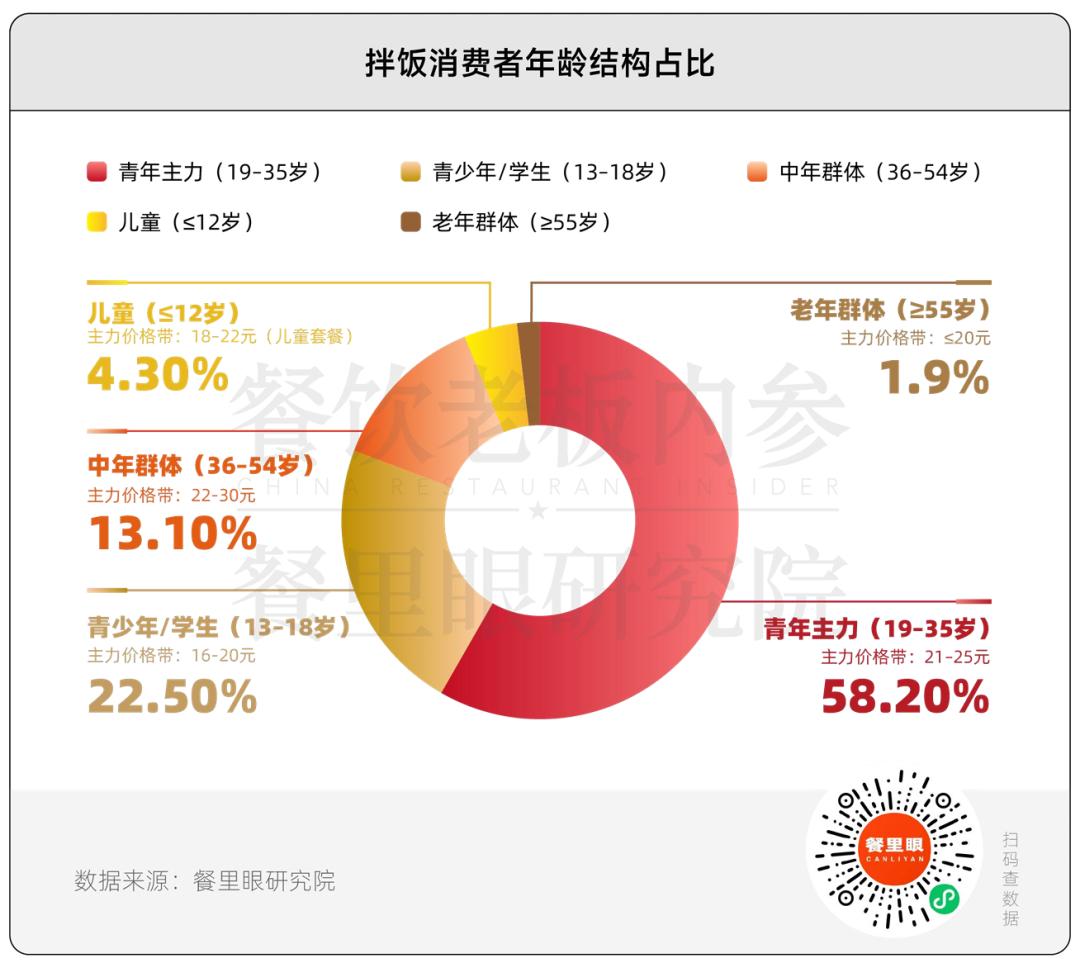
Core Insights - The article highlights the growth trajectory of the rice bowl category in the Chinese fast food market, which has seen continuous growth over the past decade, reaching a market size of over 120 billion yuan by 2025 with a year-on-year growth rate of 7.1% [3][4] - The rice bowl category is at a critical juncture as leading brands are beginning to slow down their expansion after a period of rapid growth, indicating potential challenges ahead [1][18] Market Growth - The rice bowl category has achieved a significant scale-up, with 62,000 stores projected by 2025, driven by the essential demand for rice-based meals and the synergy of dine-in and takeout channels [3][4] - The consumer base has expanded dramatically, with the number of consumers rising from 850 million to 2.4 billion in the last five years, indicating a nearly threefold increase [6] Consumer Demographics - The primary consumer demographic for rice bowls is the young population aged 19-35, which constitutes 58.2% of the market, reflecting a trend towards high-quality, affordable meals [7][10] - The rice bowl category aligns well with the preferences of this demographic, emphasizing value for money, quick service, and health-conscious options [7][10] Competitive Landscape - The competitive landscape features two leading brands, Mi Village and Uncle Park, with over 1,900 and 1,200 stores respectively, while several smaller brands are also establishing their presence [5][18] - The market is characterized by regional competition, with a lack of truly national chains, leading to a fragmented market structure [18][19] Store Distribution - The majority of rice bowl stores are located in third-tier cities, which account for 15,500 stores and 25% of the market share, highlighting a shift from traditional urban centers [4][15] - Small to medium-sized stores (≤50㎡) dominate the market, making up 65% of the total, which aligns with the fast food model of high efficiency and low cost [15] Consumer Preferences - Price sensitivity and quality are the top factors influencing consumer choices, with 28.6% prioritizing price-performance ratio, indicating a strong demand for affordable yet satisfying meals [17] - The rice bowl category is perceived as a "top choice for workers," emphasizing its role as a staple in the fast food segment [17] Challenges Ahead - Despite the growth, the rice bowl category faces challenges such as high closure rates, regional fragmentation, and product homogenization, which could threaten the sustainability of smaller brands [18][19] - The market is described as a "fast-growing, fast-dying" environment, where many small brands struggle to survive beyond six months due to intense competition [19]

一位经济学家给出的就业、创业和学区房、海南封关忠告!
Sou Hu Cai Jing· 2026-02-05 03:25
Group 1 - The core theme revolves around the importance of establishing a rational cognitive system to navigate the complexities of the market, emphasizing the need for a balance between macro trends and individual experiences [2] - The research approach combines macroeconomic analysis with grassroots insights, highlighting the significance of understanding real-life situations to validate data-driven conclusions [3][4] - The narrative includes a compelling story of a farmer who successfully adapted to e-commerce, illustrating the proactive learning and actions that can lead to significant economic improvement [5][6] Group 2 - Key industries reshaping China's talent and urban landscape include renewable energy, digital economy, and high-end manufacturing, with talent gravitating towards major urban centers [9] - The urban talent attraction strategy involves creating quality job opportunities, implementing supportive policies, and enhancing public services to retain talent [9] - When choosing a city for future living and work, it is advised to consider economic vitality, talent policies, living costs, and social ecology, rather than following trends blindly [9] Group 3 - The definition of real estate value is shifting from a general appreciation expectation to a dual logic of "residential attributes + resource scarcity," emphasizing the importance of location and community amenities [10][11] - The concept of school district housing is evolving due to educational policy reforms, making it a high-risk asset; families are advised to focus on practical living needs rather than speculative investments [11] Group 4 - The tourism real estate market is not universally favorable for investment, with opportunities limited to select high-quality vacation areas; investors should be cautious of liquidity, operational, and supply risks [12][13] - The opening of Hainan's entire island is expected to create job opportunities in cross-border trade and tourism, along with favorable conditions for entrepreneurship in e-commerce and agriculture [13][14][15] Group 5 - Recommendations for asset allocation over the next 3-5 years include prioritizing safety, diversifying investments, and making dynamic adjustments; real estate should focus on core areas with population inflow [16] - It is suggested to maintain emergency cash reserves, invest in index funds and high-dividend stocks, and allocate funds for future needs such as education and healthcare [16]

谷歌AI支出远超市场预期,资金逢低布局,低费率创业板人工智能ETF华夏(159381)成交额迅速过亿元
Xin Lang Cai Jing· 2026-02-05 02:41
Group 1 - The AI technology sector is experiencing a pullback, with notable declines in ETFs such as the Huaxia AI ETF (159381) and the Huaxia Communication ETF (515050), both dropping over 2% [1] - The total trading volume for these ETFs surpassed 160 million yuan, indicating significant market activity despite the downturn [1] - Major stocks like Taicheng Technology, Guangku Technology, and Dongshan Precision are among the hardest hit, suggesting a broader market correction [1] Group 2 - Guoyuan Securities highlights a systematic upgrade in AI computing infrastructure to meet the explosive demand for computing power, focusing on building efficient, low-latency, and low-cost interconnected networks [2] - The evolution of computing power expansion is shifting from vertical scaling (ScaleUp) to distributed cluster horizontal scaling (ScaleOut) and cross-domain collaboration (ScaleAcross) [2] - Key hardware such as optical modules and switches are undergoing rapid innovation, with domestic optical module manufacturers gaining a leading position in the global market, poised to benefit from the expansion of AI computing infrastructure [2] Group 3 - The Huaxia AI ETF (159381) tracks an index with nearly 50% weight in CPO, covering domestic software and AI application companies, providing high elasticity [3] - The top three weighted stocks in the ETF are Zhongji Xuchuang (15.64%), Xinyi Sheng (15.57%), and Tianfu Communication (6.85%), with a combined weight ranking first in the market [3] - The Huaxia Communication ETF (515050) has a scale exceeding 8 billion yuan, deeply covering optical modules, communication equipment, and computing infrastructure, with CPO and CPB concept stocks accounting for over 76% of its weight [3]
A股指数走弱:创业板指跌超2%、沪指跌逾1%,下跌个股近3500只
Feng Huang Wang Cai Jing· 2026-02-05 02:33
| | | | | 沪深京重要指数 | | | | --- | --- | --- | --- | --- | --- | --- | | 名称 *● | 咸新 | 涨幅% | | | 涨跌 涨跌家数 | 金额 | | 上证指数 | 4060.41 | -1.02 | -41.79 | 802/1471 | 0.01 | 2.61亿 15.8万 4142.34亿 | | 深证成指 | 13901.28 -1.80 -254.99 | | | 966/1882 | -0.02 3.37 7 | 16.4万5668.72亿 | | 北证50 | 1523.35 | -0.99 | -15.22 | 63/222 | 0.04 33万 | 1660 82.66 Z | | 创业板指 | 3243.49 | -2.05 | -68.02 | 433/934 | -0.10 9877 | 5.01万 2595.20亿 | 贵金属板块盘中大面积调整,湖南白银封跌停,晓程科技跌超10%,白银有色触及跌停,四川黄金、湖 南黄金、豫光金铅、招金黄金等跌幅靠前。消息面上,现货白银日内跌超4%,逼近85美元大关,另外 现货黄金价格 ...

“实”字托底干事创业(思想纵横)
Ren Min Ri Bao· 2026-02-05 02:20
Group 1 - The core message emphasizes the importance of practical action ("实") in governance and achieving historical accomplishments under the leadership of Xi Jinping [1][4] - The concept of a correct performance view is highlighted as essential for effective governance, focusing on genuine benefits for the people rather than personal gain [2][3] - The need for unity of knowledge and action is stressed, with a call to move beyond formalism and ensure that practical measures are implemented effectively [3][4] Group 2 - Establishing a long-term mechanism and improving institutional safeguards are crucial for embedding the principle of practicality in governance [4] - The importance of optimizing performance assessment criteria to include public satisfaction and actual development outcomes is noted, with a focus on accountability for superficial achievements [4] - The quote from Xi Jinping underscores that practical action is the necessary path to achieving goals, linking ideals with reality through diligent efforts [4]
A股开盘:沪指跌0.66%、创业板指跌1.02%,银行股高开,黄金、有色金属及光伏概念股集体调整
Jin Rong Jie· 2026-02-05 01:39
Market Overview - The A-share market opened lower on February 5, with the Shanghai Composite Index down 27.18 points, a decrease of 0.66%, closing at 4075.03 points [1] - The Shenzhen Component Index fell by 135.43 points, a decline of 0.96%, closing at 14020.84 points [1] - The CSI 300 Index decreased by 33.94 points, down 0.72%, closing at 4664.75 points [1] - The ChiNext Index dropped by 33.79 points, a decline of 1.02%, closing at 3277.72 points [1] - The STAR 50 Index fell by 29.82 points, down 2.05%, closing at 1423.66 points [1] Sector Performance - The photovoltaic equipment sector experienced a pullback, with major stocks like Aotewi down over 10% and Junda Co. and Jincheng Co. both down over 9% [1] - The precious metals sector opened lower, with Hunan Silver down over 6% and other stocks like Sichuan Gold and Xiaocheng Technology also declining [1] - The banking sector was active at the start, with Qilu Bank rising nearly 3% and other banks like Chongqing Bank and Jiangyin Bank also seeing gains [1] Company News - The EU has announced an investigation into Goldwind Technology due to concerns about government subsidies distorting market competition [3] - The Chinese Foreign Ministry criticized the EU's unilateral trade measures as discriminatory and damaging to the EU's image [3] - Market rumors suggest that Elon Musk's team visited several Chinese photovoltaic companies, but confirmed that no cooperation agreements have been signed [3][7] - Companies like Jingsheng Mechanical and Dualgood Energy stated that the "space photovoltaic" application is still in the exploratory stage and has not impacted their current performance [4] - Long光华芯 faced issues with false information regarding a supposed investment from Huawei, which the company strongly condemned [4] Industry Developments - The AI industry is entering a critical phase, with a focus on the integration of AI into manufacturing and the development of key technologies [8][15] - The commercial aerospace sector is seeing new opportunities with the establishment of satellite launch technology facilities, which could enhance launch efficiency and reduce costs [9] - The coal market is facing changes due to Indonesia's proposed production cuts, which may impact China's coal supply [12]





A股指数集体低开:创业板指跌超1%,贵金属、光伏等板块跌幅居前
Feng Huang Wang Cai Jing· 2026-02-05 01:35
Market Overview - Major indices opened lower, with the Shanghai Composite Index down 0.66%, Shenzhen Component down 0.96%, and ChiNext down 1.02% [1] - The decline was led by sectors such as precious metals, photovoltaic, and semiconductor chips [1] Index Performance - Shanghai Composite Index: 4075.03, down 0.66%, with 460 gainers and 1493 losers [2] - Shenzhen Component: 14020.84, down 0.96%, with 396 gainers and 2202 losers [2] - ChiNext Index: 3277.72, down 1.02%, with 182 gainers and 1099 losers [2] External Market Influence - U.S. stock markets continued to experience style rotation, with the Nasdaq down over 1% for the second consecutive day [3] - The S&P 500 Index fell by 0.51%, while the Dow Jones Industrial Average rose by 0.53% [3] - Chinese concept stocks were affected, with the Nasdaq Golden Dragon China Index down 1.95% [3] Sector Insights - CICC forecasts breakthroughs in large model technology in areas such as reinforcement learning and contextual engineering by 2026 [4] - Zhongtai Securities expresses a positive outlook on the raw material drug sector, highlighting the potential of innovative drug tracks like small nucleic acids and peptides [5] - CITIC Securities recommends focusing on automotive companies with strong cost transfer capabilities and global layouts due to rising raw material prices impacting profit margins [7]

对话北生所所长王晓东:创新没什么难的,创业要交学费
Jing Ji Guan Cha Wang· 2026-02-05 01:28
Core Insights - The conversation with Wang Xiaodong, the director of Beijing Institute of Life Sciences and founder of BeiGene and Vitaron, highlights his straightforward approach and humor, reflecting his scientific mindset and leadership in the field of biotechnology [2][3]. Group 1: Company Overview - BeiGene has established itself as a leader in China's innovative drug sector, focusing on oncology, particularly in developing first-in-class cancer therapies [5][9]. - The company was founded to address the lack of domestic cancer drugs in China, with a vision to fill this gap and improve patient outcomes [5][10]. - Wang Xiaodong emphasizes the importance of learning from early entrepreneurial challenges, indicating that the journey involved significant trial and error in drug development [5][8]. Group 2: Entrepreneurial Impact - The "BeiGene Effect" has inspired numerous scientists from the Beijing Institute of Life Sciences to pursue entrepreneurship, leading to the establishment of several innovative companies [15][18]. - Since 2011, seven scientists from the institute have launched their own companies, contributing to a broader trend of scientific entrepreneurship in China [15][18]. Group 3: Challenges and Resilience - Wang Xiaodong acknowledges the difficulties faced in the entrepreneurial journey, including recent leadership changes at Vitaron, which he views as part of the ongoing challenges in the industry [11][12][14]. - He reflects on the importance of perseverance and adaptability in overcoming obstacles, stating that the entrepreneurial path is rarely smooth [10][11]. Group 4: Research and Development Environment - The Beijing Institute of Life Sciences has made significant strides in bridging the gap between academic research and industrial application, creating a conducive environment for innovation [16][17]. - The institute has established various centers to facilitate the transformation of basic research into commercially viable products, addressing previous disconnects between academia and industry [16][17]. Group 5: Future Outlook - Wang Xiaodong expresses optimism about the future of biotechnology in China, noting the increasing support from the government and the growing pool of talent in the field [26][27]. - He believes that the current environment is the best the institute has experienced in years, with improved funding and collaboration opportunities [26][27].