
Yuanbao Inc.(YB)

Search documents
Yuanbao Inc.(YB) - 2025 Q3 - Earnings Call Transcript
2025-12-03 13:00
Financial Data and Key Metrics Changes - Total revenues grew 33.6% year-over-year to RMB 1.16 billion, with net income surging 51.3% year-over-year to RMB 317 million, marking the 13th consecutive quarter of profitability [4][16][18] - Cash reserves stood at RMB 3.75 billion, providing a solid financial foundation for continued innovation and expansion [4][19] - Non-GAAP adjusted net income rose by 51.7% to RMB 390 million, representing a non-GAAP net income margin of 33.7%, up from 29.7% a year ago [18] Business Line Data and Key Metrics Changes - Revenue from insurance distribution services reached RMB 373.3 million, marking a year-over-year increase of 27.9% [16] - System services revenues reached RMB 783.5 million, a 36.9% increase compared with the same period last year, driven by improvements in AI-integrated services [16][17] Market Data and Key Metrics Changes - The commercial health insurance sector is evolving into a vital component of China's multi-tiered healthcare protection system, with significant growth potential due to an aging population and unmet health protection needs [8][35] - The relationship between social health insurance and commercial health insurance is entering a new stage of synergy and complementarity, indicating a growing market for commercial health insurance [8][35] Company Strategy and Development Direction - The company is focused on leveraging AI technology to enhance operational efficiency and service capabilities, embedding AI into product design, operational workflows, and decision-making systems [9][13][42] - The strategy includes filling market gaps with innovative inclusive insurance offerings that lower barriers to access, while also optimizing cost structures to improve consumer value [7][13] Management Comments on Operating Environment and Future Outlook - Management highlighted the importance of establishing an internet-enabled service model to meet the health protection needs of underserved families, translating latent demand into growth [8][14] - The company aims to continue upgrading its service model towards greater personalization and proactive care, while exploring new growth opportunities through AI integration [14][35] Other Important Information - Total operating expenses increased by 31.2% year-over-year to RMB 803.4 million, with significant increases in G&A and R&D expenses reflecting investments in personnel and technology [18] - The company has built a systematic AI-driven competitive mode that enhances operational efficiency and elevates service capabilities [9][42] Q&A Session Summary Question: Selling and marketing expenses efficiency - Management noted improvements in selling and marketing expenses as a percentage of revenue, attributing this to dynamic adjustments in strategy based on growth and ROI targets [21][28] Question: Impact of new tax regulation on ad spend - Management indicated no material impact from the new 15% cap on ad spend deduction, but acknowledged potential industry-wide effects if it becomes a standard [23][24] Question: Future revenue growth drivers - Management identified market tailwinds, cross-selling, and data advantages as key drivers for sustainable growth over the next few years [41][49] Question: Brand strategy against ecosystem players - Management emphasized the importance of operational excellence and collaborative iteration across teams to strengthen the brand and improve customer loyalty [48][52]
元保发布第三季度财报:营收达11.58亿元,AI驱动业务成效显著
Ge Long Hui· 2025-12-03 10:07
Group 1: Financial Performance - In Q3 2025, the company reported total revenue of RMB 1.158 billion, representing a year-on-year growth of 33.6% [1] - The net profit for the same period reached RMB 370 million, showing a year-on-year increase of 51.3% [1] - As of September 30, 2025, the company's cash reserves stood at RMB 3.75 billion, indicating a solid financial position [1] Group 2: Technological Advancements - The company's model library expanded to over 4,900 models and 5,500 features, with approximately 400 new models and 750 new features added year-on-year [1] - The introduction of large language models (LLM) has significantly enhanced operational efficiency, with AI-generated code accounting for nearly 50% of the coding process in Q3 [1] - The AI team comprises over 10% of the total workforce, reflecting the company's commitment to technology [1] Group 3: Market Trends and Product Development - The establishment of a national "medical insurance + commercial insurance" settlement center has integrated commercial insurance into China's multi-tiered medical security system [2] - The company is focusing on the inclusive health insurance sector, launching a short-term critical illness insurance product that combines a "one-time payment + multiple reimbursements" model [2] - The customer service center has introduced a "Five Hearts Service" standard to enhance the user experience throughout the entire process [2]
Yuanbao Inc. Announces Third Quarter 2025 Unaudited Financial Results
Globenewswire· 2025-12-03 10:00
Core Insights - Yuanbao Inc. reported strong financial performance in Q3 2025, with total revenues of RMB1,157.9 million (US$162.6 million), a 33.6% increase year-over-year, and net income of RMB370.4 million (US$52.0 million), reflecting a 51.3% increase from the previous year [6][18][7]. Financial Performance - Total revenues for Q3 2025 were RMB1,157.9 million (US$162.6 million), up from RMB866.8 million in Q3 2024 [6][8]. - Net income for Q3 2025 was RMB370.4 million (US$52.0 million), compared to RMB244.8 million in Q3 2024 [6][18]. - The net income margin improved to 32.0% in Q3 2025 from 28.2% in Q3 2024 [18]. - For the first nine months of 2025, total revenues reached RMB3,197.9 million (US$449.2 million), a 33.5% increase year-over-year [8]. Operational Highlights - The number of new policies issued in Q3 2025 was 8.0 million, a 41.8% increase from 5.7 million in Q3 2024 [4][6]. - The R&D team constituted nearly 70% of the total workforce, with over 10% focused on AI innovation [4]. - The company integrated over 4,900 AI models capable of analyzing more than 5,500 labels, enhancing customer acquisition and profitability [4]. Revenue Breakdown - Revenues from insurance distribution services in Q3 2025 were RMB373.3 million (US$52.4 million), a 27.9% increase from RMB291.9 million in Q3 2024 [9]. - Revenues from system services in Q3 2025 were RMB783.5 million (US$110.1 million), a 36.9% increase from RMB572.2 million in Q3 2024 [10]. - Revenues from other services decreased to RMB1.1 million (US$0.2 million), down 59.7% year-over-year [11]. Cost and Expenses - Total operating costs and expenses in Q3 2025 were RMB803.4 million (US$112.8 million), a 31.2% increase from RMB612.2 million in Q3 2024 [12]. - Selling and marketing expenses rose to RMB569.6 million (US$80.0 million), a 23.9% increase from RMB459.6 million in Q3 2024 [14]. - General and administrative expenses surged to RMB93.1 million (US$13.1 million), a 97.8% increase from RMB47.1 million in Q3 2024 [15]. - Research and development expenses increased to RMB95.6 million (US$13.4 million), a 56.8% rise from RMB60.9 million in Q3 2024 [16]. Cash Flow and Position - As of September 30, 2025, the company had cash and cash equivalents totaling RMB3.75 billion (US$526.8 million), an 82.3% increase year-over-year [21]. - Net cash provided by operating activities in Q3 2025 was RMB326.1 million (US$45.8 million) [22].
北方化学工业股份有限公司修订公司章程 注册资本5.49亿元保持不变 多项条款优化公司治理结构
Xin Lang Cai Jing· 2025-12-01 14:05
Core Viewpoint - The recent amendments to the Articles of Association of North Chemical Industry Co., Ltd. aim to optimize corporate governance, enhance compliance operations, and protect the legitimate rights and interests of shareholders, employees, and creditors [1][12]. Group 1: Employee Rights and Governance Structure - The revised Articles explicitly include "employees" in the scope of rights protection, reflecting the company's commitment to employee rights [2] - The definition of senior management has been refined to focus on core operational responsibilities, excluding political roles [5] - The "occupy and freeze" mechanism has been deleted, which previously mandated immediate judicial freezing of assets in case of major shareholder asset encroachment [6] Group 2: Legal Responsibilities and Accountability - The responsibilities of the legal representative have been clarified, linking the position directly to the company's operations and establishing a mechanism for the company to seek compensation from the legal representative for damages caused during duty execution [4] - A new section has been added to outline the obligations of controlling shareholders and actual controllers, prohibiting them from harming the company's interests or misusing company funds [7] Group 3: Decision-Making and Shareholder Rights - The decision-making process for external guarantees and financial assistance has been detailed, with specific limits set on the total amount of financial assistance [8] - New provisions have been introduced to clarify the circumstances under which shareholder meeting resolutions may be deemed invalid, ensuring timely legal recourse [9] - The profit distribution process has been optimized to allow for more flexible mid-term dividend arrangements [10] - The company must engage with minority shareholders through various channels during cash dividend discussions, enhancing their influence [11] Group 4: Implementation and Compliance - The revised Articles will take effect upon approval by the shareholders' meeting, and the company commits to adhering to the new disclosure obligations to safeguard all shareholders' rights [12]
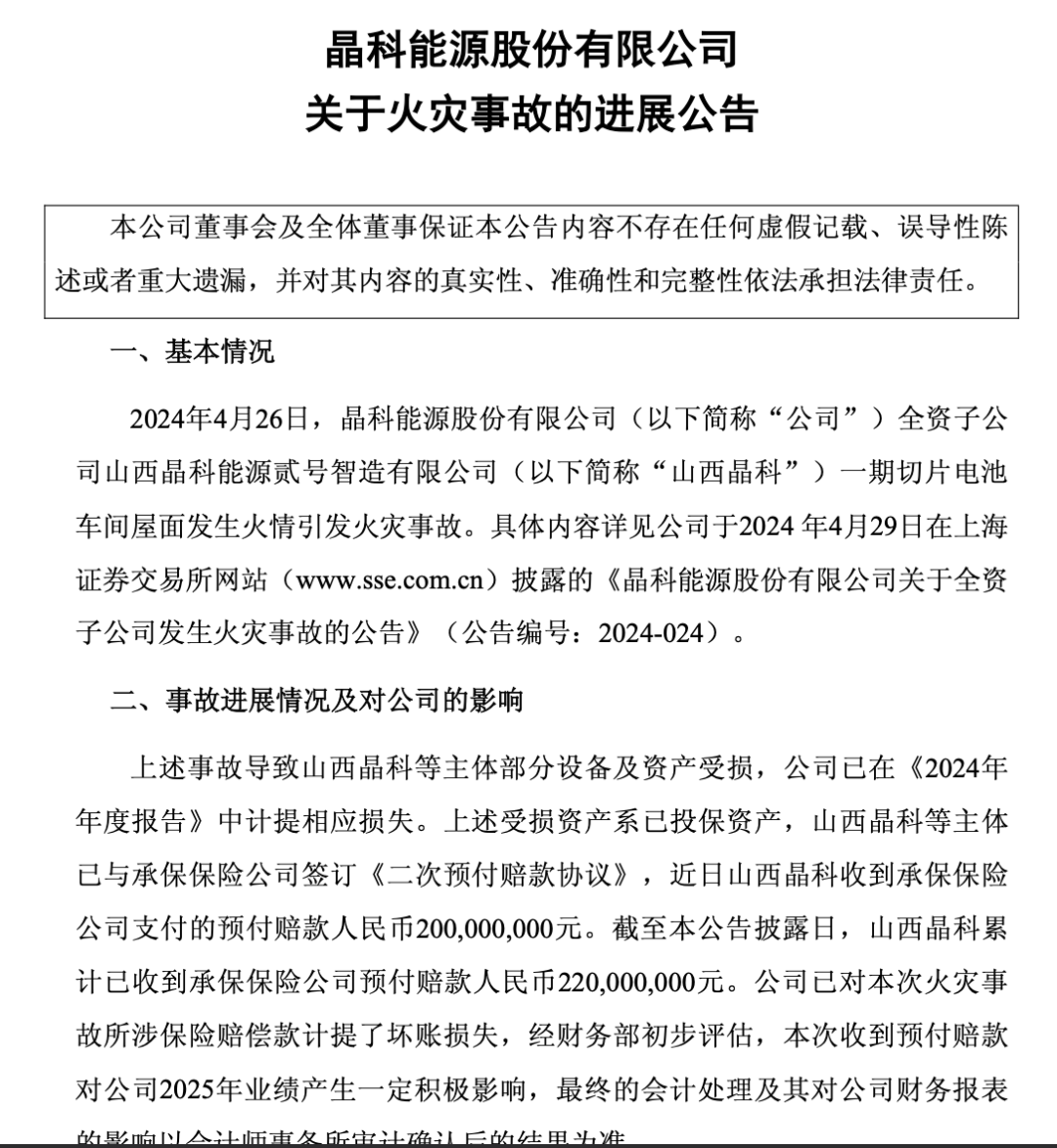
工厂发生火灾 2.2亿元保险预付赔款已到账 “对业绩有积极影响”!A股巨头去年净利跌去98% 今年能否翻身?
Mei Ri Jing Ji Xin Wen· 2025-11-30 14:12
Core Viewpoint - JinkoSolar, the world's largest photovoltaic module company, reported on the progress of a fire incident at its wholly-owned subsidiary, Shanxi Jinko Energy No. 2 Manufacturing Co., which occurred on April 26, 2024, and has implications for its financial performance and insurance claims [1][5][6]. Financial Impact - The fire incident resulted in damage to certain equipment and assets, leading the company to recognize corresponding losses in its 2024 annual report [5]. - Shanxi Jinko has received a prepayment of 200 million yuan from its insurance company, with a total of 220 million yuan received as of the announcement date [5]. - The prepayment is expected to positively impact the company's performance in 2025, although the final accounting treatment and its effects on financial statements will require confirmation from the auditing firm [5]. Operational Status - The fire occurred in the roof of the first-phase wafer battery workshop, which was still under construction at the time of the incident, meaning the company did not have statutory management responsibilities under the Production Safety Law of the People's Republic of China [6]. - The first phase of the Shanxi base, including the crystal pulling and module workshops, has been completed and is operational, while the wafer battery workshop is currently under reconstruction [6]. Market Performance - In 2024, JinkoSolar reported revenues of 92.471 billion yuan, a year-on-year decrease of 22.08%, and a net profit attributable to shareholders of 9.89276 million yuan, down 98.67% [7]. - For the first three quarters of the year, the company recorded revenues of 47.986 billion yuan, a decline of 33.14%, and a net loss of 3.920 billion yuan, a drop of 422.67% [7]. - The losses are attributed to intensified competition in the photovoltaic market and a continuous decline in product prices [7]. Future Outlook - JinkoSolar aims to ship 6 GWh of energy storage systems in 2024, with over 80% expected to come from overseas markets, particularly high-margin markets in Europe and the U.S. [7]. - The company anticipates significant improvement in profitability in the fourth quarter and next year as overseas orders are delivered and revenue is recognized [7]. Stock Performance - As of November 28, JinkoSolar's stock price increased by 0.54% to 5.63 yuan per share, with a total market capitalization of 56.3 billion yuan [8].


工厂发生火灾,2.2亿元保险预付赔款已到账,“对业绩有积极影响”!A股巨头去年净利跌去98%,今年能否翻身?
Mei Ri Jing Ji Xin Wen· 2025-11-30 13:44
Core Viewpoint - JinkoSolar, the world's largest photovoltaic module company, reported on the progress of a fire incident at its wholly-owned subsidiary, Shanxi Jinko Energy No. 2 Intelligent Manufacturing Co., which occurred on April 26, 2024, and has implications for its financial performance and insurance claims [1][4][6]. Financial Impact - The fire incident resulted in damage to certain equipment and assets, leading the company to recognize corresponding losses in its 2024 annual report [4]. - Shanxi Jinko has signed a "Second Prepayment Agreement" with its insurance company and has received a prepayment of 200 million yuan, totaling 220 million yuan received as of the announcement date [4]. - The prepayment is expected to have a positive impact on the company's 2025 performance, although the final accounting treatment and its effects on financial statements will require confirmation from the auditing firm [4]. Operational Status - The fire occurred while the first phase of the slicing battery workshop was under construction and not yet delivered, meaning the company does not bear statutory management responsibilities under the Production Safety Law of the People's Republic of China [6]. - The first phase of the Shanxi base, including the crystal pulling and module workshops, has been completed and is operational, while the slicing battery workshop is currently under reconstruction [6]. Production and Market Context - The total investment for the Shanxi large base project is approximately 56 billion yuan, divided into four phases, with the first phase having commenced production on March 26, 2024 [7]. - The second phase is planned to start production by the end of July 2024, with full production expected by the end of 2024 [7]. Financial Performance - For 2024, JinkoSolar reported revenue of 92.471 billion yuan, a year-on-year decrease of 22.08%, and a net profit attributable to shareholders of 9.89276 million yuan, down 98.67% [8]. - In the first three quarters of 2024, the company recorded revenue of 47.986 billion yuan, a decline of 33.14%, and a net loss of 3.920 billion yuan, a decrease of 422.67% [8]. - The losses are attributed to intensified competition in the photovoltaic market and a continuous decline in product prices [8]. Future Outlook - JinkoSolar aims to ship 6 GWh of energy storage systems this year, with over 80% expected to come from overseas markets, particularly high-margin markets in Europe and the U.S. [8]. - The company anticipates significant improvement in profitability in the fourth quarter and next year as overseas orders are delivered and revenue is recognized [8]. Stock Performance - As of November 28, JinkoSolar's stock price increased by 0.54% to 5.63 yuan per share, with a total market capitalization of 56.3 billion yuan [9].
33万亿元保险资管新趋势:产品增长率五年来首次为负 系统内资金仍存韧性
Zhong Guo Jing Ying Bao· 2025-11-30 11:45
Core Insights - The report indicates that by the end of 2024, the total assets under management (AUM) of 34 insurance asset management companies will reach 33.3 trillion yuan, reflecting a year-on-year growth of 10.6% [1] - The total revenue for the year is projected to be 31.83 billion yuan, with a growth rate of 7.31% [1] - However, there are concerning trends in the sources of managed funds and the structure of insurance asset management products, with a decline in third-party fund growth and a negative growth rate in insurance asset management products for the first time in five years [1][2] Fund Sources and Third-Party Funds - The growth rate of third-party funds, including third-party insurance funds and external funds, has declined, with third-party insurance funds experiencing a negative growth rate of -1.5%, down 13.42 percentage points year-on-year [2] - Pension fund growth has decreased by 44.26 percentage points to 22.93%, while bank funds have seen a significant drop of -11.73%, down 89.1 percentage points [2] - The proportion of internal insurance funds has decreased from 73.04% in 2022 to 70.56% in 2024, indicating a decline in the share of third-party funds [2] Product Management and Market Trends - By the end of 2024, the balance of insurance asset management products is expected to be 8.07 trillion yuan, a decrease of 461.3 billion yuan, marking a -5.41% growth rate, the first negative growth in five years [4] - The balance of combination-type insurance asset management products has decreased by 3.87%, while the total issuance of debt investment plans has dropped by 36.76% [4] - The decline in product attractiveness is attributed to increased market volatility and competition, leading to a shift in funds towards long-term interest rate bonds [4][5] Future Outlook - Experts predict that from 2025 onwards, the impact of new deposit regulations will diminish, and pension fund growth will continue to exceed 20%, becoming a key stabilizing factor for third-party funds [5] - The insurance asset management industry is expected to maintain a dominant position of internal funds, while the scale of non-standard asset management products will continue to shrink [5] - There is an anticipated recovery in third-party funds, particularly in equity-related products, as the capital market stabilizes [5]
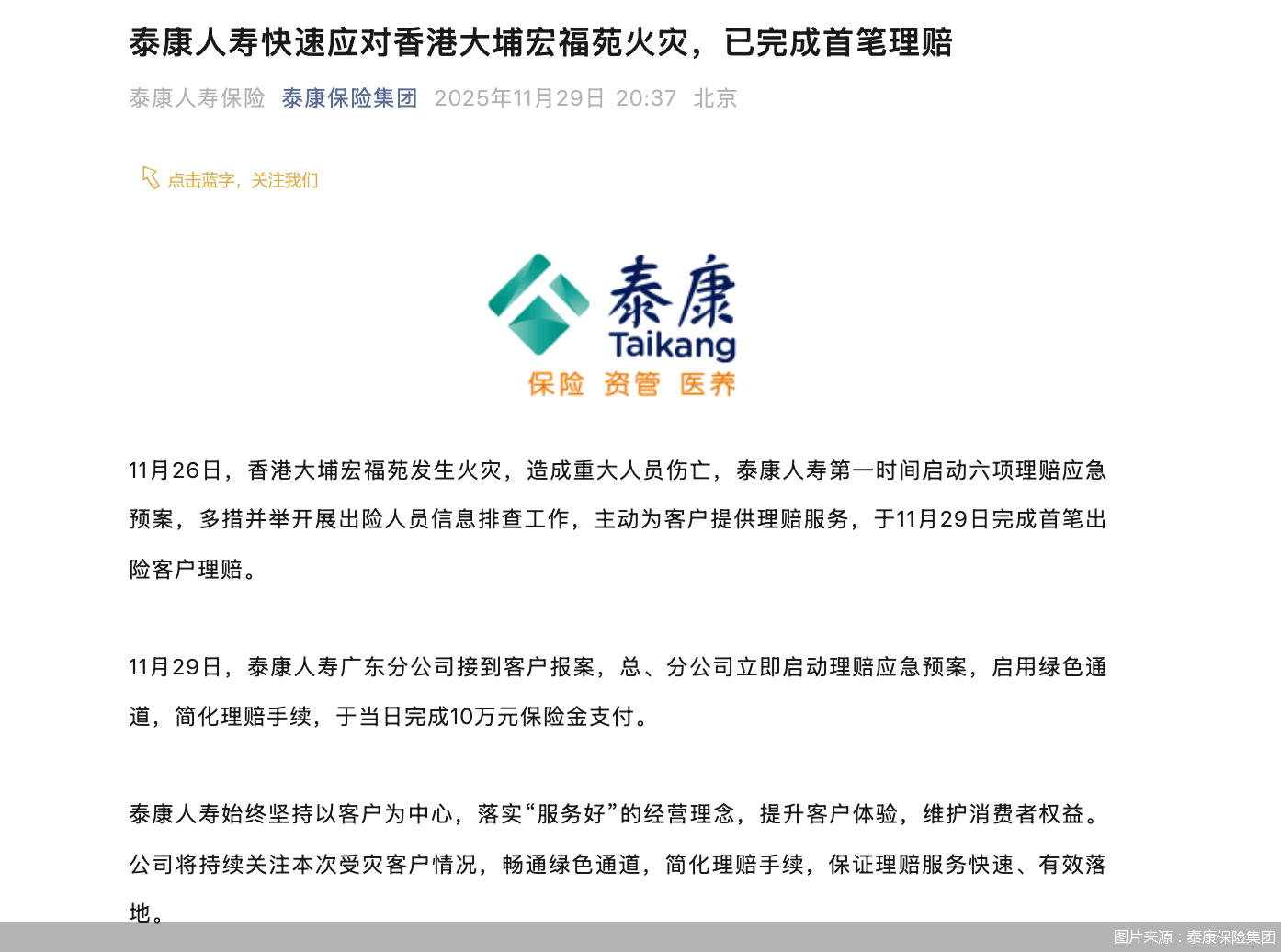
支付10万元保险金,泰康人寿完成香港大埔宏福苑火灾事故首笔理赔
Bei Jing Shang Bao· 2025-11-29 13:48
Group 1 - A fire occurred at Hong Kong's Tai Po Wang Fuk Court on November 26, resulting in significant casualties [1] - On November 29, Taikang Life Insurance activated six emergency claims response plans to assist affected individuals [1] - The company completed its first claim payment on November 29, providing 100,000 yuan in insurance benefits to a client [1]

【财经分析】澳大利亚通胀涨势降低降息可能 澳元保有升值潜力
Xin Hua Cai Jing· 2025-11-26 14:41
Core Viewpoint - Australia's inflation rate has risen for the fourth consecutive month, reaching 3.8% in October, which strengthens expectations that the Reserve Bank of Australia (RBA) will maintain the benchmark interest rate in December and may consider raising rates in the coming years [1][2][3]. Inflation Data Summary - The overall inflation rate in Australia increased from 3.6% in September to 3.8% in October, with previous months showing rates of 1.9%, 3%, and 3.2% [1]. - The trimmed mean inflation rate, an important reference for the RBA, rose from 3.2% in September to 3.3% in October, with prior months at 2.8%, 3%, and 3% [1]. - The RBA's inflation target is set between 2-3%, indicating that current inflation levels exceed this target, making further rate cuts unlikely [1]. Economic Analyst Insights - Analysts are shifting focus from potential rate cuts to predicting the timing of rate hikes, with some suggesting that the RBA is unlikely to cut rates in December [2][3]. - The possibility of rate hikes is increasing, with forecasts suggesting that if inflation continues to rise, the RBA may raise rates as early as 2026 [3]. - Some analysts believe that the rise in October's inflation may be influenced by temporary factors, leading to only a slight adjustment in their annual inflation expectations [4]. Currency and Economic Outlook - Following the inflation data release, the Australian dollar strengthened, reflecting market expectations for the RBA to maintain rates [5]. - Reports indicate a stabilization in Australia's economic recovery, with significant increases in consumer confidence regarding future economic conditions [5]. - The relationship between the Australian dollar and China's economic performance suggests further appreciation potential for the Australian dollar [5].
【UNforex财经事件】关键数据延后令定价难度上升 美元保持韧性 黄金高位震荡未破结构
Sou Hu Cai Jing· 2025-11-25 09:42
Group 1 - The market is experiencing a mixed trend, with the dollar maintaining a narrow range ahead of key U.S. data releases, while gold remains supported by Fed policy signals and geopolitical tensions [1][4] - The upcoming U.S. macroeconomic data, including PPI, retail sales, consumer confidence, and employment indicators, will strengthen market judgments regarding the Fed's December policy path [5] - Geopolitical risks, particularly the Russia-Ukraine conflict and the situation in the Middle East, continue to drive safe-haven demand for gold [3][5] Group 2 - Fed officials have recently communicated a more dovish stance, with expectations for a 25 basis point rate cut in December rising to approximately 80% [2] - The delay in the release of the November employment report has led to discussions about the potential postponement of the Fed's meeting, impacting policy expectations and market volatility [2][5] - Gold prices have strengthened in the context of rising rate cut expectations and ongoing geopolitical tensions, maintaining a high trading range near $4150 [3][4]