
华泰柏瑞

Search documents
ETF周成交1.28万亿
第一财经· 2026-01-18 12:37
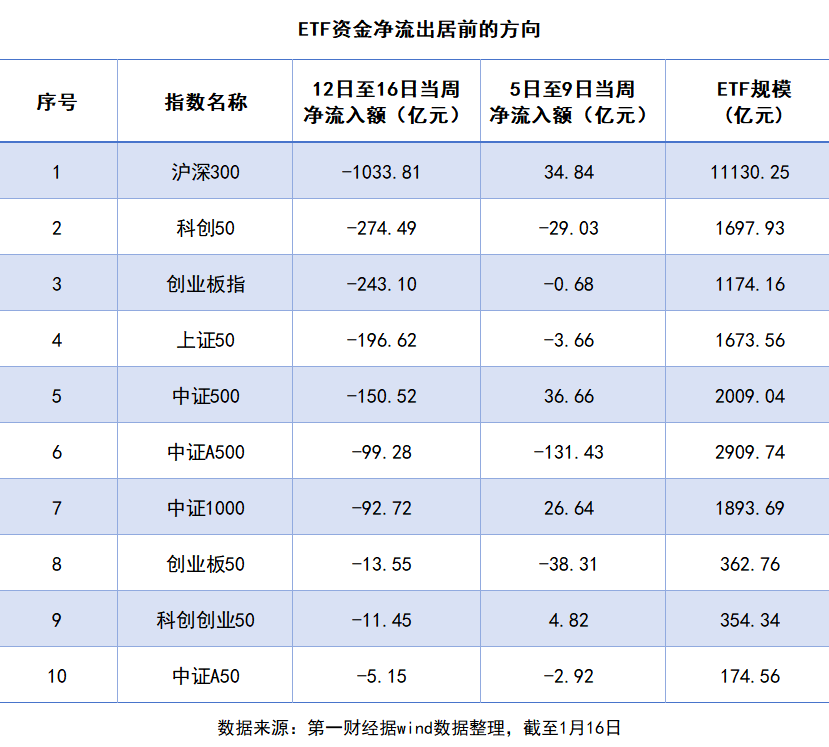
Core Viewpoint - The recent week has seen a significant shift in the A-share ETF market, with over 200 billion yuan being withdrawn from core broad-based ETFs, marking a historical high for weekly net outflows, while nearly 70 billion yuan flowed into thematic industry ETFs, indicating a potential turning point in market trends [3][4]. Group 1: ETF Market Dynamics - From January 12 to 16, the overall ETF market exhibited a "broad-based retreat, thematic advance" pattern, with a net outflow of 212.6 billion yuan from broad-based ETFs, a dramatic increase from the previous week's 12.9 billion yuan [6][7]. - The broad-based ETFs experienced a record shrinkage, with a total reduction of over 200 billion yuan in just one week, surpassing the previous record by over 94 billion yuan [7]. - Major broad-based ETFs like the CSI 300 ETF saw the largest net outflow of 103.4 billion yuan, followed by the STAR 50 and ChiNext ETFs with net outflows of 27.4 billion yuan and 24.3 billion yuan, respectively [8][10]. Group 2: Thematic ETF Inflows - In contrast to the broad-based ETFs, thematic ETFs attracted nearly 70 billion yuan in net inflows, with 117 products receiving over 100 million yuan in net subscriptions [10][11]. - Key sectors such as software, media, and semiconductors were particularly favored, with each sector receiving over 5 billion yuan in net inflows. For instance, the Jiashi CSI Software Service ETF alone saw a net inflow of 7.5 billion yuan, reaching a record scale of 14.6 billion yuan [11][12]. - The satellite internet sector emerged as a focal point, with six satellite-themed ETFs collectively attracting 7.5 billion yuan, and the Yongying Satellite ETF alone receiving 5.8 billion yuan, marking a 156% increase year-to-date [11][12]. Group 3: Trading Volume and Market Sentiment - The trading volume for stock ETFs reached 1.28 trillion yuan, the highest in five years, reflecting a 35% increase from the previous week and a 183% surge year-on-year [14]. - On January 16 alone, the trading volume hit 312.6 billion yuan, surpassing the peak from October 9, 2024, with broad-based ETFs accounting for 212.9 billion yuan of that total [15]. - Analysts suggest that the outflow from broad-based ETFs and the inflow into thematic ETFs may indicate a healthy market adjustment, with investors reallocating funds towards sectors with clearer growth prospects [15][16]. Group 4: Regulatory Environment and Future Outlook - Recent regulatory measures aimed at cooling market speculation are seen as a correction rather than a deterrent, with expectations that market sentiment will improve within two weeks [16]. - As annual performance forecasts from listed companies begin to be disclosed, the market logic is expected to shift from valuation recovery to profit growth, prompting a reallocation of funds towards sectors with solid industrial logic and higher earnings visibility [16][17]. - The ETF market is undergoing a paradigm shift, with investors increasingly viewing ETFs as long-term asset allocation tools rather than short-term trading instruments [18].


ETF周成交超1.28万亿,资金加速“弃宽基追主题”
Di Yi Cai Jing· 2026-01-18 11:23
Core Viewpoint - A significant shift in the A-share ETF market has occurred, with over 200 billion yuan withdrawn from core broad-based ETFs and nearly 70 billion yuan flowing into thematic industry ETFs, indicating a potential turning point in market trends [1][2][7]. Group 1: ETF Market Dynamics - From January 12 to 16, over 2 trillion yuan was withdrawn from broad-based ETFs, marking a 15-fold increase compared to the previous week and setting a record for weekly net outflows [2][3]. - The core broad-based ETFs, including the CSI 300 and STAR 50, were the main targets for fund withdrawals, with the CSI 300 ETF alone experiencing a net outflow of over 1 trillion yuan [2][3]. - The total trading volume of stock ETFs reached 1.28 trillion yuan during the same week, the highest in five years, reflecting intense trading activity and rapid fund turnover [7]. Group 2: Thematic ETF Inflows - In contrast to the broad-based ETFs, thematic ETFs saw a net inflow of nearly 70 billion yuan, with 117 products receiving over 1 billion yuan in net subscriptions [3][4]. - Key sectors attracting investment included software, media, and semiconductors, with specific products like the Harvest CSI Software Service ETF receiving a net inflow of 75.43 billion yuan, reaching a record size of 146 billion yuan [3][6]. - The satellite internet sector emerged as a focal point for investment, with six satellite-themed ETFs attracting 74.71 billion yuan in net inflows, highlighting a growing interest in this area [3][4]. Group 3: Market Sentiment and Future Outlook - Analysts suggest that the significant outflows from broad-based ETFs and inflows into thematic ETFs may indicate a healthy market adjustment rather than a downturn, as investors seek more flexible and growth-oriented investment opportunities [7][8]. - The recent regulatory environment is seen as a corrective measure to excessive market speculation, with expectations that market sentiment will improve within a couple of weeks [8]. - The ongoing trend of reallocating funds from broad-based to thematic ETFs reflects a broader shift in investor strategy, moving towards long-term asset allocation rather than short-term trading [9].
量化基金周度跟踪(20260112-20260116):中小盘继续上涨,500指增难获超额-20260117
CMS· 2026-01-17 12:21
Report Summary 1. Report Industry Investment Rating No relevant content provided. 2. Core View of the Report The report focuses on the performance of the quantitative fund market, summarizing the performance of major indices and quantitative funds, the overall performance and distribution of different types of public - offering quantitative funds, and the better - performing quantitative funds from January 12 to January 16, 2026, for investors' reference [1]. 3. Summary by Directory 3.1 Main Index and Quantitative Fund Performance - This week (January 12 - January 16), A - shares showed mixed performance, with small - cap growth stocks leading the rise and large - cap value stocks falling. Quantitative funds recorded positive returns, and the excess returns of index - enhanced funds were divergent. Active quantitative funds rose by an average of 1.21%. The excess returns of CSI 300 Index - enhanced, CSI 500 Index - enhanced, and CSI 1000 Index - enhanced funds were 0.63%, - 0.34%, and 0.34% respectively, and the average excess return of other index - enhanced funds was 0.25%. Market - neutral funds rose by 0.16% [2][4][6]. - The weekly returns of the CSI 300, CSI 500, and CSI 1000 were - 0.57%, 2.18%, and 1.27% respectively [3][6]. 3.2 Performance of Different Types of Public - Offering Quantitative Funds - **CSI 300 Index - enhanced funds**: The weekly return was 0.06%, the excess return was 0.63%, the maximum drawdown was - 0.72%, the excess maximum drawdown was - 0.19%, and the excess return dispersion was 0.53% [14]. - **CSI 500 Index - enhanced funds**: The weekly return was 1.84%, the excess return was - 0.34%, the maximum drawdown was - 1.18%, the excess maximum drawdown was - 1.08%, and the excess return dispersion was 0.48% [14]. - **CSI 1000 Index - enhanced funds**: The weekly return was 1.61%, the excess return was 0.34%, the maximum drawdown was - 1.46%, the excess maximum drawdown was - 0.79%, and the excess return dispersion was 0.44% [15]. - **Other index - enhanced funds**: The weekly return was 1.23%, the excess return was 0.25%, the maximum drawdown was - 1.38%, the excess maximum drawdown was - 0.50%, and the excess return dispersion was 0.68% [15]. - **Active quantitative funds**: The weekly return was 1.21%, the maximum drawdown was - 1.16%, and the return dispersion was 1.61% [16]. - **Market - neutral funds**: The weekly return was 0.16%, the maximum drawdown was - 0.13%, and the return dispersion was 0.61% [16]. 3.3 Performance Distribution of Different Types of Public - Offering Quantitative Funds The report shows the performance trends of different types of public - offering quantitative funds in the past six months, as well as the performance distribution this week and in the past year. Index - enhanced funds show the performance of excess returns, but specific data is not further elaborated in the text [17]. 3.4 High - Performing Public - Offering Quantitative Funds - **CSI 300 Index - enhanced high - performing funds**: Such as E Fund CSI 300 Selected Enhanced (managed by Zhang Shengji, with a scale of 4024 million yuan, and a weekly excess return of 2.15%), and others [31]. - **CSI 500 Index - enhanced high - performing funds**: For example, Bosera CSI 500 Index - enhanced (managed by Yang Meng, with a scale of 2764 million yuan, and a weekly excess return of 0.31%) [32]. - **CSI 1000 Index - enhanced high - performing funds**: Like Huatai - Peregrine CSI 1000 Enhanced Strategy ETF (managed by Da Huang and Liu Jun, with a scale of 40 million yuan, and a weekly excess return of 1.12%) [33]. - **Other index - enhanced high - performing funds**: Such as E Fund SSE 50 Enhanced Strategy ETF (managed by Zhang Shengji, with a scale of 49 million yuan, and a weekly excess return of 2.04%) [34]. - **Active quantitative high - performing funds**: For instance, Huian Quantitative Selection (managed by Wang Minglu, with a scale of 3 million yuan, and a weekly return of 8.68%) [35]. - **Market - neutral high - performing funds**: Such as China Post Absolute Return Strategy (managed by Yao Yi and Xing Rufeng, with a scale of 48 million yuan, and a weekly return of 2.39%) [36].
岁末年初,公募密集布局这类ETF
Sou Hu Cai Jing· 2026-01-17 06:48
Core Viewpoint - The precious metals market has seen significant price increases since the beginning of 2026, leading to heightened interest and investment in related ETFs, with public funds actively launching products in this sector [1][2]. Group 1: Market Performance - Since the beginning of 2025, the precious metals index has increased by nearly 107% [3]. - As of January 16, 2026, related ETFs have attracted a total of 242.93 billion yuan in investments this year [3]. - The Southern Precious Metals ETF has seen a growth of 129.9 billion yuan, reaching a total size of 335.50 billion yuan [4]. Group 2: Fund Launches - A total of 15 precious metals-related fund products have been reported since early December 2025, with major fund companies like Huatai-PineBridge, Huaxia, and Ping An among those launching new ETFs [3]. - The focus on upstream rare resources in the precious metals mining sector has been highlighted as a strong performer [3]. Group 3: Market Dynamics - Short-term volatility in the precious metals sector is expected to increase, driven by high market sentiment and rising margin balances [5][6]. - Despite recent price corrections, the long-term value proposition of the sector remains intact, supported by expectations of interest rate cuts and strong demand from energy transition and digital infrastructure [7]. Group 4: Supply and Demand Factors - Supply constraints are evident due to declining ore grades, insufficient capital expenditure, and geopolitical risks, while demand is bolstered by the explosive growth in electric vehicles and renewable energy sectors [7]. - The competition for resources in high-end manufacturing, including AI and semiconductors, is expected to further support metal prices [7]. Group 5: Risks and Uncertainties - Investors are advised to be cautious of multiple uncertainties, including potential volatility from high valuations and geopolitical tensions affecting supply chains [9]. - The market is also sensitive to changes in monetary policy and economic growth rates, which could impact the sector's performance [9].
1月17日|财经简报 50万亿定期存款到期 直播电商新规出台
Sou Hu Cai Jing· 2026-01-17 02:12
Market Performance - A-shares managed to stay above 4100 points, with the Shanghai Composite Index closing at 4101.91, down 0.26%, while the Shenzhen Component and ChiNext Index fell by 0.18% and 0.20% respectively, with a total market turnover of 3.06 trillion yuan [2] - The electric grid equipment sector showed strength, with power stocks rising; chip stocks surged, particularly in the memory chip segment; humanoid robot concepts were active, while AI application themes weakened across the board [2] - The Shanghai and Shenzhen stock exchanges conducted over 800 regulatory actions within a week to address abnormal trading and collectively raised the margin requirements for financing to prevent market volatility [2] Global Market Overview - U.S. stock indices experienced slight declines, with the Dow Jones down 0.17%, Nasdaq down 0.06%, and S&P 500 down 0.06%, although chip stocks performed well, with the Philadelphia Semiconductor Index rising by 1.1% and Micron Technology surging over 7%, pushing its market value above 400 billion dollars [3] - Commodity markets saw a nearly 3% drop in copper prices due to Nvidia's significant reduction in projected copper demand for data centers from 500,000 tons to 200 tons; spot gold fell by 0.7% but gained 2% over the week; WTI crude oil rose to 60 dollars before retreating [3] China Capital Market Policies - The China Securities Regulatory Commission (CSRC) plans to focus on risk prevention, strong regulation, and promoting high-quality development in 2026, advancing investment and financing reforms, combating illegal activities, enhancing the quality of listed companies, and promoting dual-directional opening [5] - The People's Bank of China and the State Administration of Foreign Exchange announced continued implementation of moderately loose monetary policy, utilizing various tools to enhance counter-cyclical adjustment and introducing eight measures to strengthen structural tool support [5] Major Funding Trends - In 2026, China will face a maturity wave of approximately 50 trillion yuan in time deposits, with most funds likely to remain within the banking system, shifting to slightly higher interest products, while a large-scale flow into the stock market is unlikely [7] - On a positive note, nine broad-based ETFs saw transaction volumes exceed 10 billion yuan, with the Huaxia CSI 300 ETF and the Huatai-PineBridge CSI 300 ETF achieving transaction volumes of 25.923 billion yuan and 22.705 billion yuan respectively, indicating a rapid adjustment of positions through ETFs [7] AI and Chip Industry Boom - Goldman Sachs believes TSMC has entered a multi-year growth cycle driven by AI, raising its target price to 2,600 New Taiwan dollars, with advanced packaging becoming a second growth engine, expected to exceed 10% of revenue by 2026 [10] - Shenghong Technology anticipates a 260.35%-295.00% increase in performance for 2025, driven by AI computing demand boosting its PCB business; Lianqi Technology expects a net profit growth of 52.29%-66.46% in 2025 due to a significant increase in interconnect chip shipments [10] - Nvidia's CEO Jensen Huang has proactively positioned the company to secure land near TSMC's Fab 18 facility, indicating strategic investments in the chip sector [11] Other Industry Dynamics - The State Administration for Market Regulation released new regulations for live-streaming e-commerce, specifying 13 categories of food that cannot be sold through live broadcasts [12] - IKEA China announced the closure of seven offline stores by February 2, with significant discounts attracting large crowds [12] - The United Nations projects a global economic growth rate of 2.7% for 2026, a decrease of 0.1 percentage points from 2025, with global trade growth expected to decline from 3.8% in 2025 to 2.2% in 2026 [12] - The IMF forecasts a 2.1% economic growth rate for the U.S. in 2026, with inflation expected to drop to 3.5% by the end of 2025 [13] - The State Council emphasized accelerating the cultivation of new growth points in service consumption and implementing paid leave systems, aiming to enhance long-term mechanisms for promoting consumption [14]

50万亿天量存款即将到期
21世纪经济报道· 2026-01-16 14:01
Core Viewpoint - The upcoming maturity of approximately 50 trillion yuan in fixed deposits by 2026 poses significant challenges for the banking sector in managing liabilities and may lead to a reallocation of household assets [3][4][5]. Group 1: Scale of Maturing Deposits - The maturity of fixed deposits is expected to reach around 50 trillion yuan in 2026, with a notable increase of about 10 trillion yuan from 2025 [4]. - The majority of this maturity will come from two- and three-year deposits, each exceeding 20 trillion yuan, while five-year deposits will be around 5-6 trillion yuan [4]. - Different research institutions estimate the total maturity of fixed deposits to be between 59 trillion and 75 trillion yuan, indicating a significant impact on the banking sector [5][6]. Group 2: Potential Directions for Maturing Funds - A substantial portion of the maturing funds is likely to remain within the banking system, as the deposit retention rate is high, around 96% [7]. - Consumers are expected to optimize their deposits by moving funds to banks offering higher interest rates, as seen in the case of a consumer moving funds from a state-owned bank to a city commercial bank [7]. - Consumer spending is projected to be a major outlet for these funds, with anticipated household consumption reaching 53 trillion yuan in 2025 [8]. Group 3: Investment Trends and Preferences - There is a growing trend towards reallocating funds into bank wealth management products, which are expected to see a net increase of approximately 3.7 trillion yuan in 2025 [8]. - Insurance products are also gaining popularity, particularly among high-net-worth individuals seeking long-term investment options [9]. - Some investors are diversifying their portfolios by allocating funds into bonds and stock-enhanced funds, indicating a shift in investment strategies [9]. Group 4: Market Dynamics and Bank Strategies - The banking sector is likely to face a re-pricing of a large volume of funds, with interest rates on large deposits declining significantly [16][17]. - The People's Bank of China has indicated potential for further interest rate cuts, which could help banks reduce their interest expenses and stabilize net interest margins [16]. - Banks are actively trying to optimize their liability structures by encouraging shorter-term deposits and promoting wealth management and insurance products [17][18].

50万亿天量存款即将到期
2 1 Shi Ji Jing Ji Bao Dao· 2026-01-16 13:27
Core Insights - A significant wave of 50 trillion yuan in fixed-term deposits is set to mature in China by 2026, raising concerns among depositors about asset allocation strategies as interest rates decline [1][3][4] - The term "caged tiger" is used to describe the potential impact of this massive capital shift on the market, with various experts weighing in on how these funds might be reallocated [3][4] Group 1: Deposit Maturity and Market Impact - The upcoming maturity of fixed-term deposits is expected to create substantial pressure on banks' liability management, with estimates suggesting that around 50 trillion yuan will mature in 2026, marking a 10 trillion yuan increase from 2025 [5][6] - Different research institutions have provided varying estimates of the total amount of maturing deposits, with a consensus that the impact on banks and asset allocation will be significant [6][8] - The majority of maturing deposits will come from long-term fixed deposits, with state-owned banks facing the largest volume of maturing funds [5][6] Group 2: Potential Fund Allocation - The reallocation of maturing funds is a key concern, with expectations that a significant portion will remain within the banking system rather than flowing into capital markets [8][9] - Current trends indicate that depositors are likely to seek higher interest rates, leading to competitive rate offerings from smaller banks to attract funds [9][10] - Consumer spending, housing repayments, and bank wealth management products are anticipated to be primary destinations for the reallocated funds [9][10] Group 3: Market Conditions and Future Projections - The current environment of declining interest rates and the potential for further monetary easing by the People's Bank of China may influence banks' ability to manage their liabilities effectively [19][20] - Analysts predict that the pressure on banks' net interest margins will ease starting in the second half of 2025, potentially leading to improved revenue and profit growth for the banking sector [20] - The overall strategy for banks will involve optimizing their liability structure while encouraging a gradual release of maturing funds into the market [20]

50万亿“笼中虎”何处去?
2 1 Shi Ji Jing Ji Bao Dao· 2026-01-16 12:53
Core Viewpoint - The upcoming maturity of approximately 50 trillion yuan in fixed-term deposits in China by 2026 is creating significant uncertainty among depositors regarding asset allocation strategies, as interest rates have declined from 3.1% to around 1.5% [1][2]. Group 1: Scale of Maturing Deposits - The discussion around the 50 trillion yuan in maturing fixed-term deposits has gained traction since the end of 2025, highlighting the challenges banks will face in managing liabilities [2]. - The surge in maturing deposits can be traced back to 2022-2023, when funds flowed back into fixed-term deposits due to a downturn in the real estate market and volatility in the stock and bond markets [3]. - Estimates from various research institutions indicate that the total maturing fixed-term deposits in 2026 will significantly impact banks' liabilities and residents' asset allocation [4][5]. Group 2: Potential Directions for Maturing Funds - The maturing funds are expected to be reallocated, but it is important to note that not all funds will leave the banking system; many will be optimized within it [6]. - Consumer spending is anticipated to be a primary outlet for these funds, with projected household consumption reaching 53 trillion yuan in 2025 [8]. - A portion of the funds will also be directed towards repaying mortgages, with an estimated 3 trillion yuan expected for early mortgage repayments in 2025 [8]. Group 3: Banking Strategies and Market Dynamics - Banks are currently engaged in competitive strategies to attract deposits, including raising interest rates on fixed-term deposits [7]. - The trend of "funds moving" within the banking system is evident, as depositors seek higher interest rates offered by smaller banks [6][7]. - The overall environment suggests that while some funds may flow into the stock market, the majority will likely remain within the banking system, reflecting a cautious approach among depositors [10][12]. Group 4: Impact on Banking Sector - The upcoming wave of maturing deposits presents a unique opportunity for banks to reprice their liabilities, potentially reducing annual costs by approximately 1.5 trillion yuan [14][16]. - The People's Bank of China has indicated that there is still room for interest rate cuts, which could further stabilize banks' interest margins [15][16]. - Banks are focusing on optimizing their liability structures, encouraging a shift from long-term to short-term deposits while promoting financial products to manage funds effectively [17][18].

谁在买入?沪深300、中证500 ETF百亿成交频现,大资金借道ETF布局动向曝光
Xin Lang Cai Jing· 2026-01-16 09:30
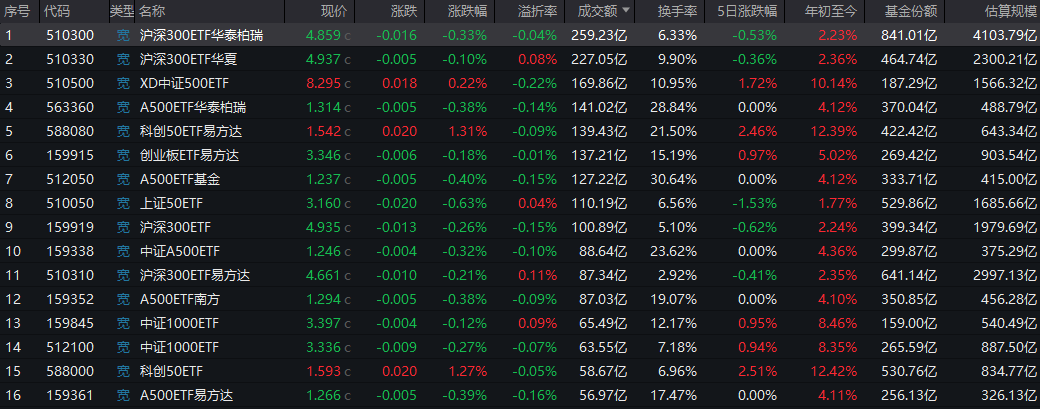
Core Viewpoint - The A-share market experienced a decline on January 16, with all three major indices closing lower, while the trading volume of broad-based ETFs surged, indicating active institutional and large-cap fund positioning near key index levels [1][4]. Group 1: Market Performance - The Shanghai Composite Index closed at 4101.91 points, down 0.26% - The Shenzhen Component Index closed at 14281.08 points, down 0.18% - The ChiNext Index closed at 3361.02 points, down 0.20% [1][4]. Group 2: ETF Trading Activity - The total trading volume of 16 mainstream broad-based ETFs exceeded 190 billion yuan in a single day, highlighting heightened trading sentiment [1][4]. - The Huatai-PineBridge CSI 300 ETF (510300) led with a trading volume of 25.923 billion yuan and a turnover rate of 6.33% [2][5]. - The China Asset CSI 300 ETF (510330) followed closely with a trading volume of 22.705 billion yuan and a turnover rate of nearly 10% [2][5]. - The Southern CSI 500 ETF (510500) recorded a trading volume of 16.986 billion yuan with a turnover rate exceeding 10% [2][5]. Group 3: Investment Trends - Innovative growth ETFs, such as the E Fund Sci-Tech 50 ETF (588080), attracted significant attention with a trading volume of 13.943 billion yuan and a price increase of 1.31%, reflecting a year-to-date gain of 12.39% [3][6]. - The E Fund ChiNext ETF (159915) also saw a trading volume of 13.721 billion yuan, indicating strong interest in the technology growth sector alongside large-cap blue chips [3][6]. Group 4: Market Implications - The surge in broad-based ETF trading volume suggests several implications: - Large institutional funds prefer high liquidity ETFs for quick asset allocation or position adjustments [3][6]. - Increased market divergence and intensified competition are evident as large volumes often occur at critical index levels [3][6]. - Derivative hedging and arbitrage activities related to index futures and options may also drive demand for spot ETFs [3][6]. Group 5: Future Outlook - The significant trading volume of broad-based ETFs serves as an important indicator of capital flow and institutional behavior in the A-share market [4][7]. - The current volume surge indicates a positive attitude from major funds, with heightened trading activity [4][7]. - Future monitoring of ETF share changes and net capital flows is essential to gauge the true intentions of large funds [4][7].
ETF交投创7500亿天量,中国股市进入“配置型投资”新阶段
Jin Rong Jie· 2026-01-16 09:08
Core Insights - The ETF market in China is experiencing unprecedented growth, with daily trading volumes exceeding 750 billion yuan, marking a record high for three consecutive trading days [1] - The total management scale of China's ETF market has surpassed 6.2 trillion yuan, with a significant increase of over 200 billion yuan in just the first few weeks of the new year [2] Group 1: Market Phenomenon - The explosive growth of the ETF market is characterized by a rapid expansion in overall market size, with stock ETFs being the primary contributors to this growth [2] - Major fund companies like Huaxia Fund have reached a management scale of over 1 trillion yuan, indicating a new phase in the industry [2] - The concentration of funds is increasingly directed towards institutions with brand, product, and operational advantages, reshaping the capital market ecosystem [2] Group 2: Driving Forces - The influx of funds into ETFs is driven by several factors, including the shift of individual investors towards more rational asset allocation through low-cost ETFs [3] - Institutional investors, such as insurance and pension funds, are strategically allocating to ETFs, supported by regulatory policies that encourage equity investments [3] - Foreign capital is increasingly flowing into China's stock market through cross-border ETFs, with the scale of foreign investment in 2025 significantly surpassing previous years [3] - A consensus on market trends is leading investors to use ETFs as efficient tools for expressing market views, particularly in sectors like technology and new energy [3] Group 3: Cross-Border ETFs and Structural Differentiation - Cross-border ETFs have reached a historic scale of over 1 trillion yuan, becoming a preferred tool for global asset allocation among residents [4] - There is a noticeable structural differentiation in the market, with significant net inflows into technology and high-end manufacturing ETFs, while traditional industry and bond ETFs face net outflows [4] Group 4: Market Impact - The massive trading volume of ETFs is enhancing market efficiency by improving liquidity and reducing overall market volatility [6] - The popularity of ETFs is promoting investment concepts such as index investing and long-term holding, contributing to a healthier investor culture [6] - There is an increasing liquidity premium for leading companies as funds favor index constituents, leading to a "Matthew effect" where smaller companies receive less attention [6] Group 5: Future Outlook - The growth of the ETF market is expected to continue, driven by the ongoing shift of household assets from real estate to financial assets and the demand for long-term capital due to pension system reforms [7] - China's capital market is transitioning from a trading-oriented market to one focused on asset allocation, with ETFs playing a crucial role in this evolution [7] - The focus of the market is shifting from mere valuation recovery to improvements in corporate fundamentals and the realization of industry trends [7]