奇瑞汽车

Search documents
南非年轻人青睐中国车
Xin Hua She· 2025-11-08 22:07
Core Insights - Chinese automotive brands are rapidly gaining popularity in South Africa, with increasing market presence and consumer preference, particularly among the youth [1][2][3] Group 1: Market Trends - South African cities are witnessing a surge in the presence of Chinese automotive brands such as Haval, Chery, BYD, and BAIC, with dealerships emerging rapidly [1] - In September, new car sales in South Africa continued to grow, with Chery and Great Wall Motors ranking 4th and 6th respectively in sales [2] - Chinese brands are reshaping consumer perceptions in South Africa, meeting demands for price, design, and technology [2] Group 2: Consumer Preferences - Young South African consumers are increasingly favoring Chinese brands, with Chery being one of the top ten brands financed by young buyers [2] - The Chery Jetour X70 Plus, launched in September last year, is noted for its high cost-performance ratio and reliability, appealing to local drivers [2] Group 3: Economic Impact - Chinese automotive companies are contributing to local employment and industry development by investing in manufacturing plants, such as BAIC's facility in Port Elizabeth, which has created over 3,000 jobs [3] - The unique technological features of Chinese vehicles, even in entry-level models, are highlighted as a significant factor in their growing popularity [3]



2025年前三季度车企服务投诉指数飙升比亚迪成主要推手
Xin Lang Cai Jing· 2025-11-07 21:08
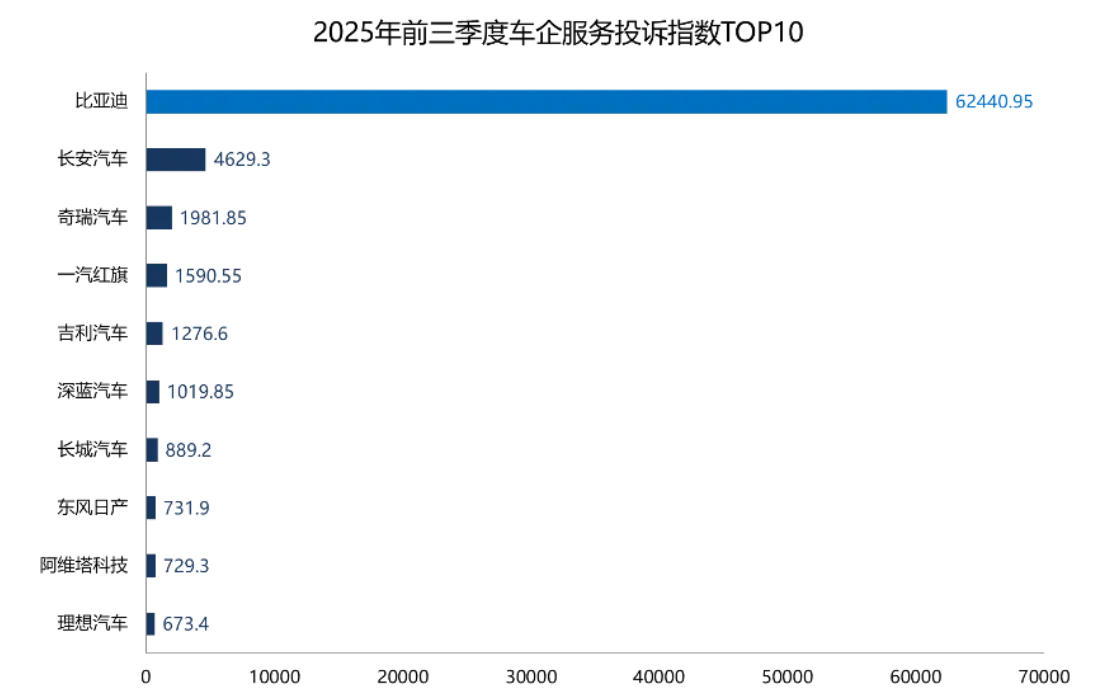
Core Insights - The complaint index for the automotive industry surged by 38.53% year-on-year in the first three quarters of 2025, with service-related complaints accounting for 55.5% of the total [1] - BYD's service complaint index reached 62,440.95, representing nearly 70% of the total service complaints, with a staggering increase of 39,218.4, contributing to 90% of the overall service complaint index growth [1] - Major issues driving complaints include new vehicle iterations and price changes, affecting customer sentiment and vehicle resale values [1] Company-Specific Summaries - **BYD**: Key issues include discrepancies between vehicle configurations and official announcements, as well as unfulfilled promises regarding purchase subsidies and maintenance rights. Complaints about the "thousand-mile-eye" feature not functioning persist [2] - **Changan Automobile**: After excluding iteration and price drop issues, Changan's service complaint index surpassed BYD's, with 97.3% of complaints related to non-upgraded vehicle systems [2] - **Chery Automobile**: Similar to BYD, Chery's complaints focus on non-upgraded vehicle systems, unfulfilled promises, and issues with deposit refunds, with over one-third of complaints related to system upgrades [2] - **FAW Hongqi**: Ranked fourth in service complaints, with the primary issue being non-upgraded vehicle systems, leading to performance lags [2] - **Geely**: Complaints mainly stem from issues with deposit refunds and unfulfilled promises, with 45% of complaints related to deposit refunds due to delays in vehicle deliveries [2] Industry Trends - The primary service issues across various automotive companies include non-upgraded vehicle systems, unfulfilled promises, and deposit refund problems, indicating a significant challenge in customer service and satisfaction [2]
汽车行业年度投资策略:品牌化、全球化、智能化,迎接AI浪潮下的产业升级机遇
Guoxin Securities· 2025-11-07 14:40
Core Insights - The automotive industry in China is transitioning from a growth phase to a mature phase, with a compound annual growth rate (CAGR) of 4% from 2010 to 2023, and is expected to see wholesale sales exceed 34 million vehicles in 2025, representing an 11% increase [1][18][24] - The report emphasizes the importance of branding and globalization as key strategies for automotive companies to maintain volume and profitability amidst intensifying competition in the electric vehicle (EV) sector [2][18] - The advent of AI and advancements in smart driving technology are set to reshape the automotive landscape, with significant investment opportunities anticipated in the components related to autonomous driving systems [3][18] Industry Characteristics and Changes - The automotive market in China is experiencing a gradual decline in total volume dividends, with annual growth rates expected to stabilize at low single digits as the industry matures [18][24] - The penetration rate of new energy vehicles (NEVs) is projected to rise significantly, with sales expected to grow from 1.21 million in 2019 to 14 million by 2024, reflecting a CAGR of 63% [18][32] - The shift from traditional fuel vehicles to electric vehicles is creating structural changes in production capacity, leading to both challenges and opportunities for manufacturers [18][32] Investment Opportunities - Recommended investments include companies in the electric vehicle sector such as XPeng Motors, Jianghuai Automobile, and Yutong Bus, as well as firms involved in smart technology and robotics [4][6] - The report highlights the potential for domestic automotive parts manufacturers to expand their global footprint, leveraging their established production capabilities and cost management skills [2][18] - The anticipated mass production of robots in 2026 is expected to create new investment opportunities in related component sectors, particularly those overlapping with automotive technologies [3][18]

2025年前三季度车企服务投诉指数飙升 比亚迪成主要推手
Xi Niu Cai Jing· 2025-11-07 12:32
Core Insights - The complaint index for the automotive industry surged by 38.53% year-on-year in the first three quarters of 2025, with service-related complaints accounting for 55.5% of the total [1] - BYD has been a significant contributor to the increase in service complaints, with its service complaint index reaching 62,440.95, representing a 39218.4 increase from the previous year [2][3] Summary by Category Complaint Index Overview - The service complaint index for the automotive industry in the first three quarters of 2025 is 90,455.3, up from 47,013.2 in the same period last year [1] - BYD's service complaint index alone accounted for nearly 70% of the total service complaints [2] BYD's Impact - BYD's service complaint index increased by 39218.4, with new car iterations and price changes being the primary causes of complaints [2] - Complaints related to price reductions and new model releases have significantly affected customer satisfaction, particularly after BYD's announcement of enhanced features without price increases [2] Other Companies' Complaints - Other companies such as Avita Technology, Deep Blue Automotive, and Li Auto also faced complaints due to similar issues of iteration and price changes [2] - Avita's complaints were concentrated around the release of a new model that affected the residual value of older models, while Deep Blue's complaints arose from significant upgrades in new models [2] Service Issues Beyond Pricing - After excluding price-related complaints, BYD's main issues were related to discrepancies between promised features and actual performance, as well as unfulfilled dealer commitments [5] - Changan Automobile's complaints were primarily due to unupdated vehicle systems, with 97.3% of complaints related to this issue [5] - Other companies like Chery and FAW Hongqi also reported high complaint rates related to unfulfilled promises and system upgrades [6] General Trends - The primary service issues across various companies include system upgrades, unfulfilled promises, and deposit refund problems, indicating a need for improved dealer management and customer service [6] - The automotive industry must focus on enhancing channel management to improve customer satisfaction and product competitiveness [6]

【新能源】2025年9月新能源汽车行业月报
乘联分会· 2025-11-07 08:35
Sales Performance - In September, the total passenger car sales reached 2.25 million units, a year-on-year increase of 4.0% and a month-on-month increase of 13.4% [5] - The new energy vehicle (NEV) market sales were approximately 1.287 million units, with a year-on-year increase of 16.4% and a month-on-month increase of 17.4% [5] - NEVs accounted for 57.2% of total passenger car sales in September, an increase of 2.0% from the previous month and up 6.1% from the same period last year [5] Market Dynamics - In September, pure electric vehicle sales were about 838,000 units, showing a year-on-year increase of 32.3% and a month-on-month increase of 19.1% [6] - Plug-in hybrid sales were approximately 449,000 units, reflecting a year-on-year decrease of 4.9% but a month-on-month increase of 14.3% [6] - By 2025, cumulative sales of NEVs are projected to reach 8.634 million units, with a cumulative year-on-year increase of 22.8% [8] Top Cities for NEV Sales - The top 10 cities for NEV sales in September accounted for 25.4% of total sales, a decrease of 0.6% from the previous month [11] - The top three cities were Chengdu, Guangzhou, and Beijing, with Ningbo replacing Tianjin in the top ten [11] - NEV penetration rates in the top 10 cities exceeded 50%, with Shenzhen leading at 67.7% [11] Pure Electric Market Analysis - In September, the personal user share in the pure electric market was 87.3%, a year-on-year increase of 36.3% [18] - Cumulative data shows that personal users account for 85.9% of the pure electric market [18] - The top three segments in the pure electric market were B-SUV (16.5%), A0 class (16.2%), and A00 class (14.2%) [12] Industry Events - On September 7, CATL launched the NP3.0 battery safety technology platform in Munich, Germany, aimed at enhancing safety standards in the electric vehicle market [20] - Chery Automobile officially listed on the Hong Kong Stock Exchange on September 25, raising 9.14 billion HKD, marking the largest IPO for a car company in the Hong Kong market this year [22] - On the same day, Mercedes-Benz announced a strategic investment of approximately 1.34 billion CNY in a local intelligent driving company to enhance its technology collaboration in China [24] Industry Policies - The Ministry of Industry and Information Technology is seeking public input on mandatory national standards for intelligent connected vehicles and safety requirements for vehicle door handles, aiming to improve road safety [27]
【联合发布】一周新车快讯(2025年11月1日-11月7日)
乘联分会· 2025-11-07 08:35
Core Viewpoint - The article provides a comprehensive overview of new car models set to launch in November 2025, detailing specifications, market segments, and engineering changes for various manufacturers [2][4][6]. Group 1: New Car Models Overview - Kia Motors will launch the Kia Yipao on November 1, 2025, in the AO SUV segment with a price range of 79,800 to 83,800 CNY, featuring a 1.4L engine and CVT transmission [9]. - Changan Mazda's Mazda EZ-6 is scheduled for release on November 1, 2025, in the B NB segment, priced between 119,800 and 162,800 CNY, offering both range-extended and pure electric versions [17]. - Chery Automobile's Jetour Shanhai T1 will debut on November 3, 2025, in the A SUV segment, with a price range of 157,900 to 167,900 CNY, featuring a 1.5T plug-in hybrid engine [25]. - FAW-Volkswagen's Volkswagen Bora will be available on November 3, 2025, in the A NB segment, with prices from 112,900 to 143,900 CNY, equipped with 1.2T and 1.4T engines [33]. - GAC Honda's Honda Breeze will launch on November 3, 2025, in the AO SUV segment, priced between 119,800 and 135,800 CNY, featuring a 1.5L engine [41]. - Avita Technology's Avita 06 will be released on November 3, 2025, in the B NB segment, with a price range of 219,900 to 229,900 CNY, offering both range-extended and pure electric versions [49]. - Changan Automobile's CS55 PLUS will be available on November 4, 2025, in the A SUV segment, priced at 112,900 CNY, featuring a 1.5L plug-in hybrid engine [57]. - BYD's BYD Xia will launch on November 4, 2025, in the C MPV segment, with prices ranging from 206,800 to 269,800 CNY, featuring a 1.5T plug-in hybrid engine [62]. - Geely's Zeekr X is set to debut on November 5, 2025, in the A SUV segment, priced between 155,800 and 175,800 CNY, featuring a pure electric powertrain [71]. - Beijing Benz's CLA New Energy will be available on November 5, 2025, in the A NB segment, with a price range of 249,000 to 299,900 CNY, featuring a pure electric powertrain [79]. - Changan Ford's Explorer will launch on November 6, 2025, in the C SUV segment, priced at 369,800 CNY, featuring a 2.3T engine [87]. - Great Wall Motors' Tank 400 will be available on November 6, 2025, in the C SUV segment, with prices ranging from 249,800 to 319,800 CNY, offering gasoline, diesel, and plug-in hybrid options [95]. - SAIC-GM-Wuling's Baojun Yueye will launch on November 7, 2025, in the AO SUV segment, priced at 80,800 CNY, featuring a pure electric powertrain [100]. - FAW-Volkswagen's Golf GTI will be available on November 7, 2025, in the A HB segment, priced at 211,900 CNY, featuring a 2.0T engine [108]. - Beijing Benz's GLC will launch on November 7, 2025, in the B SUV segment, with prices ranging from 399,800 to 525,300 CNY, offering gasoline and plug-in hybrid options [118].


燃油车又杀回来了
投资界· 2025-11-07 08:15
Core Viewpoint - Despite the rise of electric vehicles, traditional fuel vehicles continue to show resilience in the market, with recent data indicating a rebound in sales and market share [4][5][10]. Sales Performance - In September, domestic sales of traditional fuel vehicles reached 1 million units, marking a year-on-year increase of 6,000 units and a month-on-month growth of 10.9% [4]. - From January to September, cumulative sales of traditional fuel vehicles totaled 8.141 million units, reflecting a year-on-year growth of 1.7% [5]. - Fuel vehicles accounted for 47.76% of total passenger vehicle sales in the same period, indicating their significant market presence [5]. Market Dynamics - The recent growth in fuel vehicle sales is attributed to aggressive pricing strategies, with discounts averaging around 30%, and some luxury models offering discounts exceeding 40% [7][8]. - The Nissan Sylphy emerged as the best-selling fuel vehicle in September, with sales of 33,000 units, benefiting from substantial cash discounts [7]. - Traditional automakers are adjusting their product positioning and marketing strategies to compete with electric vehicles, leading to a notable increase in the cost-performance ratio of fuel vehicles [8]. Strategic Shifts - Major automakers like Honda and Volkswagen reported significant sales increases in their fuel vehicle segments, with Honda's production in China rising by 25.7% year-on-year [10][11]. - Chinese brands such as Geely and Chery are also focusing on fuel vehicle strategies, with Geely emphasizing a dual approach of investing in both fuel and electric vehicles [12][11]. Technological Advancements - Fuel vehicles are increasingly incorporating advanced technologies, such as intelligent driving systems and high-performance chips, narrowing the gap with electric vehicles in terms of smart features [13][15]. - Recent models from various manufacturers are equipped with enhanced intelligent features, indicating a shift in consumer perception regarding the capabilities of fuel vehicles [14][15]. Future Outlook - The automotive market is expected to evolve into a more diversified landscape where both fuel and electric vehicles coexist, catering to different consumer needs [16]. - Companies are likely to adopt a multi-faceted strategy rather than solely focusing on electric vehicles, reflecting a balanced approach to market demands [16].

财联社汽车早报11月7日
Xin Lang Cai Jing· 2025-11-07 08:10
Core Insights - The current strategies and targets set by automotive manufacturers regarding vehicle supply, inventory structure, and after-sales support are misaligned with market realities, leading to increased production capacity but declining revenue and profits, which has severely impacted the automotive supply chain ecosystem [1][2] - The China Automobile Dealers Association emphasizes the need for greater support for dealers amidst the challenges posed by market transformation and deep adjustments in the automotive industry [1] - Recommendations have been submitted to relevant authorities to address issues such as "inventory pressure" and "rebate arrears," including controlling reasonable inventory coefficients for dealers [1] Industry Performance - In the first nine months of 2023, Chinese self-owned brands sold 2.42 million vehicles in overseas markets, marking a 12% year-on-year increase, with September sales reaching 336,000 units, a 25% increase year-on-year [3] - Dongfeng Motor Group reported cumulative vehicle sales of approximately 1.5 million units from January to October 2023, reflecting a year-on-year decline of about 1.6%, while sales of new energy vehicles increased by approximately 37.1% [4] Company Developments - Li Auto has established a new battery company in Jiangsu with a registered capital of 70 million yuan, focusing on battery manufacturing and electric vehicle charging infrastructure [6] - DeepWay Technology has submitted its prospectus for an IPO on the Hong Kong Stock Exchange, aiming to become a leader in the smart new energy heavy truck market [8] - Nissan has announced the establishment of a new import and export company in China, marking a significant step in its local development strategy [9] - The all-new Tank 400 has been launched with a price range starting from 249,800 yuan, featuring advanced driving assistance systems and various powertrain options [10]

大反转,赛力斯上市破发,股价暴跌
Xin Lang Cai Jing· 2025-11-06 11:27
Core Viewpoint - Seres, a Chinese electric vehicle manufacturer, faces challenges after its IPO, with its stock price dropping below the issue price shortly after listing, highlighting concerns about its reliance on Huawei and declining sales performance [3][6][9]. Group 1: IPO Details - Seres listed on the Hong Kong Stock Exchange, raising approximately 14.016 billion HKD, marking the largest IPO for a Chinese car company to date and the largest global car IPO in Hong Kong since 2025 [6][9]. - The stock opened at 131.5 HKD but fell to 118 HKD, a drop of over 10%, and closed at 125.9 HKD, reflecting a decline of 4.26% [3][6]. Group 2: Financial Performance - In January, Seres sold 22,430 vehicles, a year-on-year decrease of 45.82%, with new energy vehicle sales down 51.39% [9]. - Despite a booming industry, Seres' performance lagged behind, as the overall new energy vehicle market in China saw production and sales nearing 7 million units, both growing over 40% [9]. Group 3: Dependency on Huawei - Seres' revenue heavily relies on its partnership with Huawei, with income from the "Aito" brand rising from 60% in 2022 to over 90% in the first half of 2025 [9][10]. - The company faces risks if its relationship with Huawei deteriorates, as highlighted in its prospectus [9][10]. Group 4: Strategic Initiatives - Seres plans to allocate 70% of its IPO proceeds to research and development, with 20% aimed at developing new energy vehicle models and 10% for enhancing overseas model adaptations [6][9][22]. - The company is also pursuing a partnership with ByteDance to explore embodied intelligence technology, indicating a shift towards reducing reliance on Huawei [22][24].

香港为什么又这么香?
汽车商业评论· 2025-11-06 03:52
新汽车生态合作,报名中国版CES! 撰文 | 魏 微 编辑 | 张 南 设计 | 甄 尤 美 2025年11月6日,港交所的锣声为"Robotaxi港股第一股"之争画上了戏剧性句点。 上午9时30分,小马智行(2026.HK)与文远知行(0800.HK)这两大Robotaxi玩家同步上市挂牌。两家公司也公布了最终发售价,其中文远知行 为每股27.10港元,小马智行为每股139港元。 从2025年10月14日同日拿下上市备案、10月中下旬密集通过聆讯,到10月28日同步启动全球招股,再到最终锁定同一挂牌日,两家曾在美股市场 竞速的中国Robotaxi巨头,在港股上市当天以"并肩撞线"的方式,双双完成了"美股+港股"双重架构的建立。 此前一天,11月5日,中国车企市值第二的赛力斯也正式登陆港交所,股票代码"9927",正式完成"A+H"两地上市。 凭借着公开发售超额认购133倍,融资认购超1700亿港元,赛力斯在港交所创下2025年港股最大车企IPO纪录,也是迄今为止规模最大的中国车企 IPO。 从年初赛目科技登陆,到年中宁德时代、曹操出行相继敲锣,再到下半年奇瑞汽车、禾赛科技、赛力斯、小马智行、文远知行等企业密 ...