华西证券

Search documents
券商发力!公募代销保有增势正猛 多券商将凭“权益类保有规模增量”加分
Zhi Tong Cai Jing· 2025-09-14 22:49
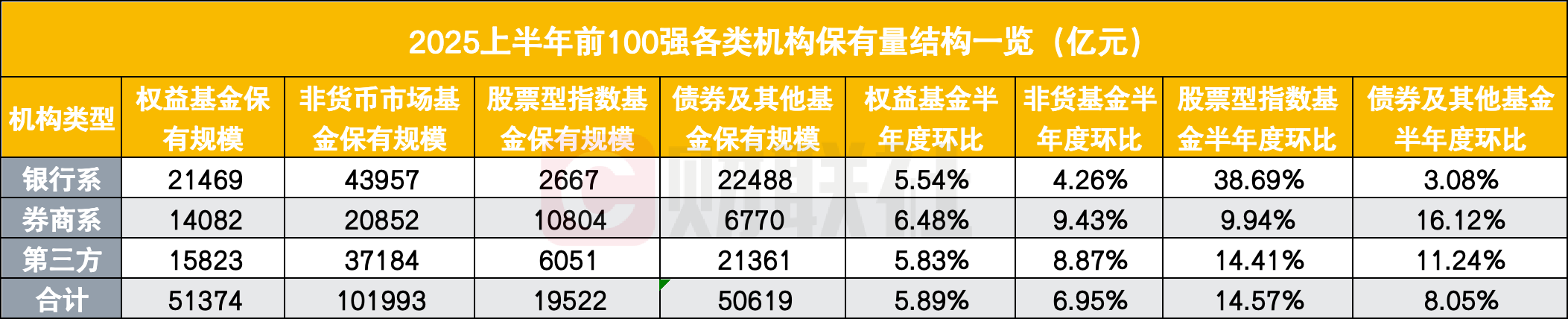
Core Insights - The public fund sales retention scale among the top 100 fund distribution institutions showed a steady growth trend in the first half of 2025, with significant performance differentiation among different types of funds and institutions [1][3][17] Group 1: Fund Performance - As of the end of the first half of 2025, the total retention scale of equity funds among the top 100 fund distribution institutions reached 51,374 billion yuan, a quarter-on-quarter increase of 5.89% [1][3] - The retention scale of non-monetary market funds was 101,993 billion yuan, with a quarter-on-quarter growth of 6.95% [1][3] - The bond and other funds reached 50,619 billion yuan, reflecting a quarter-on-quarter increase of 8.05% [1][3] - Stock index funds performed the best, with a total retention scale of 19,522 billion yuan and a quarter-on-quarter growth rate of 14.57%, becoming the core driver of public fund distribution growth [1][3] Group 2: Institutional Performance - Among the top 100 institutions, brokerage firms stood out with 57 firms listed, accounting for nearly half of the rankings [4][6] - The quarter-on-quarter growth rates for non-monetary funds, equity funds, and stock index funds for brokerage firms were 9.43%, 6.48%, and 9.94%, respectively [4][6] - Brokerage firms dominated the stock index fund market, holding over 55% market share, showcasing their absolute advantage [4][6] Group 3: Regulatory Impact - The revised "Securities Company Classification Evaluation Regulations" introduced on August 27, 2025, added specific indicators for fund advisory and equity fund sales retention scale, guiding brokerages to focus on long-term asset appreciation rather than just initial offerings [2][17] - The new mechanism is expected to shift industry resources towards equity fund sales, accelerating the optimization of wealth management business structures [2][17] Group 4: Competitive Landscape - The competition among leading brokerages remains intense, with notable ranking changes; Guotai Junan and other firms have shown significant improvements in their rankings [7][10] - The differentiation in fund distribution strategies among brokerages reflects their varying preferences and market positioning [7][8] - The retention scale of equity funds for leading brokerages like CITIC Securities and Huatai Securities remains robust, with significant absolute values [10][14]

惩罚性赎回费率抑制短期交易 监管新规或重构债基市场格局
Shang Hai Zheng Quan Bao· 2025-09-14 19:40
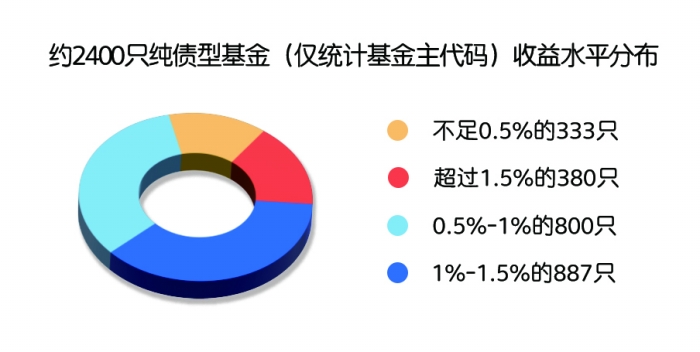
Core Viewpoint - The China Securities Regulatory Commission (CSRC) has released a draft regulation aimed at managing sales fees for publicly offered securities investment funds, which is expected to reshape the bond fund market and promote long-term healthy development of the capital market [3][4] Summary by Sections Regulation Details - The draft regulation proposes uniform redemption fees for various fund types, encouraging long-term holding by investors. Specific fees include 1.5% for holdings under 7 days, 1% for 7 to 30 days, and 0.5% for 30 days to 6 months [4][5] - The regulation has sparked discussions in the bond market, with concerns that high redemption fees could dilute investment returns for bond fund investors [4] Market Impact - As of September 12, there are approximately 2,400 pure bond funds with an average return of 1.05% over the past six months. A significant number of these funds have returns below 0.5%, indicating potential losses for investors if they redeem their investments [5] - Institutional investors, who hold a substantial portion of bond funds (91.77% in medium to long-term and 54.51% in short-term), may need to adjust their strategies due to the new fee structure [5][6] Institutional Investor Dynamics - The attractiveness of bond funds to institutional investors is primarily due to professional management and tax advantages. However, increased redemption costs may reduce the appeal of customized funds for institutions [6] - Banks, facing quarterly assessments, may reduce their allocation to long-term bond funds, which could disrupt the existing symbiotic relationship between banks and short-term bond funds used for liquidity management [7] Long-term Stability and Market Volatility - While the new regulation may lead to a decrease in the overall scale of bond funds and increase short-term market volatility, it is expected to enhance the long-term stability of bond fund sizes and investment strategies [8] - The regulation is anticipated to lower sales service fees for bond and money market funds, potentially increasing their attractiveness to individual investors [8] Growth of Bond ETFs - The bond ETF market has seen significant growth, with its scale increasing from 1.74 trillion yuan at the end of last year to over 5.7 trillion yuan by September 12, 2023, representing a 2.29-fold increase [9] - The draft regulation is expected to lead to a restructuring of the bond fund market, with a shift towards bond ETFs as a preferred liquidity management tool for institutional investors [9]
周末突发!中美,大消息!
中国基金报· 2025-09-14 15:42
Group 1: Economic and Trade Developments - The US and China held talks in Madrid regarding trade issues, including unilateral tariffs and export controls [2] - China's Ministry of Commerce initiated an anti-discrimination investigation into US measures related to integrated circuits, effective from September 13, 2025 [3] - An anti-dumping investigation was launched by the Ministry of Commerce on imported analog chips from the US, with the investigation period set from January 1, 2024, to December 31, 2024 [4] Group 2: Financial and Market Insights - The National Internet Information Office encouraged financial institutions to explore the use of digital RMB for cross-border payments, aiming to enhance digitalization in trade and reduce logistics costs [5] - Eight departments, including the Ministry of Industry and Information Technology, released a plan to promote the industrial application of intelligent connected vehicles, allowing conditional production approval for L3 models [6] Group 3: Brokerage Insights - CITIC Securities emphasized the need to evaluate fundamentals from a global perspective, noting that many companies are shifting from domestic to global exposure, particularly in manufacturing [8] - CITIC Construction Investment highlighted the importance of focusing on sectors with economic recovery potential, particularly in the context of inflation improvement [10] - Guojin Securities suggested that the market's focus should shift from style switching to the main logic of global commodity demand recovery and China's exit from deflation [12] - The strategy from China Merchants emphasized the recent improvements in macro liquidity and the potential for high-growth sectors to attract investment [13] - Shenwan Hongyuan noted the current market phase as a "bull market not afraid to wait," with a focus on structural bull trends driven by industry developments [14] - Everbright Securities maintained a positive outlook on the TMT sector, anticipating continued market growth supported by favorable conditions [15] - Galaxy Securities projected that domestic and international liquidity would continue to drive A-share market momentum, with AI expected to be a key market focus [16] - Guotai Junan expressed confidence in the Chinese market's potential for new highs, driven by economic transformation and supportive policies [17] - Zhongtai Securities discussed the ongoing debate about the sustainability of the tech sector's leadership in the market, highlighting the importance of policy and external factors [18] - Huaxi Securities identified high-growth sectors as the primary focus for the ongoing bull market, with a particular emphasis on hard technology and new productivity areas [19][20]

周末突发!中美,大消息!
Zhong Guo Ji Jin Bao· 2025-09-14 14:47
Group 1 - The US and China held talks in Madrid regarding trade issues, including unilateral tariffs and export controls [3] - China's Ministry of Commerce initiated an anti-discrimination investigation against the US regarding semiconductor measures, effective from September 13, 2025 [4] - An anti-dumping investigation on imported simulation chips from the US will also commence on September 13, 2025, with specific investigation periods outlined [5] Group 2 - The National Internet Information Office encourages financial institutions to explore the use of digital RMB for cross-border payments, aiming to enhance digitalization in trade and reduce logistics costs [6] - Eight departments, including the Ministry of Industry and Information Technology, issued a plan to promote the industrial application of intelligent connected vehicles, allowing conditional approval for L3 vehicle production [7] Group 3 - Citic Securities emphasizes evaluating fundamentals from a global perspective, noting that many companies are shifting from domestic to global exposure, particularly in manufacturing [9] - Citic Jiantou Strategy highlights the importance of focusing on sectors with economic recovery potential, particularly in AI and new energy [11] - Guojin Strategy suggests that the market should focus on the recovery of global commodity demand and the potential for domestic economic improvement [12] Group 4 - Recent macro liquidity data shows improvement, with M1 growth rebounding and a trend of residents moving deposits to equity markets [13] - Shenyin Wanguo Strategy indicates that the current market phase is a "bull market not afraid to wait," with a focus on structural bull trends driven by industry developments [14] - The market outlook remains positive, with expectations for continued upward movement in the stock market, particularly in the TMT sector [15] Group 5 - Galaxy Strategy predicts that AI will be a key market driver, supported by favorable liquidity conditions and ongoing demand in the overseas computing power industry [16] - Guotai Junan Strategy believes that the Chinese stock market will continue to rise, driven by economic transformation and supportive policies [17] - Zhongtai Strategy discusses the ongoing debate about the sustainability of the tech sector's leadership in the market, with potential for continued investment if external conditions align [18] Group 6 - Huaxi Securities identifies high-prosperity sectors as the main focus for the current "slow bull" market, with expectations for policy support and capital inflow [19] - Industry allocation recommendations include prioritizing high-prosperity sectors and new consumption areas, with a positive outlook for Hong Kong stocks amid potential foreign investment [20]
“牛市旗手”大动作,分红188亿
Zhong Guo Ji Jin Bao· 2025-09-14 09:12
Core Viewpoint - The mid-term dividend scale of Chinese securities firms has significantly increased, with 28 out of 42 listed brokers planning to distribute a total of 18.797 billion yuan in dividends for the mid-term of 2025, marking an increase of nearly 40% compared to 2024 [2][3] Group 1: Dividend Distribution - CITIC Securities leads with a proposed cash distribution of 4.298 billion yuan, marking its second consecutive year of mid-term dividends [3] - Other notable firms include Guotai Junan with 2.627 billion yuan, China Galaxy with 1.367 billion yuan, Huatai Securities with 1.354 billion yuan, and others, with respective per-share dividends [3] - Several firms, including Huaan Securities and Shanxi Securities, are announcing mid-term dividend plans for the first time [3] Group 2: Impact on Investor Experience - Analysts suggest that mid-term dividends enhance investor experience and attract long-term investors, positively influencing the sustainability of the securities sector's market performance [4] - The increase in mid-term dividends is attributed to a significant rise in profitability during the first half of the year, aligning with regulatory calls for better investor returns [4] Group 3: Balancing Dividends and Business Development - A key challenge for securities firms is balancing investor returns with the need for business development funding [5] - Analysts emphasize the importance of prudent dividend determination based on net profit and capital needs, ensuring that business expansion and risk management remain viable [5][6] - A stable dividend policy is seen as beneficial for enhancing market pricing and refinancing capabilities, thereby improving the firm's image in the capital market [6]


“牛市旗手”大动作,分红188亿
中国基金报· 2025-09-14 09:08
Core Viewpoint - The article highlights a significant increase in the mid-term dividend scale of Chinese securities firms, with 28 out of 42 listed brokers planning to distribute a total of 18.797 billion yuan in dividends for the mid-term of 2025, marking an increase of nearly 40% compared to 2024 [2][4]. Group 1: Dividend Distribution - Among the securities firms, CITIC Securities leads with a proposed cash distribution of 4.298 billion yuan, marking its second consecutive year of mid-term dividends [4]. - Other notable firms include Guotai Junan with 2.627 billion yuan, and China Galaxy, Huatai Securities, CITIC Jiantou, and China Merchants Securities proposing distributions of 1.367 billion yuan, 1.354 billion yuan, 1.28 billion yuan, and 1.035 billion yuan respectively [4]. - Several firms, such as Hua'an Securities and Shanxi Securities, are announcing mid-term dividend plans for the first time, indicating a broader trend among brokers to enhance investor returns [4]. Group 2: Impact on Investor Experience - Analysts suggest that the increase in mid-term dividends is a response to improved profitability in the first half of the year and aligns with regulatory calls for better investor returns [5]. - The implementation of mid-term dividends is seen as a way to enhance investor experience and attract long-term investors, positively impacting the sustainability of the brokerage sector's market performance [5]. Group 3: Balancing Dividends and Business Development - A key issue arises regarding how securities firms can balance investor returns with their own funding needs for growth [7]. - Analysts emphasize that mid-term dividend amounts are typically based on half-year net profit and future earnings outlook, requiring careful consideration to ensure business expansion and risk management are not adversely affected [7]. - The article notes that while short-term capital consumption may be controlled, a stable dividend policy can enhance market pricing and refinancing capabilities, ultimately supporting business expansion [8].

散户,真跑步入场了?
Ge Long Hui A P P· 2025-09-14 09:04
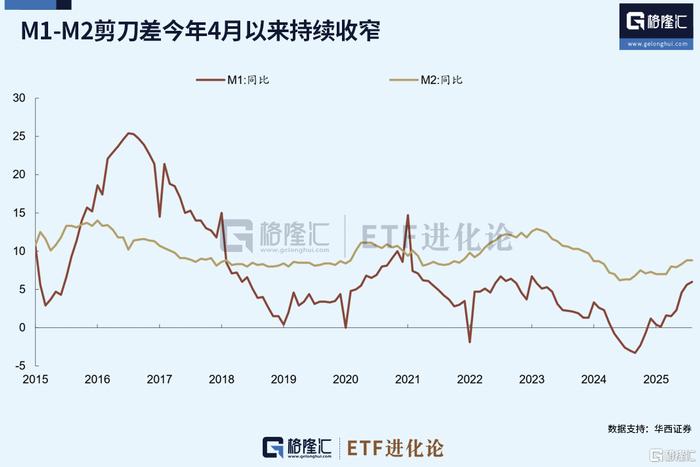
Core Viewpoint - The data from August indicates a continued trend of deposit migration, with a significant increase in non-bank deposits, suggesting a shift of funds from traditional savings to more active investment avenues like the equity market [1][4][5]. Group 1: Deposit Trends - In August, total new deposits reached 2.06 trillion yuan, with only 110 billion yuan coming from new resident deposits, a year-on-year decrease of 600 billion yuan [4]. - Non-bank deposits saw a substantial increase of 1.18 trillion yuan in August, following a record increase of 2.14 trillion yuan in July, marking the highest level since 2015 [5][4]. - The M1 growth rate expanded to 6.0% year-on-year in August, while M2 growth remained at 8.8%, narrowing the M1-M2 spread to 2.8%, the lowest in nearly 51 months [1][3]. Group 2: Market Implications - The acceleration of deposit migration is believed to be driven by a recovering equity market, with analysts suggesting that the stock market may be a primary destination for these funds [5][7]. - The number of new A-share accounts opened in August reached 2.65 million, a month-on-month increase of over 30%, indicating a growing interest from retail investors [8]. - Public fund market data shows a significant increase in equity fund subscriptions, with stock funds seeing a net increase of 108.79 billion units and a growth in scale of 485.54 billion yuan in August [12][13]. Group 3: Fund Market Dynamics - The total public fund market size grew by 571.66 billion yuan in August, alongside a 285.7 billion yuan increase in wealth management products, aligning closely with the 1.18 trillion yuan increase in non-bank deposits [12][13]. - The share of household deposits in the A-share market was 53% in July, indicating potential for further growth as the market recovers [13].
卖房卖车,这家券商集中处置逾70项资产,发生了什么?
Zheng Quan Shi Bao· 2025-09-14 08:06
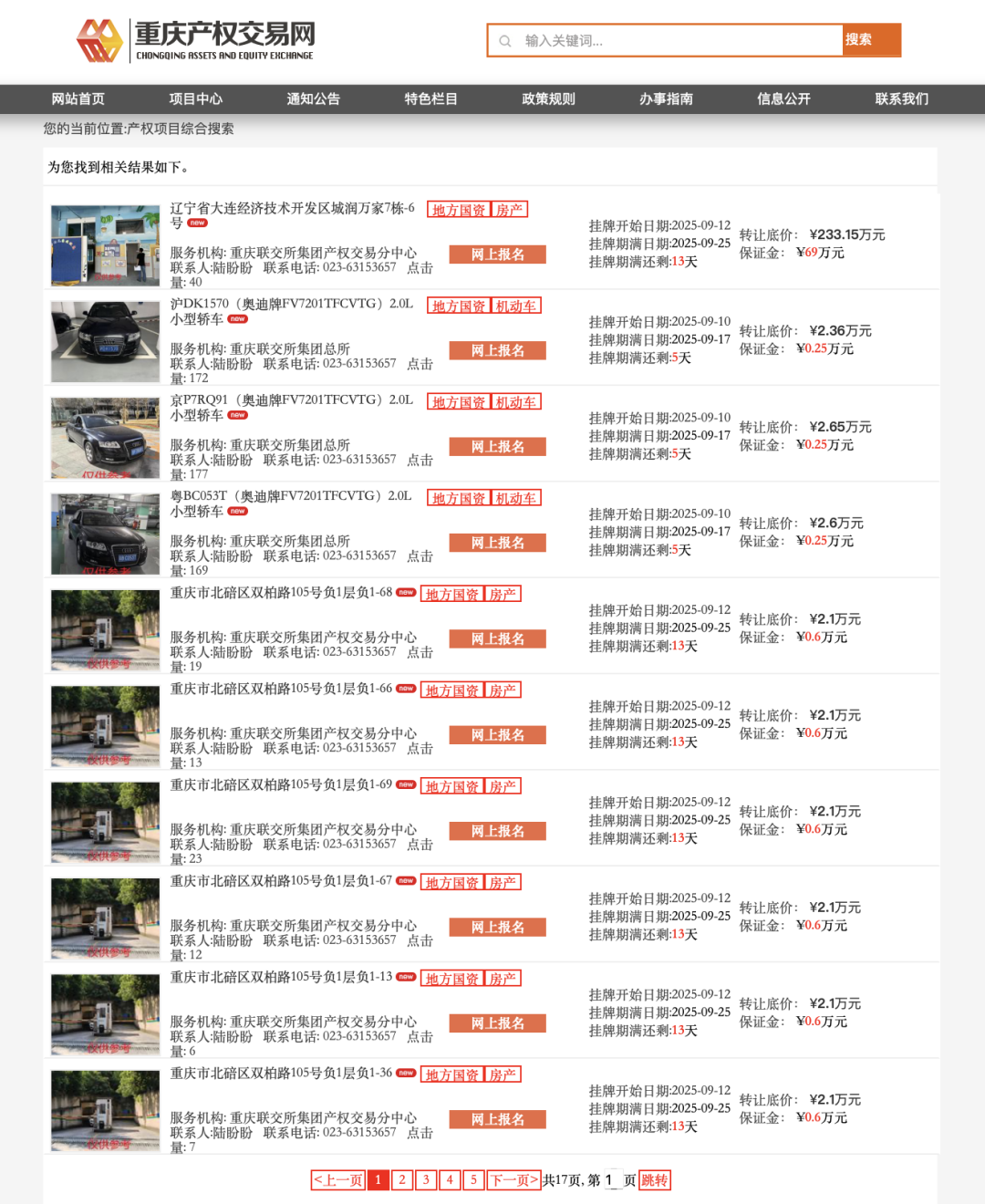
Core Viewpoint - Southwest Securities is actively disposing of assets, including over 70 projects involving real estate, parking spaces, and vehicles, with a total transfer base price of nearly 5 million yuan, primarily due to previous bond defaults by related developers [1][3][8]. Asset Disposal Details - The asset disposal includes 68 parking spaces located in Zhengyuan Xiangyuan, each with a transfer base price of 21,000 yuan, and two real estate projects with base prices of 1.0426 million yuan and 2.3315 million yuan, respectively [3][4]. - The total transfer base price for the listed assets is approximately 487.82 million yuan, with the vehicle transfer period set from September 10 to 17, and other projects from September 12 to 25 [3][8]. Background of Asset Origin - The assets are linked to developers whose controlling shareholders have previously been sued by Southwest Securities due to bond defaults, with the company acting on behalf of its asset management products to recover debts [6][7][8]. - In 2019, the developer Zhengyuan Real Estate faced a debt crisis, leading to multiple lawsuits from financial institutions, including Southwest Securities, which has since recovered approximately 54.786 million yuan through various means, including cash and asset disposals [8][9]. Industry Trends - Other securities firms have also been engaging in asset disposals to optimize their asset structures and improve operational efficiency, with examples including Hongta Securities and Huaxi Securities, which have announced plans to sell or lease properties [10].

卖房卖车!这家券商集中处置逾70项资产,发生了什么?
券商中国· 2025-09-14 07:06
Core Viewpoint - Southwest Securities is actively disposing of assets, including over 70 projects involving real estate, parking spaces, and vehicles, primarily due to previous bond defaults by developers linked to these assets [2][5][6]. Group 1: Asset Disposal Details - From September 10 to 12, Southwest Securities listed more than 70 asset transfer projects, with a total minimum transfer price of approximately 487.82 million yuan [3][4]. - The majority of the assets are parking spaces, with 68 spaces located in Zhengyuan Xiangyuan, each priced at 21,000 yuan. Additionally, two real estate projects and three Audi vehicles are also listed for sale [3][4]. - The real estate projects include a 122.66 square meter property in Anhui Province priced at 1.0426 million yuan and a 666.15 square meter property in Dalian priced at 2.3315 million yuan [3][4]. Group 2: Background of Asset Ownership - The assets being disposed of are linked to developers whose controlling shareholders have previously been sued by Southwest Securities due to bond defaults [5][6]. - Southwest Securities confirmed that the assets are indeed collateral for two defaulted bonds in litigation, and the actual ownership belongs to the asset management products issued by Southwest Securities, not the company itself [2][5]. Group 3: Legal Proceedings and Financial Recovery - In 2019, the developer Zhengyuan Real Estate faced a debt crisis, leading to bond defaults and subsequent lawsuits from multiple financial institutions, including Southwest Securities [6][7]. - Southwest Securities has recovered approximately 54.786 million yuan through cash and asset disposals related to these legal proceedings, with ongoing efforts to recover additional funds [7][8]. - The company has also engaged in similar legal actions against Anhui Foreign Economic Construction Group, which has entered bankruptcy proceedings, further complicating asset recovery [7][8]. Group 4: Industry Trends - Other securities firms are also engaging in asset disposals to optimize their asset structures and improve operational efficiency, with notable examples including Hongta Securities and Huaxi Securities [8].

金融服务 国际融合跑出“加速度”
Bei Jing Shang Bao· 2025-09-12 16:20
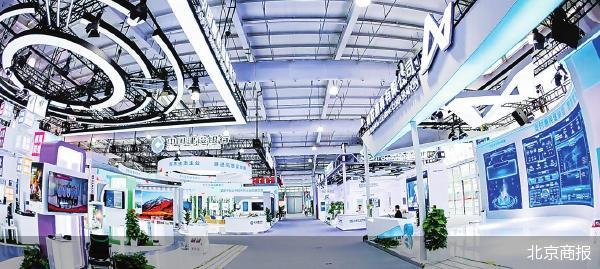
Core Insights - The 2025 Service Trade Fair showcased the integration of finance and technology, featuring 97 financial institutions, including 71 Fortune 500 companies, with an international participation rate of 47.4% [1][6] - The theme "Intelligent Drive, Open Win-Win" highlighted the digital transformation in the financial sector, supported by various policies encouraging innovation [3] - The event demonstrated significant advancements in AI, big data, and cloud computing within financial services, with practical applications already in use [3] Group 1: Technological Innovations - Financial institutions presented cutting-edge technologies, including AI-driven products and interactive exhibits, showcasing the tangible benefits of digital transformation [3] - The Industrial and Commercial Bank of China displayed a flexible intelligent robot capable of guiding visitors and engaging in natural language conversations, illustrating AI's potential in service scenarios [3] - Beijing Bank introduced a compact terminal device that facilitates payments and communication for foreign visitors, highlighting the importance of payment convenience [4] Group 2: International Participation - The fair saw a notable increase in foreign financial institutions, with a 47.4% representation, reflecting China's growing appeal as a global financial hub [6] - The International Financial Lounge served as a platform for cross-border financial exchanges, featuring over 40 institutions showcasing innovations in cross-border finance and wealth management [6] - Mastercard launched a payment facilitation project aimed at enhancing the payment experience for inbound travelers, demonstrating the internationalization of Chinese payment technology [6] Group 3: Financial Services for the Public - The event emphasized the importance of making financial services accessible and relevant to everyday life, with interactive designs allowing visitors to experience financial services firsthand [9] - The China Life Insurance Company showcased its comprehensive services in retirement finance and health management through an artistic installation [9] - The promotion of digital RMB was a highlight, with various banks collaborating to create an innovative marketplace for digital currency applications [9] Group 4: Educational Initiatives - Financial literacy and anti-fraud education were key focuses, with creative interactive zones designed to engage visitors in learning about investment and fraud prevention [10] - The event featured gamified designs to simplify complex topics like anti-money laundering, making them more accessible to the public [10] - The fair served as a significant platform for demonstrating the direction of China's financial industry, emphasizing intelligence, openness, and social value [10]