苹果

Search documents
五万亿市值的英伟达,托起了谁的脊梁?
Hu Xiu· 2025-10-29 15:43
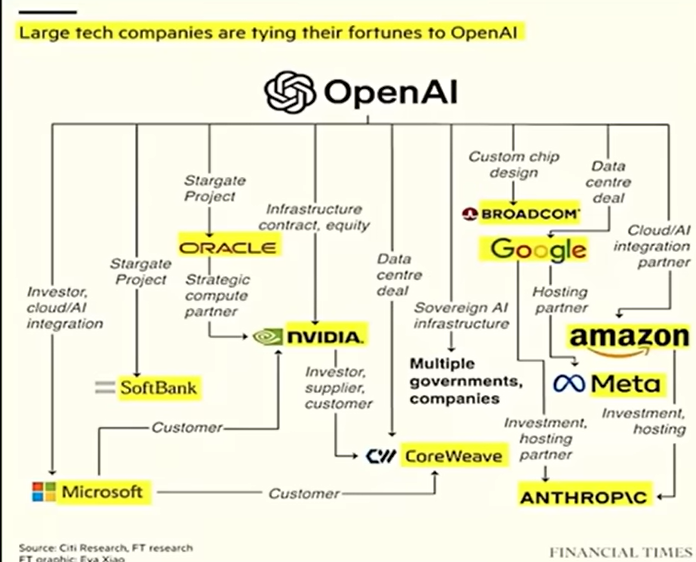
Core Viewpoint - Nvidia has become the first company in history to surpass a market capitalization of $5 trillion, driven by strong demand for AI technology and significant investments in AI infrastructure [1][2]. Group 1: Nvidia's Market Position and AI Demand - Nvidia's CEO Jensen Huang highlighted that the Blackwell and Rubin architecture chips could generate over $500 billion in revenue from 20 million GPUs by 2026, which is five times the revenue expected from the Hopper architecture chips between 2023 and 2025 [2]. - Huang also dismissed concerns regarding an AI bubble, despite rising skepticism in the market as Nvidia's valuation soared [3][4]. Group 2: Capital Circulation and Investment Dynamics - Nvidia's $100 billion investment in OpenAI has raised concerns about an AI bubble, as OpenAI committed to a $10 billion GPU order in return, creating a circular flow of capital between Nvidia and OpenAI [5][7]. - This capital cycle involves Nvidia investing in OpenAI, which in turn purchases cloud services from Oracle worth $300 billion, leading to further chip orders from Nvidia [7][8]. Group 3: Financial Health of Major Tech Companies - The free cash flow of the "Big Seven" tech companies has decreased by 62.45% from the end of 2024 to mid-2025, indicating a shift towards leveraging external financing for AI investments [12][14]. - Companies like Meta are increasingly resorting to debt financing, with Meta raising $27 billion through private debt issuance to build data centers, reflecting a trend of high-risk financing strategies [14]. Group 4: AI's Role in U.S. Economic Strategy - The U.S. government views AI as a core component of national strategic competition, leading to increased investments and policies aimed at maintaining dominance in AI technology [15][37]. - The "Stargate Project" aims to establish a global AI data center network with a $500 billion investment, indicating the scale of financial commitment required to support AI initiatives [40][42]. Group 5: Market Dynamics and Valuation Concerns - The S&P 500 has risen by 17.16% this year, driven by optimism around corporate earnings and AI investments, but this growth is largely attributed to valuation increases rather than fundamental earnings growth [22][31]. - The concentration of market capitalization among the top 10 stocks in the S&P 500, which are heavily AI-related, has reached 41.43%, raising concerns about potential overvaluation similar to the dot-com bubble [28][30].


道指首次触及48000点 英伟达市值突破5万亿美元 中概股上涨
2 1 Shi Ji Jing Ji Bao Dao· 2025-10-29 15:14
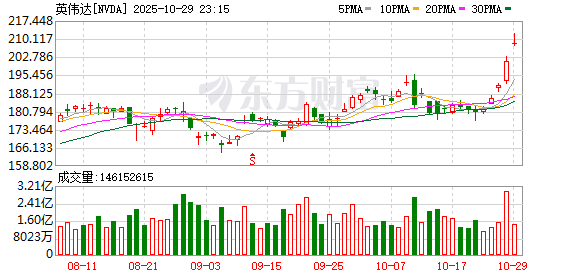
Core Insights - Nvidia has become the first company in history to reach a market capitalization of $5 trillion, with its stock price rising by 3.2% [4] - Nvidia's revenue for the first half of the fiscal year reached $90.8 billion, a 61.9% increase year-over-year, while net income rose by 43.58% to $45.2 billion [6] - Apple’s market capitalization has surpassed $4 trillion for the first time, reflecting strong performance in the tech sector [6] Nvidia Performance - Nvidia's stock price opened at $210.31, with a market capitalization of $5.11 trillion [5] - The company reported a quarterly revenue of $46.743 billion, a 56% increase year-over-year, and a 6% increase from the previous quarter [7] - Nvidia's data center revenue was $41.1 billion, also showing a 56% year-over-year growth [7] Market Trends - The U.S. stock market indices, including the Dow Jones and Nasdaq, reached new highs, with the Dow touching 48,000 points [2] - The storage sector in the U.S. stock market saw significant gains, with Seagate Technology rising by 13% and Western Digital increasing by over 8% [4] - Consumer confidence in the U.S. has dropped to a six-month low of 94.6, raising concerns about the economic outlook [8] Economic Outlook - Goldman Sachs has revised its revenue expectations for Nvidia to $500 billion, which is significantly higher than previous market consensus [6] - Analysts are cautious about the high valuations in the S&P 500, suggesting that the market may be overvalued compared to historical standards [8] - The ongoing U.S. government shutdown has raised concerns about economic stability and investor sentiment [9]
道指首次触及48000点,英伟达市值突破5万亿美元,多只热门中概股涨超2%
2 1 Shi Ji Jing Ji Bao Dao· 2025-10-29 14:50
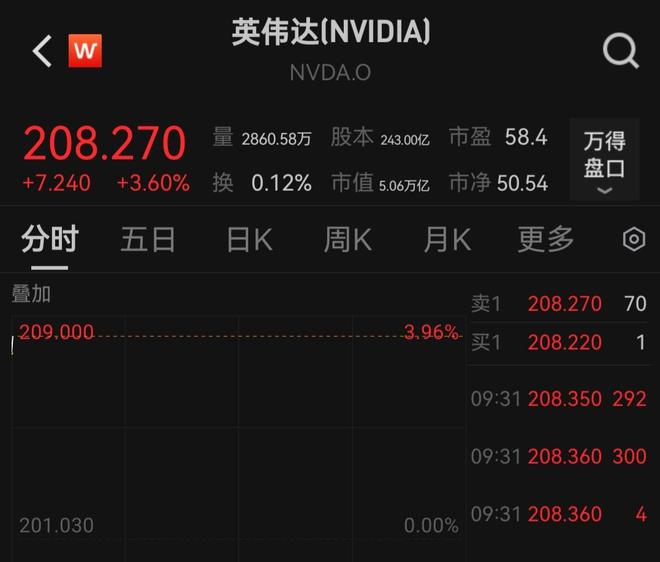
英伟达成史上首家5万亿美元市值公司 美股存储板块继续狂飙,希捷科技大涨13%,西部数据涨超8%,SanDisk涨超7%,美光科技、Rambus涨超2%。 英伟达公司股价开盘上涨3.2%,市值站上5万亿美元,成为史上第一家市值跨越这一里程碑的上市公司。随着英伟达股价的大幅上涨,福布斯实时富豪榜 显示,黄仁勋的个人财富突破了1800亿美元,成为全球第八有钱的人。 | < ロ | 英伟达(NVIDIA) | | | --- | --- | --- | | | NVDA.O | | | 210.310 | 量 1.1亿 股本 243.00亿 市盈 " 59.0 | 万得 | | 9.280 4.62% | 换 0.46% 市值 51105亿 市净 51.04 | 盘口 | | 盘中▼ 五日 日K | 周K 月K | 車名 | | 叠加 | 均价:209.820 | | | 1.11980 | | 5.45% 卖一 210.320 135 | | | | 买一 210.300 80 | | | | 100 10:26 210.285 | | | | 10:26 210.285 528 | | 201.030 | | 0 ...
史上首家!英伟达市值破5万亿美元
第一财经· 2025-10-29 13:49
Core Viewpoint - NVIDIA's stock price surged over 5%, reaching a market capitalization of $5.13 trillion, making it the first company to surpass the $5 trillion mark [3] Group 1: Financial Performance - For the second quarter of fiscal year 2026, NVIDIA reported revenue of $46.743 billion, a year-on-year increase of 56%, slightly exceeding market expectations [7] - The net profit (GAAP) for the same quarter was $26.422 billion, reflecting a year-on-year growth of 59% [7] - Data center revenue was $41.1 billion, also up 56% year-on-year, but slightly below market expectations [7] Group 2: Product Developments - CEO Jensen Huang indicated strong AI demand, projecting that revenue from Blackwell and Rubin architecture chips could exceed $500 billion from 20 million GPUs by 2026, five times the revenue from Hopper architecture chips between 2023 and 2025 [4] - The Rubin chip, which boasts a computing power of 100 PFlops, is set to enter production by next year [5] - NVIDIA announced a $1 billion investment in Nokia to accelerate AI-RAN innovation, facilitating the transition from 5G to 6G [5] - The company introduced the NVIDIA BlueField-4 data processor, which will support AI factory operating systems and is part of the Rubin architecture products scheduled for release in 2026 [6] Group 3: Market Context - The surge in stock prices for NVIDIA, Microsoft, and Apple reflects the ongoing global AI wave, with Apple reaching a market cap of $4 trillion and Microsoft at $4.04 trillion [7] - There is ongoing debate in the market regarding the potential bubble in AI stocks, with differing opinions from investment leaders [7]

史上首家!英伟达市值破5万亿美元
Di Yi Cai Jing Zi Xun· 2025-10-29 13:44
Core Viewpoint - NVIDIA's stock price surged over 5% on October 29, 2023, reaching a market capitalization of $5.13 trillion, making it the first company in history to surpass a $5 trillion market cap [1] Company Developments - NVIDIA's CEO Jensen Huang indicated strong demand for AI, projecting that revenue from the Blackwell and Rubin architecture chips could exceed $500 billion from 20 million GPUs by 2026, which is five times the revenue expected from the Hopper architecture chips between 2023 and 2025 [2] - Huang showcased the next-generation Rubin superchip, which boasts a computing power of 100 PFlops, 100 times that of NVIDIA's first AI-specific computer, DGX-1, with production expected to begin by next year [3] - NVIDIA announced a $1 billion investment in Nokia to accelerate AI-RAN innovation, facilitating the transition from 5G to 6G, and introduced the Arc Aerial RAN Computer to support next-generation AI-native mobile networks [3] - In quantum computing, NVIDIA launched NVQLink, enabling hybrid simulation between QPUs and GPU supercomputers, with support from 17 different quantum computing companies [3] - NVIDIA introduced the NVIDIA BlueField-4 data processor, which will support AI factory operating systems and is part of the Rubin architecture products set to launch in 2026 [4] Financial Performance - For the second quarter of fiscal year 2026 ending July 27, 2025, NVIDIA reported revenue of $46.743 billion, a 56% year-over-year increase, slightly exceeding market expectations, with a net profit of $26.422 billion, up 59% year-over-year [5] - NVIDIA's data center revenue reached $41.1 billion, also a 56% year-over-year increase, but slightly below market expectations [5] Market Context - On October 28, 2023, NVIDIA, Microsoft, and Apple briefly entered the "4 trillion club," with Apple's market cap at $3.99 trillion and Microsoft's at $4.03 trillion, while on October 29, Apple's market cap rose to $4 trillion and Microsoft's to $4.04 trillion [5] - The surge in market capitalization among tech giants is driven by the ongoing global AI wave, although there are ongoing discussions about the potential for an AI bubble [5]
AI热潮高歌猛进,美股创纪录涨势暗藏风险
2 1 Shi Ji Jing Ji Bao Dao· 2025-10-29 13:22
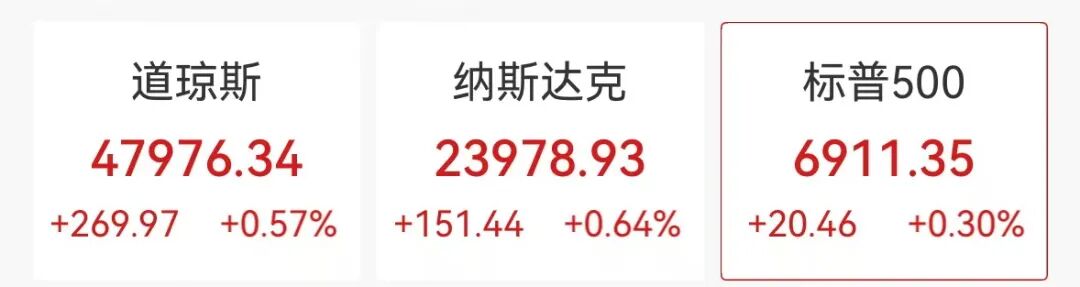
Group 1: Market Performance - The U.S. stock market indices reached new historical highs, with the Dow Jones Industrial Average rising 0.34% to 47,706.37 points, the S&P 500 increasing by 0.23% to 6,890.89 points, and the Nasdaq gaining 0.8% to 23,827.49 points [1] - Nvidia's CEO Jensen Huang announced new partnerships and downplayed concerns about an AI bubble, contributing to a 4.98% increase in Nvidia's stock price, reaching $201.03 and a market capitalization nearing $5 trillion [1][2] - Apple's market capitalization surpassed $4 trillion for the first time, following strong demand for the latest iPhone, alleviating concerns about its progress in the AI race [1] Group 2: AI Market Insights - Huang emphasized that AI models are robust enough for customers to pay for them, indicating a sustainable demand for AI technology [2] - Nvidia's latest chip shipment is projected to reach 20 million units, significantly higher than the previous generation's total of 4 million units, with business scale expected to reach $500 billion over the next six quarters [2] - The AI market is seen as being in a "virtuous cycle," with real enterprise demand driving growth, contrasting with the internet bubble of 2000 [5] Group 3: Economic Indicators - U.S. inflation data for September showed a lower-than-expected increase, with the CPI rising 0.3% month-over-month and 3% year-over-year, which supports a favorable environment for growth stocks [3] - As of October 28, 87% of S&P 500 companies that reported earnings exceeded expectations, indicating strong corporate profitability [3] - Consumer confidence fell to a six-month low of 94.6 in October, raising concerns about the economic outlook and potential implications for Federal Reserve policy [6][8] Group 4: Risks and Concerns - There are emerging concerns about the sustainability of the AI-driven market rally, with some analysts warning of potential market corrections due to high valuations and economic uncertainties [4][6] - The ongoing U.S. government shutdown has raised worries about consumer sentiment and economic stability, with historical comparisons indicating potential risks [6][8] - Analysts caution that the rise of AI may lead to job cuts in white-collar sectors, which could negatively impact consumer spending [7]
AI热潮高歌猛进,美股创纪录涨势暗藏风险|美股一线
2 1 Shi Ji Jing Ji Bao Dao· 2025-10-29 13:09
Core Viewpoint - The strong performance of large tech stocks has driven U.S. stock indices to new historical highs, with Nvidia playing a crucial role in alleviating concerns about an AI investment bubble [1][3][4]. Group 1: Market Performance - On October 28, the Dow Jones Industrial Average rose 0.34% to 47,706.37 points, the S&P 500 increased by 0.23% to 6,890.89 points, and the Nasdaq Composite climbed 0.8% to 23,827.49 points [1]. - Nvidia's stock surged by 4.98% to $201.03, reaching a market capitalization close to $5 trillion, while Apple became the third company to surpass a $4 trillion market cap [1]. Group 2: AI and Nvidia's Role - Nvidia's CEO Jensen Huang emphasized the strength of AI models and the willingness of customers to pay for them, suggesting that the investment in expensive computing infrastructure is justified [3]. - Huang predicted that Nvidia's latest chip shipments would reach 20 million units, significantly higher than the previous generation's total of 4 million units, with a projected business scale of $500 billion over the next six quarters [3]. Group 3: Economic Indicators - U.S. inflation data for September showed a lower-than-expected increase, with the CPI rising 0.3% month-over-month and 3% year-over-year, which supports the expectation of continued low interest rates [4]. - As of October 28, 87% of S&P 500 companies that reported earnings exceeded expectations, indicating strong corporate profitability [4]. Group 4: Market Sentiment and Future Outlook - The AI sector is seen as a key driver of market sentiment, with ongoing optimism about AI demand and significant capital expenditure plans from companies [4][6]. - Analysts suggest that the AI investment trend is distinct from the 2000 internet bubble due to real enterprise-level demand and healthy cash flows supporting capital expenditures [5][6]. Group 5: Risks and Concerns - Despite the positive market performance, there are emerging concerns, including a decline in consumer confidence to a six-month low of 94.6, which could influence Federal Reserve policy [7]. - The ongoing U.S. government shutdown has raised worries among consumers, with historical comparisons indicating potential risks to market stability [7]. - Analysts caution that while the current market appears strong, there are signs of a potential bear market, with high valuations and credit indicators showing weakness [8][9].
美股前瞻 | 三大股指期货齐涨,美联储利率决议来袭,微软、谷歌、Meta盘后公布财报
智通财经网· 2025-10-29 12:14
Market Overview - US stock index futures are all up, with Dow futures rising by 0.25%, S&P 500 futures up by 0.31%, and Nasdaq futures increasing by 0.47% [1] - European indices show mixed results, with Germany's DAX down by 0.02%, UK's FTSE 100 up by 0.80%, France's CAC40 up by 0.04%, and Europe's Stoxx 50 up by 0.43% [2] - WTI crude oil prices increased by 0.42% to $60.40 per barrel, while Brent crude rose by 0.38% to $64.07 per barrel [2] Federal Reserve Insights - The Federal Reserve is expected to lower interest rates by 25 basis points, with Chairman Powell likely to provide limited forward guidance due to increasing divisions among policymakers [3] - Recent CPI data indicated weaker-than-expected inflation, which may temporarily suppress hawkish sentiments within the Fed [3] Semiconductor Industry - SK Hynix reported a 62% increase in profits for Q3, achieving a record operating profit of 11.4 trillion KRW (approximately $8 billion), driven by surging demand for AI infrastructure [4] - The company has sold out its entire range of memory chip orders for next year, indicating a significant boost in industry demand [4] AI and Technology Sector - Concerns about a potential bubble in AI-driven stock market gains are alleviated by stronger-than-expected earnings from companies like SK Hynix and Advanced Micro Devices [5] - Major US tech giants, including Microsoft, Amazon, Apple, Alphabet, and Meta, are set to report earnings this week, which will provide insights into the capital expenditure trends in the AI sector [5] Inflation-Linked Securities - The US government shutdown has created a "data vacuum," affecting the pricing of inflation-linked securities as there is a lack of consumer price index (CPI) data [6] - Traders are resorting to emergency mechanisms embedded in legal documents for inflation-linked bonds and derivatives due to the absence of critical economic data [6] Banking Sector Performance - Deutsche Bank reported a 7% increase in Q3 profits, driven by strong performance in its investment banking division, with total revenue reaching €8.04 billion [14] - UBS also saw a 74% increase in net profit for Q3, attributed to significant growth in investment banking and stock trading revenues [14] Chip Equipment Manufacturing - ASM International's Q3 orders fell short of expectations, with a 17% year-over-year decline to €636.8 million (approximately $743 million), primarily due to decreased demand from advanced chip manufacturers and reduced orders from China [15] Healthcare Sector - GlaxoSmithKline raised its full-year earnings guidance due to strong demand for its HIV and immunology drugs, reporting Q3 revenue of £8.55 billion, a 4.9% year-over-year increase [13] Consumer Spending and Financial Services - Visa's Q4 revenue grew nearly 12% year-over-year to $10.7 billion, exceeding market expectations, with strong consumer spending noted in both luxury and essential goods [11] - Booking Holdings reported a 13% increase in sales for the quarter, reaching $9.01 billion, with an optimistic outlook for room night growth [12]

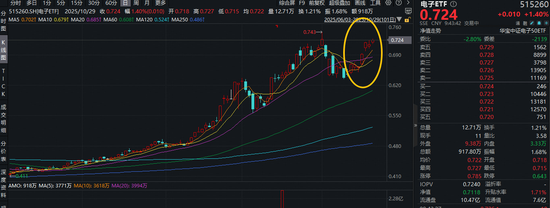
果然大涨!苹果挺进四万亿美元俱乐部!果链含量43%的电子ETF(515260)盘中涨逾1.6%冲击日线7连阳!
Xin Lang Ji Jin· 2025-10-29 01:52
Group 1 - Apple's stock price reached a new high of $269.98, with a market capitalization surpassing $4 trillion, making it the third company to join the "trillion-dollar club" after Nvidia and Microsoft [1] - Since the launch of the latest iPhone series on September 9, Apple's stock has increased by approximately 13%, marking a shift from decline to growth for the year [1] - Analysts believe that the strong demand for new products indicates that Apple is regaining growth momentum in its product cycle [1] Group 2 - The electronic ETF (515260) has a significant weight of 43.43% in Apple’s supply chain stocks, reflecting the strong performance of the "fruit chain" [1][5] - As of October 27, all 15 companies that disclosed their Q3 reports within the electronic ETF achieved profitability, with 14 companies reporting double-digit year-on-year growth in net profit [3] - Notable companies such as Shenghong Technology and Cambricon reported year-on-year net profit increases of 324% and 321%, respectively, indicating robust performance in the semiconductor sector [3] Group 3 - The semiconductor sector is experiencing a structural market driven by strong policy expectations and trends in the AI industry, with a focus on technological self-reliance and supply chain autonomy [3][4] - The upcoming peak season for consumer electronics, combined with the release of AI-related products, is expected to positively impact the electronic industry’s fundamentals [4] - The electronic ETF (515260) is designed to track the performance of the semiconductor and consumer electronics sectors, featuring major companies like Luxshare Precision and Semiconductor Manufacturing International [5]
早报 (10.29)| 黄仁勋深夜炸场!英伟达市值逼近5万亿美元;OpenAI、微软再签2500亿美元大单;日本对美投资计划清单曝光!
Ge Long Hui· 2025-10-29 00:30
Group 1 - The US and Japan signed a new alliance agreement, including a $550 billion investment from Japan to the US and a framework for securing key minerals and rare earth supplies [2] - Nvidia's CEO outlined a comprehensive AI strategy at the GTC conference, revealing $500 billion in chip orders by the end of fiscal 2026, leading to a surge in Nvidia's stock price [2][3] - Nvidia announced a $1 billion investment in Nokia, acquiring a 2.9% stake to develop AI-RAN products, significantly boosting Nokia's stock by over 20% [8] Group 2 - Tesla's EU registrations fell by 19% in September, with a cumulative decline of 38.7% for the year, while BYD's registrations surged by 272% [10] - Westinghouse Electric secured an $80 billion contract with the US government to deploy AP1000 nuclear reactors, creating 45,000 jobs and marking a significant step in US nuclear expansion [11] - Samsung announced a 30% price reduction for its HBM3E chips to regain market share after delays in certification, which may increase pricing pressure in the industry [14] Group 3 - OpenAI completed a capital restructuring, with Microsoft holding a 27% stake and committing to $250 billion in Azure services, while OpenAI has no plans for an IPO [9] - The 2025 Hurun Rich List revealed that Zhong Shanshan became China's richest person for the fourth time, with a wealth increase of 190 billion yuan due to the performance of Nongfu Spring [17] - The 2025 Global Brand Value Top 25 list ranked Apple first, followed by Microsoft and Google, with Nvidia entering the top ten due to its AI hardware advantages [18]