微软

Search documents
中国经济的新特点与新趋势
Ping An Securities· 2025-12-17 10:30
Group 1: Global Technology Competition - The global technology competition is increasingly defined by the US-China rivalry, with China narrowing the gap in fields like semiconductors and artificial intelligence[7] - In 2025, AI-related investments contributed approximately 6.8% to the US GDP, with a notable 0.92 percentage point contribution to year-on-year GDP growth in Q2[12] - The capital expenditure of the top seven US tech companies (MAG7) reached nearly $267 billion in 2025, a 67.7% increase year-on-year, accounting for about 27% of total S&P 500 capital expenditure[9] Group 2: International Trade and Economic Confidence - In 2025, China's direct exports to the US decreased to 11.3% of total exports, down from 14.7% in 2024, indicating a shift in trade dynamics[21] - The Chinese government effectively countered US tariffs, showcasing its industrial strength and market size, with the Wind All A index rising by 22.2% in 2025[19] - China's dominance in rare earth processing, with a 58% share of global production capacity, underpins its strategic response to international trade conflicts[20] Group 3: Economic Transition and Structural Changes - The "new new three" categories—robots, artificial intelligence, and innovative drugs—are set to lead China's industrial upgrade, reflecting a shift towards high-end manufacturing[27] - By 2024, the "three new" industries accounted for about 18% of GDP, while the real estate and construction sectors' share fell from 15.3% in 2020 to 12.9%[27] - In the first ten months of 2025, China's industrial robot production increased by 28.8% year-on-year, with exports growing by 61.5%[28] Group 4: Policy and Market Dynamics - The Chinese government is focusing on "anti-involution" policies to promote rational market competition, with significant measures announced in 2025 to eliminate local protectionism[35] - Fiscal policy in 2025 emphasized "stabilizing growth" through increased central leverage, with net fiscal injections contributing 76% to new M2 growth in the first three quarters[3]
观察| 人工智能背后的会计谎言
未可知人工智能研究院· 2025-12-17 10:02
Core Viewpoint - The article argues that the AI industry is experiencing a significant accounting distortion and potential bubble, similar to past financial crises, driven by inflated valuations, unsustainable business models, and questionable accounting practices [6][10][130]. Group 1: Market Reactions and Financial Signals - Following Nvidia's earnings report, the stock plummeted, and Bitcoin's value dropped from a historical high of $126,000 to $89,000, resulting in a global cryptocurrency market loss of $420 billion in a single day [3][4]. - Nvidia's accounts receivable reached $33.4 billion, indicating a concerning increase in the time taken to collect payments, with the Days Sales Outstanding (DSO) rising to 53.3 days, compared to the historical average of 46 days [16][19]. - The inventory of Nvidia surged by 32% from $15 billion to $19.8 billion, contradicting claims of high demand and supply constraints, suggesting either overproduction or customers unable to pay [28][29]. Group 2: Accounting Practices and Profitability - Nvidia's accounting practices allow for a significant underreporting of depreciation on AI infrastructure, leading to an estimated $176 billion in inflated profits by 2028 due to a discrepancy in depreciation rates [14][15]. - The company's cash conversion rate is only 75.1%, indicating that 25% of reported profits are not translating into actual cash flow, raising concerns about the sustainability of its financial health [35][36]. - Nvidia's stock buyback strategy, amounting to $9.5 billion, raises questions about prioritizing shareholder value over operational health, especially when cash flow is constrained [38][39]. Group 3: Industry-Wide Implications - The AI sector is characterized by a cycle of financing where companies invest in each other, creating a façade of revenue without real external cash flow, leading to inflated valuations [42][47]. - Major players like Microsoft and Oracle are also implicated in similar financing structures, raising concerns about the overall health of the AI ecosystem [50][51]. - Historical parallels are drawn to past financial collapses, such as Enron and WorldCom, highlighting the risks of inflated accounting practices and unsustainable business models in the current AI landscape [68][71]. Group 4: Future Outlook and Risks - The article predicts a rapid market correction, potentially more severe than the 2008 financial crisis, driven by the interconnectedness of AI companies and their reliance on inflated valuations [91][106]. - The potential for a significant drop in AI company valuations, estimated between 50% to 70%, could trigger a chain reaction affecting the broader market, particularly in cryptocurrency [98][100]. - The article emphasizes the need for a market correction to eliminate speculative investments and allow for the emergence of sustainable business models in the AI sector [110][139].


最新“世界品牌500强”:谷歌、微软和苹果居前三 中国50个品牌上榜
Zhong Guo Xin Wen Wang· 2025-12-17 08:37
Group 1 - The core finding of the "World Brand 500" list for 2025 is that Google has surpassed Apple to take the top position, with Microsoft remaining in second place and Apple dropping to third [1] - A total of 50 Chinese brands made the list, maintaining China's position as the third-largest country in terms of brand representation [1] - The United States leads with 184 brands, followed by France with 51, China with 50, Japan with 40, and the United Kingdom with 34 [1] Group 2 - This year, 23 new brands were added to the list, including three from China: CATL, China Unicom, and Tongding [2] - The average age of the brands on the list is 98.46 years, which has decreased compared to last year due to the rapid growth of younger brands in the technology sector [2] - A discussion at the Hong Kong launch focused on the impact of artificial intelligence on branding and marketing, highlighting its mixed contributions to growth and revenue [2]



世界品牌实验室发布2025年世界品牌500强,谷歌、微软、苹果排前三
Qi Lu Wan Bao· 2025-12-17 07:19
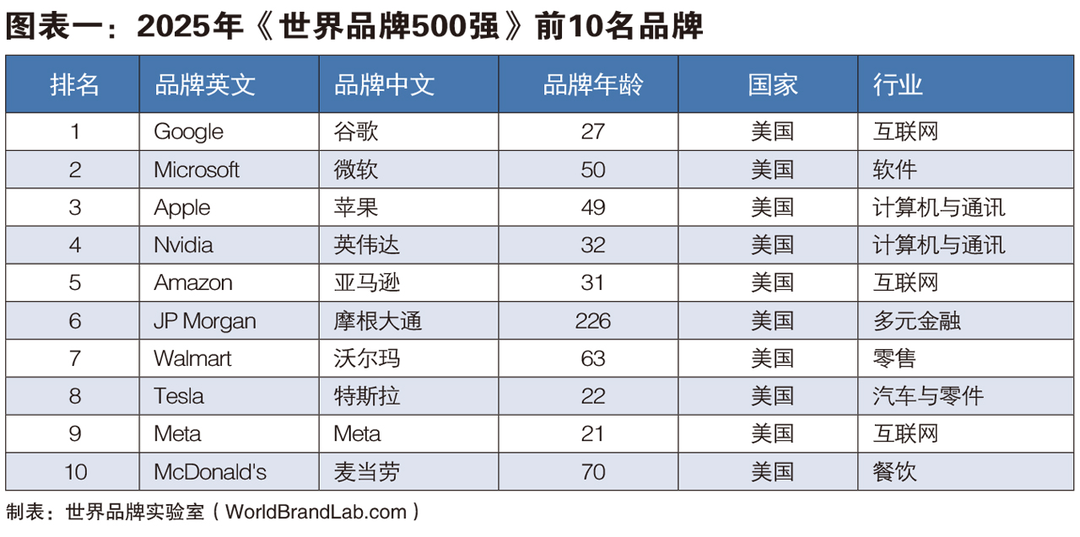
Core Insights - The 2025 World's 500 Most Influential Brands list was released on December 17, with Google ranking first, followed by Microsoft and Apple [1][3] - The United States leads with 184 brands in the list, while China ranks third with 50 brands, surpassing Japan's 40 [1][4] - The report highlights the impact of artificial intelligence on brand creativity and the dual-edged sword effect it presents [1][12] Brand Rankings - Google (27 years, USA, Internet) is ranked first, followed by Microsoft (50 years, USA, Software) and Apple (49 years, USA, Computer & Communications) [2] - Other notable brands in the top 10 include Nvidia, Amazon, JP Morgan, Walmart, Tesla, Meta, and McDonald's [2] Brand Influence Criteria - The ranking is based on brand influence, which includes market share, brand loyalty, and global leadership [3][14] - The evaluation involved approximately 8,000 well-known brands, with metrics from iTrust Rating and ESG databases [3] Brand Representation by Country - The United States has 184 brands, France 51, China 50, Japan 40, and the UK 34 [5] - Germany, Switzerland, and Italy represent the third tier of brand countries [4] Industry Representation - The automotive sector leads with 33 brands, followed by energy and food & beverage sectors with 30 brands each [6] - The banking sector has 29 brands, while retail and computer & communications each have 27 brands [6] New Entrants - A total of 23 new brands made the list, with Elevance Health (173rd) being the highest-ranked newcomer [6][7] - Notable new entrants from China include CATL, China Unicom, and Tongding, reflecting advancements in new energy and telecommunications [6] Brand Age Insights - The average age of brands in the list is 98.46 years, with 221 brands over 100 years old [7] - The oldest brand is Saint-Gobain (360 years), followed by Aviva and Moutai [8] AI and Brand Strategy - The report emphasizes the need for brands to adapt to AI-driven changes in marketing and decision-making [10][11] - AI is seen as a transformative tool that can enhance brand performance but also poses challenges in management and evaluation [10][12]



海外及传媒年度策略:算力飞轮、多极模型生态与Agent化生产力
Huaan Securities· 2025-12-17 05:30
Group 1: Generative AI and Computing Power - The landscape of generative AI is shifting from a "single supplier" model to a "multi-architecture + multiple leading players" competition, with NVIDIA, AMD, Google, and Amazon leading the charge in AI chip development [22][23] - The AI server interconnect is evolving from board-level PCIe and copper cabling to rack-level optical interconnects and reconfigurable network architectures, enhancing data transmission capabilities [24][25] - The storage sector is entering a "super cycle" driven by HBM, GDDR, DRAM, NAND, and CXL technologies, as AI models demand increased data capacity and bandwidth [27][28][31] Group 2: AI Applications and Industry Impact - Video generation models have reached a "production-grade" stage, with companies like Google and Kuaishou leading the way in integrating AI into content creation workflows [32][33] - The advertising, gaming, and automation sectors are undergoing significant transformations due to AI, with enhanced precision in ad targeting and reduced production costs in gaming [9][10] - The publishing industry is characterized by stable demand for educational materials and low PE ratios, providing a safety net for investors [12] Group 3: Market Performance and Trends - The Nasdaq Composite Index experienced a notable recovery in the second half of 2025, driven by advancements in AI and generative models, which restored investor confidence [35][38] - The MAG 7 stocks showed significant performance differentiation, with Google and NVIDIA outperforming the market, while other major players like Tesla and Microsoft lagged behind [38]
谷歌与OpenAI算力洪流将DRAM/NAND需求推向指数级扩张 美光(MU.US)迎接“AI基建超级红利”
Zhi Tong Cai Jing· 2025-12-17 04:22
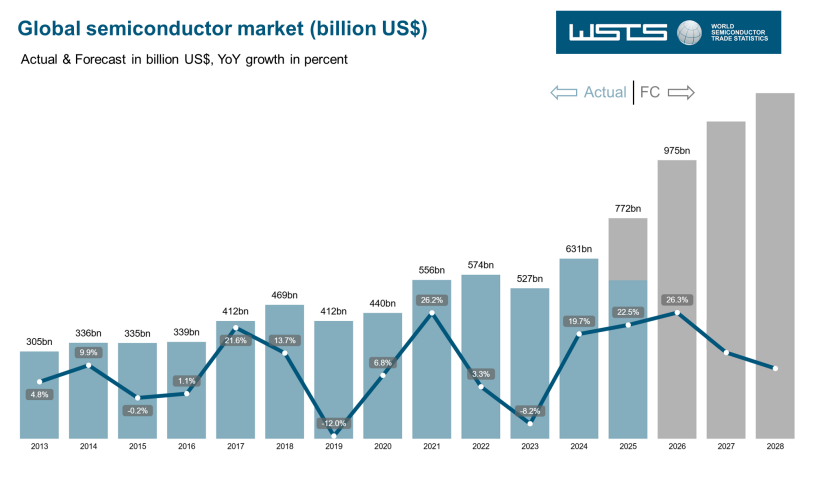
Group 1 - The core argument of the articles revolves around the "storage supercycle" driven by the increasing demand for AI infrastructure, significantly benefiting companies like Micron Technology, which has seen its stock price rise approximately 180% this year [1][2][4]. - Major investment firms, including Wells Fargo, highlight that the demand for high-performance storage products, particularly HBM and server-level DDR5, is surging due to the rapid expansion of AI data centers [1][2][8]. - The semiconductor market is projected to grow significantly, with WSTS forecasting a 22.5% increase in 2025, reaching a total value of $772.2 billion, and further expanding to $975.5 billion in 2026, indicating a robust recovery in chip demand [2]. Group 2 - Micron is identified as one of the biggest beneficiaries of the anticipated over 100% growth in the DRAM market by 2026, particularly in the HBM and high-performance DDR5 segments [4][5]. - TrendForce has revised its revenue forecasts for the DRAM industry, predicting revenues of approximately $165.7 billion in 2025 (up 73% year-on-year) and $333.5 billion in 2026 (up 101% year-on-year), indicating a strong recovery trajectory [5]. - The ongoing AI infrastructure investment wave is expected to reach $3 trillion to $4 trillion by 2030, driven by unprecedented demand for AI computing power [3]. Group 3 - The competition between Google and OpenAI is highlighted as a significant investment theme, with both companies relying heavily on high-performance storage solutions, which are essential for their AI infrastructure [6][7]. - The demand for enterprise-level high-performance storage, including HBM systems and server-level DDR5, is critical for supporting the massive AI training and inference workloads, with DRAM capacities in AI servers being 8-10 times higher than traditional CPU servers [8]. - The transition to DDR5 is driven by its 50% bandwidth improvement over DDR4, making it more suitable for large-scale AI workloads [8].

隔离器上游缺口—偏振片与法拉第片
2025-12-17 02:27
Summary of Key Points from Conference Call Records Industry Overview - The isolator market is facing supply-demand imbalances due to tight upstream material supplies, specifically Faraday rotators and polarizers, primarily controlled by overseas manufacturers such as Sumitomo, Coherent, Hoya, and Corning. This has led to price increases, creating opportunities for domestic manufacturers like Xinhua Guang and Fuzhijing [1][2][4] - Global infrastructure demand remains strong, but North America is experiencing shortages, impacting related supply chains. Space computing, as part of broader infrastructure, is expected to address ground energy shortages through commercial space technology [1][5][19] Key Insights and Arguments - The isolator is crucial in optical communication for ensuring unidirectional light transmission, with increasing demand and quality requirements, especially in North America [2] - The financial results of Broadcom and Oracle have caused market fluctuations, but the underlying demand remains strong. Concerns about AI demand and supply chain issues are significant [1][6][8] - The AI sector shows notable valuation disparities, with core AI stocks like TSMC and NVIDIA being relatively undervalued, while segments like power, fuel cells, and storage are overvalued [8] - NVIDIA's H200 offers significant cost-performance advantages, attracting major organizations like Alibaba and Tencent, and is pivotal in advancing AI technology [3][12][14] Market Dynamics - Broadcom's lack of a substantial upward revision in its 2026 guidance has led to market anxiety, despite strong financial performance. The stock dropped 10% post-earnings release due to concerns over AI demand and supply chain capabilities [6][7] - Oracle's recent financial performance raised concerns about cash flow and order fulfillment, particularly regarding its collaboration with OpenAI [9] Technological Developments - Companies are accelerating model iterations, with advancements like GPT-5.2 and Gemini 3.3 Pro showcasing different strengths in AI capabilities. NVIDIA maintains a competitive edge in computing power, although Google's TPU project has significant experience [10][11] - The light communication industry is thriving due to its high demand and favorable commercial landscape, with leading companies like Zhongji Xuchuang and Xinyi Sheng expanding their advantages in silicon photonics [17][18] Future Trends - Space computing is expected to grow significantly, driven by events like frequent rocket launches and the potential IPO of SpaceX, addressing energy supply issues through high-density solar energy [19][20][21] - Liquid cooling technology is gaining attention, with established companies maintaining dominance due to their experience and case studies, while new entrants face challenges in post-installation support and operational risks [22][23][24]
凌晨,见证历史!
天天基金网· 2025-12-17 01:31
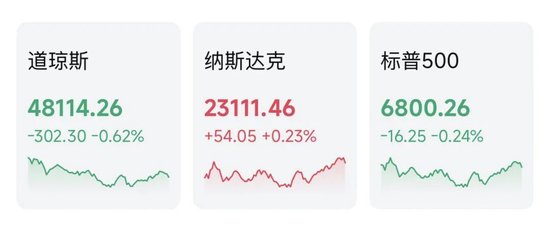
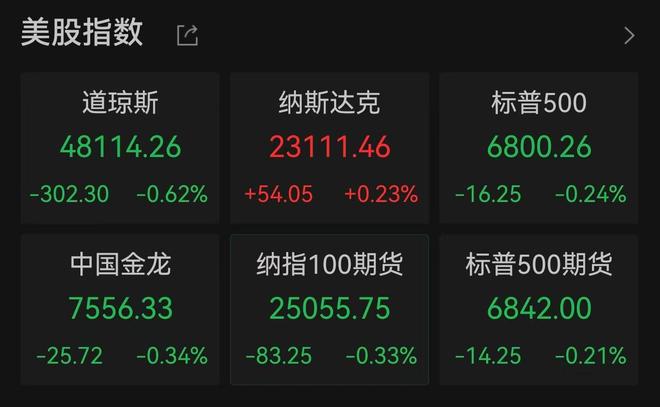
上天天基金APP搜索777注册即可领500元券包,优选基金10元起投!限量发放!先到先得! 美东时间12月16日,美股三大指数涨跌不一,仅纳指收涨。 市场担忧美国经济状况,投资者情绪偏谨慎。 截至收盘,道琼斯指数跌0.62%,报48114.26点;纳斯达克指数涨0.23%,报23111.46 点;标普500指数跌0.24%,报6800.26点。 美联储博官员斯蒂克表示,劳动力市场正在降温,但他预计不会出现明显放缓;多年未能实 现通胀目标可能"确实会损害"美联储的公信力;进一步降息将使货币政策接近或进入宽松区 间,从而使通胀和通胀预期面临风险。 大型科技股多数收涨,力撑纳指。 | 特斯拉(TESLA) | 489.880 | 3.07% | | --- | --- | --- | | TSLA.O | | | | 脸书(META PLATF | 657.150 | 1.49% | | META.O | | | | 英伟达(NVIDIA) | 177.720 | 0.81% | | NVDA.O | | | | 微软(MICROSOFT | 476.390 | 0.33% | | MSFT.O | | | | 苹 ...

美股冰火两重天:道指标普三连跌、纳指独涨,特斯拉狂飙3%创历史新高,超博通成美国市值第七大科技公司
Jin Rong Jie· 2025-12-17 00:49
Market Performance - The three major US stock indices showed mixed performance, with the Dow Jones and S&P 500 both declining, while the Nasdaq saw a slight increase driven by technology stocks [1] - The Dow Jones Industrial Average fell by 0.62% to 48,114.26 points, the S&P 500 decreased by 0.24% to 6,800.26 points, and the Nasdaq Composite rose by 0.23% to 23,111.46 points [2] Tesla's Performance - Tesla's stock reached a new all-time high, closing up 3.07%, with a market capitalization surpassing $1.6 trillion, making it the seventh-largest company in the US by market value [2] - The strong performance of Tesla is attributed to multiple favorable factors, including plans to produce battery cells in Germany starting in 2027 and optimistic market expectations regarding its autonomous driving and robotics businesses [2] - Morgan Stanley's latest report predicts that Tesla's Robotaxi fleet will grow from a few vehicles to approximately 1,000 by 2026, further boosting investor confidence [2] Broader Technology Sector - The overall performance of large technology stocks was strong, with the Wande American Technology Seven Giants Index rising by 0.45% [3] - Notable stock movements included Meta rising by 1.49%, Nvidia by 0.81%, Microsoft by 0.33%, Apple by 0.18%, and Amazon slightly increasing by 0.01%, while Google A shares fell by 0.54%, making it the weakest performer among tech giants [3] Commodity Market - In the commodity market, oil prices fell to their lowest levels since 2021, with WTI crude oil futures dropping to $55.27 per barrel, a decrease of 2.73% [4] - The decline in oil prices is attributed to increased possibilities of peace talks between Russia and Ukraine, leading to reduced geopolitical risk premiums [4] - Gold prices rose by 0.2% to $4,310.21 per ounce, driven by expectations of interest rate cuts and a weaker dollar [5] Chinese Stocks Performance - The Nasdaq Golden Dragon China Index fell by 0.34%, with Alibaba down 0.53%, Pinduoduo down 1.25%, and NetEase down 1.85%, while Baidu, NIO, and Xpeng saw slight increases [5] - Notably, Pony.ai's stock surged by 7.28%, becoming the standout performer among Chinese stocks [5] Economic Data - The US Labor Department reported an increase of 64,000 non-farm jobs in November, slightly above market expectations, while the unemployment rate rose to 4.6%, higher than the expected 4.5% [6] - Retail sales in October remained flat, below economists' expectations for a 0.1% increase [6] - Following the economic data release, market expectations for a Federal Reserve interest rate cut in January increased slightly to 31% [7]
凌晨,见证历史!特斯拉创历史新高!原油大跌至2021年以来新低
Xin Lang Cai Jing· 2025-12-17 00:37
Group 1: Tesla Performance - Tesla's stock price surged by 3.07%, reaching a record high of $489.88, with a total market capitalization of $1.6293 trillion [5][13] - Year-to-date, Tesla's stock has increased by 21% [5][13] - Elon Musk's net worth rose to approximately $684 billion, making him the world's richest person, following an increase of $8.2 billion in one night [7][15] Group 2: Economic Indicators - The U.S. non-farm payroll report for November showed an increase of 64,000 jobs, exceeding market expectations, but the unemployment rate rose to 4.6%, the highest in over four years [4][12] - Retail sales in October remained flat, primarily due to weak automobile and gasoline sales [4][12] - Concerns about the U.S. economic outlook have led to cautious investor sentiment [4][12] Group 3: Oil Market - Oil prices have declined for four consecutive trading days, with WTI crude oil dropping below $55, marking the lowest level since early 2021 [8][16] - As of the latest report, WTI crude oil was priced at $55.17, while ICE Brent crude was at $58.84 [8][16]