泸州老窖

Search documents
如何看2025年11月消费数据
2025-12-16 03:26
Summary of Key Points from Conference Call Records Industry Overview Retail Industry - In November 2025, the total retail sales of consumer goods grew at a rate of approximately 1%, indicating a slowdown in growth momentum. Restaurant revenue increased by 3.2% year-on-year but showed a month-on-month decline, reflecting weakened overall consumption market dynamics [1][3] - Online retail sales of physical goods accounted for 26% of total retail sales, but the growth rate has declined compared to previous periods. Offline retail, particularly convenience stores and supermarkets, remains relatively robust, while department stores and specialty shops show lower growth rates, indicating an imbalance in the development of online and offline retail formats [1][3] - Essential consumer goods like grain and oil maintain steady growth, while discretionary items such as cosmetics and gold jewelry perform well due to promotions and rising gold prices. However, home appliances are experiencing a year-on-year decline due to policy impacts and demand exhaustion, highlighting consumption differences across categories [1][3] Automotive Industry - The total retail sales of automobiles in November 2025 amounted to 445.4 billion yuan, down 8.3% year-on-year. Despite this, passenger car sales and export volumes continue to grow, with a penetration rate of new energy vehicles remaining high, indicating structural changes in the automotive market and potential for export growth [1][7] - The expected continuation of trade-in subsidies may release pent-up demand, with companies like Geely and Great Wall Motors being highlighted as potential investment opportunities. BYD is noted for its strong overseas market prospects, while XPeng Motors is recommended for its leading smart driving technology [1][7] Duty-Free Industry - The duty-free industry showed steady growth in the first ten months of 2025, with the fourth quarter benefiting from high-value items like gold jewelry and mobile phones. It is expected that Hainan's offshore duty-free sales will maintain positive growth at least until the third quarter of next year, reflecting the growth potential of duty-free consumption [1][6] - Companies to watch include China Duty Free Group, ShouLai JinJiang, Huazhu, and Atour, along with restaurant chains like Haidilao and Baosheng China, which are noted for their strong management capabilities and new brand incubation strategies [1][6] Food and Beverage Industry - The food and beverage sector experienced relatively flat demand in November 2025, with retail sales of tobacco and alcohol declining by 3.4% year-on-year. The overall demand is in a slow recovery phase, influenced by seasonal factors and the timing of the upcoming Spring Festival [1][11] Home Appliance Industry - The home appliance sector faced significant sales declines due to the impact of national subsidy policies, with retail sales down 19.4% year-on-year. However, there is an expectation that these policies may continue into next year, suggesting a focus on resilient demand in white goods and two-wheeler markets, as well as overseas market opportunities [1][2][14] Alcohol Industry - The liquor industry is currently in a phase of active destocking, with high-end brands like Moutai experiencing price corrections that support demand. The upcoming Spring Festival is expected to see marginal improvements in sales, with recommendations to gradually allocate investments in the liquor sector, particularly in high-end brands [1][12] Textile and Apparel Industry - In November 2025, online sales of clothing and textiles grew by 3.5% year-on-year, although there was a month-on-month decline. The overall performance is expected to improve in the fourth quarter, aiding inventory reduction and setting the stage for a favorable market in the following year [1][9] Investment Recommendations - Focus on companies with strong growth potential in the beauty and personal care sector, such as MaoGaoPing and Shangmei, and in the gold jewelry sector, prioritize firms with strong product design and foundational support [1][4] - In the automotive sector, consider companies like Geely and Great Wall Motors, as well as BYD for overseas expansion opportunities [1][7] - For the duty-free sector, keep an eye on leading companies like China Duty Free Group and ShouLai JinJiang, as well as promising restaurant chains [1][6]
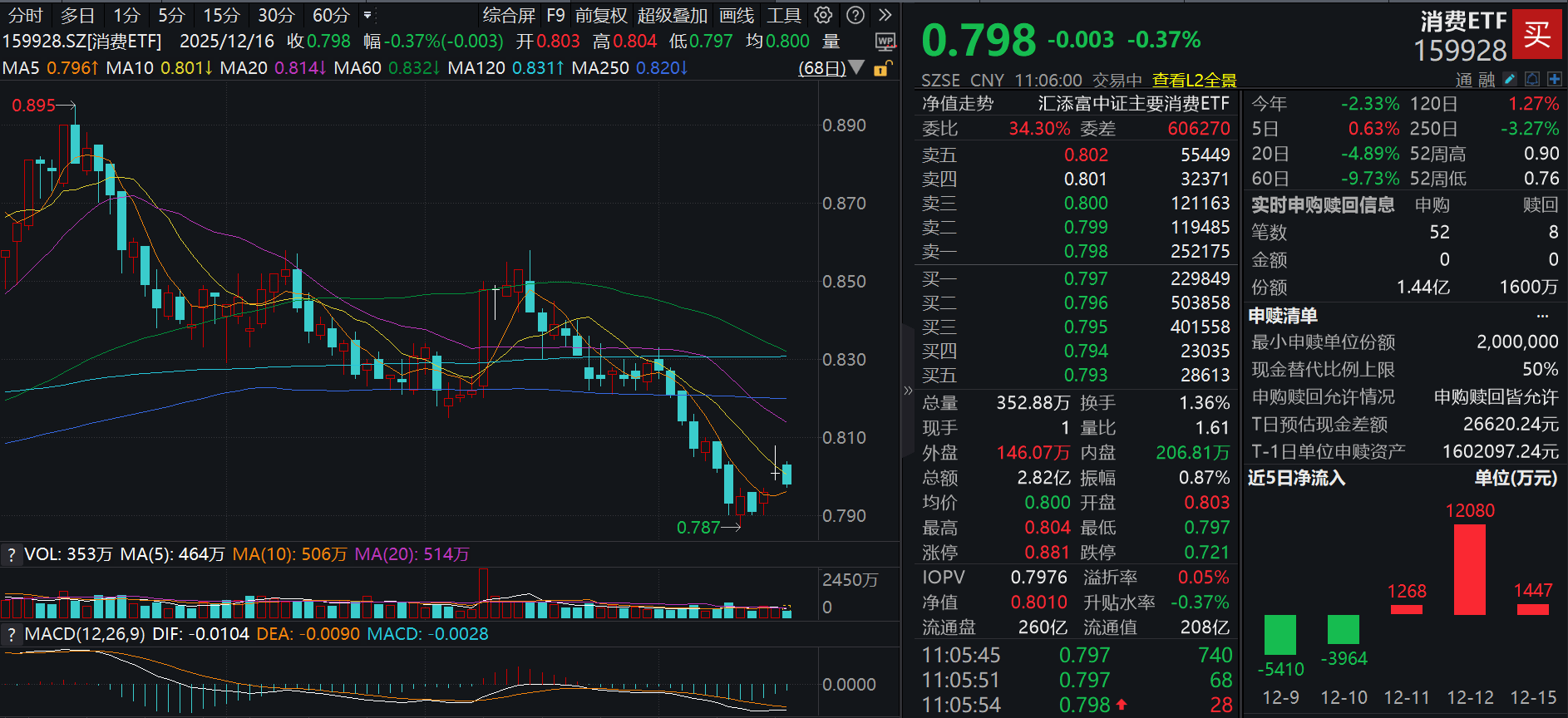
“两新”政策优化!资金关注消费防御板块,消费ETF(159928)大举“吸金”近1.3亿份!机构评白酒:茅五亮牌,剑向何方?
Sou Hu Cai Jing· 2025-12-16 03:24
Group 1: Market Overview - The Shanghai Composite Index fell over 1%, but the consumer sector showed relative resilience with a smaller decline [1] - The Consumer ETF (159928) experienced a slight drop of 0.37%, with trading volume exceeding 300 million yuan and a net subscription of 12.8 million shares during the day [1] Group 2: Policy Impact on Consumer Sector - The "Two New" policy is expected to stimulate greater consumption potential in the home appliance sector, with a focus on domestic demand and a strong domestic market [3] - The high-level economic work conference emphasized the continuation of policies for large-scale equipment updates and trade facilitation, which is likely to benefit the export chain and cross-border channels [3] - Statistics indicate that from January to November 2025, over 12.84 million home appliances were replaced under the old-for-new policy, generating sales exceeding 2.5 trillion yuan and benefiting over 360 million people [3] Group 3: Valuation and Investment Sentiment - As of December 15, the TTM price-to-earnings ratio of the Consumer ETF (159928) was 19.42, placing it in the 3.21% percentile over the past decade, indicating high valuation attractiveness [5] - The market is expected to experience seasonal changes in investment styles, particularly in December, with a tendency towards undervalued sectors [5] Group 4: Focus on Defensive Consumption Sectors - China Galaxy Securities suggests focusing on defensive sectors with stable cash flows and high dividend yields, as well as service consumption as a new growth point [7] - The market may enter a wide fluctuation phase, with short-term attention on defensive and consumer sectors, while mid-term focus may shift to TMT and advanced manufacturing sectors [7] Group 5: Alcohol Industry Insights - Concerns have arisen regarding the high-end liquor market, with price declines prompting worries about channel stability [8] - Huachuang Securities anticipates that the liquor industry will see volume growth before price recovery, with key players like Moutai and Wuliangye influencing market dynamics [9][10] - Moutai is expected to stabilize prices through controlled supply, while Wuliangye is implementing subsidies to support channel turnover [11]



白酒进入消费新时代,谁能决定未来?
Sou Hu Cai Jing· 2025-12-16 03:10
Core Insights - The Chinese liquor industry is at a crossroads, transitioning from traditional models to new consumer-driven approaches, focusing on value, experience, and connection [2] Group 1: Value Restructuring - The evolution of liquor consumption in China reflects changes in the national economy and social psychology, transitioning through three main stages: 1.0 (basic sustenance), 2.0 (social currency), and currently 3.0/4.0 (quality and self-enjoyment) [2][3][4] - The current phase emphasizes personal experience and health consciousness, with a significant young population (approximately 400 million aged 14-35, accounting for 28.35% of the total) driving this shift [4] Group 2: Multi-Dimensional Empowerment - The industry consensus has shifted from "who controls the channel wins" to "who captures the youth wins," indicating a marketing and operational transformation towards a user-centered approach [5] - Consumption is evolving from social symbols to emotional companions, with younger consumers preferring lower-alcohol beverages for a relaxed experience, valuing "heart price" and "emotion price" over mere status [5][6] - Product innovation is focusing on health, flavor diversity, and convenient packaging, breaking traditional taste barriers [7][8] - The rise of instant retail is meeting the demand for immediate satisfaction, with significant growth in online sales during promotional events [9] - Social drinking scenarios are diversifying, moving from formal gatherings to casual settings like parties and festivals, with brands leveraging social media for engagement [10][11] Group 3: Systemic Breakthrough - The new era of liquor consumption is characterized by consumer sovereignty, driven by information equality and diverse choices, with competition extending beyond the liquor industry to other beverage categories [12] - Companies need to innovate across multiple dimensions, including product offerings, channel strategies, and brand building, to create a cohesive competitive advantage [13][14] - Successful companies will be those that accurately address the core needs of health and self-enjoyment while implementing systematic innovations in products, channels, and branding [14][15]
大消费利好频发!机构:食品饮料2026年迎大年起点
Mei Ri Jing Ji Xin Wen· 2025-12-16 01:31
12月16日,第24期《求是》杂志发表高层重要文章《扩大内需是战略之举》,提出"要加快补上内需特 别是消费短板,使内需成为拉动经济增长的主动力和稳定锚。" 12月14日,商务部等三部门联合印发《关于加强商务和金融协同 更大力度提振消费的通知》。根据客 户还款能力和信用情况,合理确定贷款发放比例、期限和利率,落实好个人消费贷款额度、期限、利率 差异化政策,加快推动个人消费贷款业务发展。适当减免汽车以旧换新过程中提前结清贷款产生的违约 金。 12月14日,茅台批价企稳回升,东吴证券发布的研报指出,茅台明年的增量将聚焦于茅台1935、飞天茅 台、精品茅台3大核心单品,锚定600元、1500元、2000元价格带。12月15日,散瓶飞天批发价一度升至 1570元/瓶。 近日,大消费相关利好消息频发: 东方证券也在最近的电话会议中看好2026年是食品饮料行业大年的起点,核心在于白酒。白酒是食品饮 料中商业壁垒最强、最能累库的行业,经过3 - 4年累库,现在难再累库,且已进入加速去库状态,尤其 是今年下半年。除白酒外,调味品、啤酒等部分品类年初以来处于低基数、低增长徘徊阶段,表明业绩 风险基本释放。 个人投资者可以借道ET ...
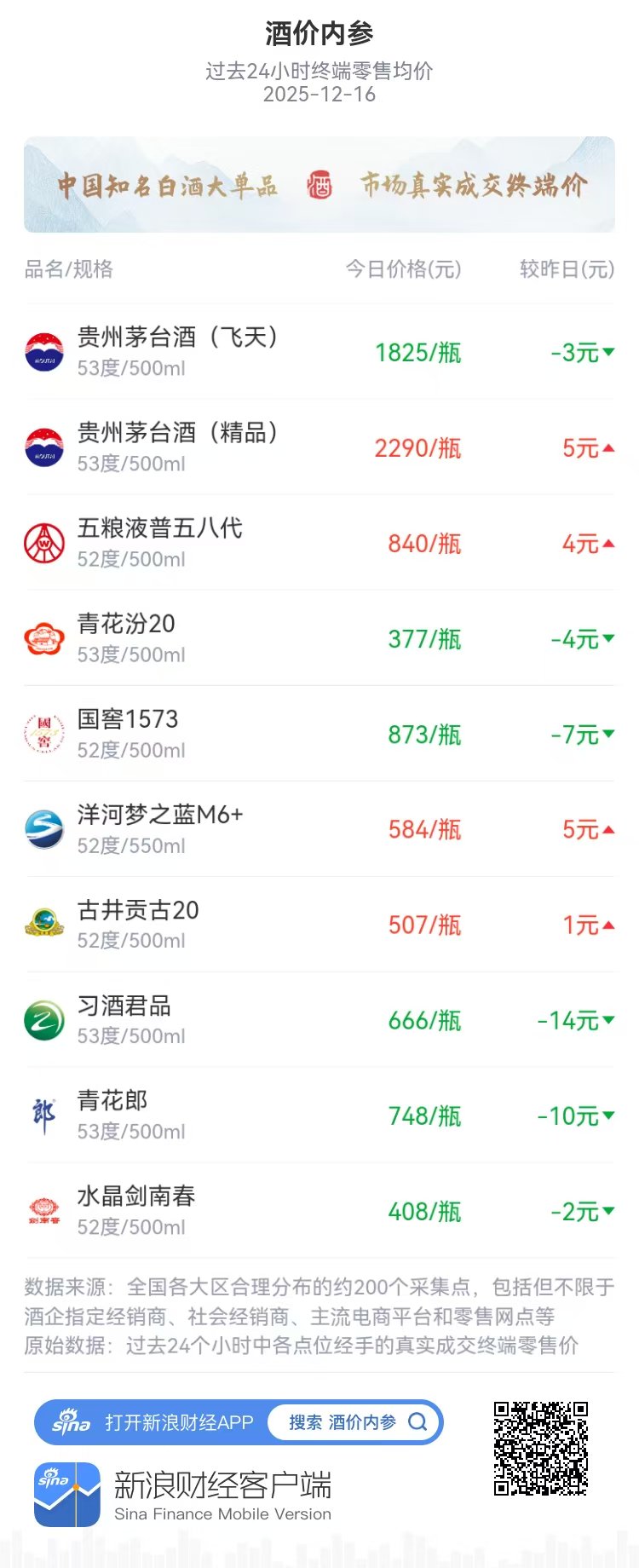
酒价内参12月16日价格发布 水晶剑南春价格小跌2元/瓶
Xin Lang Cai Jing· 2025-12-16 01:31
Core Insights - The article discusses the recent fluctuations in the retail prices of top ten Chinese liquor products, indicating a slight price correction after a significant rebound to recent highs [1][6] - The overall retail price for a bundled sale of the top ten products is reported at 9118 yuan, reflecting a decrease of 25 yuan from the previous day [1][6] Price Trends - Among the top ten products, four saw price increases while six experienced declines, showcasing a distinct structural characteristic in the market [2][7] - Notable price increases include: - Moutai (精品) and Yanghe Dream Blue M6+ both increased by 5 yuan per bottle - Wuliangye (普五八代) rose by 4 yuan per bottle, marking three consecutive days of price increases - Gujinggong (古井贡古20) saw a minor increase of 1 yuan per bottle [2][7] - Products with price declines include: - Xijiu (习酒君品) decreased by 14 yuan per bottle - Qinghualang (青花郎) fell by 10 yuan per bottle - Guojiao 1573 (国窖1573) dropped by 7 yuan per bottle - Qinghua Fen (青花汾20) and Feitian Moutai (飞天茅台) decreased by 4 yuan and 3 yuan respectively [2][7] Market Activity - The market remains active, with trading volumes approximately 50% higher than usual, indicating robust market engagement despite the price adjustments [1][6] - Data collection for the price insights is sourced from around 200 points across various regions, including designated distributors and major retail platforms, ensuring a comprehensive and objective representation of market prices [1][7] Industry Analysis - Dongwu Securities' report highlights a recent meeting among Moutai's provincial distributors to discuss channel strategies for 2026, emphasizing a "quantity control policy" aimed at short-term relief and medium-term structural adjustments [2][7] - The report suggests that Moutai's short-term certainty is improving, with stable investor returns expected, and maintains a "buy" rating for Moutai stock [2][7]



【特写】中国白酒闯荡东南亚
Xin Lang Cai Jing· 2025-12-16 01:26
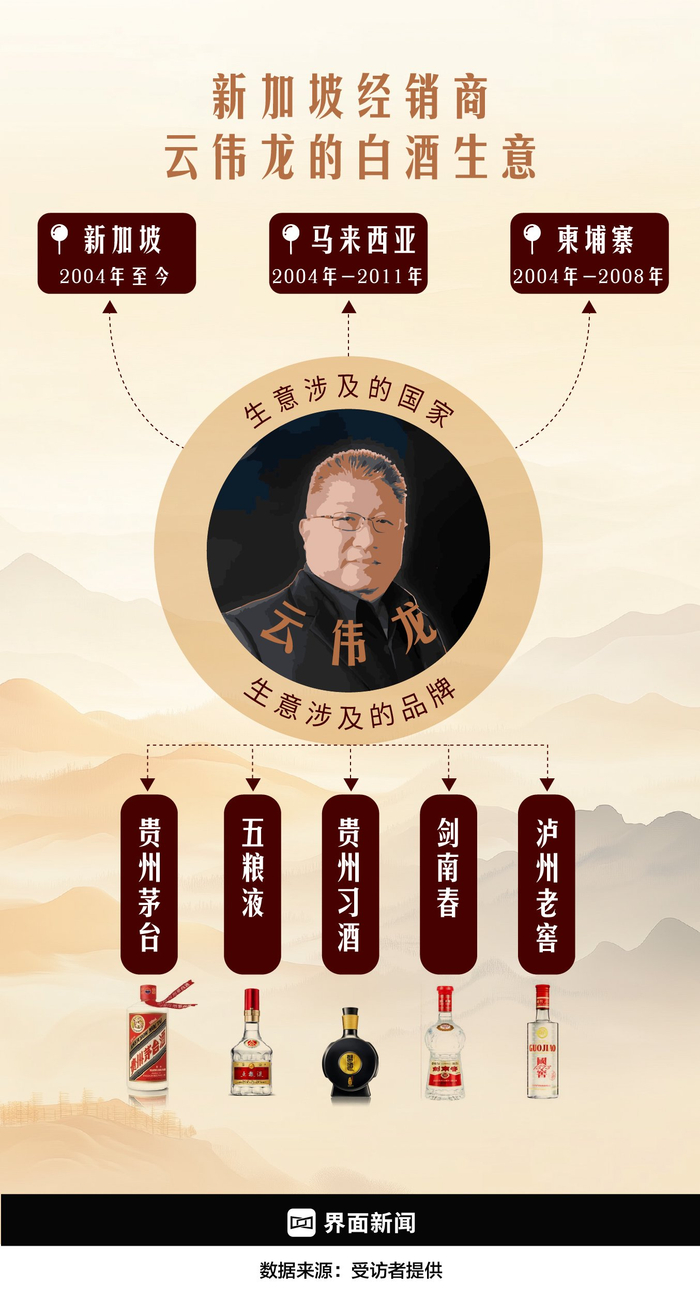
Core Insights - The article discusses the experiences of a Singaporean liquor distributor, Yun Weilong, who has been in the Chinese liquor business for 21 years, particularly focusing on the challenges and opportunities in the Southeast Asian market for Chinese liquor, especially Moutai [1][3][10]. Market Dynamics - The retail price of Moutai in Singapore can be 10%-15% higher than in China during market peaks, but recent fluctuations have led to reduced profit margins for distributors [1][3]. - In 2025, the wholesale price of Moutai in Singapore is expected to fluctuate around 300 Singapore dollars (approximately 1,650 RMB), indicating a shrinking profit space for distributors [1]. Historical Context - Yun Weilong started his journey in 2004, initially struggling with market acceptance but later establishing a successful business by focusing on Moutai and expanding to other brands like Wuliangye and Luzhou Laojiao [3][10]. - The consumption of beer dominates the Southeast Asian market, with beer accounting for 80.92% of total alcohol consumption in the region as of 2023 [3]. Emerging Opportunities - The influx of high-income Chinese immigrants and investments from Chinese companies in Southeast Asia presents new opportunities for the Chinese liquor market [4][10]. - A report by PwC indicates that many Chinese enterprises plan to increase investments in ASEAN countries, which could lead to a growing customer base for Chinese liquor [4]. Industry Challenges - The Chinese liquor industry is undergoing a significant adjustment period, with major companies like Yanghe, Wuliangye, and Luzhou Laojiao reporting declines in third-quarter performance [6]. - The competition among distributors in Singapore has intensified, with the number of authorized Moutai distributors increasing to six, leading to price competition and potential market confusion [10][29]. Marketing Strategies - Yun Weilong has adopted innovative marketing strategies, such as hosting liquor-related forums and beauty contests to promote Chinese liquor brands [4][20]. - The internationalization of Moutai is highlighted as a key growth area, with overseas revenue expected to exceed 5 billion RMB for the first time in 2024, and a 204.38% year-on-year increase in overseas revenue for the first three quarters of 2025 [10][30]. Consumer Behavior - Despite the high percentage of Chinese in Singapore, Western alcoholic beverages remain dominant due to cultural influences, making it challenging for Chinese liquor to gain popularity [17][34]. - The article notes that local consumers often prefer well-known Western brands, which complicates the marketing of Chinese liquor [34]. Future Outlook - The Chinese liquor export market is expected to grow, with a total export value of 4.478 billion RMB in 2024, marking a 16.61% increase year-on-year, and exports to Southeast Asia reaching 1.060 billion RMB, a 25.98% increase [30]. - The article concludes that while the overseas market for Chinese liquor is still small, it holds significant growth potential, especially as companies adapt their strategies to local markets [30][38].
酒价内参12月16日价格发布 市场小幅回调精品茅台与梦之蓝M6+领涨
Xin Lang Cai Jing· 2025-12-16 00:59
Core Viewpoint - The white liquor market has experienced a slight price adjustment after a significant rebound, with the average retail price of the top ten products decreasing slightly after reaching a recent high [1]. Price Trends - The total price for a bundled sale of the top ten products today is 9118 yuan, down by 25 yuan from yesterday [1]. - The market remains active, with trading volumes approximately 50% higher than usual [1]. - Among the top ten products, four saw price increases while six experienced declines, indicating a structural characteristic in the market [1]. Price Changes of Key Products - Moutai (Premium) and Yanghe Dream Blue M6+ both increased by 5 yuan per bottle, leading the market [1]. - Wuliangye (Pu Wuliangye 8th generation) rose by 4 yuan per bottle, marking three consecutive days of price increases [1]. - Gujing Gong (Gujing Gong 20) saw a slight increase of 1 yuan per bottle [1]. - On the downside, Xijiu Junpin decreased by 14 yuan per bottle, which is a significant adjustment [1]. - Other products like Qinghualang and Guojiao 1573 saw declines of 10 yuan and 7 yuan per bottle, respectively [1][3][4].
大别山红色文化培训基地在迎驾学院揭牌;华涛率队调研澳大利亚市场;酒鬼酒打造爱情主题街区
Sou Hu Cai Jing· 2025-12-15 14:56
Group 1: Cultural and Educational Initiatives - The Dabie Mountain Red Culture Training Base was inaugurated at Yingjia College, aiming to integrate local resources, academic expertise, and corporate strength to create a comprehensive platform for red education [1] - The base is expected to serve as a model for red culture inheritance and political education, contributing to the revitalization of the old revolutionary areas [1] Group 2: Market Expansion and Strategic Initiatives - Huatao, Vice Chairman and General Manager of Wuliangye, led a team to explore new cooperation models and market opportunities in Australia, focusing on adapting to local drinking habits and enhancing channel layouts [1] - This initiative aligns with Wuliangye's 2025 marketing strategy, emphasizing the importance of on-ground insights for channel development in the Oceania market [1] Group 3: Leadership Changes - Li Qiang has been appointed as the new Chairman of Yili Te, following the resignation of Chen Zhi due to retirement age, marking a leadership transition within the company [2] Group 4: Product and Facility Developments - The Xijiu Tank Storage Center in Guangzhou was officially opened, featuring a storage capacity for approximately 3,000 tanks of liquor, designed to enhance cultural experiences and social interactions [3] - The center promotes two main products, Tank Storage No. 1 and No. 2, each with a capacity of 25 liters [3] Group 5: Innovative Marketing Strategies - Jiugui Liquor has launched China's first love-themed street in Changsha, collaborating with a local media outlet to create a unique social space for young people [4] Group 6: Strategic Vision for Future Growth - Luzhou Laojiao plans to advance its ecological chain strategy during the 14th Five-Year Plan, focusing on cultural branding and technological innovation to build a collaborative network with global partners [5] Group 7: Corporate Relocation and Historical Recognition - China Resources Beer has officially relocated its headquarters from Beijing to Shenzhen, aligning with the national strategy for the Guangdong-Hong Kong-Macao Greater Bay Area [6] - Two distilleries in Shanxi have been recognized as industrial heritage sites, contributing to the preservation of local brewing history [6]

别再炒高端酒了!消费逻辑反转,年轻人弃千元酒,50元光瓶酒才香
Sou Hu Cai Jing· 2025-12-15 13:53
Group 1 - The global liquor market is experiencing a downturn, with high-end liquor sales declining due to consumers' reluctance to pay inflated prices, despite stable or increasing sales volumes [1][3][20] - In China, the price of premium liquor like Moutai has seen fluctuations, with a notable drop below the suggested retail price, indicating a trend of inventory clearance among distributors [3][9] - The overall market is shifting from high-end to affordable liquor, with a significant increase in the sales of lower-priced options, reflecting a change in consumer preferences [4][5][12] Group 2 - The import data for spirits shows a decline in average prices, particularly for whiskey, which has become the leading imported spirit in China, driven by cheaper blended varieties [4][5] - The market for light bottle liquor in China is booming, with projections indicating a growth from 35.2 billion in 2013 to over 200 billion by 2025, highlighting a shift in consumer demand towards more affordable options [7][9] - Companies are adapting to the changing market dynamics by focusing on affordable, quality products, as evidenced by Moutai and other brands adjusting their strategies to cater to this new consumer behavior [17][18] Group 3 - The consumption logic has shifted from "drinking for others" to "drinking for oneself," with consumers prioritizing value and personal enjoyment over status [12][15] - The increase in female consumers in the market, who prefer affordable options for social gatherings, further emphasizes the trend towards value-oriented purchasing [15] - The industry is recognizing the need to adjust pricing strategies, with many companies facing challenges in the mid-price range while lower-priced options thrive [18][20]
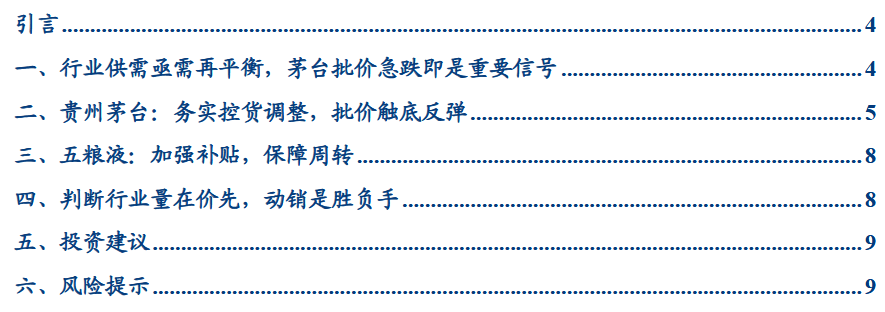
【华创食饮】茅五亮牌,指向何方?
Xin Lang Cai Jing· 2025-12-15 13:34
Core Viewpoint - Recent decline in high-end liquor prices has raised concerns in the market, with the liquor sector experiencing a roughly 7% pullback this month. Major companies like Moutai and Wuliangye have introduced new policies to address these concerns and stabilize the market [2][38]. Group 1: Industry Supply and Demand - The urgent need for supply-demand rebalancing in the industry is highlighted by the significant drop in Moutai prices, which reflects the pressure on demand and increasing concerns about future performance [10][44]. - The decline in Moutai prices from 1575 yuan to around 1500 yuan and Wuliangye's drop from 800-810 yuan to 780 yuan indicates a broader market trend of declining prices due to excess supply and weak demand [44]. Group 2: Moutai's Strategy - Moutai is implementing a strategy to control supply and restore confidence among distributors, with recent meetings across provinces to communicate new marketing policies. The price of Moutai has rebounded to around 1600 yuan after hitting a low of 1500 yuan [2][18]. - The company plans to stop the allocation of Moutai quotas that are not part of the 2025 plan and will not emphasize early sales, aiming to reduce distributor inventory pressure [20][21]. - Moutai's future growth is expected to be challenging, with a focus on high-value products to increase prices while ensuring distributor profitability [21][39]. Group 3: Wuliangye's Approach - Wuliangye has introduced a series of measures to support distributors, including a price adjustment for its flagship product to 900 yuan, marking the first change in payment policy since 2014 [39][24]. - The company is offering various incentives to distributors, which can cumulatively provide nearly 100 yuan per bottle in subsidies, effectively enhancing distributor profits [39][24]. - Wuliangye is also focusing on digital management to improve turnover and strengthen the relationship between channels and terminals, which is crucial for market recovery [39][24]. Group 4: Market Outlook - The industry is expected to prioritize volume over price in the coming year, with sales dynamics being the key determinant of success. Moutai's price stability will set the industry's ceiling, while Wuliangye will influence the speed of market clearing [39][40]. - The upcoming Spring Festival is seen as a critical period for assessing market recovery and inventory clearance, with expectations that prices will stabilize post-holiday [39][40].