
陕西煤业

Search documents
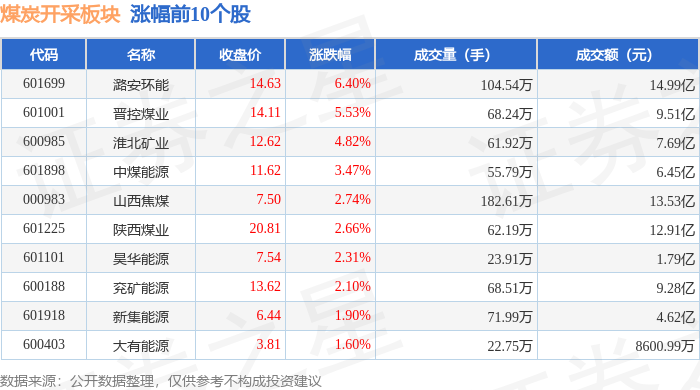
煤炭开采板块9月17日涨1.86%,潞安环能领涨,主力资金净流入2.96亿元
Zheng Xing Xing Ye Ri Bao· 2025-09-17 08:52
Group 1: Market Performance - The coal mining sector increased by 1.86% compared to the previous trading day, with Lu'an Huanneng leading the gains [1] - The Shanghai Composite Index closed at 3876.34, up 0.37%, while the Shenzhen Component Index closed at 13215.46, up 1.16% [1] Group 2: Individual Stock Performance - Lu'an Huanneng (code: 669109) closed at 14.63, up 6.40%, with a trading volume of 1.0454 million shares and a transaction value of 1.499 billion [1] - Jinko Coal Industry (code: 601001) closed at 14.11, up 5.53%, with a trading volume of 682,400 shares and a transaction value of 951 million [1] - Huai Bei Mining (code: 600985) closed at 12.62, up 4.82%, with a trading volume of 619,200 shares and a transaction value of 769 million [1] - Other notable performers include Zhongmei Energy (code: 601898) up 3.47%, Shanxi Coking Coal (code: 000983) up 2.74%, and Shaanxi Coal Industry (code: 601225) up 2.66% [1] Group 3: Capital Flow Analysis - The coal mining sector saw a net inflow of 296 million from main funds, while retail funds experienced a net outflow of 59.216 million [2] - Major stocks like Jinko Coal Industry had a net inflow of 120 million from main funds, but a net outflow of 68.97 million from retail investors [3] - Shanxi Coking Coal also reported a net inflow of 75.661 million from main funds, with retail investors withdrawing 37.116 million [3]




进口、产量维持同比下滑,再次重申“年底煤价或以最高点收官”
GOLDEN SUN SECURITIES· 2025-09-17 07:55
Investment Rating - The report maintains a "Buy" rating for several coal companies, including China Shenhua, China Coal Energy, and Qinfa, indicating a positive outlook for these stocks [9][42]. Core Viewpoints - The report emphasizes that coal prices are expected to peak by the end of the year, driven by supply constraints and resilient demand [4][44]. - It highlights a continuous decline in coal production and imports, with August coal production down 3.2% year-on-year and imports decreasing by 6.8% compared to the previous year [1][18]. - The report notes a slight increase in thermal power generation, which grew by 1.7% in August, while crude steel production saw a decline of 0.7% [21][31]. Summary by Sections Production - In August, the industrial raw coal output was 390 million tons, a year-on-year decrease of 3.2%, with a daily average of 12.6 million tons. For the first eight months, the output was 3.17 billion tons, a year-on-year increase of 2.8% [1][12]. - The forecast for 2025 suggests that coal production may reach approximately 3.88 billion tons, with a growth rate of about 1.4% [12]. Imports - In August, coal imports totaled 42.74 million tons, down from 45.84 million tons in the same month last year, marking a 6.8% decline. However, this was an increase of 20% compared to July [18][19]. - Cumulatively, coal imports for the first eight months of 2025 were 299.94 million tons, reflecting a 12.2% year-on-year decrease [18]. Demand - The report indicates that thermal power generation in August was 936.3 billion kWh, up 1.6% year-on-year, with a daily average of 30.2 billion kWh. The first eight months saw a total generation of 641.93 billion kWh, a 1.5% increase [21][22]. - The report also notes that crude steel production in August was 77.37 million tons, down 0.7% year-on-year, with a daily average iron output of 2.4055 million tons from 247 sample steel mills, reflecting a 7.69% increase [31][38]. Investment Recommendations - The report recommends companies with strong earnings elasticity such as Lu'an Environmental Energy, Yanzhou Coal Mining, and Jinneng Holding, while also highlighting the importance of companies focused on smart mining technologies [5][42]. - It suggests maintaining a focus on major coal enterprises like China Shenhua and China Coal Energy, and emphasizes the potential for recovery in companies like Qinfa [42].


内蒙古超产核查落地,原煤产量理论同比减少6117万吨 | 投研报告
Zhong Guo Neng Yuan Wang· 2025-09-17 07:29
Core Viewpoint - The report highlights the overproduction of coal in Inner Mongolia, with a significant portion of coal mines exceeding their approved production capacities, leading to potential supply constraints and price rebounds in the coal market [1][2][3]. Group 1: Production Data - In 2024, Inner Mongolia's coal production exceeded the approved capacity by 6,116.9 thousand tons, resulting in an overproduction rate of 4.95% [1][2]. - For the first half of 2025, the region's coal production surpassed the approved capacity by 2,121.9 thousand tons, with an overproduction rate of 3.43% [1][2]. - A total of 299 coal mines were reviewed, with a combined capacity of 123,570 thousand tons per year, and 93 mines were found to be operating above their announced capacities [2]. Group 2: Regulatory Actions - Strict enforcement of overproduction regulations is in place, with 15 coal mines in Ordos City required to halt operations for rectification due to exceeding production limits by 10% [3]. - The combined capacity of these 15 mines is estimated at 3,220 thousand tons per year, representing 2.61% of Inner Mongolia's total capacity [3]. Group 3: Market Outlook - The supply of coal is expected to continue contracting, potentially impacting around 400 million tons of supply due to ongoing regulatory measures and the transition of some capacities to "reserve" status [3]. - As the demand for electricity coal shifts into a low season, non-electric demand is anticipated to gradually increase, which may support a rebound in coal prices [3]. - The current market conditions, characterized by declining port inventories and ongoing supply restrictions, are expected to improve the fundamentals of the coal market, leading to a potential price increase back to levels seen in Q3 2024 [3]. Group 4: Investment Recommendations - The report suggests focusing on high spot price elasticity stocks, such as Lu'an Environmental Energy, and stable growth stocks like Jinko Coal Industry and Huayang Co., Ltd. [4]. - It also recommends monitoring companies with recovery growth in production, such as Shanxi Coal International, and industry leaders like China Shenhua, China Coal Energy, and Shaanxi Coal and Chemical Industry [4].
浙商证券:产能置换约束煤炭供给 储备产能释放弹性
智通财经网· 2025-09-17 07:20
Core Viewpoint - The coal industry in China is facing potential risks related to the newly increased coal mine capacities, which may be revoked if companies fail to fulfill their capacity replacement commitments by the end of 2025 [1][5]. Group 1: Capacity Replacement Policy - The capacity replacement policy is a key tool for supply-side structural reform, aiming to "control total volume and optimize stock" by ensuring that new advanced capacities are built only after eliminating outdated capacities [2]. - The policy promotes high-quality development in the coal industry by limiting total capacity while improving capacity quality through market and legal means [2]. Group 2: Historical Context - During the supply-side structural reform period (2016-2020), coal production exceeded demand, leading to tighter capacity allocation policies and the implementation of reduction replacement policies [3]. - The government provided financial incentives for exiting coal mines to reduce capacity replacement ratios and required that closed mines' capacities be at least 120% of the new mines' capacities [3]. Group 3: Current and Future Capacity Management - In the current production increase and supply guarantee period (2021-2025), the government maintains the "reduction replacement" or "equal replacement" principles while implementing a commitment system for capacity indicators [4]. - Companies can initially commit to increased coal mine capacities, with subsequent fulfillment of capacity replacement indicators [4]. Group 4: Capacity Constraints - Based on the 2015 capacity baseline and the "13th Five-Year Plan" exit situation, the legal capacity limits are estimated at 4.7, 4.5, and 4.4 billion tons per year, which is below the projected production of 4.76 billion tons in 2024 [6]. - Strict enforcement of capacity replacement policies may necessitate future production cuts, while a coal capacity reserve system has been established to alleviate some capacity replacement indicator constraints [6]. Group 5: Investment Targets - Key companies to focus on in the thermal coal sector include China Shenhua (601088.SH), Shaanxi Coal and Chemical Industry (601225.SH), and others [7]. - In the coking coal sector, companies such as Huaibei Mining (600985.SH) and Shanxi Coking Coal (000983.SZ) are highlighted for investment consideration [7].

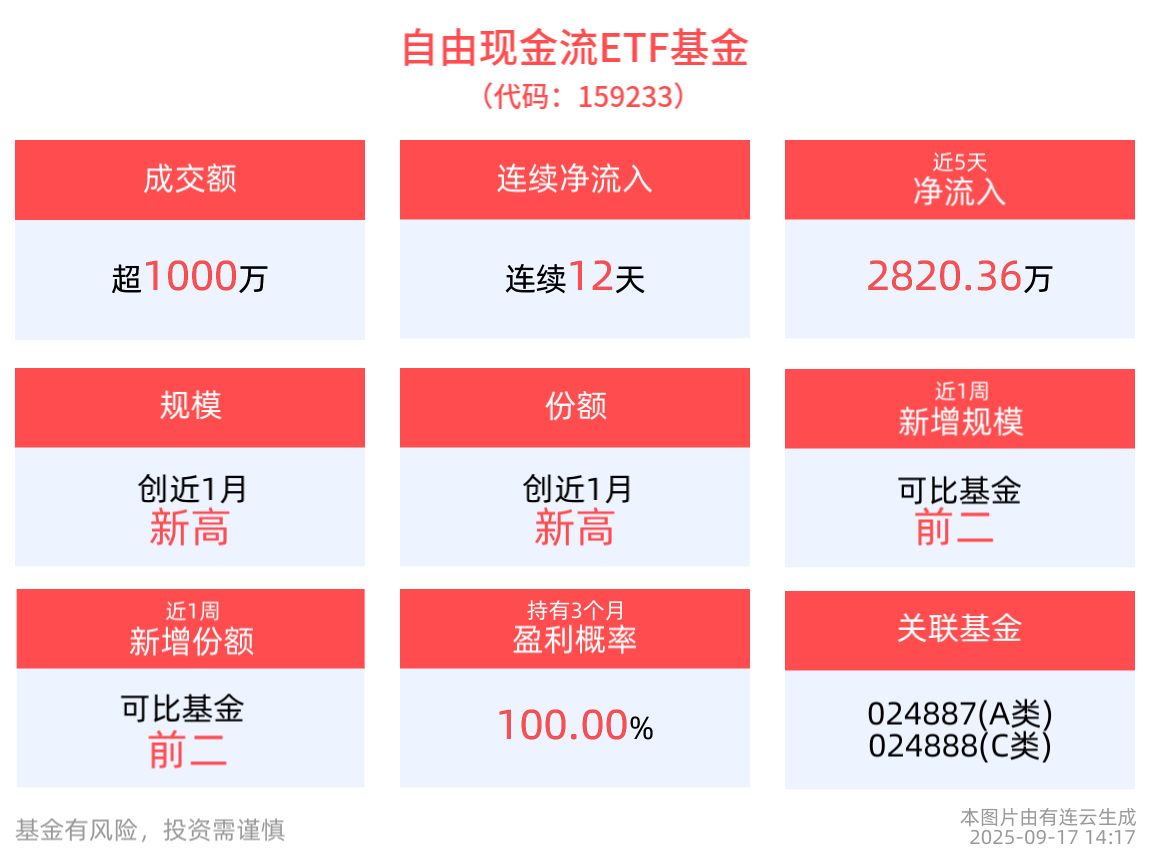
受益于宁德时代上涨,有色、煤炭等行业涨幅居前,自由现金流ETF基金备受关注
Sou Hu Cai Jing· 2025-09-17 06:33
Group 1 - The core viewpoint highlights that the Free Cash Flow ETF Fund (159233) has outperformed the market, particularly in sectors like non-ferrous metals and coal, with a rise of over 0.5% [1] - As of September 17, 2025, the CSI Free Cash Flow Index (932365) increased by 0.39%, with notable gains from stocks such as Mould Technology (000700) up 10.02% and Guizhou Moutai (000858) being among the top weighted stocks [1][3] - The Free Cash Flow ETF Fund has shown a weekly increase of 0.36% as of September 16, 2025, indicating positive momentum in the fund's performance [1] Group 2 - The Free Cash Flow ETF Fund reached a new high in size at 185 million yuan and in shares at 165 million as of the latest report [2] - The fund has experienced continuous net inflows over the past 12 days, with a total of 84.34 million yuan and an average daily net inflow of 7.02 million yuan [2] - The fund's historical performance shows a maximum monthly return of 7.80% and a 100% probability of profit over a three-month holding period [2] Group 3 - The Free Cash Flow ETF Fund closely tracks the CSI Free Cash Flow Index, which includes 100 companies with high free cash flow rates, reflecting strong cash flow generation capabilities [3] - The top ten weighted stocks in the CSI Free Cash Flow Index account for 57.03% of the index, with major companies like China National Offshore Oil Corporation (600938) and Wuliangye (000858) included [3]

国泰海通晨报-20250917
Haitong Securities· 2025-09-17 06:18
Group 1: Cosmetics Industry - The cosmetics sector is experiencing double-digit growth online, with a focus on promotional events driving sales [1][2] - In August, the combined sales of beauty products on Tmall and Douyin grew by 19.0% year-on-year, with Douyin's GMV exceeding 20 billion yuan, marking a 19.56% increase [2] - Domestic brands are gaining market share, with notable performances from brands like Han Shu and Pechoin, which have diversified product offerings [2][3] - The report recommends selecting companies with product and channel innovations, highlighting brands such as Ru Yuchen, Shangmei, and Mao Ge Ping for their growth potential [1] Group 2: Key Companies - Ru Yuchen's sales on Tmall and Douyin grew over 200% year-on-year in August, with significant increases in self-broadcasting sales [3] - Shangmei's channel and product structure are continuously optimizing, with a self-broadcasting ratio of over 72% in August [3] - The report suggests focusing on companies like Meili Tianyuan and Betaini, which are expected to reach a turning point in performance [1] Group 3: Six Fortune Group - Six Fortune Group is projected to achieve revenues of 15.318 billion, 17.418 billion, and 19.752 billion HKD for the fiscal years 2026-2028, with growth rates of 14.82%, 13.71%, and 13.40% respectively [6] - The company has a strong product design capability and is expanding its overseas presence, with plans to open 50 new stores in three years [7] - The acquisition of Kam Tin has enhanced the brand matrix and is expected to drive growth in the light luxury market [7] Group 4: Tunnel Shares - Tunnel Shares reported a 7.4% decrease in net profit for the first half of 2025, but a 15.9% increase in net profit for Q2 [8] - The company’s revenue for H1 2025 was 22.02 billion yuan, down 21.5% year-on-year, with a significant drop in construction services [9] - The report maintains a target price of 8.64 yuan for Tunnel Shares, reflecting a 9x PE ratio for 2025 [8][9]
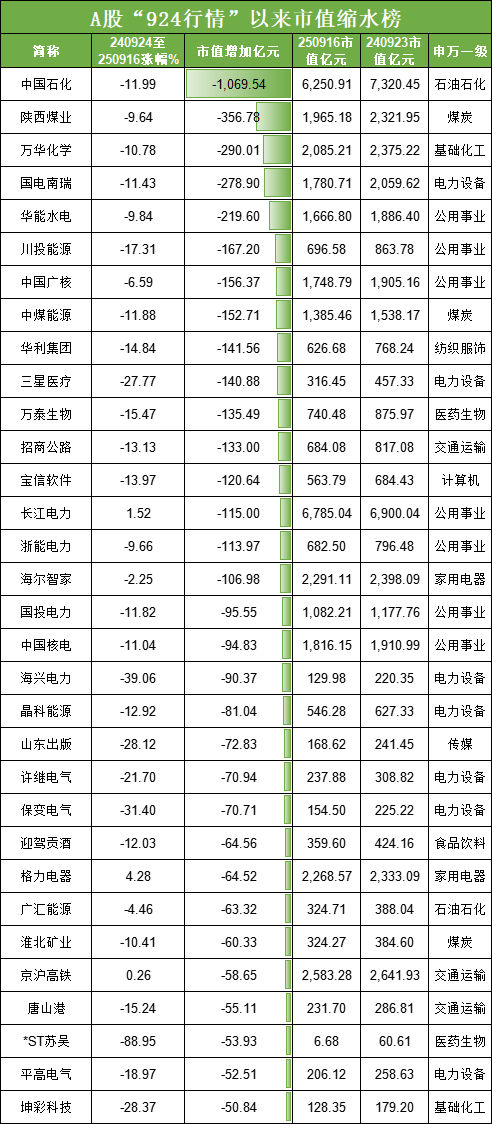
924行情1周年170股市值缩水:中国石化市值缩水1069亿元,陕西煤业市值缩水356亿元,万华化学市值缩水290亿
Xin Lang Zheng Quan· 2025-09-17 05:44
Core Insights - The A-share market has experienced significant market value shrinkage over the past year, particularly highlighted by the "924 market" event, with 170 stocks losing value from September 24, 2024, to September 16, 2025 [1] Group 1: Market Value Shrinkage - A total of 170 stocks have seen their market value decrease, with 16 stocks losing over 10 billion yuan [1] - China Petroleum & Chemical Corporation (Sinopec) reported a market value loss of 106.9 billion yuan, representing a decline of 11.99% [2] - Shaanxi Coal and Chemical Industry Co., Ltd. experienced a market value reduction of 35.6 billion yuan, down 9.64% [2] - Wanhua Chemical Group Co., Ltd. saw a decrease of 29 billion yuan, reflecting a 10.78% drop [2] Group 2: Other Notable Companies - Guodian Technology & Environment Group Corporation lost 27.9 billion yuan, a decline of 11.43% [2] - Huaneng Water Power Co., Ltd. reported a market value decrease of 21.96 billion yuan, down 9.84% [2] - China General Nuclear Power Corporation's market value shrank by 15.6 billion yuan, a 6.59% decline [2] - Other companies such as China Coal Energy Company and Huali Group also reported significant losses, with declines of 11.88% and 14.84% respectively [2]


行业专题报告:产能置换约束供给,储备产能释放弹性
ZHESHANG SECURITIES· 2025-09-17 04:56
Investment Rating - The industry investment rating is "Positive" (maintained) [3] Core Viewpoints - The capacity replacement policy is a core tool for supply-side structural reform, aiming to "control total volume and optimize stock" through "reduction replacement" or "equal replacement" principles, ensuring that new advanced capacity is built while eliminating outdated capacity [3][8] - During the supply-side structural reform period (2016-2020), coal production exceeded demand, leading to tighter capacity allocation policies and the implementation of reduction replacement policies [3][21] - In the production increase and supply guarantee period (2021-2025), the policy continues to adhere to reduction replacement principles while implementing a commitment system for capacity indicators [3][23] - The capacity replacement commitment system is crucial for optimizing coal capacity management and ensuring national energy security [3][30] - The coal industry's supply and demand are expected to gradually balance, with coal prices steadily rising under the current policy framework [3][40] Summary by Sections Capacity Replacement Policy - The capacity replacement policy is essential for addressing overcapacity in industries like coal, steel, and cement, focusing on controlling new capacity while phasing out outdated capacity [8][10] - Specific policies were introduced from 2016 to 2018, mandating "reduction replacement" for the coal industry [15][16] Supply-Side Structural Reform Period (2016-2020) - The coal industry faced a situation of oversupply, prompting the implementation of tighter capacity allocation policies and reduction replacement measures [21][24] - Policies during this period included incentives for exiting coal mines to reduce capacity indicators [24][25] Production Increase and Supply Guarantee Period (2021-2025) - The commitment system allows coal mines to promise capacity increases without immediate compliance with replacement indicators, aiming to expedite the release of quality capacity [30][31] - The policy encourages the establishment of a coal capacity reserve system to enhance supply flexibility and resilience [39] Investment Recommendations - The report suggests prioritizing investments in companies such as China Shenhua, Shaanxi Coal, and others in the thermal coal sector, as well as companies in the coking coal sector like Huabei Mining and Shanxi Coking Coal [3][40]
煤炭行业事件点评:内蒙古超产核查落地,原煤产量理论同比减少6117万吨
Minsheng Securities· 2025-09-17 04:30
Investment Rating - The report maintains a "Buy" rating for several companies in the coal industry, including Lu'an Huanneng, Huayang Co., Shanmei International, China Shenhua, Zhongmei Energy, Shaanxi Coal, and Jinkong Coal [4]. Core Insights - The Inner Mongolia Energy Bureau has confirmed the overproduction of coal, with a theoretical reduction in raw coal output of 61.17 million tons year-on-year for 2024 [1]. - In 2024, Inner Mongolia's coal production exceeded the approved capacity by 61.17 million tons, representing an overproduction rate of 4.95% [1]. - The report anticipates a continued contraction in supply due to strict enforcement of overproduction regulations, which could theoretically impact supply by approximately 400 million tons [3]. - The demand for thermal coal is expected to gradually increase as the market transitions from the off-peak season, with a potential price rebound supported by declining port inventories and ongoing supply restrictions [3]. Summary by Sections Overproduction and Regulatory Actions - A total of 93 coal mines were found to be operating above their approved production capacities in Inner Mongolia, with 30% of the inspected mines exceeding their capacities by over 110% in 2024 [2]. - Approximately 32.2 million tons per year of production capacity is pending verification before resuming operations, affecting 15 mines in the Ordos region [2]. Supply and Demand Dynamics - The report suggests that the supply side is likely to continue contracting, which, combined with seasonal demand increases, may lead to a recovery in coal prices back to levels seen in Q3 2024 [3]. - The report highlights that traders are currently cautious, but the fundamentals are improving, which could support a price increase [3]. Investment Recommendations - The report recommends focusing on companies with high spot market exposure, stable performance, and growth potential, including Lu'an Huanneng, Jinkong Coal, and industry leaders like China Shenhua and Zhongmei Energy [3].


今日48只个股突破年线
Zheng Quan Shi Bao Wang· 2025-09-17 04:22
Market Overview - The Shanghai Composite Index closed at 3877.55 points, above the annual line, with a change of 0.41% [1] - The total trading volume of A-shares reached 1561.918 billion yuan [1] Stocks Breaking Annual Line - A total of 48 A-shares have surpassed the annual line today, with notable stocks including Hongli Zhihui, Zhejiang Meida, and Berteli, showing divergence rates of 11.99%, 6.33%, and 5.02% respectively [1] - Stocks with smaller divergence rates that just crossed the annual line include Haoshen Electronics, Shanghai Auto Parts, and ST Emergency [1] Top Divergence Rate Stocks - The top three stocks with the highest divergence rates are: - Hongli Zhihui (13.45% increase, latest price 7.76 yuan, divergence rate 11.99%) [1] - Zhejiang Meida (6.79% increase, latest price 7.55 yuan, divergence rate 6.33%) [1] - Berteli (5.29% increase, latest price 53.70 yuan, divergence rate 5.02%) [1] Additional Stocks with Notable Performance - Other stocks with significant performance include: - ST Fanli (4.94% increase, latest price 5.52 yuan, divergence rate 4.88%) [1] - Hisense Video (6.06% increase, latest price 22.04 yuan, divergence rate 4.05%) [1] - Blue Ying Equipment (5.01% increase, latest price 25.16 yuan, divergence rate 3.77%) [1]


