
OPPO

Search documents
AI手机竞速智能应用,卡点在哪里?
2 1 Shi Ji Jing Ji Bao Dao· 2025-11-20 10:06
Core Insights - The focus of leading domestic smartphone manufacturers has shifted from performance metrics of large models to practical applications of edge AI, enabling rich functionalities in offline scenarios [1][2] - The rapid development of open-source large models, exemplified by DeepSeek, has facilitated the miniaturization of models, which is a fundamental reason for the enhanced capabilities of edge AI in smartphones this year [1][3] - AI smartphones are transitioning from being seen as a novelty to becoming a necessity, indicating a critical point in their evolution [1] AI Underlying Evolution - Recent breakthroughs in AI large models, including miniaturization, multimodality, and long-context expansion, have provided foundational conditions for edge applications in smartphones [1] - The integration of cloud and edge computing paradigms presents key opportunities for terminal manufacturers [2] - The miniaturization of models has significantly improved the feasibility of deploying powerful models on smartphones, allowing for enhanced offline AI functionalities [3][5] Application and Ecosystem Development - OPPO has identified three strategic pillars for AI: new computing, new perception, and new ecosystem [3] - The deployment of edge models has reduced memory requirements, allowing for more efficient use of high-end smartphones [4][5] - The evolution of AI applications is expected to enhance user experiences by integrating AI into traditional functionalities like voice assistants and photo management [6] Agent Ecosystem and User Interaction - The year 2025 is anticipated to be pivotal for the development of AI agents, with manufacturers focusing on embedding AI capabilities into smartphones [7] - The transition from basic smart assistants to more sophisticated systems with multi-agent architectures is underway, enabling complex tasks like food delivery and ride-hailing [7][8] - Challenges remain in user adaptation to AI-driven interactions, as many users are accustomed to traditional GUI methods [8] Market Dynamics and Consumer Behavior - The perception of AI capabilities in smartphones has historically been limited, impacting consumer purchasing decisions [9] - The success of AI features will depend on their ability to address user pain points and enhance convenience [9][10] - The competition among AI smartphones is shifting from technical specifications to the ability to create open and unified ecosystems that align with user interaction habits [10]
果然财经|高分成模式受诟病,手游厂家纷纷撤出渠道服
Qi Lu Wan Bao· 2025-11-20 10:06
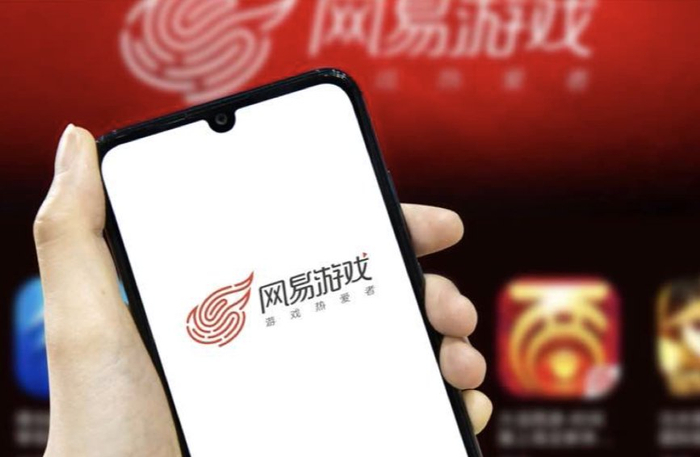
Core Viewpoint - The gaming industry is witnessing a trend where mobile game manufacturers are withdrawing from channel servers due to the criticized high revenue-sharing model imposed by Android channels, particularly OPPO [1]. Group 1: Industry Trends - Since October, several popular mobile games from NetEase have withdrawn from OPPO channel servers, including titles like "Fantasy Westward Journey," "Sky: Children of the Light," and "Big Talk Westward Journey" [1]. - Players are required to migrate their accounts and assets within a limited timeframe to continue playing on NetEase's official servers [1]. Group 2: Company Actions - The withdrawal from channel servers is part of a long-standing conflict within the industry regarding channel partnerships and revenue sharing [1]. - In 2021, NetEase's founder, Ding Lei, publicly criticized the high revenue-sharing model of Android channels during a financial report conference call [1].



黄仁勋“救了”雷军,但苦了明年买手机的人
3 6 Ke· 2025-11-20 09:28
Core Insights - The price increase of the Redmi K90 series is attributed to the significant rise in memory costs, which has affected multiple smartphone manufacturers [2][6][24] - The surge in memory prices is primarily driven by the booming demand for AI-related products, particularly from companies like NVIDIA, which has led to a reallocation of production capacity away from traditional memory products [7][12][24] - The smartphone market is expected to experience a polarization, with high-end brands like Apple and Huawei less affected by memory price increases compared to budget brands like Xiaomi and OPPO, which may struggle to maintain profitability [13][17][24] Price Increases and Market Dynamics - The Redmi K90 standard version is priced at 2599 yuan, which is 300 yuan more than its predecessor, with additional costs for higher storage options [2] - Many smartphone manufacturers, including Xiaomi, OPPO, and Vivo, are facing pressure to increase prices due to rising memory costs, with some already raising prices for flagship models [18][19] - TrendForce predicts that the overall smartphone prices will increase by 5%-15% in 2026, with an average increase of around 500 yuan per device [18][24] Impact of AI on Memory Prices - The demand for AI computing has drastically increased the need for high-bandwidth memory (HBM), leading manufacturers to prioritize HBM production over traditional memory types [9][12] - The profit margins for HBM are significantly higher than those for standard mobile memory, incentivizing manufacturers to allocate more resources to AI-related products [12][11] - The current memory price surge is expected to last longer than typical cycles due to cautious production expansion by suppliers fearing an AI bubble [24] Consumer Experience and Product Adjustments - Many smartphone manufacturers are resorting to reducing specifications in new models to offset rising costs, which has become a common practice in the industry [19][22] - The reduction in features, such as screen resolution and camera quality, reflects a broader trend of cost-cutting measures in response to increased material costs [22] - The high-end brands like Apple and Huawei are less likely to pass on costs to consumers, maintaining their pricing strategies without significant adjustments [16][17]


网易多款手游撤离OPPO渠道服,玩家需迁移至官方服务器
3 6 Ke· 2025-11-20 07:00
Core Viewpoint - The gaming industry is witnessing a significant shift as multiple game developers, including NetEase, are withdrawing their games from Android channel servers, rejecting the high revenue share model imposed by these platforms [1] Group 1: Industry Trends - Since October, several popular NetEase mobile games have exited the OPPO channel, with players required to migrate their accounts to continue playing on official servers [1] - The trend of "unbinding" from channel servers has been ongoing, with classic titles like "Dream of the Red Chamber" and "Light Encounter" also terminating their partnerships with OPPO [1] Group 2: Revenue Share Dispute - The high revenue share model for Android channels, which can reach up to 50%, has been publicly criticized by industry leaders, including NetEase's founder, who argues that this is detrimental to the industry ecosystem [1] - The shift away from traditional channel servers is partly due to a significant decline in natural traffic from mobile app stores, prompting game developers to explore alternative platforms like Douyin, Bilibili, and TapTap for customer acquisition [1]
Counterpoint Research:中国10月智能手机销量同比增长8% iPhone Q4销量持续攀升
智通财经网· 2025-11-20 05:52
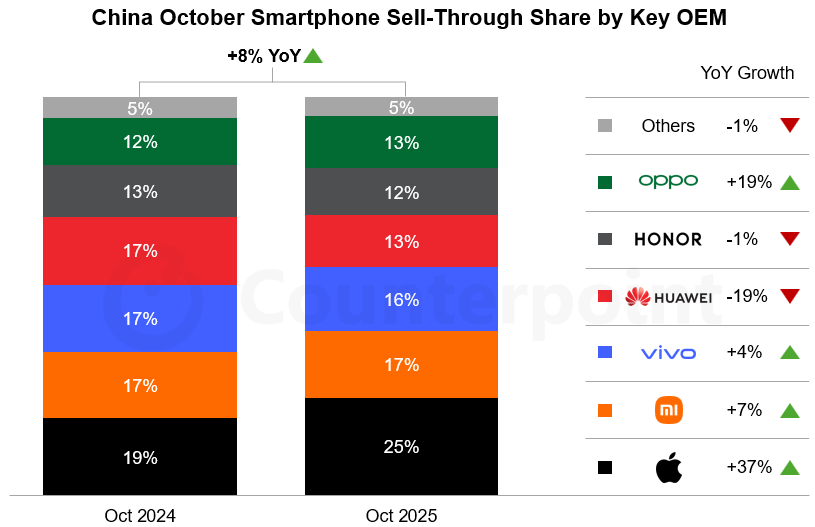
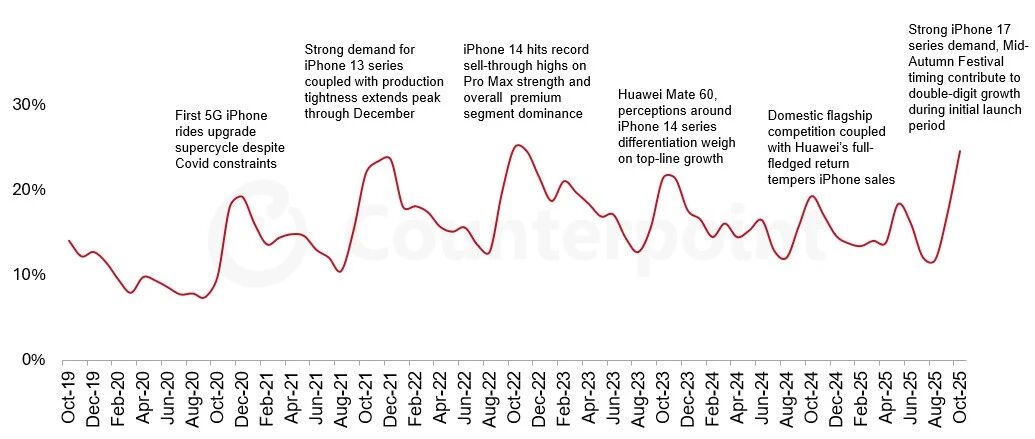
Core Insights - Apple's smartphone sales in October increased by 8% year-on-year, driven by a 37% growth in iPhone sales, particularly the iPhone 17 series [1][6] - The iPhone 17 series has achieved significant sales, with over 80% of new iPhone sales coming from this model, leading to an expected rise in overall sales due to increased average selling prices [1][6] - October marked Apple's best-ever Q4 start, with iPhones accounting for one in four smartphones sold in China, a feat only previously achieved in 2022 [4][6] Company Performance - OPPO emerged as the second-largest growth driver in the domestic smartphone market, thanks to its flagship Find X9 series and the youth-oriented Reno 14 series, exceeding expectations [6] - Xiaomi launched its Xiaomi 17 series early, along with a diverse product lineup, allowing it to reclaim the second position in the domestic market for the first time in over a decade [6] - Apple's sales momentum remains strong entering November, with expectations of achieving the best quarterly performance in December, despite potential competition from Huawei's upcoming Mate 80 series [6]

中国 10 月智能手机销量同比增长 8%;iPhone Q4 销量持续攀升,有望创历史新高
Counterpoint Research· 2025-11-20 04:14
Core Insights - In October, China's smartphone sales increased by 8% year-on-year, driven by Apple's 37% growth in sales [4][5][7] - The iPhone 17 series has significantly contributed to Apple's performance, with over 80% of sales coming from this new lineup, leading to an expected increase in overall sales due to rising average selling prices [5][7] - October marked Apple's best-ever Q4 start, with one in four smartphones sold in China being an iPhone, a feat only previously achieved once in 2022 [7] Market Performance - The iPhone 17 series, including the base, Pro, and Pro Max models, achieved double-digit growth rates in October, with the base model showing the fastest growth [7][9] - OPPO's flagship Find X9 series has performed well, driven by its strong imaging capabilities and large battery capacity, making it the second-largest growth driver in the domestic smartphone market [9] - Xiaomi reached the second position in the domestic market for the first time in over a decade, aided by its strong product lineup, including the Xiaomi 17 series launched during the Mid-Autumn Festival sales peak [9] Future Outlook - Apple's strong sales momentum is expected to continue into November, with the potential for record quarterly performance in December [9] - The upcoming launch of Huawei's Mate 80 series on November 25 poses a potential challenge, but current trends suggest that Apple's growth is robust and unlikely to see significant declines [9]
中国全面拥抱 eSIMs:苹果引领智能手机新时代
Counterpoint Research· 2025-11-20 04:14
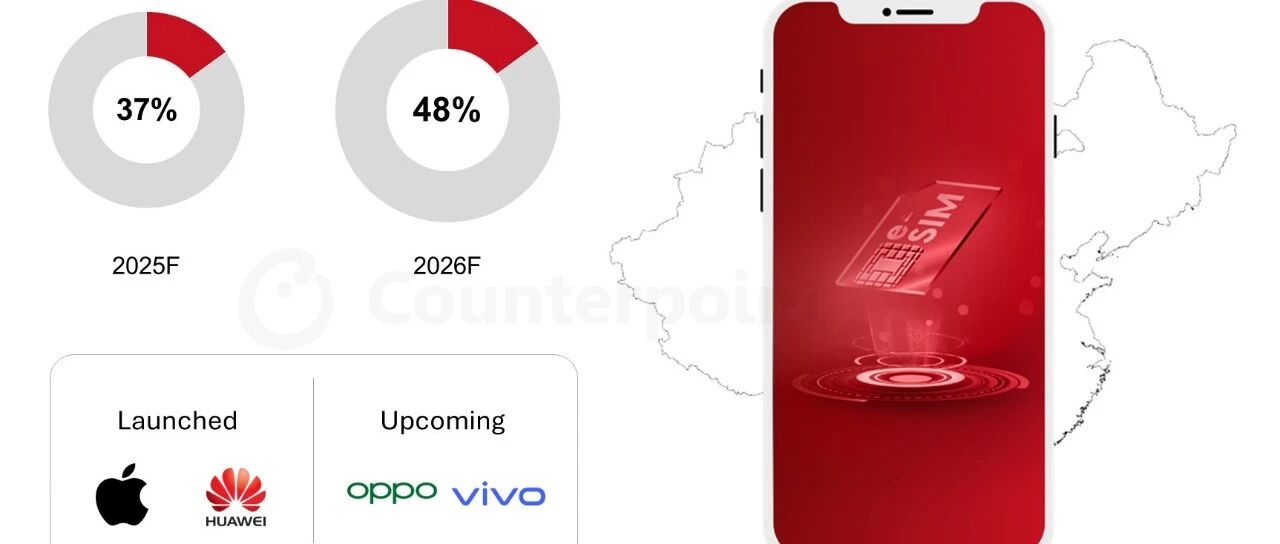
Core Insights - The article discusses the cautious adoption of eSIM technology in China due to regulatory and data security concerns, with a significant breakthrough expected in 2025 when eSIM trials for smartphones will commence [4][5][6]. Group 1: eSIM Technology in China - China has been hesitant to adopt eSIM technology in smartphones due to concerns over user identity verification and network regulation, leading to a preference for dual physical SIM card slots [5]. - The introduction of eSIM is expected to enhance device design by allowing for larger batteries and improved features, as eSIM integration eliminates the need for a SIM card slot [7][9]. Group 2: Market Impact and Projections - The approval of eSIM trials in China marks a new phase for the domestic market, with projections indicating that eSIM smartphones will account for 37% of global smartphone sales by 2025, increasing to 48% by 2026 [11]. - Apple's launch of the iPhone 17 Air, the first iPhone in China to support only eSIM, is anticipated to accelerate the adoption of eSIM technology among local brands and telecom operators [7][11]. Group 3: Competitive Landscape - The shift towards eSIM is expected to reshape the global smartphone industry, with Chinese manufacturers likely to gain a competitive edge as they adapt to this technology [11]. - As eSIM technology matures and carrier support increases, it is expected to penetrate mid-range and budget devices, moving beyond high-end models [9].
小米 17 Ultra黑科技曝光,手机摄影三大趋势已明?
3 6 Ke· 2025-11-20 04:11
Core Viewpoint - Xiaomi's upcoming 17 Ultra smartphone is expected to feature innovative imaging technology, specifically a "variable focal length" and "variable lens" system, which aims to enhance photography capabilities in mobile devices [1][12]. Group 1: Variable Focal Length Technology - The "variable focal length mobile camera system" represents an optimization of traditional optical zoom technology, allowing for seamless adjustment of focal lengths between 3x to 7x, thus addressing quality gaps in conventional multi-camera setups [5][6]. - This technology enhances hardware utilization by enabling a single variable focal length lens to perform the functions of multiple fixed focal length lenses, thereby freeing up space for other components like batteries and heat dissipation systems [5][12]. - Consistency in image quality and color across different focal lengths is achieved, minimizing discrepancies that often arise from using multiple lenses, which is particularly beneficial for users who process large volumes of photos [6][12]. Group 2: Market Context and Competitive Landscape - The exploration of variable focal length technology is not new; previous attempts by brands like Nokia and later Xiaomi and OPPO have laid the groundwork, indicating a market demand for flexible zoom capabilities [6][8]. - The current trend in mobile imaging is shifting from merely stacking lenses to optimizing single-lens performance, which could redefine the development logic of mobile photography [16][18]. - The competitive landscape among domestic flagship brands has evolved into a comprehensive competition involving hardware development, algorithm optimization, and user insights, with each brand addressing different pain points in mobile photography [18][20]. Group 3: Future Trends in Mobile Photography - The future of mobile photography is expected to see three major trends: integration of technology, professional experience simplification, and scene-specific optimizations, allowing users to achieve high-quality results across various environments [20][22]. - The advancements in imaging technology are likely to democratize high-quality photography, enabling users to create professional-grade images without the need for expensive equipment [22].
支付宝「独家」强推「碰一下」,瞄准的是移动支付的未来入口?
3 6 Ke· 2025-11-20 01:58
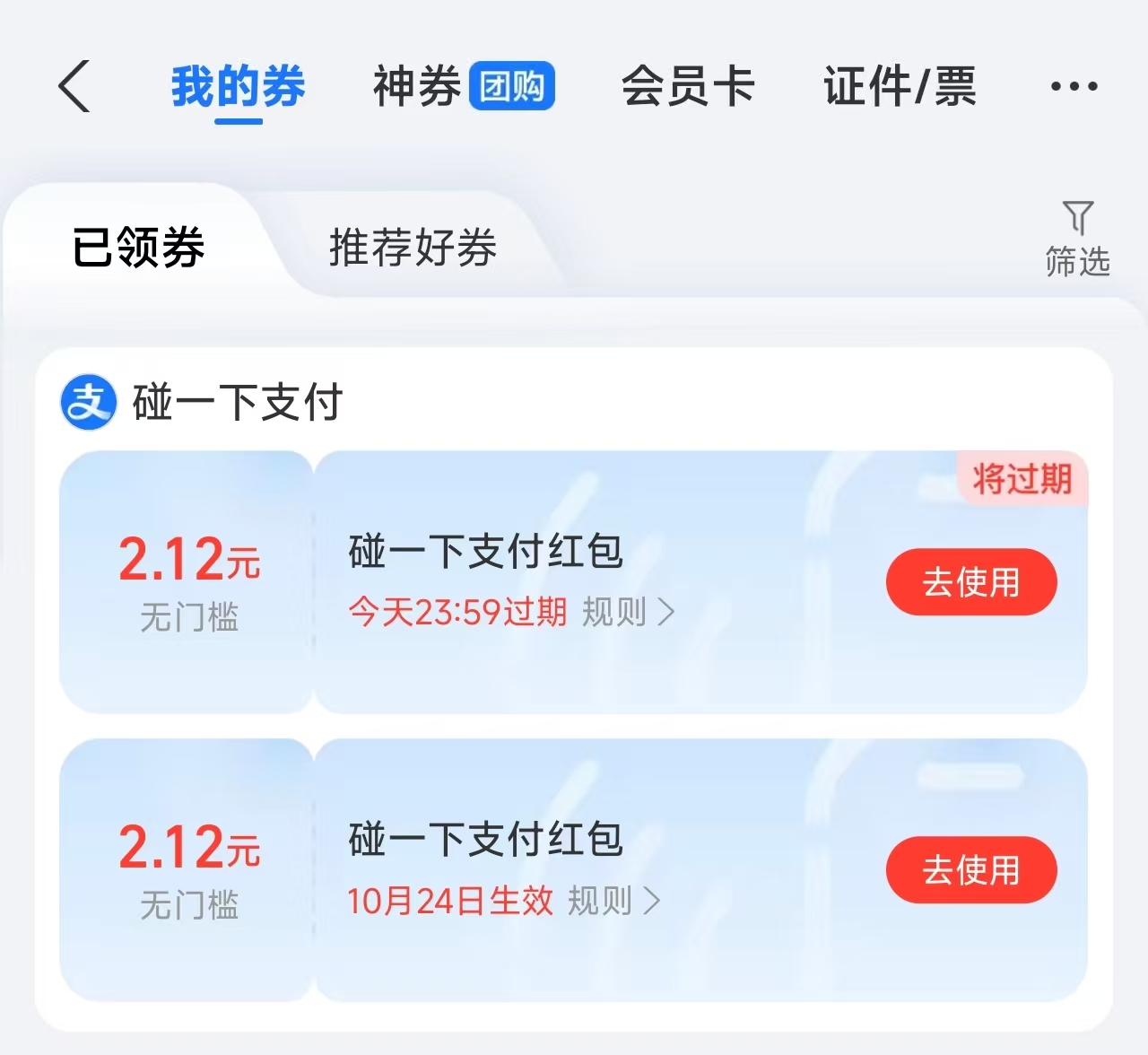
Core Insights - Alipay's "Tap to Pay" feature has rapidly gained popularity, reaching 200 million users within a year of its launch, with 80% of users preferring this method over traditional scanning [2][19][24] - The feature utilizes NFC technology, allowing users to complete transactions without opening the app, thus simplifying the payment process [1][20][28] Group 1: User Adoption and Growth - "Tap to Pay" surpassed 100 million users within 321 days of its launch, and the user base doubled from May to September this year [2][19] - Nearly 1 billion users have experienced various "Tap to Pay" services, with a significant preference for this method among users [2][19] Group 2: Marketing Strategies - Alipay has implemented several strategies to promote "Tap to Pay," including continuous red envelope giveaways to encourage user engagement [4][19] - The introduction of low-cost NFC hardware in the form of stickers has made it easier for small businesses to adopt the technology, leading to over 10 million merchants supporting "Tap to Pay" [6][8] Group 3: Expanding Use Cases - The "Tap to Pay" feature is not limited to payments; it has expanded into various applications such as ordering food, unlocking shared bikes, and checking into hotels [9][11] - Alipay is actively collaborating with merchants and ecosystem partners to promote "Tap to Pay," enhancing its market presence [12][18] Group 4: Security Measures - To address security concerns associated with "Tap to Pay," Alipay has introduced a compensation guarantee for users who experience account theft or payment issues [19][28] - Each transaction generates a unique encrypted token, ensuring user information is protected [19] Group 5: Market Positioning - Alipay aims to lead the next wave of payment technology, positioning "Tap to Pay" as a more intuitive alternative to traditional scanning methods [24][25] - The NFC technology's penetration rate among smartphones in China has reached 70%, indicating a favorable environment for the adoption of "Tap to Pay" [28][29]
段永平传奇
3 6 Ke· 2025-11-20 01:58
Group 1 - The article highlights the philanthropic efforts of Duan Yongping, who donated 220 million RMB to Beijing Normal University, emphasizing his connection to education and his mother's influence [2][4]. - Duan Yongping has donated over 1 billion RMB to various universities over the past two decades, showcasing his commitment to education and knowledge [4]. Group 2 - Duan Yongping's early life involved significant hardships, including relocating to rural areas, which shaped his understanding of hard work and perseverance [5][6][8]. - He faced challenges in his education, initially failing to pass the college entrance exam but later succeeding and attending Zhejiang University, where he developed a strong foundation in knowledge [9][12][14]. Group 3 - Duan Yongping transformed a struggling factory into a successful gaming company by focusing on the production of small gaming consoles, which led to the creation of the "Little霸王" learning machine [21][28]. - The "Little霸王" brand became a household name, achieving a market share of nearly 80% in its segment, demonstrating effective marketing and product positioning [30][34]. Group 4 - After leaving the "Little霸王" company, Duan Yongping founded BBK Electronics, implementing an employee stock ownership plan to foster loyalty and collaboration [40][41]. - BBK Electronics quickly gained market leadership in various product categories, including telephones and VCDs, underlining Duan Yongping's strategic vision [46][49]. Group 5 - Duan Yongping transitioned to investing in the U.S. stock market, achieving significant returns, particularly with his investment in NetEase, which turned $200,000 into over $100 million [50][51]. - He adopted investment principles similar to Warren Buffett, focusing on companies with strong business models and long-term value [51][53]. Group 6 - Duan Yongping is recognized as a mentor to many successful entrepreneurs in China, instilling in them a philosophy of integrity and long-term thinking in business [55][57]. - His influence extends to major companies like OPPO and Vivo, where his teachings on doing the right thing and maintaining focus have been embraced [56][58].

