
小米

Search documents
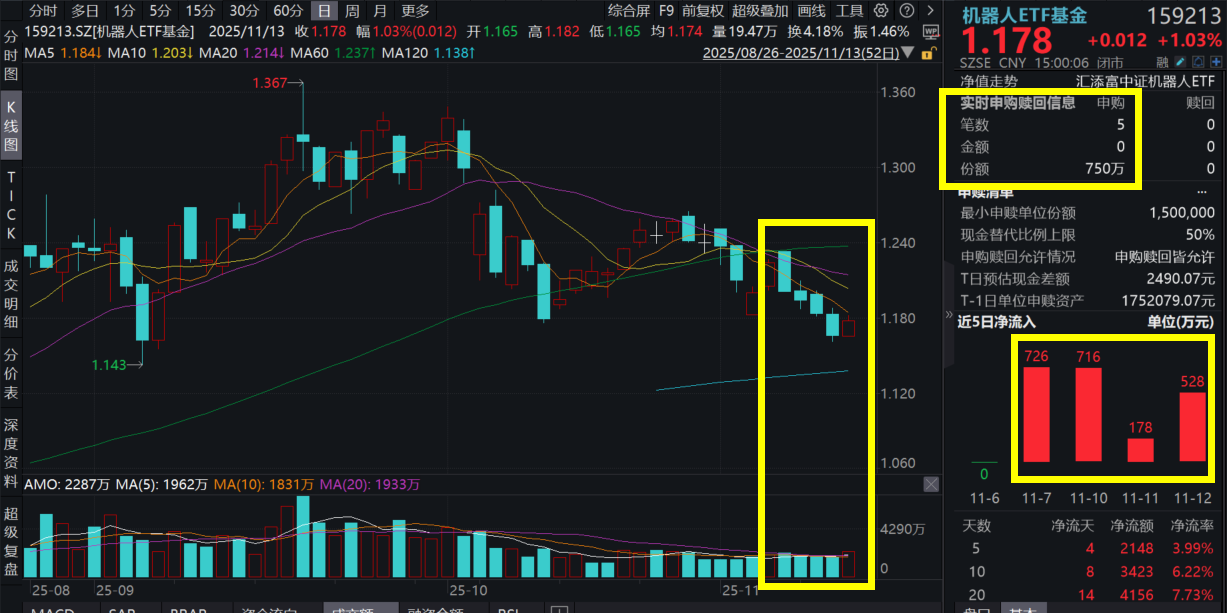
宇树科技再推新!机器人ETF基金(159213)涨超1%,连续5日净流入超3000万,机构:人形机器人产业明年有望迎来“iPhone”时刻!
Xin Lang Cai Jing· 2025-11-13 08:12
Core Viewpoint - The A-share market experienced a strong rebound on November 13, particularly in the hard technology sector, with the Robot ETF Fund (159213) rising over 1% and attracting significant net inflows of 9 million yuan on the same day, following a total of over 30 million yuan in net inflows over the previous five days [1][3]. Group 1: Market Performance - The Robot ETF Fund (159213) ended the day with a gain of over 1%, marking the end of a three-day decline [1]. - The fund has seen continuous strong capital inflow, with a total of over 30 million yuan in net inflows over the last five days [1]. - Key component stocks of the Robot ETF Fund showed positive performance, with several stocks, including Dahua Technology and Zhongkong Technology, rising by over 2% and 1% respectively [3]. Group 2: Component Stocks - The top ten component stocks of the Robot ETF Fund include: - Huichuan Technology (300124) with a gain of 1.26% and an estimated weight of 10.22% - Keda Xunfei (002230) with a gain of 0.63% and an estimated weight of 9.25% - Dahua Technology (002236) with a gain of 2.20% and an estimated weight of 5.26% [4]. Group 3: Industry Developments - Yushu Technology launched a full-stack solution for humanoid robot data collection training, featuring the G1-D robot, which is designed for various applications [5]. - UBTECH announced the mass production of its Walker S2 humanoid robots, with a delivery target of 500 units this year, contributing to a cumulative order amount exceeding 800 million yuan for the Walker series [5]. - Industry experts predict that 2026 will mark a significant turning point for the humanoid robot industry, akin to the "iPhone moment," leading to large-scale production and benefiting companies across the supply chain [6]. Group 4: Future Outlook - The robot sector is expected to enter a phase of validation and consolidation after significant adjustments in October, with key developments from companies like Tesla and others supporting market expectations [7]. - Domestic robot companies are accelerating their capitalizations, with notable IPO plans from Yushu Technology and Leju Robotics, indicating a critical moment for the industry [8]. - Major tech players are intensifying their focus on humanoid robots, with expectations for significant production increases by 2026, potentially reaching a shipment volume of "ten thousand units" for domestic robots [8].




京城股份:未投资小米机器人及天工机器人
Ge Long Hui· 2025-11-13 08:00
Core Viewpoint - The company, Jingcheng Shares (600860.SH), primarily engages in equipment manufacturing, focusing on gas storage and transportation equipment as well as intelligent manufacturing. The company has not invested in Xiaomi Robotics or Tiangong Robotics [1]. Company Overview - The main business of the company is equipment manufacturing [1]. - Key products include gas storage and transportation equipment and intelligent manufacturing solutions [1]. Investment Activity - The company has confirmed that it has not made investments in Xiaomi Robotics or Tiangong Robotics [1].

明年起购置税将减半征收,17家汽车品牌承诺兜底
第一财经· 2025-11-13 07:49
Core Viewpoint - The article discusses the impending end of the full exemption from purchase tax for new energy vehicles (NEVs) in China, leading to a competitive order-seizing battle among car manufacturers as they introduce tax subsidy plans to attract consumers before the policy changes take effect [3][4]. Group 1: Policy Changes and Impacts - Starting January 1, 2026, the purchase tax for NEVs will be halved, with a maximum tax reduction of 15,000 yuan per vehicle [3]. - From January 1, 2024, to December 31, 2025, NEVs will continue to be exempt from purchase tax, with a maximum exemption of 30,000 yuan per vehicle [3][4]. - The adjustment in tax policy has intensified consumer urgency to purchase vehicles, influencing their choice of models based on delivery timelines [4]. Group 2: Manufacturer Responses - 17 major automotive brands, including Li Auto, NIO, and BYD, have introduced purchase tax subsidy plans to cover the tax difference for consumers whose vehicles are delivered after the policy change [3][4]. - The subsidy methods include tax difference vouchers, cash reductions on final payments, and direct cash subsidies, with a maximum subsidy of 15,000 yuan [4]. - The competition among manufacturers is expected to increase as they strive to maintain market share amid changing tax incentives [5]. Group 3: Market Trends and Performance - In October, NEV production and sales reached 1.772 million and 1.715 million units, respectively, with year-on-year growth exceeding 20% and a market penetration rate surpassing 50% [4][5]. - Cumulative NEV production and sales for the first ten months of the year exceeded 13 million units, reflecting a year-on-year growth of approximately 33% [4]. - The market is witnessing a shift as consumers, influenced by the availability of popular models, are increasingly opting for less popular models, contributing to sustained sales growth [4].






明年起购置税将减半征收 已有17家主流汽车品牌承诺兜底
Di Yi Cai Jing· 2025-11-13 07:00
Core Insights - The full exemption of purchase tax for new energy vehicles (NEVs) will end in 2025, prompting a competitive order acquisition battle among car manufacturers [1] - Major automotive brands have introduced purchase tax subsidy plans to secure orders before the policy change, with subsidies covering all or part of their models [2] - The market is experiencing heightened consumer urgency to purchase vehicles due to the impending policy adjustments, leading to increased sales and a shift in consumer preferences towards models with shorter delivery times [2][3] Group 1 - As of November 13, 17 mainstream automotive brands have launched purchase tax subsidy plans, with a maximum subsidy of 15,000 yuan per vehicle [1] - From January 1, 2026, the purchase tax for NEVs will be halved, with a maximum reduction of 15,000 yuan per vehicle [1] - In October, NEV production and sales reached 1.772 million and 1.715 million units respectively, both showing over 20% year-on-year growth, with a penetration rate surpassing 50% [2] Group 2 - The automotive market is maintaining a strong development trend, with monthly production and sales hitting record highs amid a competitive environment [3] - The technical threshold for NEV purchase tax exemptions will increase starting in 2026, affecting plug-in hybrid models with electric ranges below 100 kilometers [3] - The ongoing competition will likely lead to a clearer industry differentiation, with companies possessing core technological advantages expected to gain market share [3]
明年起购置税将减半征收,已有17家主流汽车品牌承诺兜底
Di Yi Cai Jing· 2025-11-13 06:55
Core Viewpoint - The full exemption of purchase tax for new energy vehicles (NEVs) will end in 2025, prompting a competitive rush among car manufacturers to secure orders before the policy change [2][3]. Group 1: Policy Changes - From January 1, 2026, the purchase tax for NEVs will be halved, with a maximum tax reduction of 15,000 yuan per vehicle [2]. - The exemption period for NEVs will continue until December 31, 2025, with a maximum exemption of 30,000 yuan per vehicle [2]. Group 2: Market Dynamics - As of November 13, 2023, 17 major automotive brands have introduced purchase tax subsidy plans to attract consumers, covering all or part of their vehicle models [2][3]. - The urgency among consumers to purchase vehicles has increased due to the impending policy change, leading to a shift in consumer preferences towards models with shorter delivery times [3]. Group 3: Sales Performance - In October 2023, NEV production and sales reached 1.772 million and 1.715 million units, respectively, both showing over 20% year-on-year growth, with a penetration rate surpassing 50% [3][4]. - Cumulative NEV production and sales exceeded 13 million units in the first ten months of 2023, marking a year-on-year increase of approximately 33% [3]. Group 4: Competitive Landscape - The reduction in purchase tax incentives is leading NEV manufacturers to increase promotional efforts to capture market share [4]. - From 2026, plug-in hybrid vehicles with an electric range of less than 100 kilometers will no longer qualify for purchase tax exemptions, indicating a potential market shift towards manufacturers with strong technological capabilities [4].
以旧换新推动家电“质价比”转变,AI产品成“双11”新宠
Bei Ke Cai Jing· 2025-11-13 04:05
Core Insights - The "Double 11" shopping festival has seen a shift in consumer focus from "cost-performance" to "quality-price" ratio, with smart home appliances gaining significant attention [1][3][6] - AI technology has emerged as a highlight during this year's event, with innovative products like AI glasses and AI-enabled home appliances capturing consumer interest [5][7] Consumer Behavior and Trends - The "old-for-new" subsidy policy has stimulated consumer spending, with over 2000 home appliance brands on JD platform seeing a year-on-year sales increase of over 100% [2] - Consumers are increasingly prioritizing quality and efficiency in their purchases, with specific regional preferences noted, such as embedded washing and drying sets in East China and dehumidifiers in South China [2][4] - The demand for high-end cleaning appliances remains strong, with brands like Chase and Roborock achieving significant market shares in premium segments [3][6] Sales Performance - Xiaomi reported a total payment amount exceeding 29 billion yuan during "Double 11," with its smartphones leading in sales across major platforms [3] - Suining Yigou noted a 48% year-on-year growth in sales in county markets, with washing machines, dishwashers, and water purifiers being the most popular new items [2] Technological Integration - The integration of AI technology across platforms has enhanced supply chain efficiency and consumer experience, marking a transition to a more intelligent retail environment [5][6] - AI-enabled products, such as smart air conditioners and refrigerators, are becoming mainstream, reflecting a shift towards personalized and scenario-based consumption [6][7] Market Outlook - Analysts suggest that the "Double 11" event has evolved into a comprehensive test of instant retail and AI technology, indicating a significant transformation in consumer purchasing behavior [5][6] - The trend of "pursuing new" in 3C digital consumption is evident, with a growing demand for innovative products that enhance convenience and intelligence in daily life [7]
“双11”大促期间,服务消费热点频现,“AI+电商”模式屡次被提及
Mei Ri Jing Ji Xin Wen· 2025-11-13 03:14
Group 1 - The Hong Kong stock consumer sector experienced fluctuations, with the consumer ETF (513230) showing a slight decline as of the report time [1] - Notable performers included Samsonite, which surged over 21%, while companies like Wynn Macau and Miniso faced significant declines [1] - The "Double 11" shopping festival saw online retail sales reach nearly 2.4 trillion yuan, marking a new high with a year-on-year growth of over 10% [1] Group 2 - The consumer ETF (513230) tracks the CSI Hong Kong Stock Connect Consumer Theme Index, encompassing a wide range of sectors including new consumption leaders and major internet e-commerce players [2] - The ETF includes companies like Pop Mart, Lao Pu Gold, and major tech firms such as Tencent and Alibaba, highlighting a strong tech-consumer integration [2]

中国—西班牙商务论坛在川举行,与会各方有一个共识——“中西双方正处于历史上最佳的一段合作期”
Si Chuan Ri Bao· 2025-11-13 00:29
Group 1: Trade and Investment Overview - Numerous Chinese companies are actively investing in Spain across various sectors, including advanced technology, advanced materials, new energy vehicles, agriculture, tourism, and cosmetics [1][3] - The bilateral trade volume between China and Spain is projected to exceed €52 billion in 2024, with a record trade volume of $41.3 billion in the first nine months of this year, marking a year-on-year growth of 10.3% [1][5] - China has become Spain's largest trading partner outside the EU [5] Group 2: Key Partnerships and Collaborations - The launch of the innovative EBRO vehicle by Chery Automobile in Spain is highlighted as a benchmark project for cooperation between the two countries [1] - CATL has chosen Sichuan as its largest production base outside Ningde, with Spain being one of its major investment locations in Europe [1] - The partnership between Antolin Group and Chinese automakers, including Geely and Chery, has significantly increased market share in both China and Spain [4] Group 3: Economic and Cultural Ties - The visit of Spanish King Felipe VI to China, particularly to Sichuan, underscores the strong emotional and economic ties between Spain and Sichuan, which has established multiple sister city relationships since 1994 [2] - Chengdu High-tech Zone has signed a cooperation memorandum with Barcelona Technology Park to enhance innovation and product collaboration in the biopharmaceutical industry [2] - The import of Spanish olive seeds to Chengdu has resulted in a geographical indication product, producing over 10,000 tons of fresh fruit annually [2] Group 4: Future Prospects - The Spanish Minister of Economy and Business, Reyes Maroto, expressed optimism about attracting more Chinese companies to Spain, aiming to enhance employment and knowledge transfer [5] - There is a strong expectation for further cooperation in sectors such as automotive manufacturing, life sciences, and finance [5]

新能源车要开始卷充电速度了
虎嗅APP· 2025-11-13 00:09
Core Viewpoint - The article discusses the growth of China's new energy vehicles (NEVs) and charging piles, highlighting the decreasing vehicle-to-pile ratio while emphasizing that the charging difficulties persist due to the imbalance between private and public charging infrastructure [5][6][8]. Group 1: Growth of NEVs and Charging Infrastructure - In 2020, China had 4.92 million NEVs and 1.68 million charging piles, with a vehicle-to-pile ratio of 3.1:1. By 2022, NEV ownership rose to 13.1 million, and charging piles increased to 5.2 million, reducing the ratio to 2.5:1 [5][6]. - Projections for 2024 indicate NEV and charging pile ownership will reach 31.4 million and 13.08 million, respectively, with a further decrease in the vehicle-to-pile ratio to 2.4:1 [6]. - As of mid-2025, NEV ownership is expected to hit 36.89 million, with charging piles around 16.04 million, leading to a vehicle-to-pile ratio of 2.3:1 [6]. Group 2: Charging Difficulties - The article argues that simply observing a declining vehicle-to-pile ratio does not accurately reflect the alleviation of charging difficulties, as it fails to differentiate between public and private charging piles [8]. - By the end of 2024, out of 16.04 million charging piles, 11.94 million will be private piles, leaving owners of vehicles without charging piles reliant on public options [10]. - The growth of private piles has consistently outpaced public piles, with private piles increasing by 373,000 and public piles by only 85,300 in 2024 [11]. Group 3: Public Charging Infrastructure Challenges - The article identifies three critical variables affecting charging difficulties: the percentage of vehicle owners with private charging piles, the ratio of new public piles to vehicles without charging piles, and the ratio of existing vehicles to public piles [14][15]. - The ratio of existing vehicles to public piles has worsened from 6.5:1 in 2021 to 9:1 by mid-2025, indicating that the growth of public charging infrastructure is lagging behind vehicle sales [15][17]. - The annual production of 30 million vehicles contrasts sharply with the addition of only 850,000 public charging piles, highlighting inefficiencies in public charging infrastructure investment and operation [17]. Group 4: Economic Viability of Charging Operators - The article discusses the performance of 特来电 (Telai Electric), which operates 792,000 public charging terminals, holding a 24% market share as of mid-2025 [19]. - Despite a significant number of terminals, the average profit per terminal is low, with each terminal generating only 4.1 yuan in gross profit per day [24]. - The decline in revenue per terminal is attributed to the expansion of partnerships and collaborations, which dilute the profitability of individual charging stations [22]. Group 5: Charging Speed and User Experience - The article emphasizes that the primary issue is not the number of charging piles but the slow charging speed, which contributes to user anxiety regarding vehicle range [29]. - Current average charging power across 18 million charging piles is only 44 kW, leading to long wait times for users [31]. - The article advocates for a "charging revolution" where charging speeds match those of refueling gasoline vehicles, which would significantly improve user experience and operational efficiency for charging operators [31][38]. Group 6: Government Initiatives and Future Outlook - As of September 2025, China aims to have 28 million charging piles by 2027, with a focus on increasing charging speed and efficiency [32]. - The government has recognized the need for faster charging solutions and plans to enhance the infrastructure to support high-power charging stations [32]. - The article concludes that the future of NEV competitiveness will hinge on charging convenience and speed, rather than just battery capacity [41].

“中西双方正处于历史上最佳的一段合作期”
Si Chuan Ri Bao· 2025-11-12 20:16
□四川日报全媒体记者 陈碧红●目前有很多中国企业在西班牙投资兴业,从先进技术、先进材料、 新能源汽车到农业、旅游业、美妆业,都有中国企业活跃的身影●2024年中西双边贸易额超过520 亿欧元,今年前9个月双边贸易额达413亿美元,同比增长10.3%,再创历史新高,中国已成为西 班牙在欧盟外的第一大贸易伙伴"奇瑞汽车公司推出的具有创新性的EBRO汽车在西班牙亮相,一 个月前我参观过,我觉得这款汽车在西班牙市场没有竞争对手,而且将成为两国企业合作的标杆 项目。"11月11日,中国—西班牙商务论坛在成都举行,西班牙工业国务秘书乔尔迪·加西亚·布鲁 斯滕加在论坛上对这家中国企业点赞。"在中国我们选择四川作为宁德以外的最大生产基地,而西 班牙是宁德时代在欧洲投资建设的最大基地之一。"也是在这个论坛现场,宁德时代联席董事长潘 健透露了这一消息。当天,西班牙国王费利佩六世率领高规格经贸代表团来川,并出席本次论坛 活动。这是他登基以来首次对中国进行国事访问,而访华首站选择四川,无疑展现出西班牙与四 川之间的深厚情感:自1994年四川与瓦伦西亚自治区建立两国第一对省级友好友城关系以来,如 今双方建立起2对省级国际友城关系、15 ...