ING

Search documents
Wall Street Breakfast Podcast: Meta Looks To Poach OpenAI Talent?
Seeking Alpha· 2025-06-18 11:10
Group 1: OpenAI and Meta Platforms - Meta Platforms is reportedly offering signing bonuses of up to $100 million to attract OpenAI employees, aiming to poach top AI talent [2][3] - OpenAI CEO Sam Altman stated that despite these offers, none of OpenAI's best employees have accepted them, indicating a strong team loyalty [3][4] - Altman criticized Meta's hiring strategy, suggesting that large upfront compensation does not foster a positive company culture [4] Group 2: Stablecoin Legislation - The Senate passed the GENIUS Act with a vote of 68-30, which aims to establish a regulatory framework for stablecoins, enhancing the legitimacy of the cryptocurrency industry [5][6] - The bill mandates full reserve backing by U.S. dollars and Treasury bills, along with monthly audits and consumer protections [6] - Projections indicate that stablecoin issuers could become the largest holders of U.S. Treasuries by 2030 if the bill is enacted [5] Group 3: Market Reactions and Economic Indicators - The market is currently cautious ahead of the Federal Reserve's decision on interest rates, with no changes expected according to economists [10][13] - Events in the Middle East, particularly related to U.S. tensions with Iran, could influence market sentiment despite the Fed's anticipated stability [11] - Economic indicators such as housing starts, jobless claims, and petroleum inventories are scheduled for release, which may impact market dynamics [14]



区域型银行如何实现AI战略突围?
麦肯锡· 2025-06-11 09:24
Core Viewpoint - The competition for generative AI in regional banks has shifted from technological exploration to value realization, making it essential for these banks to capture AI value and implement applications effectively [1]. Group 1: Current State of Generative AI in Banking - Generative AI applications are expanding from internal use to client-facing services, transforming operational models and customer service methods within banks [2]. - The emergence of multi-agent systems is providing comprehensive solutions that can cover complex processes, allowing generative AI agents to act as virtual colleagues [3]. Group 2: Impact on Profitability - Generative AI is expected to significantly enhance productivity across industries, with banking projected to see a potential productivity increase of $200 billion to $340 billion, translating to a 14%-24% potential profit increase, which could rise to 60%-80% over the next three years [4]. Group 3: Challenges in AI Adoption - Despite the apparent technological benefits, regional banks face significant barriers to large-scale AI application, including data silos and a shortage of hybrid talent, with an estimated talent gap of 5 million in China by 2030 [7]. - Regional banks must address three core questions: how to focus on high-value scenarios with limited resources, how to balance short-term wins with long-term strategies, and how to manage innovation and ecosystem collaboration [7]. Group 4: High-Value AI Application Scenarios - Six high-value AI application scenarios are emerging as key areas for regional banks to leverage AI capabilities, transitioning from experimental phases to growth drivers [8]. - These scenarios include credit risk management, customer relationship management, software development efficiency, intelligent customer service, hyper-personalized services, and knowledge management [10]. Group 5: Strategic Pathways for Regional Banks - Regional banks must choose between three strategic models: "builders" who deeply reconstruct core business, "innovators" who enhance middle and back-office processes, and "adopters" who focus on efficiency improvements [14]. - A comprehensive AI transformation framework is necessary, integrating AI with overall business strategy and ensuring that AI investments are directly linked to financial metrics [15][16]. Group 6: Collaboration and Ecosystem Development - Finding suitable ecosystem partners is crucial for regional banks to quickly develop strategies and implement use cases, allowing them to leverage existing solutions and accelerate their AI adoption [17]. - The future of banking will see AI not just as a tool for efficiency but as a core competitive advantage for enhancing customer service, optimizing risk management, and improving operational resilience [18].

汇市观察 | 美元强势反弹,日元承压、英镑大幅回落
Xin Hua Cai Jing· 2025-06-10 11:43
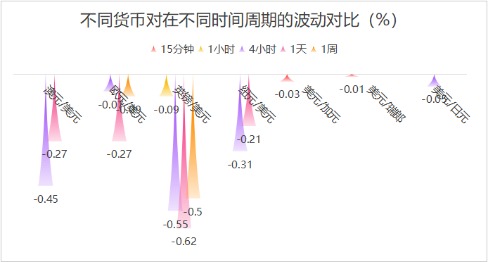
Core Viewpoint - The article discusses the fluctuations in currency markets, particularly focusing on the performance of the British pound against the US dollar, and highlights the impact of US inflation data and trade negotiations on global currency movements [1][2]. Currency Fluctuations - During the Asian trading session, the British pound showed significant negative volatility against the US dollar, with a decline of -0.62% over one day, the largest among major currencies [2][3]. - The Australian dollar and euro also experienced negative fluctuations, with the Australian dollar declining by -0.27% against the US dollar over one day [2]. British Pound Analysis - There is an increased demand for bearish options on the British pound, with the implied volatility for one-week and two-week put options at 7.6% and 7.7% respectively, following disappointing wage data [4]. - The UK Office for National Statistics reported a decrease in wage growth to 5.2%, the lowest since Q3 of the previous year, which was below economists' expectations of 5.3% [4][6]. Employment and Economic Policies in the UK - In May, the UK saw a reduction of 109,000 jobs, the largest monthly decline since May 2020, which exceeded expectations [6]. - The UK government has raised corporate wage taxes and minimum wage standards, effective from April, which may alleviate inflationary pressures by controlling rising prices [6]. Japanese Yen Performance - The Japanese yen experienced slight negative volatility of -0.05% over four hours, with the USD/JPY pair reaching a high of 145.28, the highest in over a week [7]. - The Bank of Japan's Governor indicated a delay in interest rate hikes due to insufficient confidence in achieving the 2% inflation target, which has weakened market expectations for policy normalization [7]. Australian and New Zealand Dollar Trends - Both the Australian and New Zealand dollars showed negative volatility patterns, reflecting cautious market sentiment towards risk assets amid ongoing trade negotiations and US inflation data [8].
每日机构分析:5月30日
Xin Hua Cai Jing· 2025-05-30 11:47
Group 1 - UBS forecasts global AI spending to reach $360 billion by 2025, a 60% increase from previous estimates, and further grow to $480 billion by 2026 [1] - Major global cloud platforms reported a strong 24% year-over-year revenue growth, indicating robust cloud business growth and increased adoption of AI across various industries [1] - UBS suggests balancing exposure between semiconductor and software stocks to manage volatility despite a positive long-term outlook on AI [1] Group 2 - The strong performance of the yen is unlikely due to low real interest rates, leading Japanese life insurance companies to reduce measures against potential losses from yen appreciation [2] - Japanese life insurers have shifted from buying to selling overseas stocks, reflecting a decrease in interest in foreign bonds despite higher yields compared to US, UK, Germany, and Australia [2] - PIMCO analysts expect Germany to have more fiscal space compared to other European countries, with overall European fiscal policy unlikely to expand significantly in the coming years [2] Group 3 - Tokyo's inflation rate rose to 3.6% in May, the highest since early 2023, exceeding market expectations, which may lead to a reassessment of the likelihood of a Bank of Japan rate hike [3] - If the Bank of Japan raises rates in July, it could support the yen and reduce hedging costs for Japanese investors in US assets [3] - The Federal Reserve may need to implement more accommodative monetary policy later this year to support the US economy, potentially leading to a weaker dollar [3] Group 4 - The iTraxx Europe Main index tracking euro investment-grade credit default swaps remained stable at 57 basis points, indicating no significant change in the market's view on the default risk of high-grade corporate debt in the eurozone [3]
单周下跌2%,美元创4月“对等关税”以来最大跌幅
Hua Er Jie Jian Wen· 2025-05-24 02:08
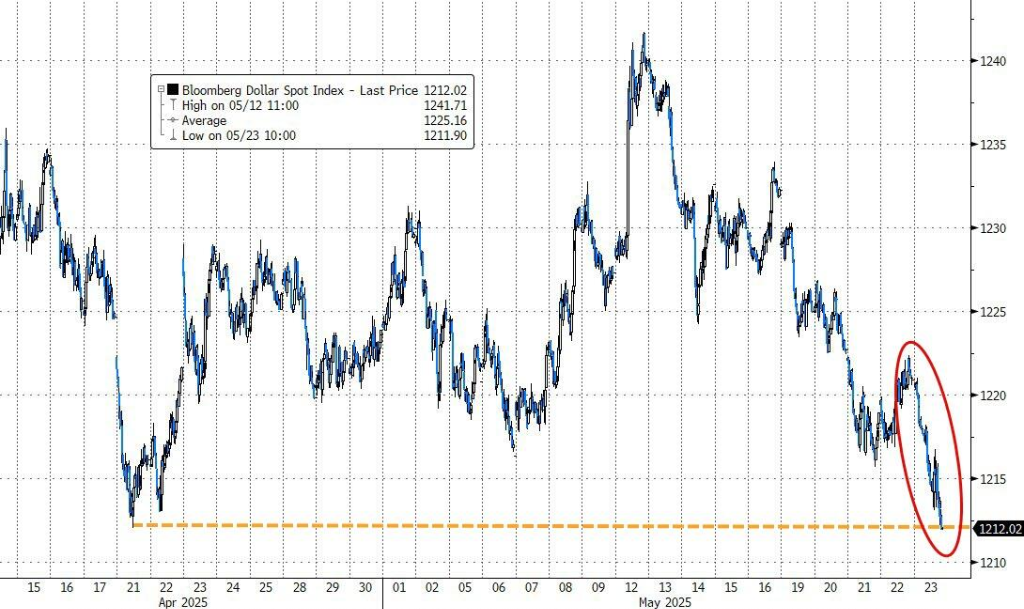
Core Points - The US dollar has dropped 2% this week, marking the largest weekly decline since April, amid rising concerns over the US fiscal situation [1] - The dollar's decline is unusual given the high interest rate environment, as typically higher yields would attract investment in dollar assets [1] - The Bloomberg Dollar Index fell significantly, breaking below April lows and reaching a new yearly low [1][4] Group 1: Market Reactions - Investors are exhibiting panic selling of dollar assets, indicated by simultaneous declines in the dollar, US government bonds, and stocks [1] - Chris Turner from ING highlights ongoing concerns about the quality of US asset markets and threats of de-dollarization putting pressure on the dollar [1] - US Treasury Secretary Mnuchin attempted to downplay the dollar's weakness, attributing it to strength in other currencies rather than a decline in the dollar itself [1] Group 2: Fiscal Concerns - The fiscal deficit concerns stemming from Trump's tax cuts have led to a sell-off in long-term US bonds, with the 30-year bond yield rising 0.13 percentage points to surpass 5% [5] - Analysts warn that worries about the increasing fiscal burden on the US are gradually intensifying [5] - MUFG's Lee Hardman states that renewed concerns about the US fiscal outlook and speculation about weakening the dollar in international discussions are exacerbating the sell-off [7] Group 3: Long-term Outlook - The ongoing decline of the dollar is linked to growing investor concerns about the impact of comprehensive tariffs on the US economy [7] - RBC Asset Management analysts predict that the dollar's weakness will persist as investors seek to hedge dollar exposure in the short term and reconsider structural overexposure to the US in the long term [7]
BNP Paribas Primary New Issues: STAB Notice - No Stab SPIE SA
GlobeNewswire News Room· 2025-05-22 13:05
Group 1 - The announcement indicates that no stabilisation was carried out for the securities offered by SPIE SA, as per the Market Abuse Regulation [2] - The securities issued by SPIE SA have an aggregate nominal amount of EUR 600,000,000 with a fixed interest rate of 3.75% maturing in May 2030 [3] - The offer price for the securities is set at 100 [3] Group 2 - The stabilisation managers involved in this offering include BNP Paribas, Credit Agricole, Natixis, SG, CIC, Commerzbank, ING, and La Banque Postale [4] - The announcement clarifies that this is not an offer of securities for sale in the United States, and the securities have not been registered under the United States Securities Act of 1933 [5]


百利好晚盘分析:内部分歧加大 美元信用削弱
Sou Hu Cai Jing· 2025-05-20 09:06
Group 1: Gold Market - Trump's attendance at the U.S. Congress discussion on comprehensive tax legislation highlights significant internal divisions within the Republican Party regarding government spending, green tax policies, and social safety net projects [2] - If the tax bill is successfully passed, it may lead to a decrease in the likelihood of Federal Reserve interest rate cuts, which would be unfavorable for gold and beneficial for the repatriation of profits by overseas companies [2] - The rising pressure of U.S. debt is weakening investor confidence in the dollar, posing a threat to its credibility [2] - Technical analysis indicates that gold has not been able to break through the resistance at $3,250, maintaining a wide trading range between $3,120 and $3,250 [2] Group 2: Oil Market - OPEC+ announced an increase in production by 414,000 barrels per day starting in June, leading Wall Street to lower oil price forecasts [4] - Morgan Stanley predicts an oversupply of 1.1 million barrels per day in the second half of the year, while Goldman Sachs notes increased downward pressure on oil prices due to high OPEC+ production capacity and recession risks [4] - ING's commodity head suggests that OPEC+'s production increase may lead to a year-long oversupply, compounded by uncertain demand due to tariff policies [4] - Federal Reserve Vice Chairman Jefferson indicated signs of weakening economic activity, with inflation data moving closer to the 2% target, and uncertainty in tariff policies potentially leading to rising inflation [4] - Technical analysis shows oil prices have struggled to break above $62.50, with a likelihood of trading within a range of $55 to $64 [4] Group 3: Copper Market - Copper has been trading in a range of $4.50 to $4.68 since last week, with the adjustment phase nearing its end [5] - There is a higher probability of an upward breakout, with resistance at $4.68 and support at $4.50 [5]

ASML publishes agenda Annual General Meeting 2025
GlobeNewswire News Room· 2025-03-05 06:30
Core Points - ASML Holding NV has published the agenda for its 2025 Annual General Meeting (AGM) scheduled for April 23, 2025, in a hybrid format allowing both in-person and virtual attendance [1][2] - Annet Aris will not stand for re-election to the Supervisory Board at the end of her current term, which concludes at the 2025 AGM [3] - Karien van Gennip has been nominated for appointment to the Supervisory Board, bringing extensive leadership experience from various sectors including public policy and financial services [5][7] - The agenda also includes the reappointment of Birgit Conix to the Supervisory Board for an additional four years, effective April 23, 2025, and the election of Terri Kelly as Vice-Chair following Annet Aris's retirement [8] Company Overview - ASML is a leading supplier to the semiconductor industry, providing hardware, software, and services for the mass production of integrated circuits [9] - The company is headquartered in Veldhoven, the Netherlands, and operates globally with over 44,000 employees [10]