
奔驰

Search documents
如何判断一个项目还能否入局?
3 6 Ke· 2025-08-16 10:17
Group 1 - The core idea is to evaluate whether an old project is still viable by analyzing various factors such as industry giants, profitability, new entrants, data reports, training activities, and the presence of project leaders [2][24]. Group 2 - The presence of industry giants indicates a large market and potential profitability, as seen in sectors like automotive and e-commerce with established players like BMW, Mercedes, and Alibaba [3][6]. - It is crucial to assess if leading companies in the industry are still making profits; if they are struggling, it becomes harder for newcomers to succeed [7][8][11]. - The entry of new players into a market, even after years of establishment, suggests ongoing opportunities, as demonstrated by the continued success of platforms like WeChat and Douyin [12][15]. Group 3 - Regular data reports from major platforms like Taobao and JD.com should be analyzed to determine if user engagement and sales metrics are still growing, indicating a healthy market [16][17]. - The existence of ongoing training programs and industry events reflects the vitality of the sector, suggesting that there is still money to be made [18][19]. Group 4 - The active presence of project leaders and their continuous engagement with the market is essential; if they are not visible or innovative, the project's sustainability is in question [20][21][23].
【重磅深度】谁在坚持买油车?
东吴汽车黄细里团队· 2025-08-15 15:40
Core Viewpoint - The article discusses the reasons why car owners prefer gasoline vehicles over electric vehicles, highlighting factors such as cost-effectiveness, charging infrastructure, and concerns about battery technology and long-distance travel anxiety [4][5][29]. Group 1: Research Methodology - The research is based on a sample of 26 car owners from 7 major brands and 13 models, focusing on popular gasoline vehicles in various price ranges [3][11]. - The sample includes owners of Audi (A6L, Q5L), BMW (3 Series, 5 Series), Mercedes-Benz (GLC), Volkswagen (Sagitar, Passat, Tiguan L), Toyota (Corolla, RAV4, Camry), Nissan (Sylphy), and General Motors (Envision) [3][11]. Group 2: Reasons for Choosing Gasoline Vehicles - Nearly all interviewed car owners agree that gasoline vehicles offer high cost-performance, with many expressing a strong preference for them [4][11]. - Concerns about the long-term costs of electric vehicles, particularly regarding battery replacement after ten years, lead to skepticism about their overall affordability [4][11]. - Approximately 50% of respondents lack the conditions to install dedicated charging stations [4][11]. - Many owners believe that electric vehicle battery technology is not yet mature, contributing to their hesitance [4][11]. - Long-distance travel anxiety remains a significant concern for potential electric vehicle buyers [4][11]. Group 3: Perception of Electric Vehicle Advantages - While owners acknowledge that the per-kilometer cost of electric vehicles is lower, this advantage diminishes for those who drive less than 10,000 kilometers annually [5][11]. - Features such as aesthetics, smart driving, and additional comforts are seen as secondary benefits that do not outweigh the fundamental acceptance of electric vehicles [5][11]. Group 4: Preference for Luxury Brands (BBA) - Owners define luxury vehicles by their social attributes and trust in high-quality brands, with BBA (BMW, Benz, Audi) being recognized for their long-standing reputation [6][11]. - The willingness to consider electric vehicles from luxury brands often stems from previous experiences with BBA, where buyers may prioritize family needs or a change of taste [6][11]. Group 5: Factors Influencing Purchase Decisions - The primary factors influencing the purchase of gasoline vehicles include brand reputation, price, and practicality, with aesthetics and advanced driving features being less significant [28][29]. - The lack of charging infrastructure is the most cited reason for not purchasing electric vehicles, with 42% of respondents indicating this as a barrier [29][30]. - Concerns about battery technology and long-distance travel capabilities are also significant factors, with 15% and 12% of respondents citing these issues, respectively [33][35]. Group 6: Future Considerations for Electric Vehicle Purchases - Many respondents express a willingness to consider electric vehicles in the future, contingent upon improvements in charging infrastructure and vehicle quality [36][37]. - A common sentiment among respondents is to wait until electric vehicles have proven reliability and cost-effectiveness compared to gasoline vehicles [36][37].



奔驰在华月销5年来首次跌破2.7万辆
Di Yi Cai Jing· 2025-08-15 12:55
Group 1 - Mercedes-Benz faces severe challenges in the second half of the year after a significant 14% year-on-year decline in sales in China during the first half [2] - In July, Mercedes-Benz's retail sales in China dropped to 26,653 units, a month-on-month decline of over 40%, marking the first time in five years that monthly sales fell below 27,000 units [2] - All models sold by Mercedes-Benz in July failed to exceed 10,000 units, with the highest-selling model, the E-Class, reaching only 7,700 units [2] Group 2 - The luxury car market is facing transformation challenges due to the rapid development of new energy vehicles, with brands like AITO, Li Auto, and NIO gaining market share [2] - Mercedes-Benz has significantly reduced its terminal prices, with discounts of up to 120,000 yuan for the C-Class and 100,000 yuan for the E-Class, indicating a shift in pricing strategy [2] - In the electric vehicle sector, the brand's premium pricing from fuel vehicles has not translated to electric models, with the EQA and EQB seeing drastic price cuts and low sales figures of 103 and 233 units respectively in July [3] Group 3 - Mercedes-Benz plans to integrate its EQ series back into the mainstream product lineup, with the launch of a new electric model based on the pure electric MMA platform set for this fall [3] - The company aims to introduce 36 new models by 2027, including 17 electric vehicles and 7 models specifically for the Chinese market [3]
汽车进口半年骤减32%,豪华油车生意被抢
3 6 Ke· 2025-08-15 12:27
Core Insights - The luxury automotive market is experiencing a significant shift as traditional brands like BBA (BMW, Benz, Audi) face declining sales, while domestic new energy luxury vehicles are gaining market share [1][6][8] - The overall market for luxury vehicles is not shrinking; instead, it is expanding, with a notable increase in the penetration rate of luxury cars in China [8][11] Sales Decline - In the first half of the year, luxury brands, including BBA, reported a decline in sales, with BMW down 15.5%, Mercedes-Benz down 14%, and Audi down 10.2% [6][11] - The import of luxury vehicles also saw a significant drop, with June imports down 30% year-on-year and a total of 220,000 imported vehicles in the first half, a 32% decrease [3][4] Market Dynamics - The luxury car market has grown from 1.45 million units in 2016 to 5.11 million units in 2024, with market penetration increasing from under 6% to 18.5% [8] - Domestic brands are increasingly competing with traditional luxury brands, with companies like Li Auto and NIO showing strong sales figures [8][11] Price Segmentation - In the price range of 300,000 to 400,000 yuan, traditional luxury brands still hold a significant share, but new energy vehicles are gaining ground, with a market share of 52.5% in July [10][11] - In the segment above 400,000 yuan, traditional luxury brands maintain a higher market share, but there is a noticeable decline in their dominance [10][11] Tax Implications - Recent tax changes may impact the sales of traditional luxury brands, as the threshold for luxury car taxation has been lowered, potentially leading to increased costs for consumers [13] - Experts suggest that traditional luxury brands need to enhance their competitive edge by focusing on performance and smart features to retain market share [13]


百度首席AI架构师培养计划第九期开学
Bei Jing Shang Bao· 2025-08-15 11:23
北京商报讯(记者 魏蔚)8月15日,由百度与深度学习技术及应用国家工程研究中心联合发起的AICA 首席AI架构师培养计划(以下简称"AICA")开学。96位企业CTO、技术高管学员将开展为期半年的 AI 大模型研发和应用共创学习。茅台、麦当劳、奔驰等90余家来自18个行业的企业技术管理者将与百度一 起围绕大模型、多模态、智能体和产业链协同等前沿方向。据了解,百度AICA通过整合飞桨产业级深 度学习平台、文心大模型等技术专家与生态资源,培养具备技术研发与项目落地能力的高端复合型AI 人才,截至目前已向业界输送489名首席AI架构师。 ...

安徽10亿元电池项目开工
起点锂电· 2025-08-15 09:54
Core Viewpoint - The article highlights the rapid development of Anhui Xingchuan New Energy's high-power battery projects in Hefei, emphasizing the company's focus on independent research and production of lithium-ion batteries with high discharge rates and their applications in various industries [2][3]. Group 1: Project Development - Anhui Xingchuan has initiated its second phase of high-power battery project in Hefei, with a total investment of approximately 9.8 billion, following the completion of the first phase which had an investment of 20 billion [2]. - The first phase of the project, covering an area of 101 acres, has already been completed and is expected to achieve an annual output value of 1.6 billion once fully operational [2]. - The second phase will occupy about 61 acres with a planned construction area of approximately 59,000 square meters, significantly enhancing production capacity upon completion [2]. Group 2: Technological Collaboration - Anhui Xingchuan has established deep collaborations with major domestic automakers such as Chery, BAIC, and Dongfeng, as well as international brands like Honda, BMW, and Mercedes-Benz [3]. - The company is a subsidiary of Beijing Xingchuan New Energy Battery Technology Co., which focuses on the research, production, and sales of hybrid electric vehicle power batteries [3]. Group 3: Market Environment - The automotive industry is the largest manufacturing sector in Beijing, with projections indicating that the automotive and transportation industry in Beijing will exceed 440 billion in output value by 2024, growing over 15% year-on-year [5]. - The presence of major battery manufacturers like CATL, EVE Energy, and others in Beijing is expected to enhance the development and capacity of new energy battery technologies in the region [6].



小鹏P7创3961公里新纪录,雷军祝贺称非常了不起
Xin Lang Ke Ji· 2025-08-15 07:23
Core Viewpoint - Xiaopeng Motors has achieved a new record in the 24-hour endurance challenge with its P7 model, completing 3961 kilometers, surpassing previous records set by competitors [1] Group 1: Company Achievements - Xiaopeng Motors' chairman, He Xiaopeng, announced the successful completion of the P7's 24-hour test, achieving a distance of 3961 kilometers [1] - The previous records were held by Porsche Taycan at 3425 kilometers in 2019, Mercedes CLA (electric) at 3717 kilometers in 2024, and Xiaomi YU7 at 3944 kilometers in 2025 [1] Group 2: Industry Collaboration - Xiaomi's chairman, Lei Jun, congratulated Xiaopeng Motors on their achievement and encouraged more manufacturers to participate in the "pure electric vehicle 24-hour endurance challenge" to promote the development of the automotive industry [1] - Xiaopeng Motors' vice president responded to Lei Jun, emphasizing that advancements in the automotive industry are a result of collective efforts and challenges faced by all manufacturers [1]

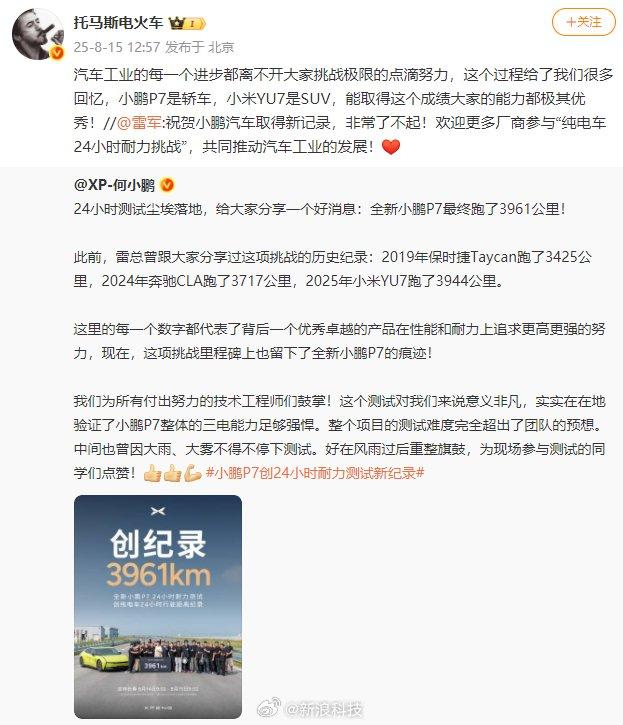
雷军祝贺小鹏汽车破纯电车耐力挑战纪录 超小米记录17公里
Feng Huang Wang· 2025-08-15 07:20
Core Insights - Xiaomi's founder Lei Jun congratulated Xpeng Motors for completing the "pure electric vehicle 24-hour endurance challenge" and achieving a new record, emphasizing the importance of collaboration in advancing the automotive industry [1] - Xpeng Motors' chairman He Xiaopeng announced that the new Xpeng P7 completed the challenge with a distance of 3961 kilometers, surpassing previous records set by other manufacturers [1][2] - The endurance challenge serves as a rigorous test of the vehicle's overall performance, including its powertrain, charging efficiency, durability, and reliability [2] Company Developments - Xiaomi's automotive division expressed its commitment to work alongside Xpeng Motors to enhance product quality through stringent standards [1] - The challenge was initiated by Lei Jun, who previously shared the historical achievements of other electric vehicles, highlighting the competitive landscape in the electric vehicle sector [2] - The testing faced significant challenges due to adverse weather conditions, but the team managed to adapt and successfully complete the test [1] Industry Context - The "pure electric vehicle 24-hour endurance challenge" is a significant benchmark in the electric vehicle industry, pushing manufacturers to demonstrate their vehicles' capabilities under extreme conditions [2] - The results of these endurance tests are crucial for establishing credibility and performance standards in the rapidly evolving electric vehicle market [2]
对标奔驰大G,宝马也要推旗舰硬派越野车
Feng Huang Wang Cai Jing· 2025-08-15 07:14
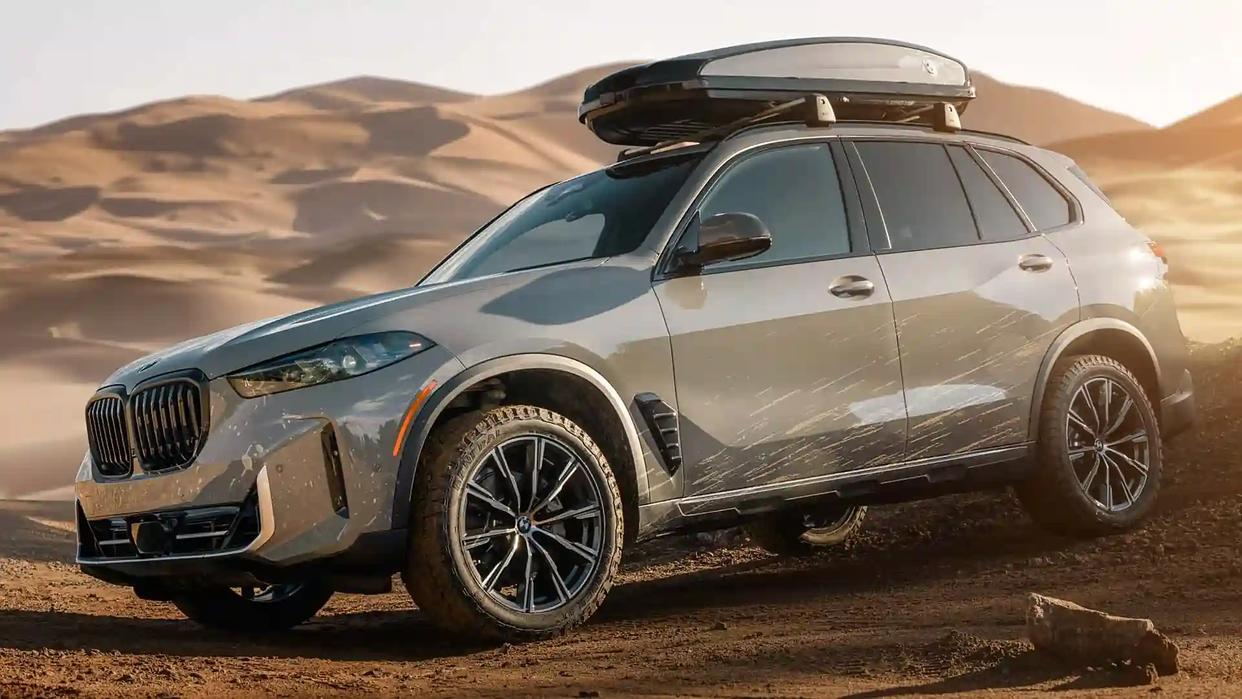
Core Insights - BMW is developing a rugged off-road SUV, codenamed G74, expected to enter production by 2030, targeting the Mercedes G-Class [1][3] - The G74 will be based on the upgraded BMW X5 platform and is planned to be produced at the South Carolina plant in the second half of 2029 [1][3] Group 1 - The G74 may replace the current flagship SUV, XM, which is focused on performance and road capabilities, while G74 will extend the flagship positioning into the off-road adventure segment [3] - The XM is currently produced in South Carolina and is expected to cease production in 2028 to make way for the G74 [3] - BMW recently launched the xOffroad package for the X5's "Silver Anniversary" edition, which includes off-road features, indicating a stronger off-road configuration for the G74 [3] Group 2 - Unlike the next-generation X5, which will develop both electric and fuel-powered versions, the G74 is expected to primarily focus on fuel power, with a possible hybrid system [3] - Sales of the electric G-Class are lagging behind the fuel version, with average sales times of 41 days for electric and 16 days for fuel [3] - If the reports are accurate, the G74 will be BMW's first rugged off-road vehicle aimed at the civilian market [3]
谁在坚持买油车?
Soochow Securities· 2025-08-15 02:43
Investment Rating - The industry investment rating is "Overweight," indicating an expected performance that is stronger than the benchmark by more than 5% over the next six months [35]. Core Insights - The report highlights that 26 car owners prefer gasoline vehicles due to several reasons, including high cost-performance ratio, concerns about electric vehicle (EV) battery replacement costs, lack of charging infrastructure, and perceived immaturity of EV technology [2][16]. - Nearly 50% of the surveyed owners do not have the conditions to install dedicated charging stations, which significantly influences their decision to stick with gasoline cars [2][16]. - The report also notes that while owners acknowledge the lower per-kilometer cost of EVs, this advantage diminishes for those who drive less than 10,000 kilometers annually [2][16]. Summary by Sections Section 1: Sample Size Introduction - The report is based on interviews with 26 car owners from seven major brands and 13 models, focusing on popular gasoline vehicles [6][7]. Section 2: Reasons for Not Choosing Electric Vehicles - The primary reason for not selecting EVs is the lack of charging infrastructure, with 42% citing this as a major concern [16][20]. - Other significant factors include skepticism about battery technology (15%) and anxiety over long-distance travel (12%) [20][23]. - The report indicates that the perception of EVs as less reliable and concerns over depreciation also play a role in the decision-making process [22][23]. Section 3: Future Considerations for Electric Vehicle Purchase - Many owners expressed that they would consider purchasing EVs if charging infrastructure improves or if they see more reliable performance from EVs in the future [24][25]. - The report categorizes potential future buyers into three groups based on their conditions for considering EVs, primarily focusing on charging solutions and vehicle quality [25].