奔驰

Search documents
亮证女司机被拘留
财联社· 2025-08-06 04:35
Core Viewpoint - The article discusses an administrative penalty decision issued by the Public Security Bureau of Fangchenggang City, Guangxi, against an individual named Hou for displaying an administrative law enforcement certificate during a dispute with another driver [2][4]. Summary by Sections Incident Description - On July 22, 2025, at approximately 17:45, the individual Hou was involved in a dispute with another driver, Li Tianming, while driving a black Mercedes SUV with license plate 桂A6874P. The incident occurred on a small road opposite the Xiongrao Restaurant in Jiangshan Town, Fangcheng District [2][8]. - During the argument, Hou retrieved an "administrative law enforcement certificate" from her vehicle and demanded the other driver to "show his certificate" [2][8]. Evidence - The facts of the case are supported by various pieces of evidence, including inquiry records, identification photos, arrest process documentation, and video screenshots [3]. Legal Basis and Penalty - According to Article 51 of the Public Security Administration Punishment Law of the People's Republic of China, Hou was sentenced to five days of administrative detention [4][8]. - The execution of the penalty will be carried out by the Jiangshan Border Police Station, with the detention period set from August 5, 2025, to August 10, 2025 [5][9]. Appeal Process - If the punished individual disagrees with the decision, she has the right to apply for an administrative review within sixty days or file an administrative lawsuit within six months [5][9].


高阶智驾免费风潮,汽车业未来靠什么挣钱
3 6 Ke· 2025-08-06 00:25
Group 1 - The automotive industry is facing challenges in monetizing software subscription models, with many companies unable to provide a clear timeline for profitability through this approach [1][2][3] - The emergence of a "free alliance" among domestic automakers, offering advanced driver assistance systems (ADAS) as standard features, has raised concerns about the sustainability of the software subscription model [1][8] - Bosch's call for not promoting high-level intelligent driving systems for free highlights the potential risks to the future profitability of the automotive sector [1][7] Group 2 - Global automakers initially viewed software subscriptions as a key revenue model, but the trend towards free offerings in China has led to a reevaluation of this strategy [2][5] - Companies like Tesla and Huawei remain committed to charging for software, with Tesla's Full Self-Driving (FSD) priced at 64,000 yuan, indicating a willingness to pay for advanced technology [2][13] - The competitive landscape has shifted, with many Chinese automakers adopting a model of embedding hardware and offering software for free, aiming to increase usage and data collection [9][10] Group 3 - The feasibility of subscription models is questioned due to consumer expectations for free access to intelligent driving features, making it difficult for companies to charge for software [3][12] - The hardware subscription model has seen limited success, with luxury brands experimenting but facing backlash from consumers who feel they should not pay extra for features already included in the vehicle [4][5] - The potential for a successful subscription model may depend on the development of higher-level autonomous driving technologies, which could change consumer willingness to pay [12][13] Group 4 - The automotive industry is experiencing a shift towards standardizing high-level intelligent driving systems, with many new models offering these features at no additional cost [8][9] - Companies are exploring various pricing strategies, including limited-time free access and one-time buyouts, to encourage adoption of intelligent driving technologies [9][10] - The long-term viability of subscription models remains uncertain, with industry experts suggesting that only a few companies may successfully implement them due to ongoing price competition [12][14]



嵘泰股份拟2.88亿元收购中山澳多51%股权 进入汽车电子领域
Zheng Quan Shi Bao Wang· 2025-08-05 13:50
Core Viewpoint - Rongtai Co., Ltd. plans to acquire 51% of Zhongshan Audo Electronic Technology Co., Ltd. for a total price of 288 million yuan, which will make Audo a subsidiary of Rongtai [1][2] Group 1: Acquisition Details - The acquisition price of 288 million yuan is based on an assessed market value of 569 million yuan for Audo, reflecting an increase of 38.5 million yuan in net asset value, with a growth rate of 210.04% compared to the parent company's net assets [2] - The acquisition is expected to create significant synergies as both companies operate in the automotive parts sector, with Rongtai leveraging its established customer relationships to expand Audo's client base [2] Group 2: Business Overview of Zhongshan Audo - Zhongshan Audo specializes in manufacturing automotive components, including smart electric pedals, electric struts, smart side door systems, and body domain controllers, with the smart electric pedal holding the largest market share in China [1] - Audo has established a strong client portfolio, including major domestic automakers such as Li Auto, Geely, and Chery, and is expanding its international presence with projects in North America and Malaysia [1] Group 3: Performance Commitments - Audo has committed to achieving a net profit of no less than 45 million yuan in 2025, 55 million yuan in 2026, and 60 million yuan in both 2027 and 2028, totaling a minimum net profit of 220 million yuan over four years [2]

450亿,又一汽车巨头被卖了
投中网· 2025-08-05 06:37
Core Viewpoint - The sale of Iveco marks the end of an era for a once-dominant commercial vehicle giant, highlighting the challenges faced by traditional automotive companies in the electric vehicle era [6][12][24]. Group 1: Company Overview - Iveco was sold for approximately €55 billion (around 452.9 billion yuan), with Tata Motors acquiring the remaining business for about €38 billion (approximately 313.1 billion yuan) [12][15]. - The acquisition will lead to the formation of a commercial vehicle group with an annual sales volume exceeding 540,000 units, positioning it as the seventh-largest commercial vehicle manufacturer globally [22]. Group 2: Market Dynamics - The decline of Iveco is attributed to its inability to compete on performance and comfort, as well as the rise of domestic competitors offering better value [8][21]. - The Chinese commercial vehicle market has seen significant growth, with heavy truck sales reaching approximately 539,160 units in the first half of 2025, reflecting a 6.9% year-on-year increase [20]. Group 3: Industry Trends - The transition to electric vehicles represents a "Darwinian moment" for traditional automakers, emphasizing the need for technological adaptation and strategic foresight [24]. - The automotive industry is witnessing a shift where technology and software integration are becoming critical, as exemplified by the partnerships between Chinese automakers and tech companies like Huawei [29][30]. Group 4: Historical Context - Iveco was established in the 1970s through the merger of five European automotive companies, quickly gaining prominence with its flagship model, the Daily, which became a top seller in Europe [16][17]. - The brand's historical significance in China is marked by its joint ventures, particularly in the light commercial vehicle sector, which has since lost its competitive edge [19][21]. Group 5: Future Outlook - The lessons from Iveco's decline serve as a warning and an opportunity for Chinese automakers to prioritize technological innovation and ecosystem development in the face of global automotive restructuring [24][32]. - The rapid evolution of the automotive landscape necessitates continuous innovation to avoid obsolescence, as seen in the struggles of established luxury brands transitioning to electric vehicles [25][26].

专论 || 方建华:发挥资本协同效能 驱动新能源汽车创新发展
Zhong Guo Qi Che Bao Wang· 2025-08-05 03:42
Core Insights - The rapid development of the new energy vehicle (NEV) industry is driving a transformation in production capacity and reshaping the global automotive industry landscape [1] - China's NEV industry has maintained its position as the world's largest producer and seller for ten consecutive years, with production and sales expected to reach 12.888 million and 12.866 million units in 2024, representing year-on-year growth of 34.4% and 35.5% respectively [1] Industry Transformation - The transition from "Made in China" to "Intelligent Manufacturing in China" signifies a significant shift in the industry [1] - The entry of tech giants like Huawei and Xiaomi is expected to deepen the ongoing transformation in the NEV sector [1] - The exit of Apple from the NEV market and the slowdown of German luxury brands (BBA) in electrification reflect a cautious adjustment to the new ecosystem led by "Intelligent Manufacturing in China" [1] Supply Chain Competitiveness - The integrity and scale of the supply chain are core competitive advantages for China's NEV industry in the global market [2] - Chinese companies have significantly reduced the cost of separator materials from 18 yuan/m² to between 0.4 and 0.9 yuan/m², showcasing breakthroughs in technology and production processes [2] - Leading companies like CATL and BYD dominate the global battery market, demonstrating strong vertical integration capabilities [2] Technological Advancements - The integration of autonomous driving and intelligent networking technologies is redefining vehicles as smart mobile terminals, leading to cost reductions [3] - The cost of lithium iron phosphate batteries has decreased from 2.2 yuan/Wh in 2014 to 0.42 yuan/Wh in 2024, while the price of BYD's Qin Plus DM-i is projected to drop from 130,000 yuan in 2022 to below 80,000 yuan by 2025 [3] - By the end of 2024, China is expected to have 12.818 million charging facilities, with a year-on-year increase of 49.1% [3] Industry Logic Restructuring - The NEV industry is transitioning from the "electrification" phase to the "intelligentization" phase, indicating a deep restructuring of industry logic [4] - The achievements of the electrification phase are attributed to policy guidance, market drive, innovation support, capital assistance, and industry collaboration [4] - The expected production and sales of over 15 million vehicles in the first half of 2025 mark a shift from growth to optimization in the industry [4] Global Expansion and Competition - The "going global" strategy for China's NEV industry is both a response to domestic market dynamics and a practice of the "dual circulation" strategy [5] - The imbalance between production capacity expansion and technological innovation efficiency highlights the competitive nature of the industry [5] - The stabilization of upstream material prices and the low operation of power batteries provide an adjustment window for industry upgrades [5] Carbon Neutrality Goals - The "dual carbon" goals are pivotal for the green revolution, with the NEV industry playing a crucial role in achieving these objectives [7] - In 2024, China's total carbon emissions are projected to be 12.6 billion tons, with the transportation sector contributing around 1 billion tons [7] - The anticipated global market share of electric vehicles is expected to exceed 40% by 2030, with China's share potentially reaching 80% [7] Capital Coordination Mechanisms - The transition to high-quality development necessitates a robust capital coordination mechanism to support the NEV industry's innovation [9] - Key mechanisms include activating venture capital, enhancing bank financing channels, and strengthening the capital market's role [9] - A collaborative mechanism involving venture capital, bank empowerment, and capital market support is essential for fostering technological innovation and industrial application [10]

轴向磁通电机在人形机器人领域的应用
2025-08-05 03:16
Summary of Axial Flux Motor Application in Humanoid Robots Industry Overview - The axial flux motor is increasingly being applied in the humanoid robot sector, offering significant advantages in space and weight savings, particularly in joints such as arms, lower limbs, and hips [1][2]. Key Points and Arguments - **Space and Weight Efficiency**: Axial flux motors can save 30%-60% in space and 30%-70% in weight compared to traditional radial flux motors, making them particularly suitable for humanoid robots [1][2]. - **High Torque and Power Output**: These motors excel in enhancing torque density and power density in humanoid robot joints, especially in high-torque areas like hips, waist, and shoulders [1][4]. - **Cost Considerations**: The current cost of axial flux motors is relatively high due to the use of heavy rare earth materials like dysprosium and tantalum, which increases costs by 10%-30% compared to traditional neodymium-iron-boron permanent magnets [1][5]. - **Emerging Startups**: Several startups are adopting the PPB configuration of axial flux motors, achieving a balance between performance, cost, and quality stability, with products suitable for both large and small joints [1][5]. - **Technological Barriers**: The design and manufacturing of axial flux motors face significant technical barriers, including the need for advanced materials and precision manufacturing processes [10]. Additional Important Insights - **PCB Stator Technology**: This technology offers advantages such as lightweight design and reduced iron loss but faces challenges like low magnetic saturation and poor heat dissipation [7]. - **Market Players**: Key global players include Yasa (acquired by Mercedes), Wireless, and others focusing on high-end products, while domestic leaders like Pangu Power and Xiang Elephant Electric are making strides in commercialization [3][8]. - **Future Cost Reduction**: The cost of axial flux motors is expected to decrease significantly with increased production volumes, with potential prices dropping to 300-500 RMB per unit for large-scale production [15]. - **Adoption in Humanoid Robots**: Current users of axial flux motors in humanoid robots include companies like Xiang Elephant, which prioritize performance stability and reliability in real-world applications [16]. - **Industrialization Timeline**: The large-scale industrialization of axial flux motors in the robot sector may take several more years, requiring further technological integration and support from complete machine manufacturers [17].

高阶智驾免费狂奔 “靠软件挣钱”无望?
Jing Ji Guan Cha Wang· 2025-08-05 03:04
Group 1 - The core viewpoint of the articles highlights the concern that free promotion of advanced driving assistance systems (ADAS) could undermine the profitability of the automotive industry, as emphasized by Bosch's president in China, Wu Yongqiao [2][7] - The trend of "free high-level intelligent driving" is gaining traction among domestic automakers, with companies like Chery, Leap Motor, BYD, and Xpeng announcing that their entire model ranges will be equipped with advanced ADAS, leading to over a hundred models being offered [2][8] - The expectation of profitability through software subscription models has become uncertain, with industry insiders stating that discussions on software subscription profitability are currently not feasible [2][5] Group 2 - International automakers are prioritizing "sustainable revenue" and have begun charging subscription fees for embedded hardware features, although this approach has faced backlash from domestic consumers [3][5] - Tesla and Huawei are strong proponents of software charging, with Tesla's Full Self-Driving (FSD) priced at 64,000 yuan, while Huawei has increased the price of its Qian Kun intelligent driving system by 2,000 yuan [3][12] - The consensus among industry experts is that the realization of a paid subscription model is more challenging than anticipated due to intense price competition and consumer expectations for free features [3][11] Group 3 - The feasibility of hardware subscription models has diminished significantly, with luxury brands still experimenting with them despite low consumer uptake [4][5] - BMW and Mercedes-Benz have faced criticism for charging fees for features that are standard in many domestic vehicles, leading to adjustments in their subscription strategies [4][5] - The trend of free high-level intelligent driving features is seen as a way to build consumer habits and dependencies, but there is skepticism about the potential for high subscription rates post-free periods [9][10] Group 4 - The articles suggest that the subscription model for software may be collapsing, with experts indicating that a successful implementation would require overcoming fierce competition and establishing significant technological barriers [11][12] - The potential for consumers to pay for advanced driving technologies may increase with the advent of Level 3 autonomous driving, but achieving a consensus among automakers on subscription models remains challenging [11][12] - The automotive industry is experiencing a shift where hardware upgrades are seen as the foundation for profitability, with companies like Horizon predicting a profitability turning point by 2027 [12][13]
继车规级纸巾盒后雷军发布小米汽车新周边 169元雨伞争议中售罄
Sou Hu Cai Jing· 2025-08-05 01:32
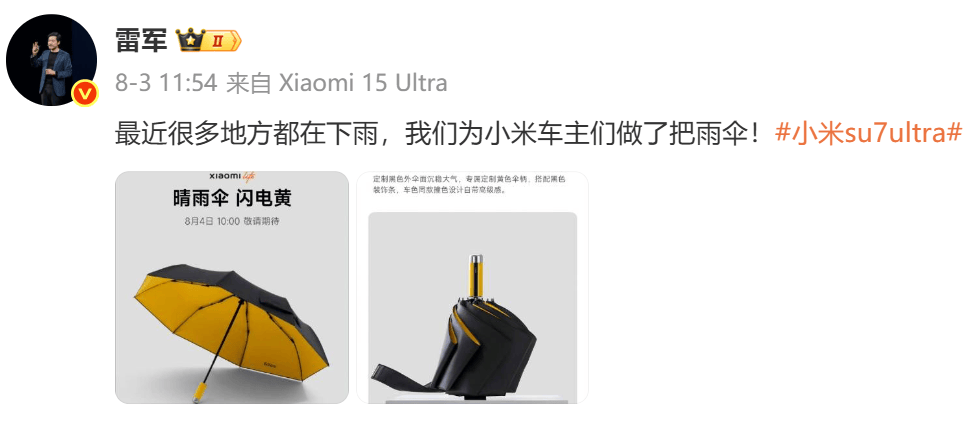
凤凰网科技讯 8月5日,小米商城信息显示,雷军于8月4日刚刚发售的小米SU7 Ultra同款配色晴雨伞已宣告售罄。这款专为小米车主打造的周边产品,在短 时间内便迎来热销,同时也因定价引发网友热议。 据悉,雷军8月4日在社交媒体平台公布这款雨伞时表示:"最近很多地方都在下雨,我们为小米车主们做了把雨伞!" 官方定价169元的消息一出,迅速引发 网友关注与讨论。 不少网友对这一价格提出质疑,认为售价偏高; 还有网友调侃式提问 "是自研吗?不是自研我不支持"。 尽管伴随价格争议,小米晴雨伞上架后仍迅速售罄。 据悉,今年7月,小米曾推出一款售价169元的磁吸车载纸巾盒,同样因价格引发热议并登上微博热搜,但次日便售罄。 更有网友模仿"雷军风格",将其称为"车规级晴雨伞",为这场讨论增添了几分趣味。 【免责声明】本文仅代表作者本人观点,与和讯网无关。和讯网站对文中陈述、观点判断保持中立,不对所包含内容的准确性、可靠性或完整性提供任何明 示或暗示的保证。请读者仅作参考,并请自行承担全部责任。邮箱:news_center@staff.hexun.com 对比其他汽车品牌,问界折叠伞售价228元,奔驰迎宾雨伞售价513元。 ...
OpenAI 官宣周活 7 亿;特斯拉宣布马斯克获授价值 290 亿美元股票;苹果脑控技术首次现场演示 | 极客早知道
Sou Hu Cai Jing· 2025-08-05 01:03
Group 1: OpenAI and ChatGPT - OpenAI announced that ChatGPT's weekly active users will reach 700 million, a year-on-year increase of over four times [1] - The number of paid commercial users has rapidly increased from 3 million in June to 5 million, indicating a significant acceleration in commercialization [1] - Daily user message volume has surpassed 3 billion, reflecting a growth rate that is accelerating compared to a year-on-year increase of 2.5 times [1] - OpenAI's VP Nick Turley hinted at an important week ahead, likely signaling the upcoming release of GPT-5, which is expected to include integrated reasoning and performance enhancements [1] Group 2: Tesla - Tesla approved the grant of 96 million shares of restricted stock to CEO Elon Musk, valued at approximately $29 billion, to retain his leadership [2][3] - The shareholder letter emphasized the importance of retaining Musk, stating that Tesla is at a critical turning point with the potential for sustained extraordinary value creation [3] Group 3: Apple - Apple is reportedly developing a large foldable device, potentially a MacBook/iPad hybrid, with an 18.8-inch display, but its release has been delayed to after 2027 [5][6] - The device may run on macOS or iPadOS, with further details yet to be disclosed [6] Group 4: Google - Google has signed agreements with two U.S. power companies to reduce electricity consumption at its AI data centers during peak demand periods to alleviate pressure on the power grid [7][8] Group 5: E-commerce and Retail - Taobao's flash sales reported a significant increase in non-food small store revenues, with over 100,000 stores seeing month-on-month revenue growth exceeding 100% [8] - The number of "ten-thousand order stores" in the restaurant sector increased by 274% compared to June, indicating a strong recovery in the market [8] Group 6: Automotive Industry - Neta Auto's factory in Tongxiang has resumed full operations, with employees receiving full salaries in July, indicating a recovery from previous wage cuts [10] - "Hotpot first stock" Xiaobai Xiaobai reported cumulative losses exceeding 1.3 billion yuan over five years, with ongoing challenges in the competitive market [11] Group 7: Mercedes-Benz - Mercedes-Benz announced a new design language for its electric vehicles, with the first model to showcase this style being the electric GLC, set to debut at the Munich Auto Show [12][13] Group 8: Technology and Innovation - Apple demonstrated brain-control technology allowing ALS patients to operate an iPad using only their thoughts, showcasing advancements in assistive technology [17]


BBA集体失守中国市场
2 1 Shi Ji Jing Ji Bao Dao· 2025-08-04 23:13
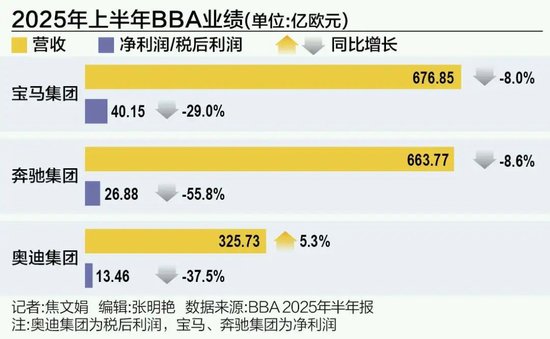
Core Viewpoint - The traditional luxury car giants BBA (BMW, Mercedes-Benz, Audi) are facing significant growth challenges, with declining revenues and profits, particularly in the Chinese market, indicating a critical phase in their transformation efforts [1][2][4]. Financial Performance - In the first half of 2025, BBA's financial results showed a mixed performance: BMW led with €67.685 billion in revenue, down 8% year-on-year; Mercedes-Benz followed with €66.377 billion, experiencing the largest revenue drop of 8.6% and a net profit decline of over 50%; Audi was the only brand with revenue growth, reaching €32.573 billion, but its net profit was only €13.46 billion, one-third of BMW's [2][4][5]. - The overall net profit for Mercedes-Benz fell by 55.8% to €2.688 billion, while BMW's net profit decreased by 29% to €4.015 billion, and Audi's net profit dropped by 37.5% [7][8]. Market Challenges - BBA collectively struggled in the Chinese market, with delivery volumes declining by 15.5% for BMW, 14.2% for Mercedes-Benz, and 10.3% for Audi [4][6]. - The entry-level models of BBA are facing intense competition from domestic brands, leading to significant sales declines in the mid-range price segment [7][8]. Electric Vehicle Transition - The shift towards electric vehicles (EVs) is critical for BBA, with distinct strategies emerging: BMW is leading in EV sales, with 220,600 units sold in the first half of 2025, a 15.7% increase; Audi's EV sales grew by 32.3%, while Mercedes-Benz's EV sales fell by 14% to 87,300 units [9][12][13]. - Audi is cautiously pursuing electrification, planning to launch new internal combustion and hybrid models between 2024 and 2026, while BMW is focused on its new generation platform to boost EV sales [12][13][14]. Strategic Adjustments - BBA is adjusting its electrification goals, with Mercedes-Benz postponing its target for full electrification to 2030, aiming for a maximum of 50% of new models to be electric or hybrid by that year [14][15]. - The competitive landscape is shifting, with BBA needing to enhance their smart technology capabilities alongside their electrification efforts to regain their former market dominance [15].