
三星

Search documents
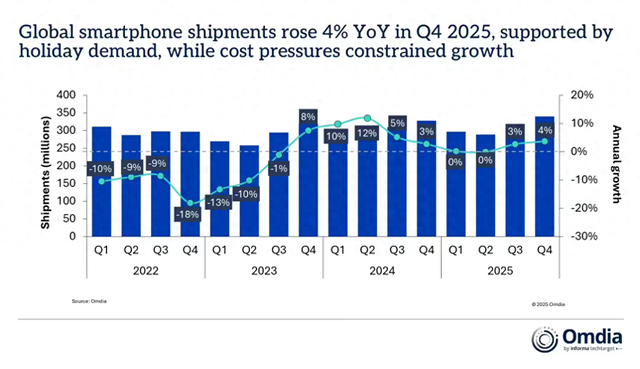
Omdia 报告:2025Q4 全球手机出货量出炉,苹果、三星、小米稳居前三
Huan Qiu Wang· 2026-01-15 07:17
【环球网科技综合报道】1月15日消息,市场调查机构 Omdia 发布报告显示,2025 年全球智能手机出货 量达 12.5 亿台,同比增长 2%,呈现 "前低后高" 的复苏态势。其中第四季度表现尤为亮眼,全球出货 量同比增长 4%,苹果、三星、小米等头部品牌格局稳定,行业在结构调整中迈向高质量发展。 在 2025 年第四季度全球智能手机市场份额排名中,苹果以 25% 的占比创下该季度历史新高,凭借 iPhone 17 系列的强劲需求及旧款机型的持续热销,连续第三年蝉联年度全球销量冠军。具体来看,基 础款 iPhone 17 采用 "存储升级不加价" 的亲民策略,销量超出市场预期;主打超薄设计的 iPhone Air 则 进一步提升了高端产品线的市场吸引力,成为苹果业绩增长的重要支撑。Omdia 首席分析师 Sanyam Chaurasia 表示,产品矩阵的精准布局的用户需求的深度契合,推动苹果实现了出货量的历史性突破。 来源:环球网 安卓阵营中,三星以 18% 的市场份额位居第四季度第二,其增长动力主要来自 300 美元以下的中低端 市场,Galaxy A17 系列的 4G 和 5G 机型凭借高性价比深受消费 ...



全球 AI 的咽喉:为何台积电的产能跟不上世界的野心?
Hua Er Jie Jian Wen· 2026-01-15 06:33
Core Insights - The global AI arms race is hitting a physical wall due to TSMC's production capacity constraints, leading to a significant supply-demand gap in the semiconductor industry [1] - Major tech companies like NVIDIA and Google are struggling to secure sufficient chip supply from TSMC, which is currently unable to meet the surging demand [2] - TSMC's production lines are under pressure from both AI chip demand and traditional client orders, complicating capacity allocation [3] Group 1: Demand Surge and Allocation Challenges - TSMC is facing a difficult balancing act between maintaining stability for existing clients and addressing the unpredictable demand from the AI sector [3] - The demand for chips is driven by multiple factors, including OpenAI's plans for super data centers and Google's aggressive procurement of NVIDIA GPUs [3] - TSMC adheres to strict annual schedules for capacity and pricing negotiations, limiting flexibility for clients to adjust orders based on market conditions [3] Group 2: Expansion Plans and Limitations - TSMC is adjusting its global footprint to address capacity shortages, including shifting a new factory in Japan to produce advanced 2nm chips, expected to be completed by 2027 [4] - The company is accelerating the construction of a second factory in Arizona, aiming to start 3nm chip production a year earlier than planned in 2027 [4] - Current expansion efforts will not resolve immediate capacity issues, as TSMC is primarily redesigning existing factory space to accommodate new production lines [4] Group 3: Investment Caution Amid Cyclical Nature - Despite the booming AI demand, TSMC is cautious about committing to new factory constructions due to the cyclical nature of the semiconductor industry [6] - Building a cutting-edge fab costs billions and takes years, while demand can fluctuate rapidly, as seen during the pandemic [6] - TSMC's pure foundry model limits its investment flexibility, as it relies entirely on customer orders and faces risks of idle capacity if clients cancel orders [6] Group 4: Packaging Bottlenecks - Advanced packaging has emerged as another critical bottleneck, essential for high-end AI chips [7] - TSMC has reallocated some older chip production capacity to advanced packaging, but the complexity of the process remains a challenge [7] - NVIDIA has previously faced packaging capacity shortages, leading to difficulties for other clients like Google when trying to increase their orders [7]



2026科技风向标:八大趋势重塑产业与生活
2 1 Shi Ji Jing Ji Bao Dao· 2026-01-15 06:05
Core Insights - The rapid iteration of technology is expected to lead to significant breakthroughs in key areas such as artificial intelligence, quantum computing, fusion energy, and aerospace engineering by 2025, reshaping the global technology landscape and intensifying competition between China and the United States [1] Group 1: Major Technological Events in 2025 - DeepSeek emerged as a leading open-source AI model, significantly improving GPU utilization and reducing model costs, thus enabling a new wave of AI efficiency and innovation in China [2] - The commercial space industry accelerated, with SpaceX's Starship achieving a complete flight cycle and China's satellite internet constellations addressing the "arrow without a star" issue, leading to explosive growth in launch capacity [3][4] - Humanoid robots made a significant appearance at the Spring Festival Gala, showcasing advancements in AI-driven robotics and marking a transition from research to practical applications [5] - The storage chip industry entered a "super cycle" as major companies shifted production towards AI-related storage solutions, leading to price increases across various hardware sectors [6] - China's "artificial sun" achieved a record of 1 billion degrees Celsius for over 1,000 seconds, marking a milestone in controlled nuclear fusion research [7] - The competition in quantum computing intensified, with significant advancements from both China and Google, indicating a shift towards practical applications in various fields [8] Group 2: Trends for 2026 - AI agents are predicted to mature, enabling collaborative intelligence that could revolutionize user interfaces and operational efficiency for small businesses [12] - AI technology is expected to transition from cloud-based systems to physical devices, with AI PCs and glasses becoming standard, enhancing user experience even in low-connectivity scenarios [13] - The commercial viability of Level 3 autonomous driving is anticipated to grow, with more cities implementing pilot programs and new business models emerging [14][15] - Quantum computing is nearing a practical breakthrough, with advancements in hardware and software expected to demonstrate "quantum advantage" in real-world applications [16] - The demand for computational power is driving upgrades in the energy sector, with tech companies investing in stable energy sources to support AI data centers [17] - Brain-computer interface technology is transitioning from experimental phases to commercial applications, with significant investments and developments expected in the coming years [18] - The commercial space sector is expected to mature, with established revenue streams and reduced launch costs through reusable rocket technologies [19][20] - The low-altitude economy is gaining traction, with multiple companies expanding into international markets and significant growth projected in the eVTOL sector [21]
三星关闭8寸晶圆代工厂!
国芯网· 2026-01-15 04:36
Group 1 - Samsung is accelerating the adjustment of its foundry production line structure, planning to close an 8-inch wafer foundry by the end of the year to focus resources on more profitable 12-inch lines [2][4] - The closure of the S7 8-inch wafer factory will reduce Samsung's monthly production capacity from 250,000 wafers to below 200,000 wafers, with customer orders already being transferred [4] - The overall operating rate of Samsung's 8-inch wafer factories is approximately 70%, and the operational cost pressure is increasing as core products are gradually shifted to 12-inch lines [4] Group 2 - TrendForce predicts a 2.4% year-on-year decline in global 8-inch wafer foundry capacity this year, with TSMC also reducing related capacity since last year [4] - Despite the capacity reduction, market demand remains strong, particularly for power management chips driven by AI servers, keeping the average operating rate of 8-inch wafer factories high [4] - TrendForce expects the operating rate of global 8-inch wafer factories to rise to between 85% and 90% this year, with some foundries preparing to increase prices by 5% to 20% [4] Group 3 - DB Hitek, a local foundry in South Korea, is seen as a potential beneficiary of the situation, currently operating at full capacity with a backlog of orders and unable to accept new ones [5] - DB Hitek specializes in BCD and other analog processes, capable of small-batch production of power management chips and display driver chips [5]

手机市场混战下的新变数:规模与利润之间的博弈,华为、苹果成最大赢家
Tai Mei Ti A P P· 2026-01-15 03:57
Group 1 - In 2025, global smartphone shipments reached 1.26 billion units, marking a 1.9% year-over-year growth, while the Chinese market saw a decline of 0.6% with shipments of approximately 285 million units [2][9][10] - Apple and Samsung maintained their leadership in the high-end market, with Apple achieving a market share of 19.7% and Samsung at 19.1%, both showing significant year-over-year growth [6][7] - Huawei regained the top position in the Chinese market with a market share of 16.4%, despite a slight decline in shipments compared to 2024 [9][10] Group 2 - Apple's iPhone 17 series significantly boosted its performance, leading to a record-breaking market share in China, with a 21.5% year-over-year increase in Q4 shipments [5][6] - Samsung achieved a remarkable 7.9% growth in 2025, the highest among the top five brands, driven by the popularity of its Galaxy A series [7][8] - The smartphone market is expected to face challenges in 2026 due to rising storage costs and changing consumer demands, with predictions of a potential decline in shipments [12][14] Group 3 - The competitive landscape is shifting towards high-end products, with brands focusing on premium offerings to counteract market pressures [16][17] - Xiaomi experienced a mixed performance, benefiting from government subsidies but facing significant declines in Q4, highlighting the volatility in the market [11] - The ongoing shortage of storage chips is anticipated to impact production costs and pricing strategies, leading to adjustments in product specifications and offerings [13][14]

今年最快千亿独角兽诞生
3 6 Ke· 2026-01-15 03:05
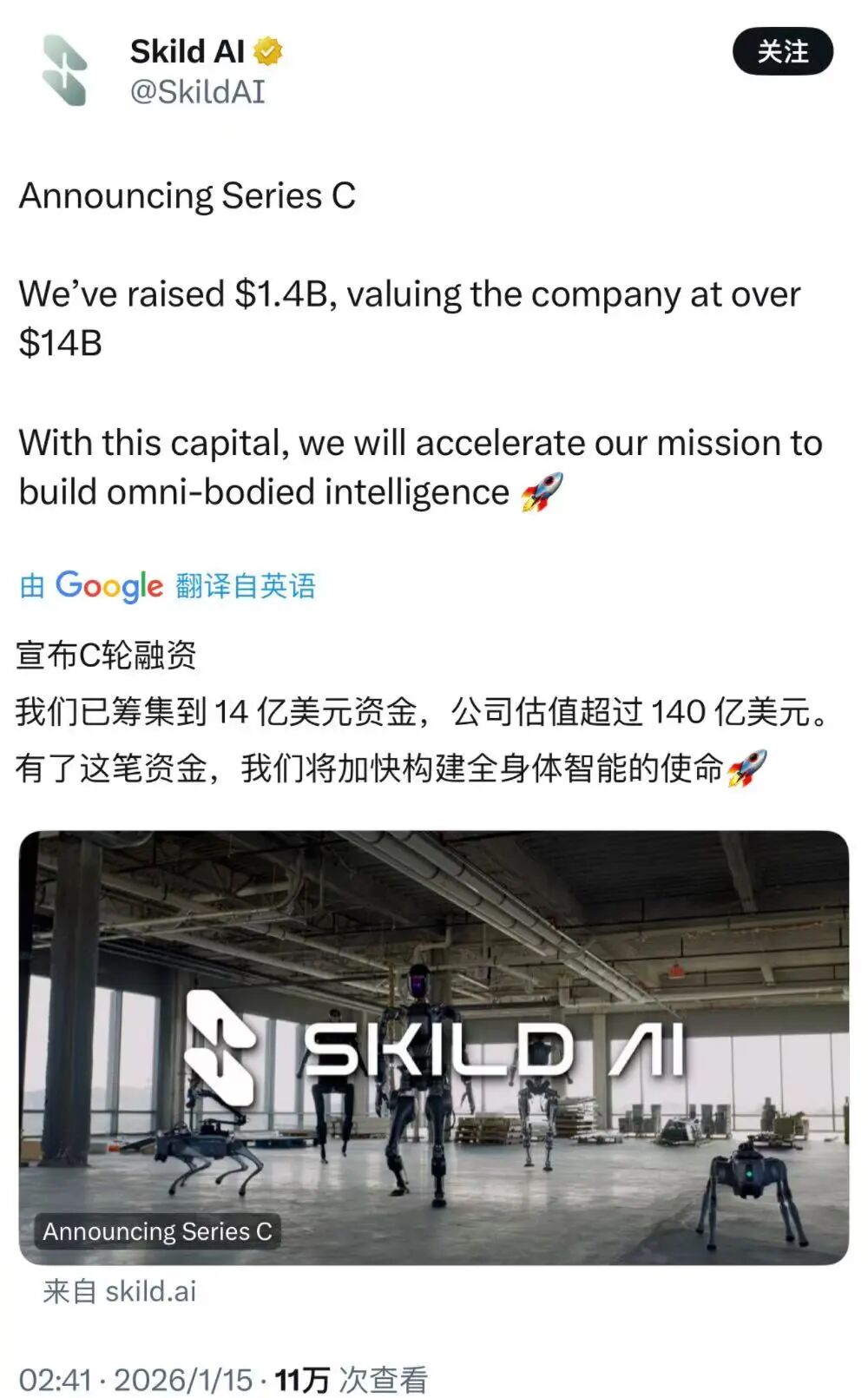
Core Insights - Skild AI, a US robotics startup, has completed a C round financing of approximately $1.4 billion, raising its valuation to over $14 billion, which is three times its valuation from seven months ago [1][3] Financing and Investment - The financing round was led by SoftBank, with participation from Nvidia, Macquarie, 1789 Capital, Bezos Expeditions, and companies like Samsung, LG, and Salesforce [3] - Since its establishment in May 2023, Skild AI has raised a total of around $2 billion [3] Company Vision and Technology - Skild AI aims to create a "general robotic brain" that allows robots to learn tasks through video observation and practical experience, similar to human learning [3][4] - The founders, Deepak Pathak and Abhinav Gupta, previously worked at Meta's robotics lab and are focused on overcoming the limitations of current robotic systems [4][6] - The Skild Brain system utilizes large-scale human video and simulation training to optimize control strategies, integrating internal sensory data with external visual signals for robust task execution [6] Market Potential and Applications - Skild Brain is adaptable to various robotic forms, including quadrupeds, robotic arms, and humanoid robots, and can operate in complex environments such as homes, warehouses, hospitals, and construction sites [7] - By 2025, Skild AI aims to serve over eight clients, with revenue projected to grow from zero to several tens of millions of dollars [10] Industry Trends and Competitive Landscape - The high valuation and significant funding for Skild AI reflect a shift in investment strategies among tech giants, moving towards early-stage investments rather than heavy asset acquisitions [11] - Competitors in the robotics AI space, such as Physical Intelligence, are also experiencing rapid growth, indicating a competitive landscape with similar challenges [12] Conclusion - The race for developing a general robotic brain is intensifying, with major tech companies accelerating their investments in the robotics sector, signaling a collective push towards scalable deployment of robotic systems [13]
信达国际控股港股晨报-20260115
Xin Da Guo Ji Kong Gu· 2026-01-15 02:01
Market Overview - The Hang Seng Index (HSI) faces short-term resistance at 27,188 points, with expectations of two interest rate cuts in 2026 following the Federal Reserve's December decision to lower rates by 0.25% [2] - The market anticipates increased monetary policy support from mainland China in early 2026, focusing on expanding domestic demand and achieving technological self-reliance [2] - Recent adjustments in financing margin requirements by the Shanghai, Shenzhen, and Beijing stock exchanges may lead to short-term market corrections due to reduced leverage [2] Macro Focus - China's December trade data exceeded expectations, with exports rising by 6.6% and imports by 5.7%, resulting in a trade surplus of 114.14 billion USD [9] - The Chinese Ministry of Industry and Information Technology is regulating industry competition to resist disorderly price wars, particularly in the electric vehicle sector [9] - The Chinese government has extended tax refund policies for home purchases to stimulate the housing market, effective from January 1, 2026, to December 31, 2027 [9] Company News - Baidu is reportedly considering upgrading its Hong Kong listing status to primary listing to attract more mainland investors [11] - Alibaba's AI assistant, Qianwen, is set to release a significant product iteration, with its monthly active users surpassing 100 million [11] - Eastroc Beverage has passed the listing hearing for its IPO in Hong Kong, aiming to enhance its production capacity and brand presence [11] - Kuaishou plans to raise approximately 2 billion USD through its first offshore bond issuance [11] - Trip.com Group is under investigation for alleged monopolistic practices related to its pricing tools affecting hotel partners [11]


三星将关闭8英寸晶圆代工厂
半导体行业观察· 2026-01-15 01:38
Group 1 - Samsung plans to close one of its 8-inch wafer fabs by the end of the year to focus on more profitable 12-inch fabs, reflecting a global trend in the semiconductor industry [1] - The S7 fab, which has a monthly capacity of 50,000 wafers, will be shut down, reducing Samsung's total monthly capacity for 8-inch wafers from 250,000 to below 200,000 [1] - The current utilization rate of Samsung's 8-inch wafer fabs is approximately 70%, with the company shifting its focus to 12-inch fabs for key products [1] Group 2 - TrendForce predicts a 2.4% decline in global 8-inch wafer fab capacity this year, with TSMC also reducing its capacity and some fabs expected to close next year [2] - Despite the supply decrease, demand remains strong, particularly for power management ICs used in AI servers, leading to stable utilization rates of 85% to 90% for 8-inch fabs this year [2] - DB Hitek, a South Korean foundry, is expected to benefit from Samsung's capacity cuts, as it currently operates at full capacity and has a backlog of orders [2] Group 3 - Competitors of DB Hitek in the 8-inch wafer foundry space include Vanguard International Semiconductor, United Microelectronics Corporation, SMIC, and Tower Semiconductor, with SMIC offering competitive pricing and increasing order volumes [3] - Key Foundry has a lower utilization rate of 90% and is considered to have lower profitability compared to its competitors [3]
带宽战争前夜,“中国版Groq”浮出水面
半导体行业观察· 2026-01-15 01:38
Core Viewpoint - NVIDIA is transitioning from a "computing powerhouse" to a "king of inference" by acquiring Groq's core technology for $20 billion, aiming to dominate the AI inference market [2][6]. Group 1: NVIDIA's Strategy and Market Position - NVIDIA has established a strong technical barrier in AI training with its GPU architectures like Hopper and Blackwell, but faces challenges in low-batch, high-frequency inference tasks due to traditional GPU latency issues [1]. - The acquisition of Groq's technology signifies NVIDIA's intent to enhance its capabilities in AI inference, particularly by integrating Groq's Language Processing Unit (LPU) into its upcoming Feynman architecture GPU [2][4]. - The competition in the AI industry is shifting from pure computing power to maximizing bandwidth per unit area, aligning with NVIDIA's findings that a significant portion of inference latency stems from data movement [4]. Group 2: Emergence of Domestic Competitors - In the Chinese market, the AI wave has led to the rise of domestic AI chip companies, with ICY Technology (寒序科技) being highlighted as a potential "Chinese version of Groq" due to its focus on ultra-high bandwidth inference chips [6][7]. - ICY Technology has been developing a 0.1TB/mm²/s bandwidth streaming inference chip, directly competing with Groq's technology [7]. - The company employs a dual-line strategy, focusing on both magnetic probabilistic computing chips and high-bandwidth magnetic logic chips aimed at accelerating large model inference [7][9]. Group 3: Technical Innovations and Advantages - ICY Technology's choice of on-chip MRAM (Magnetic Random Access Memory) over traditional DRAM or SRAM solutions is seen as a more innovative and sustainable approach, addressing the limitations of existing technologies [9][11]. - The MRAM technology offers significant advantages, including higher storage density and lower costs, making it a viable alternative to SRAM and HBM in AI applications [11][20]. - The SpinPU-E chip architecture aims to achieve a bandwidth density of 0.1-0.3TB/mm²·s, significantly outperforming NVIDIA's H100 [12]. Group 4: Industry Trends and Future Outlook - The global MRAM market is projected to grow from $4.22 billion in 2024 to approximately $84.77 billion by 2034, with a compound annual growth rate of 34.99% [30]. - The strategic importance of MRAM is heightened by geopolitical factors and the need for supply chain independence, positioning it as a critical technology for China's semiconductor industry [21][22]. - The industry is witnessing a shift towards MRAM as a mainstream solution, with major semiconductor companies actively investing in its development [23][26].

1000 个 CFET、SK 海力士次世代 NAND、超越铜的互连技术、二维材料及其他进展 --- 1,000 CFETs, SK Hynix Next-Gen NAND, Interconnects Beyond Copper, 2D Materials, and More
2026-01-15 01:06
Summary of Key Points from the Conference Call Industry Overview - The semiconductor industry is experiencing a unique phase characterized by a significant supercycle, with high demand for advanced logic, DRAM, and NAND products. Chipmakers are struggling to expand capacity quickly enough, and there may soon be limitations due to fab equipment supply [1][2] - Despite the booming demand, technological advancements in scaling, power consumption, and chip costs have slowed considerably, leading to a perception that Moore's Law has become a "Moore's Wall" [1][2] Innovations and Developments - The semiconductor industry has a history of overcoming skepticism, with promising innovations on the horizon for the next decade [3][4] - Memory prices are surging, making 3D NAND technology relevant again. The report discusses SK Hynix's latest V9 NAND technology and Samsung's improvements using molybdenum (Mo) [5][6] NAND Technology Insights - NAND scaling is critical due to rising demand and limited cleanroom space for capacity expansion. Memory producers are constrained to upgrading existing lines, with leading fabs utilizing a 3xx-layer 3D NAND process yielding approximately 20-30 Gb/mm² of memory, equating to over 30 TB on a single 12" wafer [8] - SK Hynix's 321-layer process offers 44% more memory per wafer compared to the previous 238-layer technology, making upgrades a clear choice for manufacturers facing cleanroom space constraints [10] Scaling Methods - Four main avenues for scaling NAND storage capacity per wafer include logical scaling, vertical scaling, lateral scaling, and architecture scaling [11][12][13] - Vertical scaling is currently the most cost-effective method, with NAND layer counts increasing rapidly [19][20] Challenges in Manufacturing - Increasing the number of layers per deck presents significant challenges, with Hynix reporting a 30% increase in overall process steps and a 20% increase in etch steps from V8 to V9, while layer counts increased by nearly 35% [28] - The complexity of manufacturing processes increases with the number of layers, and achieving high yields in production remains a challenge [27][55] Competitive Landscape - Hynix's 321L V9 product faces commercial challenges, as its density of 21 Gb/mm² is comparable to Micron's 276L G9, which achieves similar density with fewer decks, resulting in lower costs [33][34] - Samsung's upcoming 332L BiCS10 technology is expected to outperform Hynix's offerings, achieving densities of 29 Gb/mm² for TLC and over 37 Gb/mm² for QLC [34] Next-Gen Interconnects - As semiconductor nodes scale below 10 nm, traditional copper interconnects face critical bottlenecks, prompting the exploration of ruthenium (Ru) as a superior alternative [59] - Samsung's introduction of Grain Orientation Engineering through Ru Atomic Layer Deposition (ALD) has shown promising results, achieving a 46% reduction in resistance for ultra-fine interconnects [60][61] Conclusion - The semiconductor industry is at a crossroads, balancing unprecedented demand with technological challenges. Innovations in NAND technology and interconnect materials are crucial for maintaining competitive advantages and meeting future market needs.