台达

Search documents
威尔高20250911
2025-09-11 14:33
Summary of Weigao Conference Call Company Overview - Weigao focuses on AI server power supply business, with 80% of products used for AI servers [2][3] - The company is currently engaged in small batch delivery certification for secondary power supplies, expecting large orders by year-end [2][3] - The GB300 series has seen a significant increase in shipment volume since September 15 [2][7] Key Points Industry and Market Position - Weigao's production capacity structure consists of 60% for back copper plates and power boards, expected to reach 65% by mid-2024 [2][5] - Display products account for approximately 20% of the capacity, with automotive electronics (mainly BYD) contributing about 8-10% [2][5] - The company produces optical modules with specifications up to 800G, without involvement in 1.6T products [2][6] Financial Performance and Projections - For 2025, Weigao anticipates revenue of approximately 1.6 billion yuan, with a target of over 2.5 billion yuan for 2026 [4][19] - The company expects a profit margin contribution of 8-10% from Thai operations in the second half of 2025, reaching a normal level of 10% by year-end [3][19] - Third-quarter performance met expectations, with increased shipments of GB300 products [20] Product Development and Upgrades - Weigao is upgrading power supplies from 5.5kW to 8kW, increasing the number of modules in GB200 and GB300 models to eight [4][11] - The Ruby project will implement HDR technology for 8kW power supplies starting in 2026, enhancing integration and value [12][8] - The company is collaborating with Delta to develop new samples and high-voltage direct current solutions [9][8] Customer Relationships and Collaborations - Weigao has a strong cooperative intention with Micromet's Thai factory but has not yet collaborated on NV products [15] - There is no current procurement or collaboration with BYD Electronics regarding NV-related products [15] Supply Chain and Capacity Expansion - The Thai production capacity expansion to 100,000 square meters is underway, with equipment expected to arrive by year-end [3][18] - The company is actively discussing the timing of capacity startup for 2025 or 2026 to ensure smooth supply [18] Challenges and Market Conditions - The company faced supply chain issues in the second quarter but has since recovered, with third-quarter performance normalizing [20] - Long-term projections for orders from Delta indicate significant growth, prompting Weigao to prepare sufficient capacity [17] Additional Insights - The optical communication sector has low order volumes, contributing minimally to revenue [5] - The company is in the design phase for HVDC-related products, with ongoing collaboration with Delta for product upgrades [14]
关注AIDC电源技术迭代驱动增量需求
2025-09-11 14:33
Summary of Conference Call Notes Industry Overview - The AIDC (Artificial Intelligence Data Center) power supply system is transitioning to 800V HVDC, with solid-state transformers (SST) expected to become the final solution in the next 3-5 years [1][4] - Domestic companies like Shenghong Co. and Jinpan Technology are anticipated to leverage their technological advantages and existing overseas channels to penetrate the global supply chain [1][4] - The global capital expenditure growth is projected to exceed 50% in 2025, driving the adoption of HVDC over traditional UPS systems and SST over traditional HVDC+BRT [1][7] Key Trends and Developments - The application of green electricity in AIGC has significant potential, which may enhance its market space and impact power quality [1][6] - The UPS market is characterized by regional strengths and a fragmented competitive landscape, with the top three manufacturers holding about 40% market share, while the top three HVDC manufacturers currently dominate with approximately 90% market share, expected to decline to 60-70% [1][16][17] - The increasing power density in server power supplies is a clear trend, with domestic manufacturers like Oton and Meritec beginning to enter overseas supply chains [2][5][19] Market Dynamics - Domestic manufacturers have not yet fully penetrated the downstream market in onboard power supplies but are actively participating in the first-level UPS and second-level floating power supply segments [3] - The overseas market has been slow to adopt HVDC technology due to the stability of UPS systems and a lack of significant power increases in the industry [10] - However, the integration of renewable energy and the increase in cabinet power to over 200 kW are accelerating the introduction of HVDC technology in overseas markets [10][11] Technological Innovations - Delta's 800V HVDC solution utilizes a combination of HVDC modules, supercapacitors, and BPU to achieve direct current reduction within IT racks, facilitating the transition from 800V to a 50V system for data center servers [12][13] - SST is expected to see product rollout in 3-5 years, with decreasing semiconductor costs making it more competitive with traditional transformers [14] - The acceptance of SST technology is anticipated to be higher than current market perceptions due to its integration of traditional transformers with SSD and HVDC [14] Competitive Landscape - The competition in the UPS market is fragmented, while the HVDC market is more concentrated, with a significant share held by major internet companies [16][17] - The potential for HVDC technology in overseas markets is increasing, particularly as power requirements rise and existing supply systems approach their limits [11][18] Future Outlook - The market for second-level server power supplies is expected to continue growing, driven by increasing GPU and server power demands [18][19] - The development of power quality equipment is crucial for addressing harmonics and reactive power issues in data centers, with leading companies like Shenghong Co. expected to maintain their market share [20] - Chinese manufacturers are well-positioned to expand overseas, with a focus on first-level power supply innovations like 800V HVDC and SST [21][22]
GB200 GB300液冷价值量拆解
傅里叶的猫· 2025-09-07 13:16
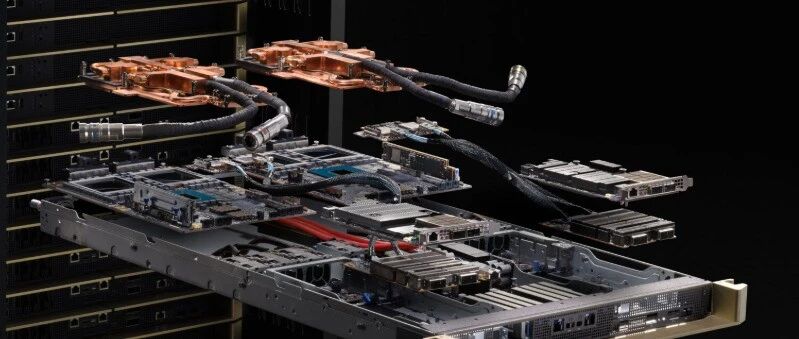
Core Viewpoint - The article focuses on the delivery and value breakdown of liquid cooling systems in NVIDIA's GB200 and GB300 server racks, highlighting the differences in design and component value between the two models [2]. Liquid Cooling Server Rack Components - The liquid cooling server rack includes several key components such as manifolds, cooling distribution units (CDUs), pumps, water tanks, plate heat exchangers, and cooling towers [5][6][8][9]. Value Breakdown of Liquid Cooling - The article emphasizes the importance of understanding the architecture of GB200 to facilitate the value breakdown analysis [21]. - For GB200, the demand for large cold plates is 45 units, while GB300 requires 117 units of small cold plates [22]. - The value of a large cold plate in GB200 is $650, whereas a small cold plate in GB300 is valued at $240 [23]. Supplier Dynamics - The supplier landscape for cold plates has shifted significantly from GB200 to GB300, with Cooler Master becoming the primary supplier for GB300, capturing over 55% of the market share [24][25]. - The production process for GB300's liquid cooling plates involves more integration steps compared to GB200, indicating a more complex supply chain [25]. Component Pricing - The price of hoses for GB200 is $1,200 per cabinet, while for GB300, it has increased to between $1,800 and $2,000 per cabinet [26]. - The price of quick disconnects (QDs) has also increased from $45 per pair in GB200 to $55 per pair in GB300 [28]. Technological Upgrades - The quick disconnect technology has evolved from UQD in GB200 to NVUQD in GB300, with a significant change in the supplier base, reducing the share of European and American companies [29]. - The CDU supplier model has transitioned from a single authorized supplier for GB200 to a more diversified supplier base for GB300, enhancing market responsiveness [30]. Profit Margins - The gross margin for CDUs is approximately over 50%, while for cold plates, manifolds, and quick disconnects, it is around 30% [30].


AI服务器电源供电进化论
2025-09-03 14:46
Summary of Conference Call Records Industry Overview - The AI power supply equipment industry is experiencing significant technological changes, particularly in GPU power consumption, which has increased from 200W to 300W and may double in the future. The number of cards in cabinets is also rising, from 172 to potentially 288 cards, leading to increased cabinet power from 198kW to an expected 500kW or even megawatt levels by 2027-2028. This presents challenges for data center space architecture but also opportunities for leading domestic companies [2][6][10]. Key Points and Arguments - **Market Size and Pricing**: The price of power supplies is approximately 2 yuan per watt. A 200kW cabinet corresponds to a market space of about 40 billion yuan, with the overall market potentially reaching 100 billion yuan when including components like supercapacitors and BBO [4][5]. - **HVDC Technology**: As cabinet power exceeds 250kW, the need for higher energy efficiency will drive the adoption of HVDC paths, with penetration expected to rise from 10% to over 20% by 2026. Major overseas clients are choosing Delta and Veichi Technology, while domestic companies like Megmeet, Kehua, and Kstar are also actively positioning themselves [6][10]. - **Supercapacitors**: Supercapacitors are crucial in AI power supply devices, capable of handling millisecond-level fluctuations. For instance, the JD300 chip can experience a 90% fluctuation, equating to a 1.9kW variation for a 1kW load. Supercapacitors provide high-frequency, long-lifetime energy storage solutions, essential for system stability [7][9]. - **Investment Opportunities**: There are multiple investment opportunities in PSU, HVDC, and DC-DC segments. Companies like Megmeet and HVDC-related firms show strong certainty, while new players like Newray may achieve AC-DC conversion. Jianghai Co., Blok New Materials, and Sanhuan Group may also see new opportunities due to technological changes [12]. Additional Important Insights - **Technological Iteration**: The secondary power supply (ACDC) segment is expected to undergo technological iterations due to increased power density. The core components will change as integration levels rise and switching frequencies increase from 30kHz to 500kHz, presenting substantial investment opportunities [3]. - **Market Potential for Jianghai Co.**: Jianghai Co. has secured significant orders from major clients like Meta for supercapacitors, with each module priced around $5,000. The company is expected to capture a significant market share and gradually realize profits as downstream clients ramp up demand [10]. - **Impact of IFAX**: The anticipated increase in IFAX production in 2026 will lead to changes in the DC-DC segment, with a projected market space of 1.7 billion yuan for chip-level components. Companies like Boke, with integrated advantages, are expected to capture a large share of this market [11].

江海股份:业绩稳健下的市场波澜与多元业务新增长
Sou Hu Cai Jing· 2025-09-02 22:29
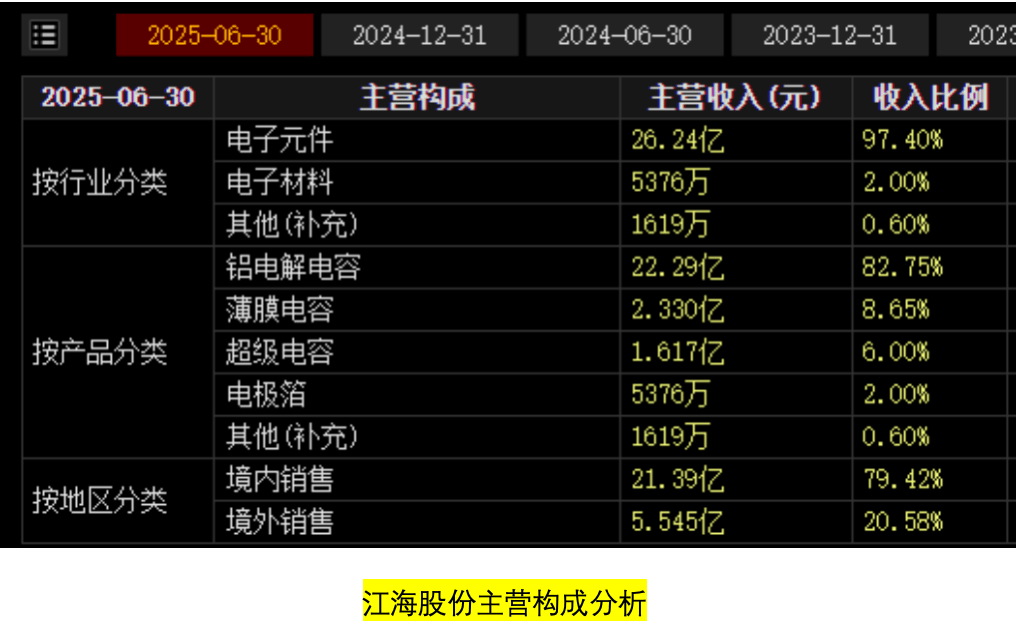
Core Viewpoint - The recent performance of Jianghai Co., Ltd. has attracted significant market attention, particularly following the release of its semi-annual report for 2025, which led to notable stock price fluctuations [1] Financial Performance - Jianghai Co., Ltd. reported a revenue of 2.694 billion yuan for the first half of 2025, representing a year-on-year growth of 13.96%, while net profit reached 358 million yuan, up 3.19% [2] - The company's main business, aluminum electrolytic capacitors, accounted for 82.75% of total revenue, indicating its critical role in the company's financial structure [4] - Despite stable gross margins, net profit margins have declined, reflecting cost pressures, and operating cash flow net amount decreased by 45.46% year-on-year due to faster growth in accounts receivable and inventory compared to revenue [2][6] Business Structure and Growth Drivers - The company has seen strong growth in its film capacitors and supercapacitors, which are emerging as new growth engines alongside its traditional aluminum electrolytic capacitor business [2][3] - Jianghai Co., Ltd. has established deep partnerships with leading companies such as Huawei, Delta, and BYD, further solidifying its market position [2] Technological Advancements - The company has made significant technological breakthroughs in supercapacitors, particularly for AI servers and grid frequency regulation, positioning itself favorably in the rapidly growing markets of renewable energy and artificial intelligence [3][6] - Jianghai Co., Ltd. has successfully reduced costs for high-temperature automotive modules in film capacitors, showcasing its competitive edge in domestic substitution [2][6] Market Position and Future Outlook - Jianghai Co., Ltd. is well-positioned for long-term growth due to its strong control over the entire industry chain, advanced technology barriers, and deep ties with major clients, despite facing short-term challenges such as declining net profit margins and cash flow pressures [6]
AIDC电容专家交流
2025-09-01 02:01
Summary of Conference Call Records Industry Overview - The conference call discusses the capacitor industry, specifically focusing on the use of capacitors in data centers and high-voltage direct current (HVDC) systems. The key components mentioned include the "horn capacitor" (a type of aluminum electrolytic capacitor), EDLC (Electric Double Layer Capacitor), and LIC (Lithium Ion Capacitor) [1][2][3]. Key Points and Arguments 1. **Data Center Upgrades**: The upgrade to GB300 in data centers aims to address customer complaints related to unstable power supply pulses by introducing active sub-card structures and advanced filtering components like supercapacitors, significantly reducing complaint rates [1]. 2. **Demand for Horn Capacitors**: The demand for horn capacitors is increasing due to higher system operating voltages, indicating a growing need for high-performance filtering components in high-voltage applications [1][10]. 3. **Capacitor Usage in Power Systems**: Capacitors are categorized into three levels in power systems: - Level 1: Input stage (200V or 300V) using aluminum electrolytic capacitors for initial purification and noise reduction. - Level 2: Medium voltage conversion (48V to 54V) where horn capacitors and supercapacitors may be used. - Level 3: Low voltage conversion (3.3V to 0.65V) requiring supercapacitors to ensure high purity and stability [3][4][5]. 4. **Cost Comparison**: The unit price of horn capacitors is approximately 50 yuan, while EDLCs range from 20 to 40 yuan. However, due to the larger capacity of horn capacitors, the actual cost is lower in high-performance applications [3][10]. 5. **Market Trends**: Major CSP manufacturers like Meta and Google are adopting horn capacitors and EDLC solutions, indicating a trend towards supercapacitor solutions in the industry [1][14]. 6. **HVDC Applications**: Horn capacitors are being considered for HVDC systems to improve ripple issues in power supply, with Meta and Google actively researching their implementation [2][17]. 7. **Future Demand**: The demand for horn capacitors is expected to continue increasing as system voltages rise, necessitating stronger filtering capabilities [10]. 8. **Competition Landscape**: The horn capacitor market is primarily dominated by Japanese companies, with domestic players like Jianghai actively participating in the competition [22][24]. Additional Important Insights - **Customer Complaint Reduction**: The introduction of active sub-card structures in data center designs allows for easier replacement of faulty components, reducing the need for complete system repairs and thus lowering customer complaints [6]. - **Capacitor Functionality**: Capacitors serve to filter and eliminate overshoot, protecting chips from damage and providing short-term energy storage [9]. - **Future Trends in Capacitor Demand**: There may be new demand points for capacitors, such as enhanced inductors on server boards, indicating potential opportunities for innovation in the capacitor market [32]. This summary encapsulates the critical insights from the conference call, highlighting the trends, challenges, and competitive landscape within the capacitor industry, particularly in relation to data centers and HVDC systems.
聊一聊液冷
傅里叶的猫· 2025-08-31 15:18
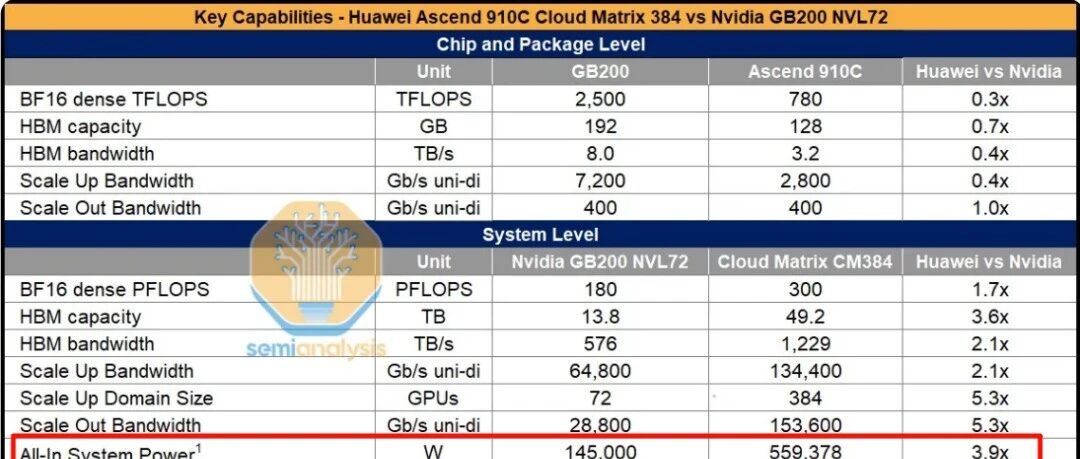
Core Viewpoint - The article discusses the rapid advancements in liquid cooling technology within the semiconductor industry, highlighting the significant power consumption increases of GPUs from Nvidia and AMD, and the evolving design and cost dynamics of liquid cooling systems. Group 1: Liquid Cooling Technology Overview - Nvidia and AMD are leading the application of liquid cooling technology, with Nvidia's B200 chip consuming 1200 watts and the latest B300 chip reaching 1400 watts, while future chips like Rubin are expected to consume up to 3600 watts [2][3] - AMD's GPU power consumption has also surged, with the MI300 series at 700-750 watts, MI325 at 1000 watts, and MI355 at 1400 watts, with the MI375 series projected to reach 1600 watts [2][3] Group 2: Core Component Upgrades - The core components of liquid cooling systems, such as cold plates, quick connectors, and piping, are evolving. The GB200 platform features 45 cold plates at a cost of $600-700 each, while the GB300 has 117 cold plates with a reduced cost of $200-300 each, leading to an overall value increase from $780,000 to $900,000 [4] - The quick connector used in GB200 is the OCP standard UQD04, while GB300 has upgraded to Nvidia's NVQD03, nearly doubling the quantity and increasing the total value to about twice that of GB200 [4] Group 3: Cooling Distribution Units (CDUs) - CDUs are moving towards standardization, with types including embedded, cabinet, and distribution types. The domestic market favors high-power CDUs (1500-2000 watts), while North America and Europe prefer distribution types with capacities of 70 kW and 150 kW, priced around $30,000 to $40,000 [5] - The unique "density stacking" strategy in the domestic GPU market has led to increased demand for liquid cooling solutions, as seen with Huawei's CloudMatrix384 cabinet having a power consumption four times that of Nvidia's NVL72 cabinet [5] Group 4: Market Dynamics and Competition - Domestic data centers are expected to adopt domestic GPU cards extensively, making liquid cooling systems a standard feature. Customization of cold plates and quick connectors is particularly pronounced in the domestic market [7] - Taiwanese manufacturers hold a leading position in the liquid cooling market due to their first-mover advantage, while domestic manufacturers like Invec offer competitive pricing and customization capabilities, with costs for CDU and internal components being 20-30% lower than their Taiwanese counterparts [8] Group 5: Challenges and Future Directions - Current challenges in liquid cooling include issues with dual-sided cold plates, such as increased pressure and deformation, as well as the high cost and environmental concerns associated with immersion cooling fluids [9] - The market is shifting focus towards new mineral oils to optimize flow rates and heat dissipation capabilities, aiming to balance cost and performance [9]


伊戈尔(002922):逐步走出降价阴霾,静候AIDC产品放量
Great Wall Securities· 2025-08-29 08:45
Investment Rating - The report maintains a rating of "Accumulate" for the company [4] Core Views - The company is gradually emerging from the impact of price reductions and is awaiting the ramp-up of AIDC products [2] - The energy products segment achieved revenue of 1.836 billion yuan in H1 2025, representing a year-on-year increase of 23.67%, although the gross margin declined by 7.4 percentage points [2] - The lighting business experienced a revenue contribution of 437 million yuan, down 3.4% year-on-year, while incubation projects showed significant growth with a revenue increase of 67.43% [3] - The company is expanding its market presence in data center transformers and has secured a major contract in Japan, indicating a shift towards international markets [2] Financial Summary - Revenue projections for 2025-2027 are 5.639 billion yuan, 6.750 billion yuan, and 7.796 billion yuan, respectively, with corresponding net profits of 253 million yuan, 366 million yuan, and 490 million yuan [3] - The company expects a decline in net profit in 2025 by 13.4%, followed by growth of 44.6% in 2026 and 33.9% in 2027 [3] - The latest diluted EPS is projected to be 0.60 yuan in 2025, 0.87 yuan in 2026, and 1.16 yuan in 2027 [3] - The current P/E ratios are 37.6x for 2025, 26.0x for 2026, and 19.4x for 2027 [3]
AIDC核心公司最新更新
2025-08-28 15:15
Summary of Key Points from Conference Call Industry Overview - The conference call focuses on the centralized computing power market, specifically the comparison between HVDC (High Voltage Direct Current) and UPS (Uninterruptible Power Supply) systems, highlighting the advantages of HVDC in terms of reliability, efficiency, and space utilization [1][3][5]. Core Insights and Arguments - **Market Adoption**: Domestic CSP (Cloud Service Providers) like Alibaba and Tencent have widely adopted HVDC systems, while overseas market penetration remains in its early stages [1][5]. - **SST Development**: Solid State Transformers (SST) are viewed as an upgrade to HVDC, primarily driven by advancements in power electronics technology. Although SST won't see mass application in the short term, it represents a potential upgrade path for integrated systems [1][6]. - **Investment Potential**: The UPS and HVDC sectors have shown strong performance recently, with stock prices rising approximately 30%. North American HVDC penetration is expected to surge from 3-5% to over 50% by the second half of 2026, indicating significant investment opportunities [1][7]. - **Overseas Market Dynamics**: The overseas UPS market has experienced positive price and profit changes due to stable market conditions and shifts in supply-demand dynamics. Chinese companies like Kehua Data and Shenghong are actively entering this market, laying the groundwork for future HVDC business [1][9]. Company-Specific Insights - **Kehua Data**: The company has a strong presence in the data center sector, boasting leading technologies in UPS, HVDC, and liquid cooling systems. It holds a significant market share in Tencent's systems, with liquid cooling technology already implemented in the U.S. market. ITC orders have seen rapid growth, with a potential performance inflection point expected in Q3 [1][10]. - **Chinese Companies in the U.S.**: Companies like Shenghong and Kehua Data are making notable strides in the U.S. data center power quality sector, enhancing their profitability and establishing a foundation for future HVDC market entry [1][11]. Additional Important Insights - **Market Trends**: The power conversion sector is witnessing a significant increase in power density, with expectations of cabinet power density rising from 130-140 kW to 600-650 kW by 2027, presenting both challenges and opportunities [2]. - **UPS Shortage Impact**: The current shortage of UPS systems provides Chinese companies with opportunities to participate in North American tenders and meet overseas OEM demands, significantly enhancing their profitability [1][19]. - **Future Demand for HVDC**: Companies with UPS experience are more likely to transition to HVDC, indicating a strong future demand for those already established in the UPS market [1][20]. - **Taiwanese Companies' Progress**: Taiwanese firms like Delta and Lite-On have launched advanced HVDC solutions, showcasing their rapid development in the field [1][23]. Conclusion - The HVDC and UPS markets are poised for significant growth, driven by technological advancements and increasing demand in North America. Companies that adapt to these trends and leverage their existing market positions are likely to see substantial benefits in the coming years [1][7][20].

AI“探电”系列:如何看待HVDCSST以及服务器电源板块?
2025-08-28 15:15
Summary of Conference Call Records Industry Overview - The conference call discusses the **AI server power supply market** and its growth driven by increasing power demands from advanced server architectures, particularly from NVIDIA's products [1][2][6]. Key Points and Arguments AI Server Power Demand - AI server power demand is expected to double, with NVIDIA's GB200 server rack consuming 120 kW but requiring 198 kW of power, while the GPU300 cabinet consumes 140-150 kW but requires 264 kW [1][2]. - The value per watt of server power supplies is rapidly increasing, projected to rise from 2.5 RMB in 2025 to 3.5 RMB in 2026, potentially reaching 7-8 RMB in the future [1][7]. HVDC (High Voltage Direct Current) Applications - HVDC technology is anticipated to play a significant role in data center power supply, offering advantages such as reduced energy consumption, lower losses, and improved reliability [1][4]. - The trend towards megawatt-level cabinets and gigawatt-level data centers supports the adoption of HVDC as a mainstream power supply choice [4][12]. Solid State Transformers (SST) - SSTs are characterized by their compact size, lightweight, and high efficiency, making them suitable for smart grids and renewable energy applications, particularly in data centers and electric vehicle charging stations [1][5]. - The North American market shows strong demand for SSTs, driven by the need for efficient power solutions and the long delivery cycles of traditional transformers [2][21]. Market Growth and Future Trends - The server power supply market is expected to nearly double by 2027, driven by advancements in power conversion technology and the need for power installations in both Power Rack and IT Rack [1][6]. - The introduction of new technologies such as BBU (Battery Backup Unit) and supercapacitors is expected to enhance the value of power supplies significantly [3][6]. Competitive Landscape - Companies like **Maguemite** are highlighted as key players in the server power supply market, benefiting from their unique position in NVIDIA's supply chain and their ability to rapidly iterate on technology [2][8]. - **Delta** and **Lite-On** are also mentioned as significant competitors in the market, with potential for substantial growth [9][10]. Investment Opportunities - The conference emphasizes the investment potential in companies involved in HVDC and SST technologies, particularly as these technologies gain traction in the market [5][17]. - The domestic leader **Oulutong** is noted for its performance in the domestic market and potential for international expansion, making it a noteworthy investment target [11]. Challenges and Considerations - The transition to HVDC and SST technologies presents challenges, including the need for companies to develop products that can meet the demands of large-scale data centers [26][28]. - The market is currently experiencing a valuation correction, with many companies in the sector trading at relatively low multiples, indicating potential for future growth [27]. Additional Important Content - The call discusses the advantages of HVDC over traditional UPS systems, including higher efficiency and reduced footprint, which are critical for modern data center requirements [14][13]. - The rapid development of solid-state transformer technology is highlighted, with expectations for significant market penetration in North America by 2027-2028 [26][18]. This summary encapsulates the key insights from the conference call, focusing on the growth dynamics of the AI server power supply market, the role of HVDC and SST technologies, and the competitive landscape shaping future investment opportunities.