奇瑞汽车

Search documents
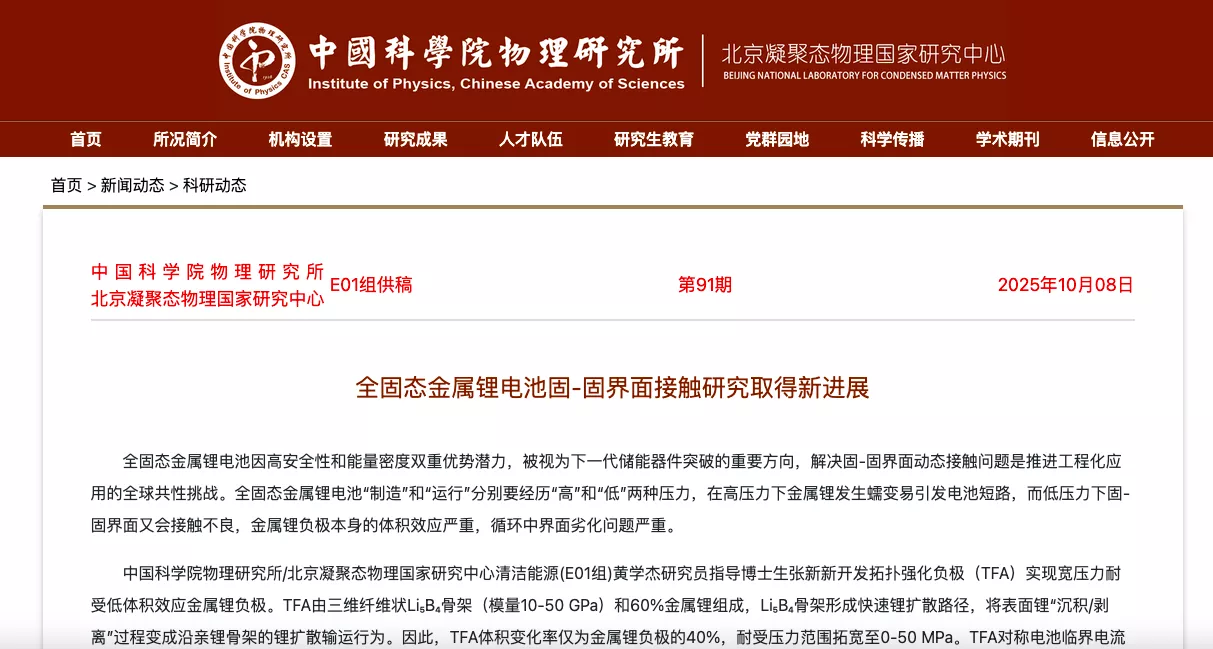
任正非与尹同跃会晤,华为奇瑞深化智界合作
Xin Lang Ke Ji· 2025-10-17 13:03
Group 1 - Huawei and Chery are deepening their collaboration with the launch of the Zhijie brand, which currently has two models: Zhijie S7 and Zhijie R7. A new model, possibly the Zhijie 9 series, is anticipated [1] - Chery's chairman, Yin Tongyue, emphasized that Zhijie is the company's top strategic priority, with all resources directed towards its success. Chery plans to invest over 10 billion yuan in research and development over the next three years, expanding the R&D team to 5,000 people [1] - Huawei's founder, Ren Zhengfei, has been actively meeting with top executives from various automotive companies, indicating a strategic push in the automotive sector [2] Group 2 - Dongfeng Motor's chairman, Yang Qing, discussed strengthening strategic cooperation with Ren Zhengfei, focusing on the transition to new energy and intelligent vehicles [2] - Changan Automobile's chairman, Zhu Huarong, recently met with Ren Zhengfei to discuss industry competition and received strategic guidance for Changan and its Avita brand [2] - Xpeng Motors announced a partnership with Huawei, following a closed-door meeting between Xpeng's chairman, He Xiaopeng, and Ren Zhengfei, highlighting the exchange of insights on technology and corporate governance [3]

2025年9月银行理财市场月报:银行理财大事记:政策重塑流动性管理,指数化布局与科技金融成创新焦点-20251017
HWABAO SECURITIES· 2025-10-17 09:39
Investment Rating - The report does not explicitly state an investment rating for the banking wealth management industry Core Insights - The banking wealth management market is experiencing growth, with a focus on innovative product offerings and strategic partnerships to enhance revenue structures and market reach [4][15][19] - Regulatory changes, such as the new public offering sales fee regulations, are reshaping liquidity management and may drive investors towards banking wealth management products [13][15] - The trend towards index-based investment products is gaining momentum, with banks actively developing proprietary indices to diversify risk and enhance returns [5][19] Summary by Sections Regulatory and Industry Dynamics - In September, new regulations on public offering sales fees were introduced, impacting both the asset and liability sides of banking wealth management [13] - The rise in gold prices has led to an increase in the issuance of gold-linked wealth management products by banks [13][15] - Several banks in Sichuan are collaborating to apply for wealth management licenses, which could serve as a model for other small and medium-sized banks [13][15] Market Performance - The total market size of wealth management products in September was 30.80 trillion yuan, showing a slight decrease of 0.48% month-on-month but a year-on-year increase of 6.30% [6][11] - The annualized yield for cash management products was recorded at 1.30%, a decrease of 1.86 basis points from the previous month [6][11] - The issuance of new wealth management products increased in September, aligning with seasonal trends, with a focus on fixed income and closed-end products [6][11] Product Development and Innovation - Wealth management companies are increasingly focusing on index-based products, with significant activity in the development of proprietary indices [5][19] - The report highlights the launch of various innovative products, including those linked to technology and gold, as banks seek to capture market opportunities [5][19] - The trend of wealth management companies participating in the issuance of science and technology bonds is noted, reflecting a strategic alignment with national innovation policies [19][22] Performance Metrics - The closed-end product compliance rate reached 86.09% in September, while the open-end product compliance rate was 54.35% [6][11] - The report indicates that the majority of new wealth management products have seen a downward adjustment in performance benchmarks, reflecting a consensus on the long-term low interest rate environment [6][11]
透视奇瑞出海成绩单,前三季度近百万辆出口“含金量”如何?
Ge Long Hui· 2025-10-17 09:11
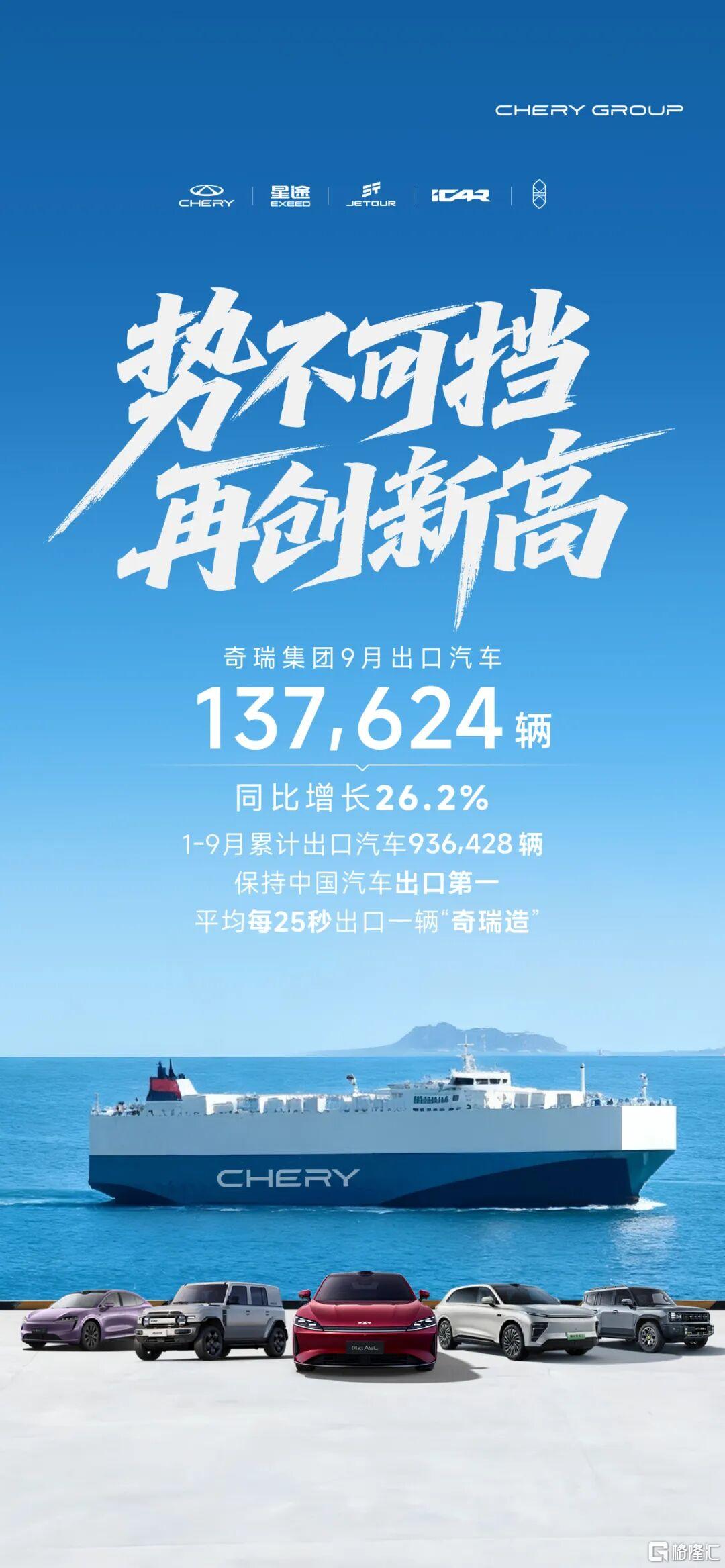
Core Viewpoint - The current trend of Chinese automotive companies going global is not only a sign of industry upgrade but also a focal point for capital market attention, with companies that can sustain overseas expansion and penetrate high-barrier markets expected to enjoy higher valuation levels [1][4]. Summary by Sections Export Performance - In the first three quarters of this year, China's automotive export volume reached 4.95 million units, a year-on-year increase of 14.8%. In September alone, the export volume was 652,000 units, up 21% year-on-year, indicating strong momentum [1]. - Chery's export performance stands out, with a single-month export of 137,624 units in September, a year-on-year increase of 26.2%, setting a new record. From January to September, Chery exported a total of 936,428 units, up 12.9% year-on-year [1][5]. Market Positioning - Chery leads the industry with an export volume that is double that of the second-ranked company, showcasing its strong scale effect. The models Chery exported, such as the Tiggo 7 and Tiggo 5X, consistently ranked among the top two in September [5][6]. - Chery has maintained its position as the top exporter of passenger cars in China for 22 consecutive years, achieving significant milestones such as the first Chinese brand to export over 5 million units cumulatively [8][9]. Growth Logic - Chery's success in overseas markets is attributed to its dual strategy of "technology defining standards" and "localization reconstructing ecosystems." The company has established a robust technological foundation through its "Yaoguang 2025" strategy, which includes five core technology matrices [11][12]. - Chery's global expansion is supported by eight R&D centers worldwide, allowing for localized product adaptations to meet regional market demands [11][12]. Financial Performance - Chery's overseas revenue has shown a consistent upward trend, with revenues of 30.39 billion yuan, 77.06 billion yuan, 100.90 billion yuan, and 26.29 billion yuan from 2022 to the first quarter of 2025, representing 32.8%, 47.2%, 37.4%, and 38.5% of total revenue respectively [10]. - The company plans to establish 45 sales outlets in Europe by the end of 2025, expanding to 100 by 2026, which will further solidify its market presence and revenue growth [17][18]. Investment Potential - Chery is transitioning from an "export champion" to a "global industrial ecosystem builder," which is expected to release significant value for investors. The company's focus on high-value markets like Europe positions it for quality growth [17][18]. - Chery's current PE TTM is 10.10, which is considered undervalued in the context of the recent automotive sector pullback. The company is expected to achieve revenues of 269.90 billion yuan and a net profit of 14.33 billion yuan in 2024, indicating a robust operational style [18][19]. Conclusion - Chery's impressive export achievements are the result of over two decades of commitment to globalization, technology development, and localization. This case serves as a benchmark for the global competitiveness of Chinese automotive brands, emphasizing the importance of solid technological foundations and sustainable global strategies [22].
【银行理财】银行理财大事记:政策重塑流动性管理,指数化布局与科技金融成创新焦点——2025年9月银行理财市场月报
华宝财富魔方· 2025-10-17 09:08
Core Viewpoint - The article discusses the recent developments in the banking wealth management sector in September, highlighting regulatory changes, market trends, and innovative product offerings by various banks and wealth management companies [3][4][5]. Regulatory and Industry Dynamics - In September, significant regulatory changes were introduced, including new public fund sales fee regulations, which are expected to impact both the asset and liability sides of bank wealth management [3][8]. - The issuance of gold-linked wealth management products surged due to rising gold prices, with several banks actively launching these products to meet investor demand [4][9]. - Several banks in Sichuan province are collaborating to apply for wealth management company licenses, which could serve as a model for small and medium-sized banks [9][10]. Performance and Market Trends - The total market size of wealth management products in September was 30.80 trillion yuan, reflecting a slight decrease of 0.48% month-on-month but a year-on-year increase of 6.30% [5][12]. - The annualized yield for cash management products decreased to 1.30%, while pure fixed-income products saw a yield of 1.27%, down by 0.50 percentage points [5][12]. - The market's net value decline rate rose to 5.32%, indicating a continued upward trend in this metric [5][12]. Product Innovations - Wealth management companies are increasingly focusing on index-based products and actively participating in the investment of science and technology bonds ETFs, employing a dual strategy of expanding product offerings and enhancing research capabilities [3][4][10]. - Notable innovations include the launch of self-developed asset allocation indices by various banks, such as the "Bay Area Global Asset Selection Index" by 招银理财 and the "Technology Five Forces Model" by 浦银理财 [4][10][11]. - The trend of wealth management companies engaging in IPO investments has gained momentum, with 中邮理财 participating in significant IPOs like "禾赛科技" and "奇瑞汽车" [9][10]. Market Structure and Product Characteristics - The new wealth management products launched in September predominantly featured fixed-income and closed-end products, maintaining a consistent structure with a focus on solid returns [5][12]. - The performance benchmarks for many newly issued products have been adjusted downward, reflecting a consensus among wealth management companies regarding the long-term low interest rate environment [5][12]. - The closed-end product compliance rate reached 86.09%, while the open-ended product compliance rate was 54.35%, indicating varying levels of performance across product types [6][12].

13家理财公司,9月规模回落8700亿!“含权”产品逆势增长
券商中国· 2025-10-17 07:20
Core Viewpoint - In September, bank wealth management products experienced a significant decline in scale after several months of net inflows, with a total reduction of approximately 870 billion yuan across 13 out of 14 major wealth management companies [2][5]. Group 1: Scale Changes in Wealth Management Products - As of the end of September, the total scale of the top 14 wealth management companies was 24.19 trillion yuan, a decrease of about 830 billion yuan from the end of August [5]. - The decline was primarily driven by a notable drop in fixed-income products, particularly pure bond wealth management products, which saw a reduction of approximately 6.7 trillion yuan [5][6]. - Among the 14 companies, state-owned banks accounted for over 75% of the total decline, with a combined decrease of about 6.54 trillion yuan [5][4]. Group 2: Performance of Different Product Types - Cash management products also saw a decline, with a total balance of 5.67 trillion yuan, down approximately 280 billion yuan from the previous month [6]. - Conversely, wealth management products with equity assets, such as "fixed income plus" and mixed products, experienced growth, with a total increase of about 110 billion yuan in September [6]. Group 3: Sales Channels and Strategies - The sales structure and channels have become crucial factors influencing the changes in wealth management scales, with many companies increasing their reliance on external sales channels [8]. - By the end of September, the external sales scale of the 14 wealth management companies exceeded 6.94 trillion yuan, with four companies having external sales accounting for over 50% of their total sales [8]. Group 4: Growth of Equity-Linked Products - The issuance of equity-linked wealth management products has seen a "volume growth" trend, with 49 existing equity products and 1,056 mixed products issued this year, significantly surpassing last year's figures [11]. - The interest in IPO investments has also increased, with wealth management companies participating in IPOs, such as the case of Chery Automobile's listing in Hong Kong [12]. Group 5: Future Strategies and Opportunities - To capitalize on the upward cycle of the stock market, wealth management companies are advised to optimize their strategies by increasing allocations to equity and other risk assets while maintaining a balanced approach [14]. - Multi-asset strategies are seen as a key solution, with a focus on diversifying revenue sources and controlling product value fluctuations [14].

银行理财规模再现跨季回落 含权产品逆势增长风景独好
Zheng Quan Shi Bao· 2025-10-16 19:01
Core Insights - The banking wealth management sector experienced a decline in net inflows at the end of Q3, with 13 out of 14 major wealth management companies reporting a decrease in balance, totaling approximately 870 billion yuan [1][2] Group 1: Overall Performance - The total scale of the top 14 wealth management companies was 24.19 trillion yuan at the end of September, down about 830 billion yuan from the end of August [2] - The decline in scale is primarily attributed to state-owned banks, which accounted for approximately 75% of the total decrease, with three companies alone (Agricultural Bank, Industrial Bank, and CCB) each seeing declines exceeding 100 billion yuan [2][3] Group 2: Product Categories - The most significant decline was observed in fixed-income pure bond products, which saw a reduction of about 670 billion yuan, with state-owned banks contributing approximately 440 billion yuan to this drop [2][3] - Cash management products also experienced a decline, with a total balance of 5.67 trillion yuan, down about 280 billion yuan from August and 570 billion yuan from the beginning of the year [3] Group 3: Market Trends - The stock market's performance in September positively impacted wealth management products with equity assets, leading to a growth of approximately 110 billion yuan in these products [3] - The number of wealth management companies participating in equity asset research has increased, with 23 companies conducting 168 research sessions since September [5] Group 4: Distribution Channels - Wealth management companies are increasingly focusing on external distribution channels, with a total external distribution scale exceeding 6.94 trillion yuan, and four companies reporting external distribution ratios of 50% or more [4] - Companies like China Merchants and Everbright have significantly increased their external distribution ratios, indicating strong channel expansion capabilities [4] Group 5: IPO Investments - There has been a notable increase in the issuance of wealth management products that include equity assets, driven by favorable policies and market conditions [6] - The number of wealth management products related to IPO investments has surged, with several new products launched in September alone [6]
降价减少、促销平缓 9月乘用车市场格局微变
Mei Ri Jing Ji Xin Wen· 2025-10-16 14:01
Core Insights - The Chinese automotive market experienced both month-on-month and year-on-year growth in September 2025, with retail sales reaching 2.241 million units, a 6.3% increase year-on-year and an 11.0% increase month-on-month [1] - The trend of "decreasing price competition and stable promotions" is emerging in the market, leading to a more stable automotive environment [1] - Domestic brands continue to outperform, while joint venture brands face challenges, with only a few exceptions showing positive performance [1] Domestic Brands Performance - In September, domestic brands achieved retail sales of 1.5 million units, marking a 13% year-on-year increase and a 12.9% month-on-month increase, capturing 66.9% of the domestic retail market share, up 3.6 percentage points year-on-year [2] - The penetration rate of new energy vehicles (NEVs) among domestic brands reached 78.1%, solidifying their position as a sales driver [2] - BYD remains a leader among domestic brands, although it experienced its first year-on-year decline in sales since March 2024, with September sales at 396,200 units, down 5.52% [2] Key Competitors in Domestic Market - Geely and Chery are actively increasing their market share in the NEV sector, with Geely reporting sales of 273,100 units in September, a 35.24% year-on-year increase [3] - Chery, which recently listed on the Hong Kong Stock Exchange, achieved sales of 255,600 units in September, up 8.90% year-on-year [3] - Other domestic brands like Changan and Great Wall also reported significant growth, with Changan's sales at 266,300 units (up 24.92% year-on-year) and Great Wall's at over 133,600 units (up 23.29% year-on-year) [3] Joint Venture Brands Performance - Joint venture brands saw a month-on-month sales increase but faced year-on-year declines, with mainstream joint venture brands retailing 490,000 units in September, down 6% year-on-year [4] - Luxury brands also experienced a year-on-year decline, with sales of 240,000 units in September, down 1% year-on-year [4] - Volkswagen's joint ventures showed mixed results, with SAIC Volkswagen achieving a record high of 94,100 units sold, while FAW-Volkswagen faced a similar decline as other mainstream joint ventures [4] Performance of Foreign Brands - Japanese brands held an 11.6% market share in September, down 1.1 percentage points year-on-year, with mixed performances among different brands [5] - American brands saw a slight increase in market share to 5.8%, with SAIC General reporting a remarkable year-on-year sales increase of over 124% [5]





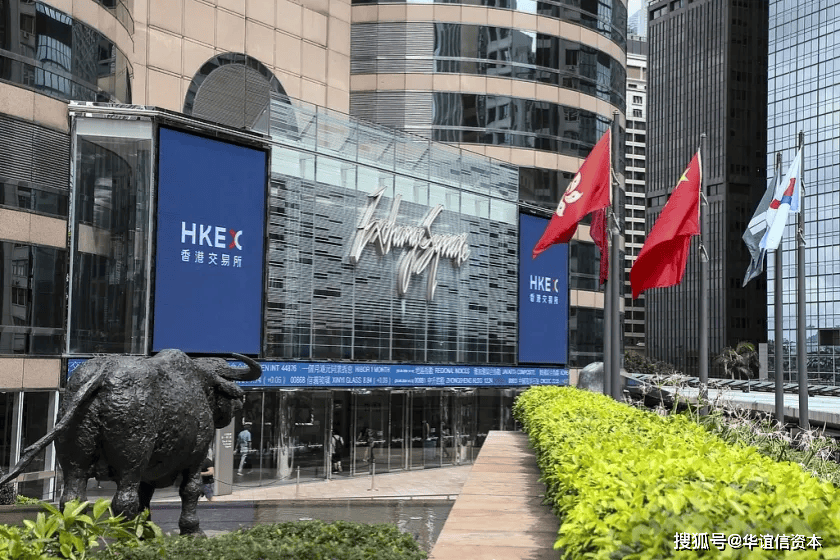
快讯|港股IPO月度透视:9月IPO募资超516亿港元
Sou Hu Cai Jing· 2025-10-16 05:59
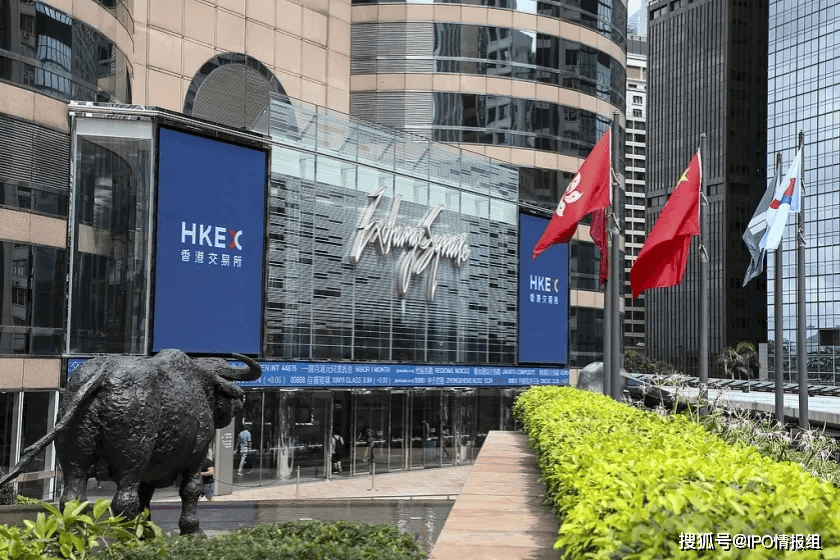
Core Insights - In September, the Hong Kong Stock Exchange (HKEX) saw 10 new IPOs, raising a total of HKD 51.641 billion, representing a quarter-on-quarter increase of 66.67% and a year-on-year increase of 787.24% [1] - Zijin Mining International and Chery Automobile led the fundraising efforts, with total amounts of HKD 28.732 billion and HKD 9.145 billion, respectively [1] - As of October 13, 2025, there are 283 companies queued for IPOs in the Hong Kong market, with 275 on the main board and 11 having passed the hearing [1]
快讯 | 港股IPO月度透视:9月IPO募资超516亿港元
Sou Hu Cai Jing· 2025-10-16 05:59
Core Insights - In September, the Hong Kong Stock Exchange (HKEX) saw 10 new IPOs, raising a total of HKD 51.641 billion, representing a quarter-on-quarter increase of 66.67% and a year-on-year increase of 787.24% [1] - Zijin Mining International and Chery Automobile led the fundraising efforts, with amounts of HKD 28.732 billion and HKD 9.145 billion, respectively [1] - As of October 13, 2025, there are 283 companies queued for IPOs in Hong Kong, with 275 on the main board and 11 having passed the hearing [1]
全球固态电池竞速驶入新阶段
Cai Jing Wang· 2025-10-16 05:49
Core Insights - Solid-state batteries represent a key technological direction for next-generation lithium batteries, with significant application potential in electric vehicles and low-altitude economies [1] - Chinese scientists have successfully overcome critical challenges in all-solid-state lithium batteries, leading to a breakthrough in performance and addressing the solid-solid interface contact issue [2][3] - Toyota has announced a partnership with Sumitomo Metal Mining to accelerate the development of solid-state battery technology, aiming for mass production of electric vehicles equipped with these batteries by 2027-2028 [8] Technological Breakthroughs - A research team from the Chinese Academy of Sciences has developed an anion regulation technology that resolves the contact issue between the electrolyte and lithium electrode in all-solid-state batteries [2] - The introduction of iodine ions in the electrolyte creates a rich iodine interface that actively attracts lithium ions, ensuring tight contact between the electrode and electrolyte [3] - Prototype batteries utilizing this technology have shown stable performance after hundreds of charge-discharge cycles, surpassing existing battery levels [4] Industry Developments - Toyota's collaboration with Sumitomo Metal Mining focuses on the development of cathode materials for all-solid-state batteries intended for pure electric vehicles [8] - Other companies, including Hyundai, Mercedes-Benz, BYD, and Changan, are also advancing their solid-state battery research and development efforts, with various timelines for testing and production [8] - The domestic semi-solid-state battery market is nearing mass production, with some models already in operation, while full-scale applications of solid-state batteries are projected for 2030 [8] Market Projections - According to CITIC Securities, 2025 is expected to be a pivotal year for the maturation and gradual rollout of semi-solid-state batteries, with global solid-state battery shipments projected to reach 642.6 GWh by 2030, reflecting a compound annual growth rate of 133% from 2024 to 2030 [9] - Despite advancements, experts caution that significant challenges remain before solid-state batteries can achieve commercial viability, with most current applications still in the semi-solid-state phase [9]