
春秋航空

Search documents
西部证券晨会纪要-20250811
Western Securities· 2025-08-11 02:25
Group 1: Company Overview - Gu Ming (01364.HK) has a strong core competitiveness in delivering fresh fruits and milk to lower-tier cities with a two-day shelf life, benefiting from significant cost advantages [1][6] - The company has a leading quarterly repurchase rate supported by a robust supply chain and high-quality research and development [1][7] - The store count in the top eight key provinces accounts for nearly 80% under the regional densification strategy [1][7] Group 2: Industry Insights - The tea beverage industry is characterized by a long-term growth trajectory, with brands possessing comprehensive capabilities expected to dominate the market [6][7] - The head effect intensifies, leading to rapid expansion of second and third-tier brands, while local long-tail brands will follow suit [6] Group 3: Financial Projections - Gu Ming's projected revenues for 2025, 2026, and 2027 are 116 billion, 140 billion, and 169 billion respectively, with corresponding net profits of 21 billion, 26 billion, and 32 billion [8] - The company is expected to achieve a PE ratio of 26X, 21X, and 17X for the years 2025, 2026, and 2027, indicating strong growth potential [8] Group 4: Competitive Advantages - The company maximizes supply chain efficiency and offers products with a high quality-to-price ratio, which enhances customer loyalty and repurchase rates [7][8] - The regional densification strategy allows for a significant market share in key provinces, while the coffee segment is expected to increase per-store revenue [8] Group 5: Market Position - Ju Chen Co., Ltd. (688123.SH) is positioned as a global leader in EEPROM, with a strong foothold in the smartphone camera market and a growing presence in automotive-grade EEPROM products [11][12] - The company is expected to see revenue growth from its DDR5 SPD products, with projected revenues of 13.09 billion, 17.95 billion, and 24.03 billion for 2025, 2026, and 2027 respectively [11][12] Group 6: Industry Trends - The macroeconomic environment shows signs of stabilization, with CPI remaining flat and core CPI rebounding, indicating potential for price recovery in the second half of the year [15][17] - The electrical equipment sector, represented by Hua Ming Equipment (002270.SZ), is experiencing stable growth in core business and significant export growth, with projected net profits of 7.38 billion, 8.44 billion, and 9.43 billion for 2025, 2026, and 2027 [19][21]


快递“反内卷”政策陆续落地,如何看待航空“反内卷”
Changjiang Securities· 2025-08-11 01:13
Investment Rating - The report maintains a "Positive" investment rating for the transportation industry [10] Core Insights - The express delivery "anti-involution" policy has gained traction, with Guangdong Province leading the way in raising express delivery base prices, which is expected to spread nationwide. However, the aviation sector faces challenges in implementing similar price increases due to its high-end and optional nature, especially given the weak summer performance [2][6] - The Civil Aviation Administration of China (CAAC) has emphasized the need to address "involution" in the aviation industry, particularly focusing on the low-price competition in business routes. The report suggests that the key to "anti-involution" in aviation lies in improving service differentiation and addressing the oversupply in business routes [6][18] Summary by Sections Aviation Sector - The CAAC has made "anti-involution" a priority, with meetings held in June and July 2025 to address the issue. Since 2020, major airlines have reported continuous losses for five years, highlighting the necessity of this initiative [6][18] - Business travel demand remains weak, with expectations for recovery around mid-September. The oversupply in business routes, exacerbated by the shift of international capacity to domestic markets, has led to intense price competition among major airlines [6][18] - Recent improvements in service on key routes, such as Beijing-Shanghai, have shown positive responses in average ticket prices, indicating potential for further expansion of these practices [6][18] Passenger Traffic and Revenue - As of August 9, 2025, domestic passenger traffic showed a slight year-on-year increase of 1%, while international passenger traffic rose by 11%. However, domestic ticket prices faced pressure, with a year-on-year decline of 6.2% [7] - The report notes that the average ticket price for domestic flights has decreased by 8.7% due to fuel surcharges, indicating ongoing revenue challenges despite slight improvements in passenger traffic [7] Shipping and Logistics - The report highlights a rebound in oil shipping rates, with the average VLCC-TCE rate increasing by 52.5% to $35,000 per day, driven by increased cargo from the Middle East [8] - The logistics sector is seeing improvements in coal transport volumes, with daily truck traffic at the Ganqimaodu port rising by 34 vehicles per day, suggesting a recovery in trade demand [8] Market Dynamics - The report emphasizes the need for airlines to shift from a focus on market share to differentiation in service to avoid the pitfalls of low-price competition. The recovery of business travel and the management of flight supply by the CAAC are seen as critical to improving the competitive landscape [66]
申万宏源交运一周天地汇:制裁效果初现伊朗俄油发货减少需重视,快递反内卷或进入新阶段
Shenwan Hongyuan Securities· 2025-08-10 12:42
Investment Rating - The report maintains a positive outlook on the logistics and transportation industry, particularly highlighting the express delivery sector and shipping companies [1][3]. Core Insights - The express delivery sector is entering a new phase of price increases, with significant price adjustments observed, particularly in Guangdong, which may spread to other regions. Three scenarios are proposed for this new phase: 1) elimination of price disparities leading to profit recovery and substantial dividends; 2) continuation of competitive dynamics in many regions; 3) potential for higher-level mergers and acquisitions [3]. - The shipbuilding sector is experiencing robust profitability, with Yangtze River Shipbuilding reporting a gross margin of 35% and a net margin of 32.5% for the first half of 2025, prompting recommendations for companies like China Shipbuilding and China Heavy Industry [3]. - Recent geopolitical pressures have led to a decline in oil exports from Iran and Russia to India, which may increase compliance demand and VLCC (Very Large Crude Carrier) demand as a substitute for smaller tankers. Iran's oil exports have dropped to around 1.2 million barrels per day recently [3]. - VLCC freight rates have surged by 52% week-on-week, reaching $34,679 per day, indicating a potential end to the seasonal downturn in the market [3]. - The report highlights the resilience of railway freight volumes and highway truck traffic, with national railway freight at 77.69 million tons and highway truck traffic at 52.59 million vehicles for the week of July 28 to August 3 [3]. Summary by Sections Express Delivery - The express delivery sector has seen a price increase of 4.34%, outperforming other sub-sectors [4][5]. - Companies recommended include Shentong Express and YTO Express, with a focus on Jitu Express, Zhongtong Express, and Yunda Express [3]. Shipping - The report notes a significant increase in VLCC rates, with a 9.34% rise in the crude oil tanker index [4]. - Recommendations include China Shipbuilding and China Heavy Industry due to strong performance in the shipbuilding sector [3]. Air Transportation - The report suggests that the "anti-involution" policy in civil aviation may optimize industry competition, benefiting airline profitability in the long term [3]. - Recommended airlines include China Eastern Airlines, China Southern Airlines, and Spring Airlines [3]. Railway and Highway - The report indicates steady growth in railway and highway freight volumes, with a focus on high-dividend investment opportunities in the highway sector [3]. - The establishment of a new railway company under the China National Railway Group is noted as a positive development [3]. High Dividend Stocks - The report lists high dividend stocks in the transportation sector, including Bohai Ferry with a dividend yield of 8.46% and Zhonggu Logistics at 7.53% [3][21].
每经热评︱空姐告别高跟鞋 民航业撕掉“伪精致”标签
Mei Ri Jing Ji Xin Wen· 2025-08-10 12:24
Core Viewpoint - The recent changes in dress code regulations for flight attendants, particularly the shift from mandatory high heels to the option of flat shoes, reflect a broader transformation in the aviation industry that prioritizes safety and comfort over outdated aesthetic standards [1][2][3] Group 1: Historical Context - The tradition of requiring flight attendants to wear high heels originated in the 1980s during the early market reforms of China's civil aviation, influenced by international airlines' emphasis on "elegant service" [1] - High heels became a symbol of professionalism and were institutionalized as a standard, with even the stability of walking in them becoming a training requirement [1] Group 2: Changing Expectations - The perception of air travel has shifted from a luxury experience to a more common mode of transportation, leading to a change in passenger expectations from aesthetic appeal to efficiency and safety [2] - High heels pose a potential safety risk during turbulence, as they hinder flight attendants' ability to stabilize themselves and assist passengers effectively [2] Group 3: Global Trends - The global aviation industry has seen a trend towards relaxing dress codes, with 70% of airlines worldwide easing restrictions on high heels since 2020, reflecting a move towards greater professional equality and individual comfort [2] - Airlines like Aerolineas Argentinas have eliminated mandatory skirt and stocking requirements in favor of pants and sneakers, indicating a shift in industry standards [2] Group 4: Regulatory Changes - The Civil Aviation Administration of China has formalized this shift with new regulations that allow for more flexibility in dress codes, emphasizing that flight attendants are primarily safety guardians rather than mere aesthetic figures [3] - This regulatory change signifies a step towards a more humane approach in the service industry, prioritizing employee well-being and adapting to contemporary needs [3]


招商交通运输行业周报:华南快递涨价正式启动,关注油运景气度改善-20250810
CMS· 2025-08-10 11:51
Investment Rating - The report maintains a positive investment rating for the transportation industry, highlighting potential opportunities in various segments such as shipping, infrastructure, aviation, and express delivery [2][4]. Core Insights - The report emphasizes the improvement in oil shipping market conditions and the potential for price increases in the express delivery sector, driven by a reduction in price competition due to "anti-involution" policies [1][8][24]. Shipping - The oil shipping industry is experiencing improved market conditions, with OPEC+ planning to increase production by 548,000 barrels per day in September, which may lead to better freight rates in the second half of the year [8][16]. - Container shipping rates have declined, necessitating close monitoring of US-China trade negotiations [8][12]. - The report suggests focusing on companies with strong Q2 performance, such as德翔海运, 海丰国际, 中谷物流, and 中远海特 [8][16]. Infrastructure - The report notes that highway passenger traffic decreased by 4.0% year-on-year in June 2025, while cargo traffic showed a slight decline [18][55]. - Port cargo throughput increased by 4.8% year-on-year, indicating stable growth in the infrastructure sector [18][55]. - The report recommends investing in leading highway and port companies, such as 招商公路, 皖通高速, 唐山港, and 青岛港, due to their attractive dividend yields [20][55]. Express Delivery - The express delivery sector is projected to maintain a growth rate of over 20% in 2024, with a 19.3% increase in business volume in the first half of 2025 [24][68]. - The report highlights the initiation of price increases in the express delivery sector in South China, which is expected to alleviate price competition and support valuation recovery [24][68]. - Recommended companies in this sector include 中通快递-W, 圆通速递, 申通快递, and 韵达股份 [24][68]. Aviation - The report indicates a 1.9% week-on-week increase in passenger traffic, with domestic ticket prices experiencing a year-on-year decline of 5.4% [25][26]. - The aviation sector is expected to benefit from "anti-involution" measures aimed at reducing excessive competition, which may enhance valuation recovery [25][26]. - Recommended airlines include 中国国航, 南方航空, 吉祥航空, 春秋航空, and 华夏航空 [26].




7月行业信息思考:“反内卷”对消费量、价、利润基本面的影响
SINOLINK SECURITIES· 2025-08-09 12:26
Group 1: Historical Insights - The previous supply-side reform period (2016-2017) saw significant pressure on consumption profits due to insufficient transmission of cost pressures from upstream resources and raw materials, leading to a general decline in profit growth across the consumption sector [1][12][21] - During the 2016-2017 period, despite strong demand-side policies, the ability of the consumption sector to pass on cost increases was limited, resulting in a divergence between revenue and profit growth [1][12][17] - Consumer confidence index rose from 103.7 in December 2015 to 122.6 in December 2017, indicating a strong demand environment during the previous reform [12][17] Group 2: Current "Anti-Internal Competition" Insights - The current "anti-internal competition" policy is expected to impose more stringent constraints on supply, particularly in sectors like automotive and express delivery, which may stabilize prices more quickly compared to the previous reform period [1][21] - The consumption sector is facing a more severe demand-side challenge now, with consumer confidence at low levels and growth relying more on "value-for-money" rather than brand premium pricing [1][21] - In July, the retail sales of passenger vehicles reached 1.826 million units, a year-on-year increase of 6.3%, but the growth rate significantly slowed from June's 13.3% [1][21] Group 3: Sector-Specific Observations - In the energy and resources sector, coal demand is expected to rise during peak seasons, with July's domestic raw coal production at 42.107 million tons, a year-on-year increase of 3.9% [22][23] - The real estate sector experienced a significant decline in transaction volume, with July's average daily transaction area for commercial housing in 30 major cities down 32.3% month-on-month and 18.6% year-on-year [35][37] - The manufacturing sector showed resilience, with strong performance in machinery and equipment exports, and heavy truck sales performing well [5][10]
航空机场板块8月8日跌0.07%,春秋航空领跌,主力资金净流入7712.3万元
Zheng Xing Xing Ye Ri Bao· 2025-08-08 08:35
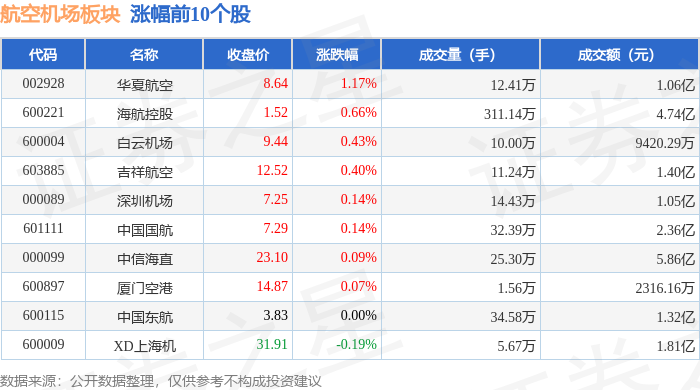
证券之星消息,8月8日航空机场板块较上一交易日下跌0.07%,春秋航空领跌。当日上证指数报收于 3635.13,下跌0.12%。深证成指报收于11128.67,下跌0.26%。航空机场板块个股涨跌见下表: | 代码 | 名称 | 收盘价 | 涨跌幅 | 成交量(手) | 成交额(元) | | | --- | --- | --- | --- | --- | --- | --- | | 002928 | 华夏航空 | 8.64 | 1.17% | 12.41万 | | 1.06亿 | | 600221 | 海航控股 | 1.52 | 0.66% | 311.14万 | | 4.74亿 | | 600004 | 白云机场 | 9.44 | 0.43% | - 10.00万 | | 9420.29万 | | 603885 | 吉祥航空 | 12.52 | 0.40% | 11.24万 | | 1.40亿 | | 000089 | 深圳机场 | 7.25 | 0.14% | 14.43万 | | 1.05亿 | | 601111 | 中国国航 | 7.29 | 0.14% | 32.39万 | | 2.36亿 | | ...

航空机场行业董秘薪酬榜:上海机场因股票激励事项被处罚 董秘黄晔年薪85万高于同行均值
Xin Lang Zheng Quan· 2025-08-08 06:27
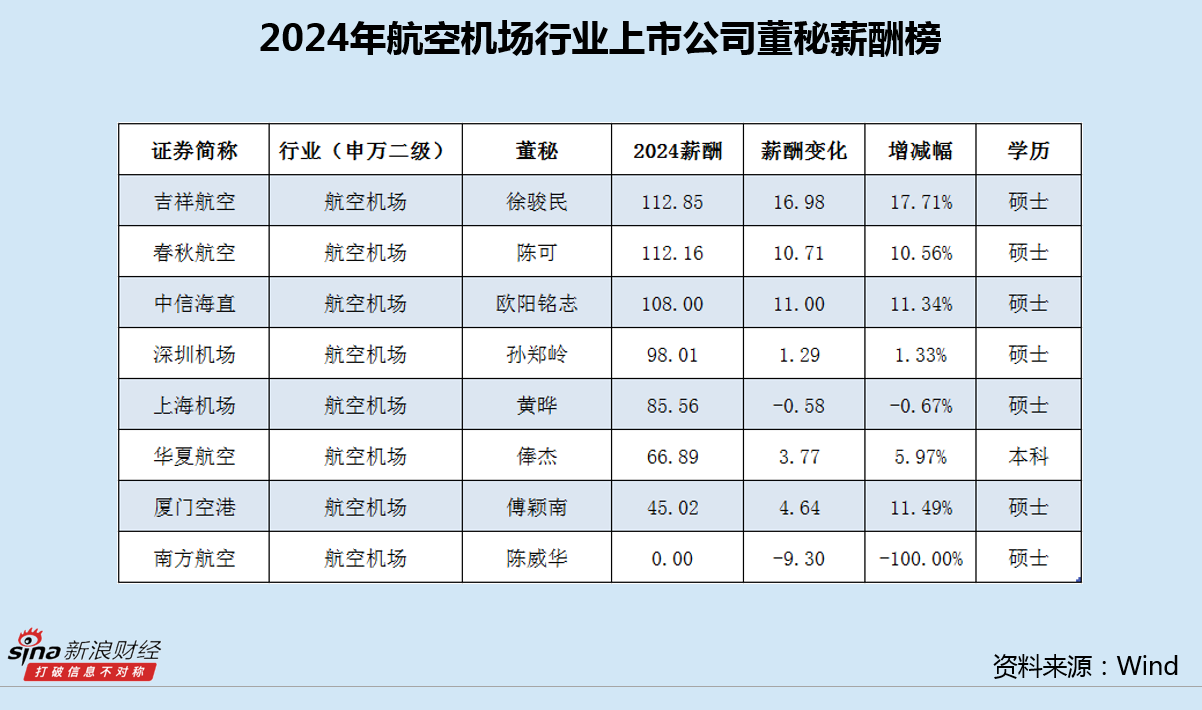
专题:专题|2024年度A股董秘数据报告:1144位董秘年薪超百万 占比超21% 董秘作为连接投资者与上市公司的"桥梁",在上市公司资本运作中发挥着关键作用。新浪财经《2024年度A股董秘数据报告》显示,2024年A股上市公司董 秘薪酬合计达40.86亿元,平均年薪75.43万元。 | 证券简称 | 行业(申万二级) | 童秘 | 2024薪酬 | 薪酬变化 | 増减幅 | 学历 | | --- | --- | --- | --- | --- | --- | --- | | 吉祥航空 | 航空机场 | 徐骏民 | 112. 85 | 16. 98 | 17.71% | 硕士 | | 春秋航空 | 航空机场 | 陈可 | 112. 16 | 10. 71 | 10. 56% | 硕士 | | 中信海直 | 航空机场 | 欧阳铭志 | 108. 00 | 11. 00 | 11. 34% | 硕士 | | 深圳机场 | 航空机场 | 孙郑岭 | 98. 01 | 1. 29 | 1. 33% | 硕士 | | 上海机场 | 航空机场 | 黄晔 | 85. 56 | -0. 58 | -0. 67% | 硕士 | ...

航空机场行业董秘薪酬榜:南方航空连续5年亏损 董秘陈威华年薪未被披露
Xin Lang Zheng Quan· 2025-08-08 06:23
| 证券简称 | 行业(申万二级) | 董秘 | 2024薪酬 | 薪酬变化 | 増減幅 | 学历 | | --- | --- | --- | --- | --- | --- | --- | | 吉祥航空 | 航空机场 | 徐骏民 | 112. 85 | 16. 98 | 17.71% | 硕士 | | 春秋航空 | 航空机场 | 陈可 | 112. 16 | 10. 71 | 10. 56% | 硕士 | | 中信海直 | 航空机场 | 欧阳铭志 | 108. 00 | 11. 00 | 11. 34% | 硕士 | | 深圳机场 | 航空机场 | 孙郑岭 | 98. 01 | 1. 29 | 1. 33% | 硕士 | | 上海机场 | 航空机场 | 黄晔 | 85. 56 | -0. 58 | -0. 67% | 硕士 | | 华夏航空 | 航空机场 | 俸杰 | 66. 89 | 3.77 | 5.97% | 本科 | | 厦门空港 | 航空机场 | 傅颖南 | 45. 02 | 4. 64 | 11. 49% | 硕士 | | 南方航空 | 航空机场 | 陈威华 | 0. 00 | -9. 30 | ...
航空机场行业董秘薪酬榜:吉祥航空未依法履责被处罚 董秘徐骏民年薪反超春秋航空位居业内之首
Xin Lang Zheng Quan· 2025-08-08 06:21
Core Insights - The report highlights that in 2024, the total salary for A-share listed company secretaries reached 4.086 billion yuan, with an average annual salary of 754,300 yuan [1] - Over 21% of the secretaries earned more than 1 million yuan annually, indicating a significant compensation trend in the industry [1] Industry Summary - In the aviation and airport sector, which includes 12 listed companies, the total salary for secretaries amounted to 9.2244 million yuan, with an average salary of 768,700 yuan [1] - The report notes that despite receiving a regulatory work letter for failing to fulfill duties, the secretary of Jixiang Airlines, Xu Junmin, saw a salary increase of nearly 170,000 yuan, reaching 1.1285 million yuan, making him the highest-paid in the industry [1] Company Salary Data - Jixiang Airlines: Xu Junmin, 1.1285 million yuan, increase of 169,800 yuan (17.71%) [2] - Spring Airlines: Chen Ke, 1.1216 million yuan, increase of 107,100 yuan (10.56%) [2] - CITIC Offshore Helicopter: Ouyang Mingzhi, 1.08 million yuan, increase of 110,000 yuan (11.34%) [2] - Shenzhen Airport: Sun Zhengling, 980,100 yuan, increase of 12,900 yuan (1.33%) [2] - Shanghai Airport: Huang Ye, 855,600 yuan, decrease of 5,800 yuan (-0.67%) [2] - Huaxia Airlines: Feng Jie, 668,900 yuan, increase of 37,700 yuan (5.97%) [2] - Xiamen Airport: Fu Yingnan, 450,200 yuan, increase of 46,400 yuan (11.49%) [2] - China Southern Airlines: Chen Weihua, 0 yuan, decrease of 93,000 yuan (-100.00%) [2]
