
晶澳科技

Search documents
最新光伏双榜单出炉,透露了哪些信号?
Xin Lang Cai Jing· 2025-08-13 04:29
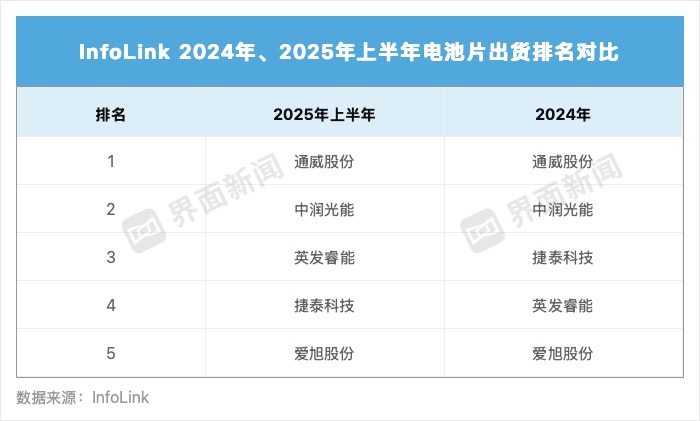
Core Insights - InfoLink has released a new ranking for leading companies in the photovoltaic battery and module sectors, showing slight changes compared to the previous year, with no new entrants in the top ranks for the first half of 2025 [1][2]. Battery Segment Summary - The top five battery manufacturers remain unchanged in terms of participants, with slight positional shifts: Tongwei Co., Ltd. retains the top position, while Yingfa Renergy moves from fourth to third, swapping places with Jietai Technology [2]. - Yingfa Renergy's N-type battery shipments reached the top two globally in the first half of the year, and it became the first company to export BC battery cells [2][3]. - The total global shipment volume of the top five battery suppliers reached approximately 87.8 GW, marking a year-on-year increase of about 12.5% [2]. Module Segment Summary - The module segment saw more significant changes, with JinkoSolar maintaining its leading position and LONGi Green Energy in second place. JA Solar and Trina Solar are now tied for third [5][6]. - The total shipment volume of the top ten module suppliers was approximately 247.9 GW, reflecting a 10% increase year-on-year [7]. - The production of modules in the first half of the year reached 310 GW, a 14.4% increase compared to the previous year [9]. Market Trends and Observations - The market is witnessing a shift towards larger TOPCon battery cells, with the 210RN size accounting for about 31.4% of shipments, up from 8% in the previous year [3]. - Companies like Tongwei and Yida New Energy reported shipment increases of 30-40%, indicating rapid expansion in their module business [10]. - The industry is experiencing a transformation aimed at addressing long-standing issues of supply-demand mismatch and unhealthy price competition, with a focus on sustainable profitability rather than just market share [12][13]. Financial Performance - The financial performance of companies like Yongdian Dongci and Aiko Solar has been noteworthy, with Yongdian Dongci achieving a net profit of 960-1,050 million yuan, a year-on-year increase of 49.6%-63.6% [11]. - Despite high shipment volumes, many companies are facing significant losses, with 31 A-share listed photovoltaic companies reporting a total net loss of 57.47 billion yuan in 2024 [12][15].





工业硅:上游逐步复产,关注市场情绪,多晶硅:关注市场信息扰动
Guo Tai Jun An Qi Huo· 2025-08-13 01:39
Report Summary Industry Investment Rating No industry investment rating is provided in the report. Core Viewpoints - The report focuses on the industrial silicon and polysilicon markets, tracking their fundamentals, including futures market data, basis, prices, profits, inventory, and raw material costs [2]. - On August 11, a government - business symposium on the crystalline silicon photovoltaic industry was held in Baotou, with enterprises expressing confidence in the industry and their development in the area [2][4]. - The trend intensity for both industrial silicon and polysilicon is 0, indicating a neutral view [4]. Summary by Relevant Catalogs 1. Fundamentals Tracking - **Futures Market**: For industrial silicon, the Si2511 closing price was 8,840 yuan/ton, down 160 yuan from T - 1. Its trading volume was 520,504 lots, down 141,692 lots from T - 1, and the open interest was 278,860 lots, up 6,917 lots from T - 1. For polysilicon, the PS2511 closing price was 51,800 yuan/ton, down 1,185 yuan from T - 1, the trading volume was 481,809 lots, down 111,013 lots from T - 1, and the open interest was 136,055 lots, down 3,684 lots from T - 1 [2]. - **Basis**: The industrial silicon spot premium (against East China Si5530) was +600 yuan/ton, up from 95 yuan/ton at T - 1. The polysilicon spot premium (against N - type re - injection) was - 4,800 yuan/ton, down from 1,185 yuan/ton at T - 1 [2]. - **Prices**: The price of Xinjiang 99 - silicon was 8,800 yuan/ton, up 100 yuan from T - 1. The price of Yunnan Si4210 was 10,000 yuan/ton, unchanged from T - 1. The price of polysilicon N - type re - injection material was 47,000 yuan/ton, unchanged from T - 1 [2]. - **Profits**: The profit of silicon plants in Xinjiang (new standard 553) was - 2,461 yuan/ton, down 160 yuan from T - 1, and in Yunnan (new standard 553) was - 3,199 yuan/ton, down 160 yuan from T - 1. The profit of polysilicon enterprises was - 16.9 yuan/kg, up 0.4 yuan from T - 1 [2]. - **Inventory**: Industrial silicon's social inventory (including warehouse receipt inventory) was 54.7 tons, with an increase of 0.7 tons compared to T - 5. Polysilicon's factory inventory was 23.3 tons, with an increase of 0.4 tons compared to T - 5 [2]. - **Raw Material Costs**: The price of silicon ore in Xinjiang was 340 yuan/ton, unchanged. The price of washed coking coal in Xinjiang was 1,250 yuan/ton, unchanged [2]. 2. Macro and Industry News On August 11, the Baotou government held a symposium with 10 crystalline silicon photovoltaic enterprises. Enterprises expressed confidence in the industry and their development in Baotou and were willing to deepen cooperation [2][4]. 3. Trend Intensity The trend intensity of industrial silicon and polysilicon is 0, indicating a neutral market view [4]
宋志平:如何克服内卷|宏观经济
清华金融评论· 2025-08-12 08:48
Core Viewpoint - The photovoltaic industry in China has achieved remarkable success but is now facing challenges such as price declines and reduced profitability, prompting the need for internal adjustments to overcome industry "involution" [2]. Summary by Sections Involution and Competition - "Involution" has become a significant issue across various industries, necessitating a re-evaluation of competitive philosophies and the establishment of new competition rules [3]. - The distinction between healthy and unhealthy competition is crucial, with the latter often leading to value destruction. The recognition of "involution" as a form of harmful competition has gained consensus [4]. Industry Self-Regulation - Industry self-regulation is essential, with associations playing a key role in promoting self-discipline among members. This includes industry planning, policy formulation, technological innovation, and combating unfair competition [6]. - The importance of leading enterprises in setting examples for self-regulation is emphasized, fostering a collaborative ecosystem among businesses [6]. Mergers and Acquisitions - Mergers and acquisitions are vital for enhancing industry concentration and overcoming involution. Historical examples from the U.S. steel industry illustrate the benefits of consolidation [8]. - The advantages of mergers include strengthening enterprises, improving company quality, facilitating innovation, and increasing industry concentration [9]. Capacity Management - The photovoltaic industry faces a significant supply-demand imbalance, necessitating both production cuts and capacity reductions to stabilize prices and maintain profitability [10]. - Historical practices in the cement industry demonstrate that production limits can effectively balance supply and demand without adversely affecting overall sales [11]. Pricing Strategy - A shift from a volume-based to a price-based profit model is necessary, emphasizing the importance of maintaining pricing power rather than solely focusing on sales volume [12][13]. - Effective pricing strategies can significantly impact profitability, and companies should avoid relying on sales personnel for pricing decisions [14]. Innovation and Value Creation - To transition from a competitive "red ocean" to an innovative "blue ocean," companies must focus on differentiation, market segmentation, high-end product development, and brand building [15][16][17][18]. - The emphasis on innovation is crucial for enhancing product quality and achieving competitive advantages in the market [19].
在吃力不讨好的反复博弈中寻求突破
Great Wall Securities· 2025-08-12 08:38
Investment Rating - The report maintains a "Buy" rating for the industry, indicating a positive outlook for selected companies within the electric power equipment and new energy sector [3]. Core Insights - The photovoltaic sector is experiencing demand front-loading, with supply-side reforms needing close observation. The report emphasizes that significant demand growth is essential for market expansion, but limited absorption capacity and mismatched demand in overseas markets complicate the situation. Policy intervention is deemed crucial for the industry's recovery [1][13]. - In the energy storage segment, demand remains robust, but market dynamics are shifting. The report expresses optimism about large-scale storage despite concerns that it may follow the path of photovoltaics. The focus is on high-quality products and integrated service solutions, with expectations for profit margins to stabilize around 20-25% [2][7]. - The lithium battery sector faces challenges due to weak pricing power in the materials segment, driven by supply-demand imbalances. The report notes that the industry's effective capacity utilization is projected to hover around 60-65%, with leading battery manufacturers exerting significant influence over pricing and production cycles [6][12]. Summary by Sections Photovoltaics - Demand has been front-loaded, leading to a significant increase in installations, with 212.21 GW added in the first half of 2025, a 107.1% year-on-year increase. However, the market saw a sharp decline in June, indicating potential overcapacity and absorption issues [13][16]. - The report highlights the need for supply-side reforms and policy support to stabilize the industry, as the current market dynamics are characterized by a mismatch between supply and demand [1][19]. Energy Storage - The report indicates a positive outlook for large-scale energy storage, with expectations for profit margins to stabilize at 20-25%. The competitive landscape is evolving, with a focus on high-quality integrated solutions [2][7]. - The report also notes that the distributed energy storage market is entering a new phase, with competition intensifying and previous easy profits becoming harder to achieve [5][12]. Lithium Batteries - The lithium battery sector is experiencing a lack of pricing power in the materials segment, with effective capacity utilization projected at 60-65%. The report suggests that leading manufacturers are likely to dominate pricing and production cycles, impacting smaller players [6][12]. - The report emphasizes the need for material suppliers to adapt through cost reduction and technological advancements to remain competitive in a challenging market [6][12]. Investment Recommendations - The report suggests that the electric new energy sector is in a phase of "repeated games," with expectations for growth and recovery being tempered by market realities. The priority for sector recovery is seen as energy storage, followed by power batteries and photovoltaics [7][8]. - Selected companies such as Tongwei Co., Longi Green Energy, and Aiko Solar are highlighted as potential investment opportunities due to their competitive advantages in management, cost, and technology [8].


净利增长近四成,股价盘中跌近5%,帝尔激光欲将激光工艺延申至泛半导体领域
Di Yi Cai Jing· 2025-08-12 07:45
Core Viewpoint - The company reported a nearly 40% increase in net profit for the first half of 2025, but the market reacted negatively, with a stock price drop of 4.92% despite the strong financial results [1][2]. Financial Performance - In the first half of 2025, the company achieved revenue of 1.17 billion yuan, a year-on-year increase of 29.20%, and a net profit of 327 million yuan, up 38.27% year-on-year [1]. - For the second quarter of 2025, revenue reached 609 million yuan, reflecting a 33.81% year-on-year increase, while net profit was 164 million yuan, marking a 61.91% increase year-on-year [1]. - The gross margin for Q2 2025 was 47.4%, remaining stable quarter-on-quarter, while the net margin was 26.9%, down 2.2 percentage points [2]. - The operating cash flow for Q2 2025 was 37.02 million yuan, showing a positive turnaround [2]. - The company's debt-to-asset ratio was 44.3% at the end of the first half of 2025, a decrease of 3.3 percentage points from the end of 2024 [2]. Business Operations - The company operates under a "sales-driven production" model, allowing for flexible capacity utilization [2]. - The company is currently fulfilling orders normally, despite the overall losses in the photovoltaic industry [2]. Market Risks - The company has expressed concerns about potential market demand fluctuations, international procurement issues, and inventory risks [1][2]. - The solar cell production industry faces uncertainties that could impact the company's performance and accounts receivable if equipment purchases decrease or operational risks arise [2]. - The company relies heavily on international procurement for its main raw materials, and any disruptions in supply or changes in import/export policies could adversely affect operations [2]. Inventory Management - The company's inventory value was reported at 1.753 billion yuan, accounting for 26.29% of total assets, which is relatively high due to long product acceptance cycles [3]. - High inventory levels can tie up working capital and pose risks of inventory write-downs if products fail to meet acceptance standards [3]. Strategic Initiatives - To mitigate the impact of cyclical fluctuations in the photovoltaic industry, the company is expanding into new areas such as consumer electronics, new displays, and semiconductors [3]. - The company is actively developing laser processing equipment for these new sectors, which may open up a second growth curve [3].

季报披露进行时 公募基金二季度调仓布局路径浮现
Xin Hua Wang· 2025-08-12 06:20
公募基金二季报本周进入密集披露期,部分头部基金及知名基金经理的调仓动向也备受市场关注。 综合来看,各家基金在二季度保持了高仓位运作,新能源产业链、医药消费等成为关注重点。 此外,睿远基金傅鹏博管理的基金则对光伏行业板块个股更为关注。综合季报,通威股份、迈为股 份等新晋十大重仓股,大族激光、先导智能等退出前十大重仓股序列;由傅鹏博、朱璘管理的睿远成长 价值混合基金前十大重仓股为三安光电、中国移动、立讯精密、东方雨虹、万华化学、通威股份、吉利 汽车、沃森生物、迈为股份、国瓷材料。相比一季度,该基金新进持仓了通威股份、吉利汽车、迈为股 份,而先导智能、大族激光、卫宁健康则被调出十大重仓股序列;广发基金刘格菘持仓结构没有出现大 幅调整。其前十大重仓股当中,亿纬锂能、龙佰集团的持仓量不变,国联股份、福莱特分别新晋成为第 七大重仓股和第九大重仓股。另外,晶澳科技、隆基绿能、锦浪科技等多只个股持股数量均较一季度末 有所增长。 Wind数据显示,截至7月20日记者发稿时,已经有多家基金公司旗下1338只股票型开放式基金(未 合并A/C)发布了二季度报告,其中不乏头部基金公司和张坤、刘格菘、傅鹏博、李晓星等知名基金经 理。易方 ...




成本下降 需求向好 多家光伏产业链上市公司半年报业绩预喜
Xin Hua Wang· 2025-08-12 05:54
Core Viewpoint - The photovoltaic industry is experiencing a positive outlook for the first half of 2023, driven by declining silicon material prices, reduced industry costs, and strong market demand, leading to increased shipment volumes across multiple listed companies [1][2]. Group 1: Company Performance - JunDa Co., Ltd. expects a net profit of 900 million to 1.1 billion yuan for the first half of 2023, representing a year-on-year growth of 230% to 300%, with a shipment volume of 11.4 GW, up 181% [2]. - Yijing Photovoltaic anticipates a net profit increase of 1086% to 1255% year-on-year [2]. - JA Solar forecasts a net profit of 4.2 billion to 4.9 billion yuan, reflecting a year-on-year growth of 146.81% to 187.95% [2]. - GCL-Poly Energy expects a net profit growth of 166.57% to 219.89% year-on-year [2]. - Companies are benefiting from lower silicon material prices, which have significantly improved profitability for photovoltaic cells and modules [3]. Group 2: Market Trends - Silicon material prices have seen a significant decline of 47.5% to 53.4% since June, stabilizing around mid-July [4]. - As of July 13, the average transaction price for N-type silicon was 74,500 yuan per ton, with prices for various types of silicon remaining stable [4]. - The stabilization of silicon prices is attributed to inventory levels approaching reasonable thresholds and an increase in operating rates among downstream silicon wafer companies [4]. - The global photovoltaic direct current installation demand is projected to reach 382 GW in 2023, with a year-on-year growth rate of 58% [5].


碳中和目标取得重要进展 相关公司业绩持续高增长
Xin Hua Wang· 2025-08-12 05:49
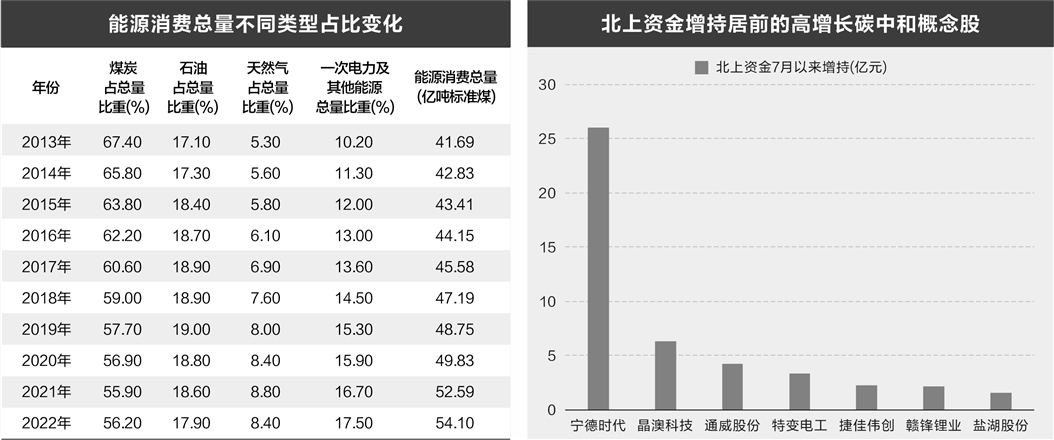
北上资金增持居前的高增长碳中和概念股 能源消费总量不同类型占比变化 ■ 北上资金7月以来增持(亿元) 30 25 20 15 10 5 0 宁德时代 晶澳科技 通威股份 特变电工 捷佳伟创 赣锋锂业 盐湖股份 | 净利润持续高增长的碳中和概念股一览 | | --- | | 代码 | 简称 | A股市值 | 年内 | 滚动 | | --- | --- | --- | --- | --- | | | | (亿元) | 涨跌幅 | 市盈率 | | | | | (%) | (倍) | | 600089 | 特变电工 | 810.60 | 9.25 | 4.64 | | 600438 | 通威股份 | 1531.12 | -4.51 | 5.26 | | 002460 | 赣锋锤业 | 935.40 | -15.24 | 6.04 | | 000792 | 盐湖股份 | 1051.26 | -14.72 | 7.36 | | 603185 | 弘元绿能 | 280.82 | -33.64 | 9.19 | | 002709 | 天赐材料 | 685.03 | -17.83 | 13.95 | | 002459 | 晶澳 ...



市场需求旺盛 光伏赛道景气度高
Xin Hua Wang· 2025-08-12 05:49
Group 1: Industry Performance - In the first half of 2023, 21 listed photovoltaic companies reported their performance forecasts, with 19 companies expecting profit increases, representing 90% of the total [1] - The production of polysilicon, silicon wafers, cells, and modules all saw over 60% year-on-year growth [1][8] - The forecast for new photovoltaic installations in China for 2023 has been raised from 95-120 GW to 120-140 GW, while the global forecast has been adjusted from 280-330 GW to 305-350 GW [1][8] Group 2: Company-Specific Highlights - JinkoSolar expects a net profit of 3.66 billion to 4.06 billion yuan, a year-on-year increase of 304.38% to 348.58%, driven by strong global demand and an increase in the proportion of advanced N-type products [2] - JunDa Co. anticipates a net profit of 900 million to 1.1 billion yuan, a year-on-year increase of 230% to 300%, with a significant rise in battery shipments [2] - GCL-Poly, Yichin Photovoltaic, JA Solar, and Aikang Technology reported substantial sales increases due to lower silicon prices and abundant component orders [3] Group 3: Equipment and Storage Sector - Inverter and equipment manufacturers also reported strong performance, with companies like DeYe Co. expecting a net profit of 1.3 billion to 1.38 billion yuan, a year-on-year increase of 188.58% to 206.34% [5] - Qingyuan Co. forecasts a net profit of 100 million to 120 million yuan, a year-on-year increase of 251.59% to 321.91%, driven by growth in overseas markets [5] - Oujing Technology expects a net profit of 385 million to 426 million yuan, a year-on-year increase of 318.05% to 362.57%, due to rising demand for quartz crucibles [6] Group 4: Market Trends and Future Outlook - The photovoltaic industry is experiencing a booming market, with significant growth in demand for N-type products leading to supply shortages [2] - The first half of 2023 saw 78.42 million kilowatts of new photovoltaic power generation, accounting for 56% of total new power installations [7] - The integration of photovoltaic technology with various industries is expected to create vast development opportunities for the sector in the future [8]
光伏行业一二级市场投融资火爆 产能过剩下掘金新技术
Xin Hua Wang· 2025-08-12 05:49
Core Insights - The photovoltaic industry has seen a surge in investment and expansion this year, with financing in the primary market reaching 90% of last year's total and over 130 billion yuan in refinancing plans from listed companies [1][2][4] - Despite the growth, concerns about overcapacity and declining prices across the supply chain persist, indicating a complex development stage for the industry [1][7] - The industry is experiencing a technological transformation, with a shift from P-type to N-type photovoltaic technologies, which is expected to drive new materials and processes [3][8] Financing and Investment - There have been 58 financing events in the photovoltaic sector this year, with major investments from top institutions and state-owned funds [2] - Notable unicorns in the industry include Yidao New Energy, valued at over 9 billion yuan after multiple funding rounds, and Zhengtai New Energy, valued at 13 billion yuan post-C round financing [2] - The total refinancing amount from 82 photovoltaic companies has exceeded 130 billion yuan, with significant contributions from companies like Tongwei Co. and Trina Solar [4][5] Market Demand and Production - The photovoltaic industry has achieved record production levels, with polysilicon, wafers, cells, and modules all seeing over 55% year-on-year growth in 2022 [2] - In the first quarter of this year, new installations reached 48.31 GW, and exports of photovoltaic modules grew by 40.11% year-on-year [2] - The industry is characterized by high demand and strong market expectations, driven by domestic and international market needs [3] Technological Advancements - The industry is at a critical juncture for technological innovation, with N-type technologies like TOPCon and HJT expected to dominate future developments [3][8] - Companies are under pressure to innovate and upgrade their technologies to remain competitive, as traditional P-type technologies approach their efficiency limits [8] - The need for new production capacity to meet demand for advanced technologies is driving significant capital investment [7][8] Challenges and Industry Dynamics - Overcapacity remains a significant concern, particularly in the context of traditional P-type cells, while the industry seeks to replace outdated capacities with new technologies [7] - The transition to a subsidy-free era for photovoltaic power generation necessitates continuous improvements in efficiency and cost reduction [8] - Companies are increasingly focused on expanding production capabilities to avoid being outpaced by competitors in a rapidly evolving market [8][9]