翰森制药

Search documents
6月18日汇添富医疗积极成长一年持有混合A净值增长0.63%,今年来累计上涨35.18%
Sou Hu Cai Jing· 2025-06-18 11:27
Group 1 - The core viewpoint of the news is the performance and holdings of the Huatai-PineBridge Medical Active Growth One-Year Holding Mixed Fund A, which has shown significant returns in various time frames [1] - As of June 18, 2025, the fund's latest net value is 0.6747 yuan, reflecting a growth of 0.63% [1] - The fund's performance over the past month has yielded a return of 16.12%, ranking 61 out of 4668 in its category [1] - Over the past six months, the fund has achieved a return of 31.70%, ranking 103 out of 4512 [1] - Year-to-date, the fund has returned 35.18%, ranking 89 out of 4534 [1] Group 2 - The top ten stock holdings of the fund account for a total of 56.30%, with the largest holding being Kelun-Botai at 9.63% [1] - Other significant holdings include BeiGene-U (8.84%), Kangfang Biotech (7.07%), and Betta Pharmaceuticals (5.98%) [1] - The fund was established on August 21, 2020, and as of March 31, 2025, it has a total scale of 1.68 billion yuan [1] Group 3 - The fund manager, Zheng Lei, has a background in social medicine and health management from Fudan University and has held various positions in the finance and investment sectors [2] - Zheng Lei has been with Huatai-PineBridge since November 2017 and has managed multiple funds, including the Huatai-PineBridge Medical Active Growth One-Year Holding Mixed Fund since its inception [2]
美国药监局宣布新方案,药品审查时间大幅缩短,港股医药ETF(159718)、医疗创新ETF(516820)助力把握全球创新药高速发展机遇
Xin Lang Cai Jing· 2025-06-18 06:12
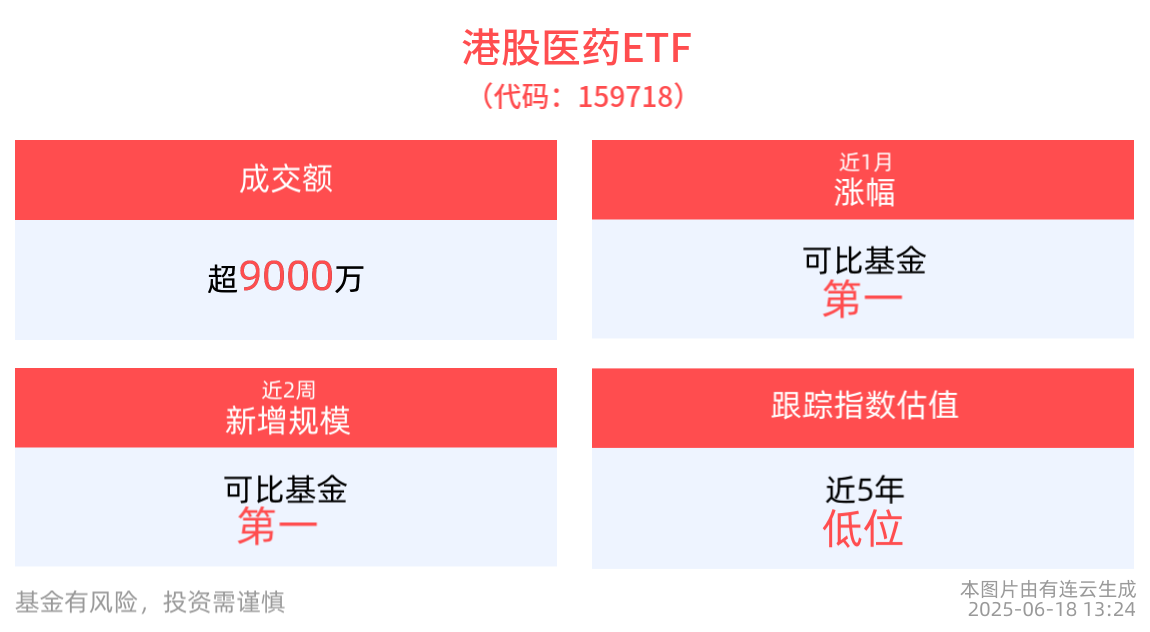
Group 1 - The core viewpoint of the news highlights the recent decline in the 中证港股通医药卫生综合指数 and the mixed performance of its constituent stocks, with 美中嘉和 leading the gains at 11.76% and 微创机器人-B experiencing the largest drop at 3.63% [1] - The 港股医药ETF has seen a recent decline of 0.84%, but over the past two weeks, it has accumulated a rise of 7.24%, ranking in the top 25% among comparable funds [1] - The liquidity of the 港股医药ETF is strong, with a turnover rate of 39.77% and a trading volume of 99.7363 million yuan, indicating active market participation [1] Group 2 - The FDA's introduction of the "Director's National Priority Review Voucher" program is expected to significantly shorten drug review times from the usual 10-12 months to 1-2 months, presenting unprecedented opportunities for the biopharmaceutical industry [2] - 中信建投证券 notes that China's innovative drugs are gaining global competitiveness, with the NewCo model emerging as a new choice for innovative drug companies to expand internationally [2] Group 3 - The 中证医药及医疗器械创新指数 has also seen a decline of 0.50%, with 艾力斯 leading the gains at 1.55% and 智飞生物 experiencing the largest drop at 2.63% [5] - The 医疗创新ETF has a recent trading price of 0.35 yuan and has accumulated a rise of 2.63% over the past month [5] - The latest scale of the 医疗创新ETF has reached 1.428 billion yuan, with continuous net purchases from leveraged funds over the past three days [5] Group 4 - The 中证医药及医疗器械创新指数 consists of 30 listed companies with good profitability and growth potential, reflecting the overall performance of the pharmaceutical and medical device sectors [7] - The top ten weighted stocks in the 中证医药及医疗器械创新指数 account for 66.57% of the index, with companies like 恒瑞医药 and 药明康德 being prominent [7] - The 港股医药ETF tracks the 中证港股通医药卫生综合指数, which includes 50 liquid and large-cap healthcare companies, with the top ten weighted stocks comprising 60.77% of the index [8]

恒生医疗ETF嘉实(159557)盘中交投活跃,最新规模创近1年新高!
Sou Hu Cai Jing· 2025-06-18 03:50
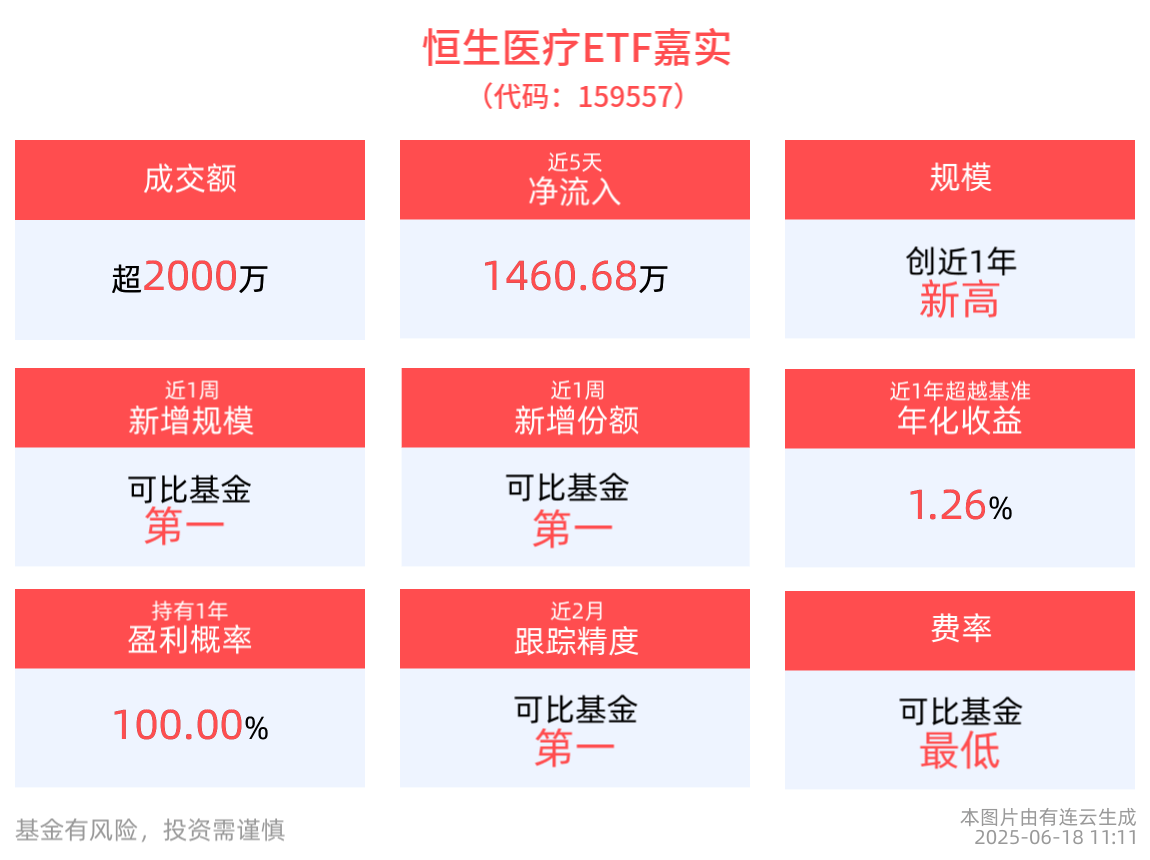
Group 1 - The Hang Seng Medical ETF managed by Harvest has shown active trading with a turnover of 10.03% and a transaction volume of 28.177 million yuan, indicating a vibrant market activity [3] - As of June 17, the latest scale of the Hang Seng Medical ETF reached 282 million yuan, marking a new high in nearly a year, with a significant increase of 13 million shares over the past week [3] - The net inflow of funds into the Hang Seng Medical ETF was 11.5645 million yuan, with a total of 14.6068 million yuan accumulated over the last five trading days [3] Group 2 - The Hang Seng Medical ETF has achieved a net value increase of 56.06% over the past year, ranking 15th out of 119 QDII equity funds, placing it in the top 12.61% [3] - The ETF's highest monthly return since inception was 23.84%, with the longest consecutive monthly gains being four months and a maximum cumulative increase of 35.08% [3] - The average monthly return during the rising months was 7.62% [3] Group 3 - The Hang Seng Medical ETF closely tracks the Hang Seng Healthcare Index, which reflects the overall performance of healthcare-related securities listed in Hong Kong [4] - The top ten weighted stocks in the Hang Seng Healthcare Index include Innovent Biologics, BeiGene, WuXi Biologics, CSPC Pharmaceutical Group, CanSino Biologics, China National Pharmaceutical Group, JD Health, 3SBio, Hansoh Pharmaceutical, and Zai Lab, collectively accounting for 58.13% of the index [4] Group 4 - The Hong Kong stock market has performed well this year, with institutional investors believing that external disturbances have limited impacts on the fundamentals, and corporate earnings remain resilient [6] - The combination of domestic growth stabilization policies and improved global liquidity conditions is expected to support the Hong Kong stock market, potentially leading to new highs [6] Group 5 - Wanlian Securities suggests focusing on opportunities in the innovative drug sector, emphasizing high technical barriers and rapid iteration in niche markets, while also considering companies' R&D and commercialization capabilities [7] - The outlook for domestic high-end equipment and key raw materials is promising, with a recovery in biotech financing expected to boost orders for CXO companies [7] - Investors without stock accounts can consider the Hang Seng Medical ETF Harvest Connect Fund (018433) to gain exposure to investment opportunities in the Hong Kong healthcare sector [7]
如何看待创新药波动?港股通创新药ETF(159570)连续4日调整,近11日大举吸金近26亿元!创新药的核心驱动:从盈利到BD爆发!
Xin Lang Cai Jing· 2025-06-18 02:54
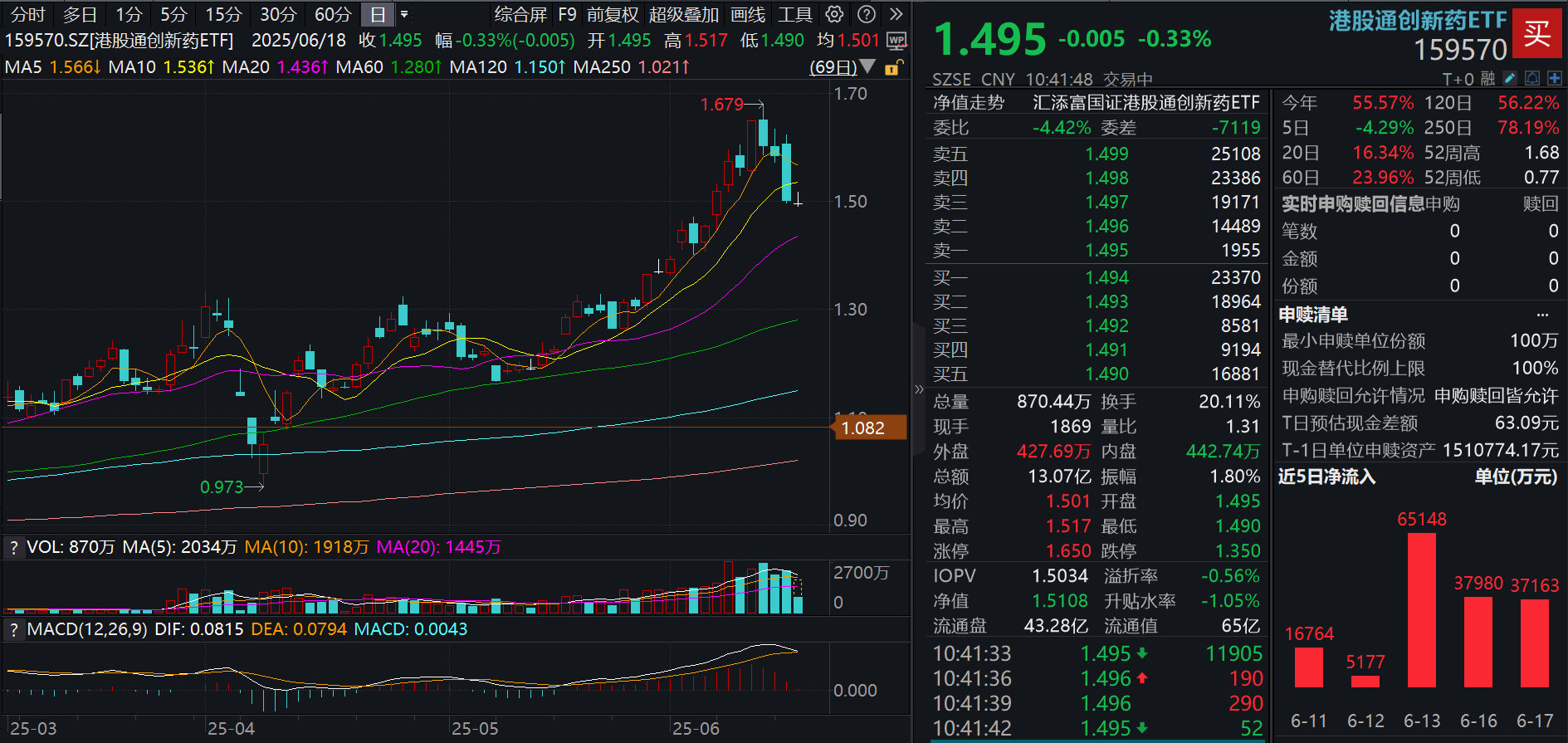
Core Viewpoint - The Hong Kong Innovation Drug ETF (159570) has shown significant market activity, with a recent inflow of nearly 2.6 billion RMB over 11 days, leading to a total scale exceeding 6.5 billion RMB, outperforming similar funds [1][3]. Group 1: Market Performance - The Hong Kong Innovation Drug ETF (159570) experienced fluctuations, initially rising over 1% before slightly declining, with a trading volume exceeding 1.3 billion RMB [1]. - The top ten weighted stocks in the ETF mostly experienced declines, with notable drops from WuXi Biologics, CSPC Pharmaceutical, and King’s Flair International, while Hansoh Pharmaceutical saw an increase [3]. Group 2: Investment Sentiment - Dongwu Securities attributes the recent strength in innovative drugs to strong fundamental support and a funding-driven approach, with a "FOMO" (Fear of Missing Out) sentiment accelerating market activity [3]. - The long-term outlook remains positive for innovative drug companies, particularly in a low-interest-rate environment, as they enter a phase of commercial realization [4]. Group 3: Industry Trends - The biotech industry in China is at a turning point, with leading companies beginning to achieve profitability, marking a transition into a new phase of business model validation [4]. - There is a growing trend of international collaboration, with domestic upfront payments for licensing deals exceeding 2.5 billion USD, indicating a robust market for business development (BD) [4]. - Continuous technological innovation is driving the industry upward, with new drug development in areas such as ADCs and dual antibodies leading to increased valuation of early-stage pipelines [4]. Group 4: Index Performance - The Hong Kong Innovation Drug ETF has shown superior performance compared to other medical indices, with a cumulative return of 104.46% from August 2020 to June 2021, significantly outperforming A-share medical indices [7]. - The ETF's underlying assets are exclusively in Hong Kong stocks, allowing for T+0 trading, which enhances liquidity and investment flexibility [12].
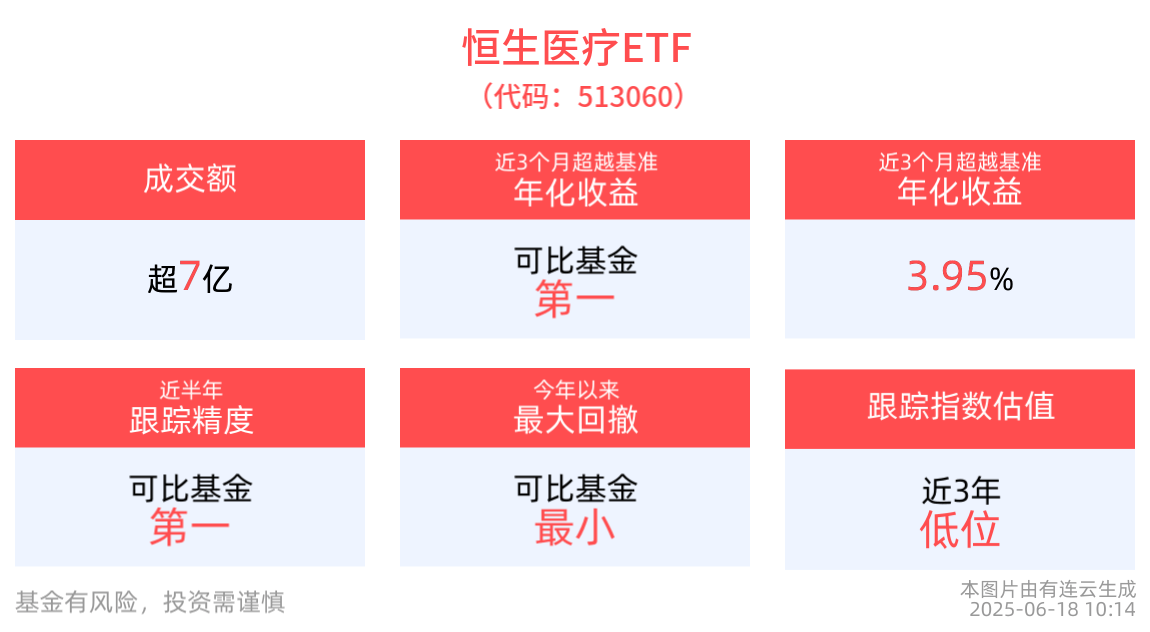
6月ADA盛会来袭,恒生医疗ETF(513060)成交额超7亿元
Sou Hu Cai Jing· 2025-06-18 02:33
Group 1 - The Hang Seng Healthcare Index (HSHCI) decreased by 1.12% as of June 18, 2025, with mixed performance among constituent stocks [3] - The top-performing stocks included Sipai Health (00314) up by 8.93%, and Health Road (02587) up by 6.54%, while MicroBrain Science (02172) led the decline at 4.25% [3] - The Hang Seng Healthcare ETF (513060) fell by 0.54%, with a latest price of 0.56 yuan and a turnover rate of 9.23% [3] Group 2 - The 85th American Diabetes Association (ADA) Scientific Sessions will take place from June 20-23, 2025, in Chicago, focusing on GLP-1 agonists as a research hotspot [3] - Chinese pharmaceutical companies are innovating around GLP-1 targets, including long-acting GLP-1 agonists and oral small molecule GLP-1 agonists [3] Group 3 - According to Aijian Securities, there is uncertainty in the US-China competition, but domestic "hard technology" and "strong demand" should be prioritized, particularly in innovative drugs [4] - The Hang Seng Healthcare ETF's latest scale reached 8.055 billion yuan, ranking in the top third among comparable funds [4] Group 4 - As of June 17, 2025, the Hang Seng Healthcare ETF had a one-year Sharpe ratio of 1.91, ranking in the top half among comparable funds [5] - The ETF's management fee is 0.50%, and the custody fee is 0.15% [5] Group 5 - The top ten weighted stocks in the Hang Seng Healthcare Index account for 58.13% of the index, with notable companies including Innovent Biologics (01801) and BeiGene (06160) [6]
创新药行情催生年内首只“翻倍基”!
2 1 Shi Ji Jing Ji Bao Dao· 2025-06-17 14:16
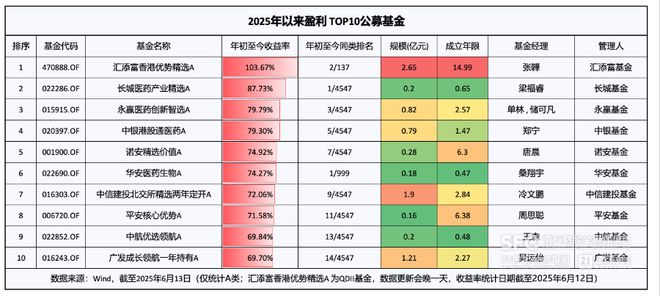
Group 1 - The first "doubling fund" in the public fund market for 2025 is the Huatai-PineBridge Hong Kong Advantage Selection A, which has achieved a 99.5% year-to-date return as of June 13, 2025, leading the entire market [1][2] - Among the top 10 funds for year-to-date returns in 2025, 8 are heavily invested in pharmaceutical companies, particularly in the innovative drug sector [1][2] - The innovative drug sector has seen significant growth, with the Wind Innovative Drug Concept Index rising over 25% and the Hang Seng Innovative Drug Index increasing over 53% since April 9, 2025 [2][3] Group 2 - Notable stocks in the innovative drug sector have experienced substantial price increases, with Shuyou Pharmaceutical leading at a 478.84% increase, followed by Sanofi Health at 129.81% [3][4] - The top-performing funds have a high concentration of investments in innovative drug companies, with the most frequently held stock being Kelong Biotechnology-B, which has also doubled in price [4][5] - Fund managers of the top-performing funds are predominantly new faces, with half of them having less than two years of investment experience [5][6] Group 3 - Zhang Wei, the manager of Huatai-PineBridge Hong Kong Advantage Selection A, has maintained a strong focus on the pharmaceutical sector, with the fund's top holdings consistently being in the biopharmaceutical industry [7][8] - The fund has shown resilience despite previous years of losses, with a significant recovery in 2025 attributed to the performance of its long-held innovative drug stocks [9][10] - Zhang Wei's investment strategy emphasizes long-term perspectives and stability in holdings, focusing on companies with global competitiveness and growth potential in the pharmaceutical and biotech sectors [10][11] Group 4 - The performance disparity among active equity funds in 2025 is notable, with 12 funds experiencing declines of over 20%, including several managed by Jin Zicai [13][14] - Jin Zicai's aggressive investment style has led to high turnover rates and concentrated positions, which can result in significant volatility [15][16] - The overall market sentiment towards innovative drugs remains positive, with expectations for continued growth driven by domestic medical demand recovery and supportive policies [10][11]


石药集团(01093):海外授权助力抵御业绩波动,创新研发持续推进
Huajing Securities· 2025-06-17 13:45
Investment Rating - The report maintains a "Buy" rating for the company with a target price of HK$10.59, representing a potential upside of 20% from the current price of HK$8.84 [1][8][18]. Core Insights - The company has faced revenue declines in its core pharmaceutical business but has offset some of this through strong licensing income, demonstrating its ability to commercialize its pipeline effectively [6][15]. - The report highlights a strategic partnership with AstraZeneca, which includes an upfront payment of US$110 million, indicating strong collaboration in innovative drug development [6][15]. - Adjustments to earnings per share (EPS) forecasts reflect a cautious outlook on the growth of the company's core generic drug business, with 2025 and 2026 EPS estimates reduced by 14% [2][11]. Financial Performance - The company reported a revenue of RMB 70.15 billion in Q1 2025, a year-on-year decline of 21.9%, while net profit was RMB 14.95 billion, down 8.3% [6][10]. - The revenue forecast for 2025 has been adjusted down to RMB 28.306 billion, a decrease of 12% from previous estimates, with a further decline expected in 2026 [12][15]. - The report anticipates a gross margin of 70% for 2025, slightly lower than previous forecasts, reflecting ongoing challenges in the market [11][12]. Research and Development - The company continues to invest in R&D, with expenditures reaching RMB 13 billion in Q1 2025, representing an 11.4% increase year-on-year [7][11]. - The R&D intensity remains high at 23.7% of revenue, indicating a strong commitment to innovation [7][11]. - The company has nearly 90 products in various stages of clinical development, with several already submitted for registration, enhancing future approval efficiency [7][11]. Valuation - The report employs a two-stage DCF model for valuation, adjusting the WACC to 8.5% and increasing the perpetual growth rate to 4% [8][17]. - The target price of HK$10.59 is based on the DCF analysis, suggesting that the current valuation does not fully reflect the company's growth potential in innovative drugs and licensing income [8][17]. - The company's projected P/E ratio for 2025 is 21, slightly above the industry average of 20, indicating a potential undervaluation relative to its peers [8][17].
半年达成14项许可交易!中国创新药拯救“专利悬崖”
第一财经· 2025-06-17 11:00
Core Viewpoint - Multinational pharmaceutical companies are increasingly seeking to convert tens of millions of dollars in upfront payments into treatment solutions worth billions, with Chinese innovative drugs becoming a focal point for competition [1][2]. Group 1: Market Trends - As of this year, U.S. pharmaceutical companies have signed 14 licensing agreements related to Chinese drugs, with a potential value of $18.3 billion, compared to only two agreements in the same period last year [1]. - By 2030, up to $200 billion worth of drugs will lose patent protection due to the expiration of numerous blockbuster drug patents, prompting multinational companies to seek new product lines to avoid the "patent cliff" [1]. - The pace of licensing agreements for Chinese innovative drugs is expected to accelerate, as multinational companies recognize the availability of high-quality assets at lower prices compared to similar products in the U.S. [1]. Group 2: Financial Implications - Licensing agreements allow companies to develop, produce, and commercialize drugs or technologies from other companies in exchange for future milestone payments, reducing development risks for sellers and providing protection for buyers [1]. - Although upfront payments may not be high, they can quickly supplement the R&D funding of selling companies, alleviating pressures from performance declines due to centralized procurement [2]. Group 3: Competitive Landscape - After receiving upfront payments, companies may face intensified competition, as buyers can cancel licensing agreements if clinical data shows abnormalities or if better alternatives emerge [3]. - In 2024, it is anticipated that one-third of the assets licensed by large pharmaceutical companies will come from China, with projections for this figure to rise to 40%-50% [3]. Group 4: Innovation and Investment - The value chain of Chinese biotech companies is increasingly improving, with China's share in global drug R&D nearing 30%, while the U.S. share has decreased to about 48% [3]. - Recent approvals from the U.S. FDA for drugs developed from Chinese companies indicate a shift towards more innovative therapies, including targeted cancer therapies and novel drugs [4]. - The recent surge in interest from U.S. investors in Chinese biopharmaceutical companies is reflected in the strong stock performance of several companies, with notable increases in share prices [4].

半年达成14项许可交易!中国创新药拯救“专利悬崖”
Di Yi Cai Jing· 2025-06-17 10:18
Group 1 - By 2030, patents for blockbuster drugs worth up to $200 billion are set to expire, prompting multinational pharmaceutical companies to seek new product lines to address the "patent cliff" [1][3] - There has been a significant increase in licensing agreements between U.S. pharmaceutical companies and Chinese drug developers, with 14 agreements signed this year alone, potentially valued at $18.3 billion, compared to only two agreements in the same period last year [1][3] - Mizuho Securities reports that multinational companies are discovering high-quality innovative drug assets in China, which are priced more competitively than similar products found in the U.S. [3] Group 2 - Licensing agreements allow one company to develop, produce, and commercialize another company's drugs or technologies in exchange for milestone payments, reducing development risks for sellers and providing protections for buyers [3] - Analysts indicate that the trend of Chinese innovative drugs being licensed abroad began in 2023, driven by the urgent need for foreign pharmaceutical companies to replenish their pipelines due to the patent cliff [3][4] - Chinese biotech companies are increasingly recognized for their value, with nearly 30% of global drug development attributed to China, while the U.S. share has decreased to about 48% [4] Group 3 - Recent reports indicate that multinational pharmaceutical companies are expanding their interest beyond small molecule drugs to include targeted cancer therapies and novel drugs, with some already receiving FDA approval [5] - The approval of drugs developed from Chinese companies is enhancing the strategic advantage for large pharmaceutical firms, allowing them to conduct efficient early-stage clinical trials in China [5] - The surge in interest for Chinese biopharmaceutical companies has led to significant stock price increases for several U.S.-listed Chinese biotech firms, with notable gains in companies like Zai Lab and BeiGene [5]
ETF热门榜:中证短融相关ETF成交居前,港股医疗ETF(159366.SZ)交易活跃-20250617
Xin Lang Cai Jing· 2025-06-17 10:07
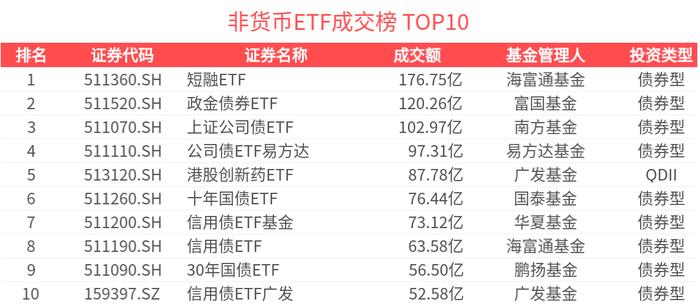
2025年6月17日,非货币类ETF合计成交2371.73亿元,其中有46只ETF成交额破10亿元。 截至今日收盘,短融ETF、政金债券ETF、上证公司债ETF成交额居市场前列,分别达176.75亿、120.26 亿、102.97亿。行业主题类ETF仅1只:港股创新药ETF。 截至今日收盘,港股医疗ETF、基准国债ETF、港股创新药ETF基金换手率居市场前列,分别达 585.68%、382.54%、177.66%。行业主题类ETF共计7只,分别是港股医疗ETF、港股创新药ETF基金、 恒生医疗ETF基金、恒生创新药ETF、恒生创新药ETF、港股通医药ETF、港股创新药ETF。 短融ETF(511360.SH)最新份额规模达4.26亿。该产品紧密跟踪中证短融指数,中证短融指数从银行间市 场上市的债券中,选取投资级短融作为指数样本,以反映相应评级短融的整体表现。 该ETF全天成交额较前一交易日增长24.67%,明显放量。该ETF近5日日均成交额为130.72亿,近20日日 均成交额90.08亿,近期明显放量。该ETF当日换手率较前交易日增长27.19%。该ETF近5日和近20日日 均换手率分别为27.14%、19 ...