小米

Search documents
56岁雷军财富暴增至3260亿元,年增近2000亿元涨幅151%,排名飙升14位跻身前五
Xin Lang Zheng Quan· 2025-10-28 07:21
Core Insights - The 2025 Hurun Rich List reveals that Lei Jun, founder of Xiaomi, has a net worth of 326 billion RMB, an increase of approximately 196 billion RMB, representing a growth rate of 151% compared to the previous year [1] - Lei Jun's ranking improved significantly from 19th to 5th place, marking his return to the top five for the first time in ten years [1] - Xiaomi's revenue for the first half of the year reached 227.2 billion RMB, a year-on-year increase of 38%, with a net profit of 21.5 billion RMB, up 70% [1] Company Performance - The automotive sector has emerged as a key growth driver for Xiaomi, with 157,200 vehicles delivered in the first half of the year, placing it among the top five new automotive forces in China, generating 21.3 billion RMB in revenue [1] - The IoT (Internet of Things) business generated 71 billion RMB in revenue, reflecting a year-on-year growth of 51%, and has become a major profit contributor, surpassing smartphone profits [1] - Smartphone revenue was reported at 96.1 billion RMB, with a global market share of 14.7%, ranking third, although there was a slight decline in revenue in the second quarter [1] Notable Rankings - Xiaomi had a total of 10 individuals listed in the Hurun Rich List this year, indicating a strong presence in the wealth rankings [1]

2025胡润百富榜:钟睒睒财富5300亿比去年增长1900亿,第四次成为中国首富!80%财富来源于农夫山泉,一年分红70亿
Sou Hu Cai Jing· 2025-10-28 07:10
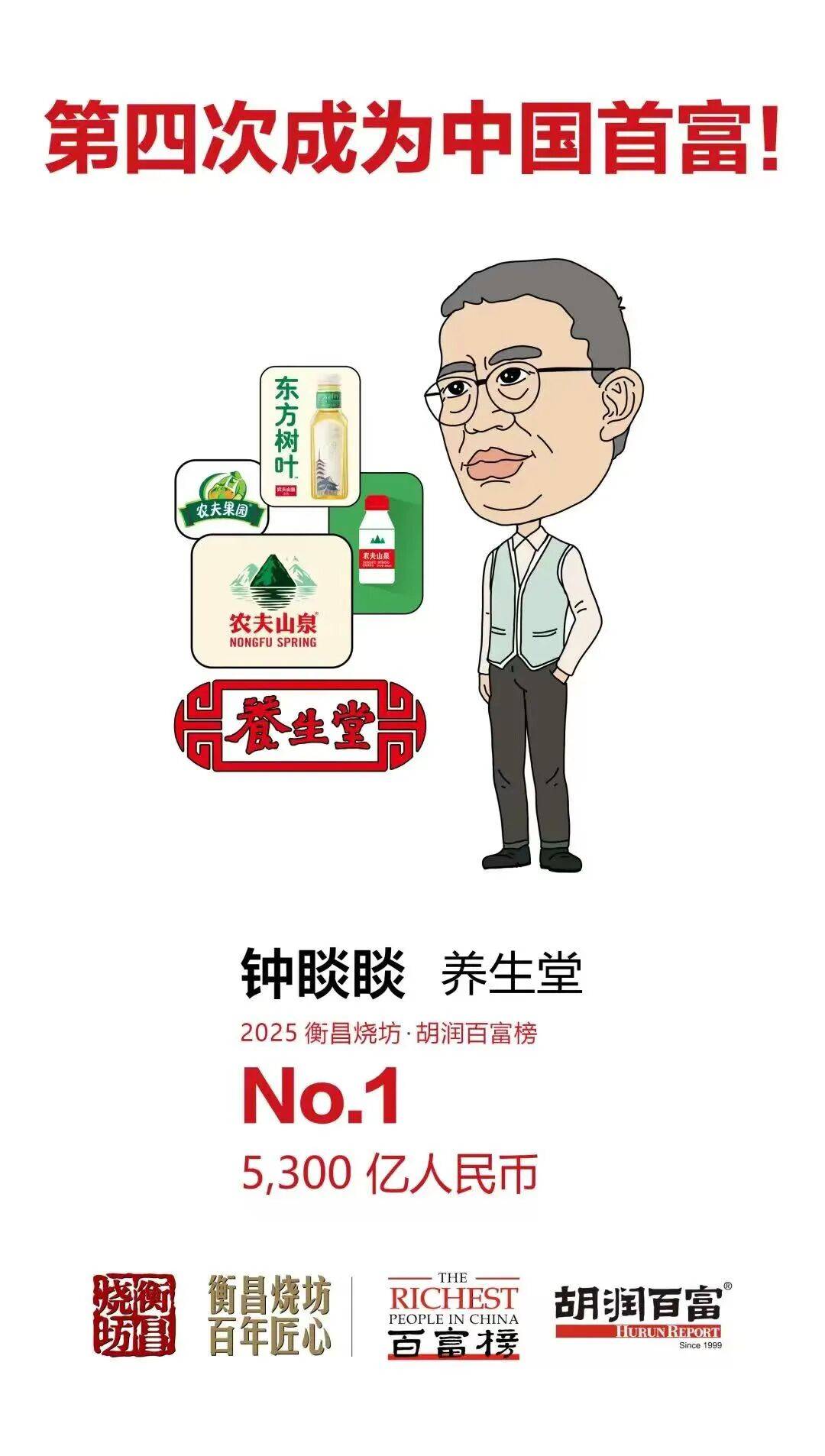
Core Insights - The 2025 Hurun Rich List reveals that Zhong Shanshan's wealth has increased by 190 billion RMB, reaching 530 billion RMB, making him the richest person in China for the fourth time and setting a new record for wealth among Chinese billionaires [1] - Zhong Shanshan's wealth grew by 56% compared to the previous year, and he is a representative of China's vast domestic market with a population of 1.4 billion [1] Company Performance - Nongfu Spring, led by Zhong Shanshan, maintains the top market share in China's packaged drinking water, with sales exceeding 25 billion RMB in the first half of the year, reflecting a year-on-year growth of over 15% [1] - The company has made significant progress in the tea beverage sector, with new brands like Dongfang Shuye contributing to overall performance growth [1] - The market capitalization of Nongfu Spring has reached a record high of 520 billion RMB, driven by overall market recovery and rapid performance growth [1] Wealth Distribution - Approximately 80% of Zhong Shanshan's wealth is derived from Nongfu Spring, highlighting the company's pivotal role in his financial success [1] - In the past year, Zhong Shanshan distributed over 7 billion RMB in dividends, indicating strong cash flow and profitability within the company [1]

2025胡润百富榜发布:钟睒睒5300亿四度蝉联中国首富,雷军财富暴涨1960亿成“增长王”
Guan Cha Zhe Wang· 2025-10-28 07:06
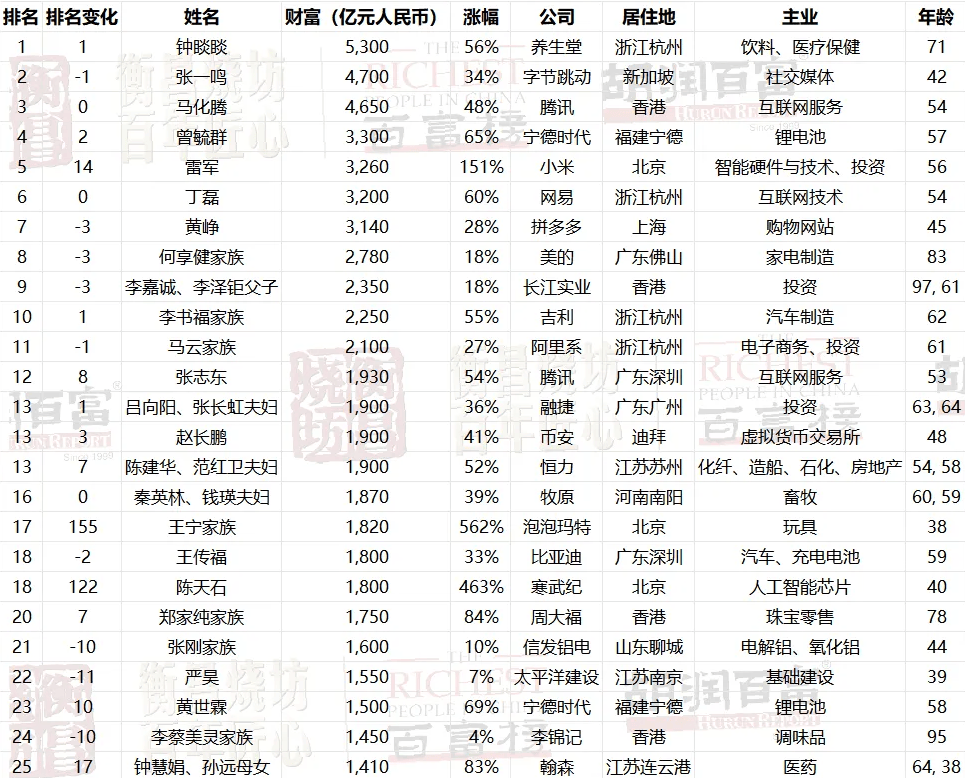
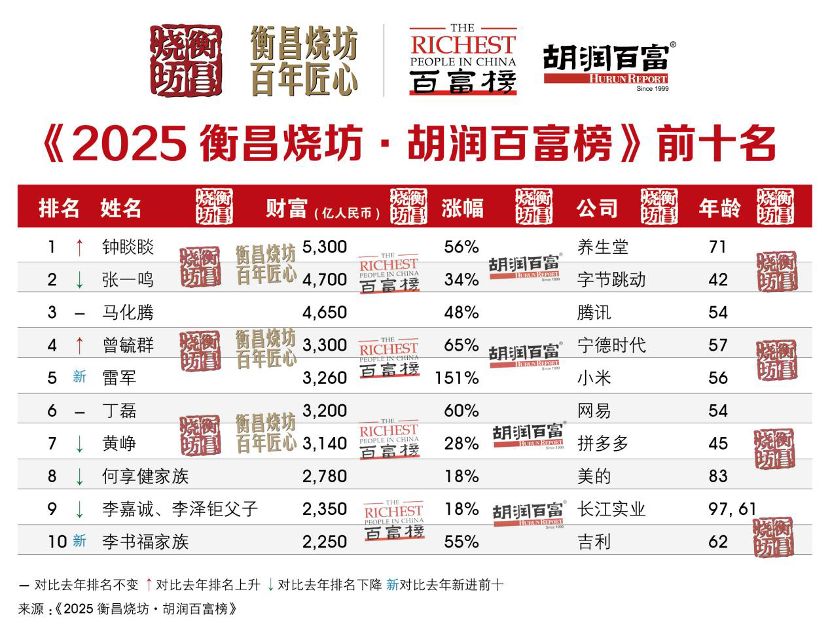
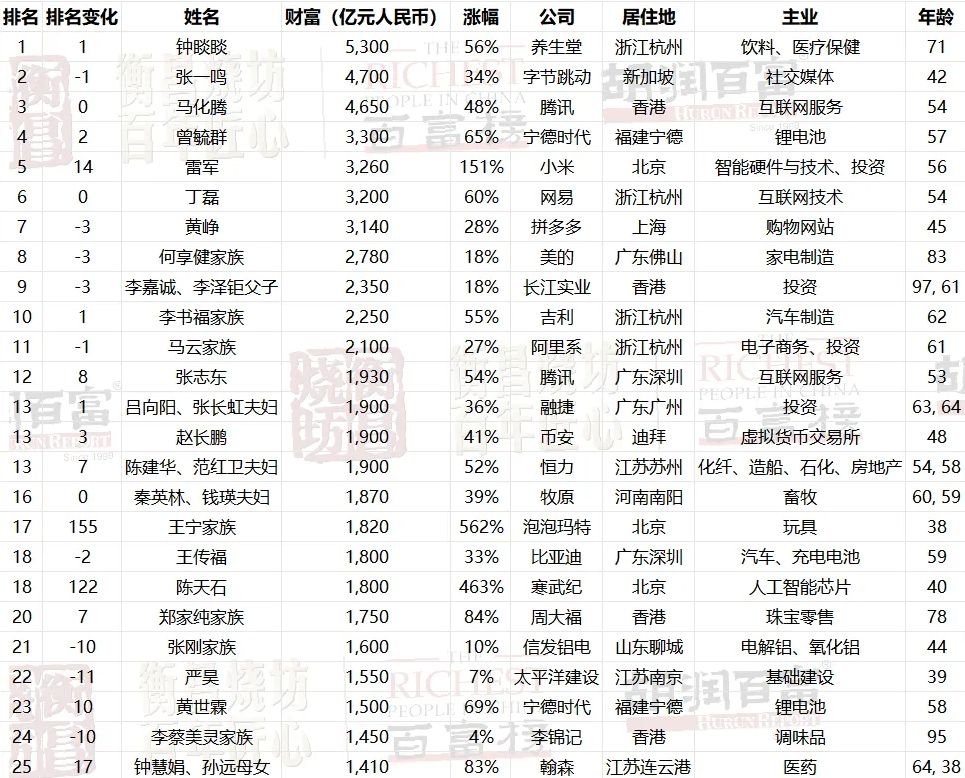
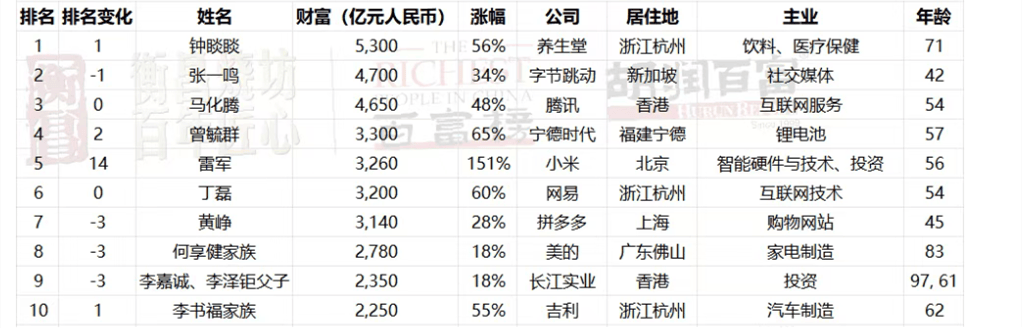
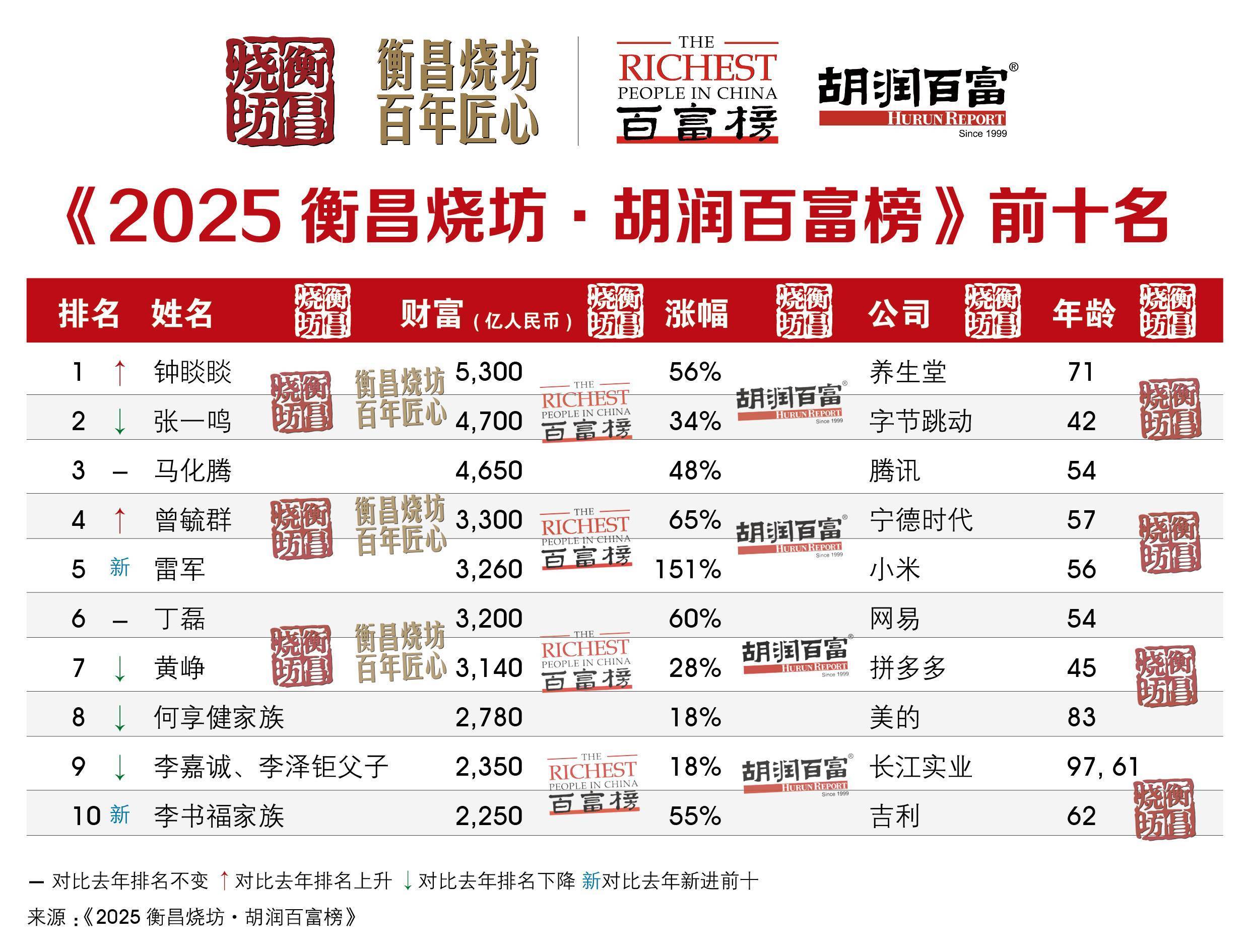
Core Insights - The 2025 Hurun China Rich List reveals significant wealth growth among top entrepreneurs, with the founder of Nongfu Spring, Zhong Shanshan, topping the list for the fourth time with a net worth of 530 billion RMB, marking a record high [1][4] - ByteDance's Zhang Yiming, last year's richest, saw his wealth increase by 120 billion RMB, placing him second with 470 billion RMB, while Tencent's Ma Huateng ranked third with a wealth increase of 150 billion RMB, totaling 465 billion RMB [1][3] - The list indicates a total of 1,434 individuals with wealth exceeding 5 billion RMB, a 31% increase from last year, and a total wealth close to 30 trillion RMB, reflecting a 42% growth [3][6] Group 1: Wealth Growth and Rankings - Zhong Shanshan's wealth increased by 190 billion RMB, while Zhang Yiming's grew by 120 billion RMB, and Ma Huateng's by 150 billion RMB [1][3] - The threshold for the top ten increased by 60 billion RMB to 225 billion RMB, with an average age of 62 years, which is three years younger than last year [3][4] - New entrants in the top ten include Lei Jun of Xiaomi and the Li Shufu family of Geely, with Lei Jun's wealth increasing by 196 billion RMB, marking a 151% growth [3][7] Group 2: Industry Insights - The food and beverage sector, represented by Zhong Shanshan, showed strong performance, with Nongfu Spring's stock price rising by 80% over the past year [6][7] - The technology sector also saw significant contributions, with Xiaomi's stock surging by 177%, contributing to Lei Jun's wealth increase [7] - The report highlights a shift in wealth concentration, with a notable decline in real estate entrepreneurs, indicating a changing landscape in the Chinese economy [6][8]
钟睒睒财富5300亿元比去年增长1900亿元,排名提升1位
Xin Lang Zheng Quan· 2025-10-28 06:57
Core Insights - Zhong Shanshan's wealth increased by 190 billion RMB, reaching 530 billion RMB, making him the richest person in China for the fourth time and setting a new record for wealth in the country [1][2] - His company, Nongfu Spring, maintains the largest market share in China's packaged drinking water, with sales exceeding 25 billion RMB in the first half of the year, reflecting a year-on-year growth of over 15% [1] - The company has made significant progress in the tea beverage sector, with new brands like Dongfang Shuye contributing to overall performance growth [1] Company Performance - Nongfu Spring's market capitalization has reached 520 billion RMB, driven by a recovery in the Hong Kong stock market and rapid growth in performance [1] - Zhong Shanshan's wealth is primarily derived from Nongfu Spring, accounting for 80% of his total wealth [1] - The company has been focusing on product premiumization and brand upgrading, representing a model for high-quality development among Chinese enterprises [1] Wealth Rankings - The 2025 Hurun Rich List shows Zhong Shanshan at the top, followed by Zhang Yiming with 470 billion RMB and Ma Huateng with 465 billion RMB [2] - The list highlights significant wealth increases among various entrepreneurs, with notable growth percentages, such as 151% for the Xiaomi founder [2]
雷军带队,小米汽车成立架构部,探索电车终局|36氪独家
3 6 Ke· 2025-10-28 06:52
Core Insights - Xiaomi Auto has announced a significant organizational restructuring, establishing a new primary department called the Architecture Department, which will focus on the next-generation technology architecture for smart electric vehicles [1] - The new department will report directly to Lei Jun and includes key personnel from the R&D department, indicating Xiaomi's commitment to forward-looking technological investments and its strategic positioning in the automotive market [1][6] Group 1: Organizational Changes - The restructuring includes the appointment of Cui Qiang to the Architecture Department, while Wang Zhensuo will take over as the head of vehicle development [1] - This move elevates the function of technology architecture to a primary department, which is uncommon in the industry where such roles are typically handled by secondary departments [1][6] Group 2: Strategic Importance of Technology Architecture - The establishment of the Architecture Department is crucial as it will influence the technological direction of Xiaomi's future products, which is vital for maintaining competitive advantage in the rapidly evolving automotive sector [1][2] - The automotive platform typically launches multiple models over a span of 3-5 years, making early technology decisions critical for long-term survival and competitiveness [2] Group 3: Industry Context and Challenges - The automotive industry is experiencing rapid technological advancements, but there are underlying uncertainties, particularly in electric vehicle technologies where companies like Xiaomi and BYD are competing on high-performance electric motors [3] - The industry faces pressure to deliver low-cost, competitive products in shorter cycles, leading to a trend of product homogenization, which may not be sustainable in the long run [7] Group 4: Xiaomi's Market Position and Performance - Since its establishment in 2021, Xiaomi Auto has positioned itself as a high-performance electric vehicle manufacturer, achieving significant sales milestones, including over 258,000 units for the SU7 and more than 40,000 units for the YU7 within three months of its launch [6] - The company aims to leverage its technological advancements to enhance its market image and drive sales growth, with expectations of achieving quarterly profitability in its automotive business [6] Group 5: Future Outlook - The restructuring is seen as a proactive measure to enhance Xiaomi's strategic foresight in technology trends, which is essential for navigating the competitive landscape of the automotive industry [6][8] - The effectiveness of this organizational change will depend on Xiaomi's ability to translate its technological explorations into viable products that meet market demands [8]
中国首富换人!71岁钟睒睒反超张一鸣,以5300亿元身价第四次登顶;雷军成为“增长王”,钟慧娟取代宗馥莉成为中国女首富
Sou Hu Cai Jing· 2025-10-28 05:08
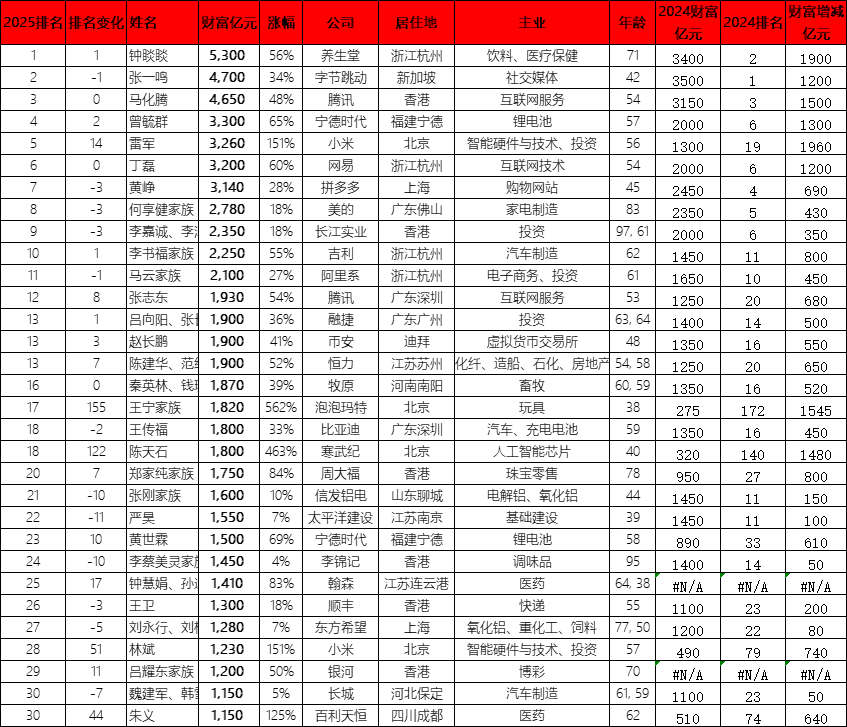
Core Insights - The 2025 Hurun Rich List was released, marking the 27th consecutive year since its inception in 1999, with the wealth calculation deadline set for September 1, 2025 [1] - The top three positions are held by Zhong Shanshan of Nongfu Spring, Zhang Yiming of ByteDance, and Ma Huateng of Tencent [1][3] - The total number of individuals with wealth exceeding 5 billion RMB reached 1,434, a 31% increase from the previous year, with total wealth nearing 30 trillion RMB, up 42% [2][3] Company Performance - Zhong Shanshan's wealth increased by 1,900 billion RMB, reaching 5,300 billion RMB, making him the richest person in China for the fourth time and setting a new record for wealth [3][6] - ByteDance's Zhang Yiming saw his wealth grow by 1,200 billion RMB to 4,700 billion RMB, driven by advancements in AI business [6][10] - Tencent's Ma Huateng's wealth rose by 1,500 billion RMB to 4,650 billion RMB, supported by growth in gaming, advertising, and fintech sectors [10][12] New Entrants and Trends - The list welcomed two new faces in the top ten: Lei Jun of Xiaomi and Li Shufu of Geely, with the threshold for entry raised by 600 billion RMB to 2,250 billion RMB [3][12] - The average age of the top ten billionaires is now 62, which is three years younger than last year [3] - The number of billionaires with wealth exceeding 1 billion USD increased by 268 to a total of 1,021 [2][3] Notable Wealth Increases - Lei Jun of Xiaomi was named the "growth king," with a wealth increase of 1,960 billion RMB, attributed to the explosive growth of Xiaomi's automotive business and high-end smartphone breakthroughs [12][14] - Other notable wealth increases include Wang Ning of Pop Mart, whose wealth grew by 1,545 billion RMB, and Chen Tian Shi of Cambricon, with an increase of 1,480 billion RMB due to AI chip advancements [12][14] Female Billionaires - The proportion of female entrepreneurs on the list decreased to 22.4%, with over 70% being self-made [16] - Zhong Huijuan of Hansoh Pharma became the richest woman in China, surpassing Zong Fuli of Wahaha, with a wealth of 1,410 billion RMB compared to Zong's 875 billion RMB [16][19]

2025胡润百富榜发布:钟睒睒以5300亿元登顶中国首富,雷军增长最快
Sou Hu Cai Jing· 2025-10-28 04:49
Core Insights - Zhong Shanshan has become the richest person in China for the fourth time with a wealth of 530 billion RMB, followed by Zhang Yiming, Ma Huateng, Zeng Yuqun, and Lei Jun in the top five [1][4] - The threshold for entering the top ten has increased by 60 billion RMB to 225 billion RMB, with an average age of 62 years, which is three years younger than last year [4] Group 1: Wealth Changes - Wang Ning from Pop Mart saw his wealth increase by over 150 billion RMB, entering the top 20 and ranking among the top three in wealth growth this year [1] - Lei Jun of Xiaomi is recognized as the "growth king," with his wealth increasing by 196 billion RMB, driven by explosive growth in Xiaomi's automotive business and breakthroughs in high-end smartphone profitability [5] - Other notable wealth increases include Chen Tian Shi from Cambrian, whose wealth grew by 148 billion RMB due to rapid performance in AI chips [5] Group 2: New Faces and Rankings - The top ten list welcomed two new faces: Lei Jun and Li Shufu from Geely [4] - The Zhejiang business community dominates the top ten with four representatives, while Guangdong has three, Fujian two, and Hubei one [4] - Last year's top ten member Jack Ma has dropped to 11th place, and the founder of Henderson Land, Lee Shau Kee, has passed away, with his sons taking over the business [4]
胡润百富榜公布!41名企业家资产超千亿元 | 名单
Sou Hu Cai Jing· 2025-10-28 04:38
Core Insights - The 2025 Hurun Rich List was released, marking the 27th edition since its inception in 1999, with wealth calculations as of September 1, 2025 [1] - A total of 1434 individuals with wealth exceeding 5 billion RMB were included, representing a 31% increase from the previous year [1] - The number of billionaires increased by 268 to reach 1021, while the number of billionaires worth over 100 billion RMB rose by 15 to 41 [1] Group 1: Top Billionaires - The threshold for the top ten increased by 60 billion RMB to 2250 billion RMB, with an average age of 62, which is 3 years younger than last year [1] - New entrants in the top ten include Lei Jun from Xiaomi and Li Shufu from Geely [1] - Jack Ma dropped to 11th place, while the late Li Ka-shing's sons ranked 44th [1] Group 2: Notable Wealth Increases - Zhong Shanshan's wealth grew by 190 billion RMB (+56%) to 530 billion RMB, making him the richest person in China for the fourth time [5] - Zhang Yiming's wealth increased by 120 billion RMB (+34%) to 470 billion RMB, placing him second [6] - Ma Huateng's wealth rose by 150 billion RMB (+48%) to 465 billion RMB, maintaining third place [6] Group 3: Industry Performance - Zhong Shanshan's company, Nongfu Spring, continues to lead the Chinese bottled water market with sales exceeding 25 billion RMB in the first half of the year, a 15% increase year-on-year [5] - ByteDance, led by Zhang Yiming, reported revenues exceeding 650 billion RMB in the first half of the year, a 25% increase, with AI business driving valuation growth [6] - NIO's stock surged, contributing to a 65% increase in the wealth of its founder, Zeng Yuqun, who ranked fourth with 330 billion RMB [7] Group 4: Regional Representation - Zhejiang entrepreneurs dominated the list with four representatives, including Zhong Shanshan and Ding Lei [1] - Guangdong entrepreneurs accounted for three spots, including Ma Huateng and He Xiangjian [1] - Fujian and Hunan also had notable representations with Zhang Yiming and Zhang Hongchao, respectively [1][10]
港股指数午间涨跌不一 半导体活跃 黄金股跌幅明显 两只新股上市大涨
Ge Long Hui· 2025-10-28 04:04
Group 1 - The Hong Kong stock market opened higher influenced by the overnight record highs in the US stock market, with the Hang Seng Index up 0.02% at midday [1] - The technology sector showed mixed performance, with Xiaomi continuing to decline by nearly 2%, while semiconductor stocks remained active due to favorable policies and high industry demand [1] - Two new stocks were listed in the Hong Kong market, with Dipu Technology rising over 120% and Bama Tea increasing by more than 63% [1] Group 2 - The Hang Seng Tech Index also saw a slight increase of 0.02%, indicating some resilience in the tech sector despite individual stock performance [1] - Gold prices fell below $3980, leading to significant declines in gold stocks, while copper and other non-ferrous metal stocks also experienced declines [1] - Airline stocks continued to rise, reflecting ongoing recovery trends in the aviation industry [1]
雷军财富增长1960亿跻身胡润榜第五,小米汽车业务成引擎
Bei Ke Cai Jing· 2025-10-28 03:29
Core Insights - Lei Jun's wealth increased by 196 billion yuan (+151%) compared to last year, making him the entrepreneur with the highest wealth growth this year, ranking fifth on the 2025 Hurun Rich List [1] - Xiaomi's revenue for the first half of the year reached 227.2 billion yuan, a year-on-year increase of 38%, with a net profit of 21.5 billion yuan, up 70% [1] - The automotive business has become a key growth driver for Xiaomi, delivering 157,200 vehicles in the first half of the year, ranking among the top five new energy vehicle manufacturers, generating 21.3 billion yuan in revenue [1] - The IoT (Internet of Things) business generated 71 billion yuan in revenue, a year-on-year increase of 51%, becoming a major profit contributor, surpassing smartphone profits [1] - Smartphone revenue was 96.1 billion yuan, with a global market share of 14.7%, ranking third, although revenue slightly declined in the second quarter [1] Company Performance - Xiaomi's overall revenue growth is driven by multiple segments, including automotive and IoT, indicating a diversified business model [1] - The significant increase in net profit suggests improved operational efficiency and cost management within the company [1] - The decline in smartphone revenue in the second quarter may indicate potential challenges in maintaining market share amidst competition [1] Wealth Ranking - Lei Jun's rise in the wealth ranking reflects not only his personal financial success but also the overall performance and market perception of Xiaomi [1] - The wealth growth of other entrepreneurs in the list, such as Zhang Yiming and Ma Huateng, indicates a competitive landscape among leading tech companies in China [1]