陕西煤业

Search documents
陕西煤业(601225)8月25日主力资金净流出5115.41万元
Sou Hu Cai Jing· 2025-08-25 15:52
Group 1 - The core viewpoint of the news is that Shaanxi Coal Industry Co., Ltd. has reported a decline in revenue and net profit for the first quarter of 2025, indicating potential challenges in its financial performance [1] - As of August 25, 2025, the company's stock price closed at 22.09 yuan, with a slight increase of 0.45% and a trading volume of 426,200 hands, amounting to 937 million yuan [1] - The company's total operating revenue for the first quarter of 2025 was 40.162 billion yuan, a year-on-year decrease of 7.30%, while the net profit attributable to shareholders was 4.805 billion yuan, down 1.23% year-on-year [1] Group 2 - The company has a current ratio of 1.083 and a quick ratio of 0.993, indicating its liquidity position [1] - The debt-to-asset ratio stands at 41.80%, reflecting the company's leverage [1] - Shaanxi Coal Industry has made investments in 44 companies and participated in 79 bidding projects, showcasing its active engagement in the market [2]

从财务及固定资产视角看价格支撑 - 煤炭成本专题研究
2025-08-25 14:36
Summary of Coal Industry Conference Call Industry Overview - The conference call focuses on the coal industry, specifically the production costs and financial pressures faced by coal companies [1][2][3]. Key Points and Arguments - **Rising Production Costs**: Coal companies have seen a steady increase in production costs over the years, with labor costs exceeding 20%, materials and power costs around 20%, depreciation and amortization costs between 10%-20%, and safety maintenance costs between 15%-20% [1][2]. - **Indirect Costs Decline**: The overall indirect cost rate in the coal industry has decreased, with management expenses being the largest component at approximately 8%. Employee compensation constitutes over 50% of management expenses [4]. - **Resource Tax Increases**: Resource tax is a significant part of the taxes and additional charges for coal companies, with some provinces raising resource tax rates to increase fiscal revenue. For instance, Shanxi raised its resource tax to 10% and Xinjiang to 9% [5]. - **Cost Increase from 2015 to 2023**: The average cost of thermal coal has increased by approximately 130 CNY/ton, while coking coal has risen by around 307 CNY/ton, with the latter experiencing a higher increase due to labor and safety costs [6][7]. - **Mining Rights and Construction Costs**: The price of mining rights has surged from 2-3 CNY/ton to 10-15 CNY/ton, and construction costs have risen from 500 CNY/ton to an average of 1,169 CNY/ton, with some regions exceeding 1,800 CNY/ton [3][10]. - **Financial Pressures**: New mines are expected to raise production costs by about 40 CNY/ton, with the average production cost of thermal coal now at approximately 130 CNY/ton, indicating limited room for cost reduction [11]. - **Comparison with 2015**: The current coal market differs significantly from 2015, with improved supply-demand dynamics and lower debt levels among coal companies, leading to a more stable financial environment [12][15]. - **Future Price Predictions**: The bottom price for coal is estimated to be around 610 CNY, with limited upward elasticity due to increasing renewable energy installations impacting demand [16]. - **Investment Recommendations**: Investors are advised to focus on leading companies with strong dividend yields above 4.5%, such as China Shenhua, Shaanxi Coal, and others, while also considering coking coal companies for potential gains [17]. Additional Important Information - **Labor Cost Drivers**: The rise in labor costs is attributed to the diminishing low-cost labor advantage, inflation-driven wage increases, and stricter safety regulations [9]. - **Tax and Additional Charges**: Taxes and additional charges account for about 10% of coal revenue, with resource tax being the most significant component [5]. - **Market Dynamics**: The coal market is currently experiencing a phase of temporary supply-demand imbalance, primarily due to seasonal factors like warm winters affecting electricity demand [14].
从福建煤矿事故看煤炭供给脆弱性
Changjiang Securities· 2025-08-25 05:12
Investment Rating - The report maintains a "Positive" investment rating for the coal industry [9]. Core Viewpoints - The recent coal mine accident in Fujian has raised concerns about the vulnerability of coal supply in China. The accident is expected to amplify local safety regulation efforts, potentially impacting coal supply. Despite this, stable demand and rigid supply constraints suggest that coal prices may continue to rise in the short term [2][7]. - The coal index (Yangtze) increased by 0.99% this week, underperforming the CSI 300 index by 3.19 percentage points, ranking last among all industries [6][14]. - The market anticipates that the upcoming "Golden September and Silver October" period will support coal demand, particularly as non-electric demand begins to pick up [6][7]. Summary by Sections Supply and Demand Overview - As of August 21, the daily coal consumption in 25 provinces was 6.427 million tons, up 8.0% week-on-week. The supply of coal was 6.324 million tons, an increase of 3.8% [31]. - The total coal inventory in these provinces was 119.798 million tons, a decrease of 0.4% from the previous week, with an available days supply of 18.6 days, down 1.6 days [31]. Price Trends - As of August 22, the market price for Qinhuangdao 5500 kcal thermal coal was 704 RMB/ton, reflecting a week-on-week increase of 6 RMB/ton (+0.86%) [38]. - The price for coking coal at Jingtang Port remained stable at 1610 RMB/ton [6]. Market Performance - The report highlights that the coal sector's performance has been mixed, with the thermal coal index rising by 1.09% and the coking coal index increasing by 0.76%, both underperforming compared to the CSI 300 index [14][18]. - The report identifies several companies with strong investment potential, including Yanzhou Coal Mining Company, Shanxi Coking Coal Group, and China Shenhua Energy [8]. Company Announcements - China Shenhua announced the approval of its Chongqing Wanzhou Power Plant expansion project, which will add 2×1000 MW capacity [52]. - Yanzhou Coal's Australian subsidiary reported a revenue of 2.675 billion AUD for the first half of 2025 [53]. Future Outlook - The report suggests that while daily consumption may gradually decline, the overall demand for coal remains robust, supported by seasonal factors and ongoing supply constraints [6][15]. - The focus will be on monitoring safety regulations and their impact on supply, as well as the performance of coal prices in the context of broader market conditions [7][8].



权益类ETF突破4万亿,大盘冲击3900点,不含银行地产的自由现金流ETF基金备受关注
Sou Hu Cai Jing· 2025-08-25 02:53
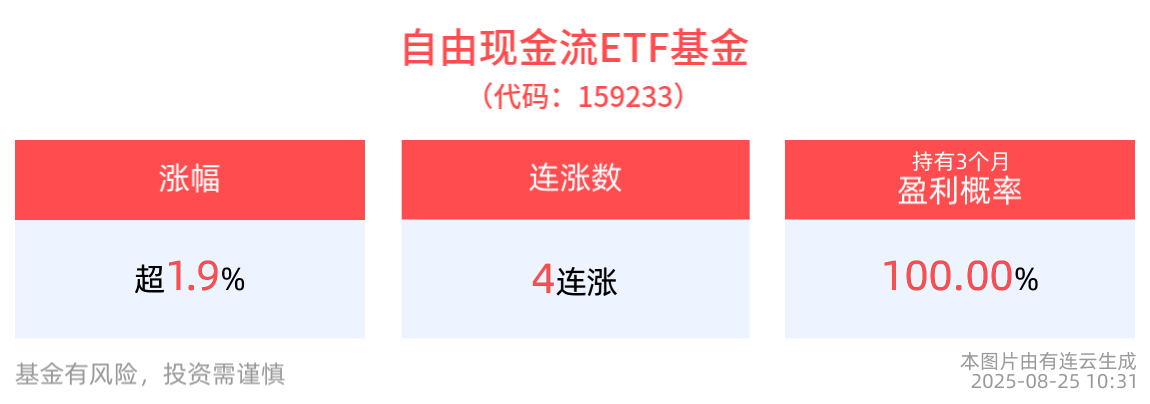
Core Insights - The Zhongzheng All Index Free Cash Flow Index (932365) has shown a strong increase of 1.84%, with notable gains in constituent stocks such as Mona Lisa (002918) up by 10.03% and Yaxiang Integration (603929) up by 10.01% [2] - The Free Cash Flow ETF Fund (159233) has also risen by 1.99%, marking its fourth consecutive increase, with a latest price of 1.13 yuan [2] - Over the past week, the Free Cash Flow ETF Fund has accumulated a rise of 1.19% as of August 22, 2025 [2] Performance Metrics - The Free Cash Flow ETF Fund has a turnover rate of 4.14% during the trading session, with a transaction volume of 3.92 million yuan [2] - The average daily transaction volume over the past year for the Free Cash Flow ETF Fund is 25.03 million yuan [2] - Since its inception, the fund's highest monthly return has been 4.04%, with a maximum consecutive monthly increase of 4.42% [2] Drawdown and Recovery - The maximum drawdown for the Free Cash Flow ETF Fund since inception is 3.28%, with a relative benchmark drawdown of 0.21% [3] - The recovery time after drawdown is 12 days, indicating a relatively quick recovery compared to comparable funds [3] Fee Structure - The management fee for the Free Cash Flow ETF Fund is 0.50%, while the custody fee is 0.10% [3] Tracking Precision - As of August 22, 2025, the tracking error for the Free Cash Flow ETF Fund year-to-date is 0.168% [3] - The fund closely tracks the Zhongzheng All Index Free Cash Flow Index, which selects 100 listed companies with high free cash flow rates to reflect the overall performance of companies with strong cash flow generation capabilities [3] Top Holdings - As of July 31, 2025, the top ten weighted stocks in the Zhongzheng All Index Free Cash Flow Index include China National Offshore Oil Corporation (600938), COSCO Shipping Holdings (601919), and Wuliangye Yibin (000858), collectively accounting for 57.53% of the index [3]

上半年盈利承压印证底部,煤价中枢有望稳步回升 | 投研报告
Zhong Guo Neng Yuan Wang· 2025-08-25 02:50
Core Viewpoint - The coal industry is currently in the early stages of a new economic cycle, with a combination of fundamental and policy factors supporting the sector. The report suggests that it is an opportune time to accumulate coal sector assets at lower prices [6]. Price Summary - As of August 23, the market price for Qinhuangdao port thermal coal (Q5500) is 702 RMB/ton, an increase of 7 RMB/ton week-on-week. The price for thermal coal from Yulin, Shaanxi remains stable at 630 RMB/ton, while the price from Dongsheng, Inner Mongolia is 535 RMB/ton, also stable. However, the price from Datong has decreased by 9 RMB/ton to 575 RMB/ton [2]. - Internationally, Newcastle NEWC5500 thermal coal FOB price is 71.0 USD/ton, up by 1.0 USD/ton week-on-week, while ARA 6000 kcal thermal coal price is 100.7 USD/ton, up by 6.2 USD/ton [2]. Production Capacity Utilization - As of August 22, the capacity utilization rate for sample thermal coal mines is 91.9%, a decrease of 2.0 percentage points week-on-week. In contrast, the utilization rate for sample coking coal mines is 85.21%, an increase of 1.5 percentage points week-on-week [3][6]. Consumption Trends - Coastal provinces have seen an increase in daily coal consumption, with a rise of 16.30 thousand tons/day (6.86%) week-on-week. Inland provinces also experienced an increase of 31.20 thousand tons/day (8.72%) week-on-week [4][6]. - Chemical coal consumption has increased by 6.83 thousand tons/day (1.00%) week-on-week, while the steel furnace operating rate has decreased to 83.4%, down by 0.23 percentage points [5][6]. Investment Insights - The coal sector is characterized by high performance, cash flow, and dividends, with a favorable long-term outlook. The report emphasizes the importance of investing in high-quality coal companies that demonstrate strong profitability and cash flow [7]. - The report suggests that the coal sector is currently undervalued, with a potential for valuation improvement as coal prices stabilize and rise. The sector is expected to maintain a tight supply-demand balance in the next 3-5 years, reinforcing the attractiveness of coal assets [6][7].
动力煤修复剑指第三目标750元,煤炭布局稳扎稳打行业周报 | 投研报告
Zhong Guo Neng Yuan Wang· 2025-08-25 02:28
Group 1 - The core viewpoint of the report indicates that the price of thermal coal has been rebounding, with the Qinhuangdao Q5500 thermal coal closing price reaching 704 RMB/ton as of August 22, marking a 15.6% increase from the lowest price of 609 RMB/ton in the first half of the year [1][2] - The supply side shows weakness due to production restrictions and rainfall in major coal-producing regions, with the operating rate of 442 coal mines in Shanxi, Shaanxi, and Inner Mongolia at 81.7%, which is still at a relatively low level for the year [1][2] - Port inventories have been declining, with the inventory in the Bohai Rim region at 23.274 million tons as of August 22, down 29.82% from the highest inventory of 33.163 million tons in the first half of the year [2] Group 2 - The demand side remains strong during the summer, with daily consumption at high levels, and the domestic methanol operating rate at 80.65%, which is among the highest in recent years [2] - Coking coal prices have also rebounded significantly, with the price at Jing Tang Port reaching 1610 RMB/ton, up from a low of 1230 RMB/ton in early July, and coking coal futures rising from 719 RMB to 1162 RMB, a cumulative increase of 61.61% [2] - The investment logic suggests that both thermal and coking coal prices are on the right side of the turning point, with expectations for further price recovery towards long-term contract prices [2] Group 3 - The report outlines four main investment lines in the coal sector, emphasizing the dual logic of cycles and dividends, with selected coal stocks expected to benefit from the current market conditions [3] - The first line focuses on cyclical logic with companies like Jinko Coal and Yanzhou Coal Mining, while the second line emphasizes dividend potential with companies like China Shenhua and China Coal Energy [3] - The third line highlights diversified aluminum elasticity with companies like Shenhua Holdings and Electric Power Investment, and the fourth line focuses on growth logic with companies like Xinji Energy and Guanghui Energy [3]
能源周报(20250818-20250824):下游刚需采购为主,动力煤市场价格小幅上涨-20250825
Huachuang Securities· 2025-08-25 02:15
Investment Strategy - The report highlights that global oil and gas capital expenditures are on a downward trend, leading to a slowdown in supply growth. Since the signing of the Paris Agreement in 2015, capital expenditures in the oil and gas upstream sector have significantly decreased, with a notable drop of nearly 22% from the 2014 peak [9][29]. - The report indicates that major energy companies are facing increasing pressure from policies aimed at carbon reduction, prompting them to shift focus towards energy transition and renewable projects. This trend is expected to continue, resulting in a sustained reduction in capital expenditures for oil and gas [9][29]. - The report notes that the active drilling rig count in the U.S. remains low, which may lead to a slowdown in U.S. oil production growth. The OPEC+ group is also expected to maintain limited supply increases in the coming year [9][29]. Oil Market - The Brent crude oil price is reported at $67.93 per barrel, reflecting a slight increase of 0.03% week-on-week, while WTI crude oil is at $63.13 per barrel, down 0.28% [31][30]. - The report mentions that geopolitical tensions, particularly the ongoing conflict in Ukraine, have contributed to fluctuations in oil prices, with expectations of resilient demand amid limited supply growth [10][29]. Coal Market - The report states that the average market price for Qinhuangdao port thermal coal (Q5500) is 703 RMB per ton, showing a week-on-week increase of 1.59%. The market is characterized by stable prices, with downstream demand primarily driven by essential purchases [11][12]. - Inventory levels at major ports are reported to be 23.336 million tons, down 1.27% week-on-week, indicating a tightening supply situation [11][12]. - The report highlights that domestic coal production is being affected by weather conditions, but overall supply remains sufficient to meet demand from power plants and the chemical industry [11][12]. Coking Coal Market - The report indicates that the coking coal market is currently in a stalemate, with prices for coking coal remaining stable at 1,610 RMB per ton. The market is influenced by fluctuating raw material prices and the profitability of downstream steel enterprises [14][15]. - The report notes that the average daily pig iron production from 247 steel mills is 2.4082 million tons, reflecting a slight increase of 0.04% week-on-week, which supports the demand for coking coal [14][15]. Natural Gas Market - The report highlights a breakthrough in natural gas helium extraction technology in China, with a new device achieving a helium purity level of 6N9. This development is expected to enhance the domestic helium supply [16][17]. - Natural gas prices in the U.S. have decreased, with the NYMEX natural gas average at $2.81 per million British thermal units, down 2.2% week-on-week [16][17]. Oilfield Services - The report emphasizes that the oilfield services sector is expected to maintain its growth due to government policies aimed at increasing oil and gas reserves. The capital expenditure for major oil companies is projected to remain high, supporting the oilfield services industry's outlook [18][19]. - The global active rig count is reported at 1,621, with a slight increase of 21 rigs week-on-week, indicating ongoing activity in the oilfield services sector [18][19].




高温带动7月用电超预期 原煤产量大幅转负 | 投研报告
Zhong Guo Neng Yuan Wang· 2025-08-25 01:24
Core Insights - The report highlights a significant increase in electricity consumption in July 2025, with total electricity usage surpassing 1 trillion kilowatt-hours for the first time, marking an 8.6% year-on-year growth [1][2][3] Electricity Sector - July 2025 saw a total electricity consumption of 10,226 billion kilowatt-hours, with the first, second, and third industries and urban-rural residents accounting for 1.7%, 58.0%, 20.4%, and 19.9% of the total, respectively [1][2] - The growth in electricity consumption is attributed to high temperatures, with the national average temperature reaching a historical high since 1961, leading to increased demand across various sectors [2][3] - Cumulative electricity consumption from January to July 2025 grew by 4.5% year-on-year, with the first, second, and third industries and urban-rural residents showing respective growth rates of 10.8%, 2.8%, 7.8%, and 7.6% [1][2] Coal Sector - In July 2025, raw coal production experienced a year-on-year decline of 3.8%, marking the first negative growth in nearly two years, primarily due to the "overproduction check" policy implemented by the National Energy Administration [5][6] - Coal imports fell significantly, with July 2025 imports at 35.61 million tons, a decrease of 22.9% year-on-year, and a cumulative decline of 13.0% for the first seven months of the year [6][7] - The domestic coal price has been under pressure, leading to a self-induced contraction in supply, with expectations that the price may stabilize above 700 yuan per ton, which could mark a new equilibrium in the coal market [7] Investment Recommendations - The report suggests focusing on long-term investments in hydropower and undervalued green energy stocks, as well as short to medium-term investments in resilient leading companies such as China Resources Power, Longyuan Power, and Chuanwei Energy [3][4][7] - Specific companies to watch include Xin Zhu Co., Ltd. and Yuanda Environmental Protection [4]
价格寻底,布局右侧 - 迎接煤炭新周期
2025-08-24 14:47
Summary of Key Points from Conference Call Industry Overview - The coal industry is currently experiencing a slowdown in price increases, with the current price at 704 RMB/ton. This is attributed to the peak expectations of capacity verification policies and poor mid-year performance from some listed companies, leading to increased selling pressure in the sector [1][3][4]. Core Insights and Arguments - **Production Decline**: In July, coal production in major producing areas decreased significantly, with a reduction of 35.07 million tons, a year-on-year decline of 11.3%. Xinjiang also saw a nearly 30% drop in production due to stricter safety checks and adverse weather conditions [1][6]. - **Short-term Price Pressure**: The coal price is expected to face a phase of adjustment from August 20 to the end of September due to three main factors: a decrease in daily consumption after the end of the hot season, the market's peak expectations regarding capacity control, and disappointing mid-year earnings reports from listed companies [3][4]. - **Supply Tightness**: Increased rainfall in major coal-producing areas and upcoming significant events (like military parades) are expected to tighten coal supply further. This could lead to increased imports, which may partially suppress price increases [1][8][9]. - **Demand Resilience**: Despite short-term pressures, demand for thermal coal remains high due to sustained high temperatures in the Yangtze River basin and a decrease in hydropower output, which supports thermal power demand. Non-electric coal demand is also expected to remain strong [9][10]. Investment Recommendations - **Investment Opportunities**: The current market conditions present a good opportunity for investment in the coal sector. It is suggested to focus on stocks with high elasticity, such as Lu'an Environmental Energy, North China Mining, Pingmei Shenma Energy, and Shanxi Coking Coal for coking coal, and Yanzhou Coal Mining for thermal coal [10][20]. - **Market Dynamics**: The absence of intermediaries in the coal market has increased price sensitivity, leading to a more responsive price mechanism during periods of sustained demand [17][19]. Policy and Structural Changes - **Logistics and Contracting**: The introduction of logistics outsourcing contracts by the National Railway Company has benefited large coal enterprises, as they can now secure long-term contracts and reduce logistics costs. This trend is expected to strengthen the competitive position of larger firms while pushing smaller traders out of the market [2][11][13][19]. - **Regulatory Environment**: The recent regulatory changes by the National Development and Reform Commission (NDRC) aim to standardize railway transport contracts, which will further consolidate market power among larger coal companies [14][19]. Additional Considerations - **Weather Impact**: The forecast indicates a significant increase in rainfall in key coal-producing regions, which could disrupt production and transportation, leading to tighter supply conditions [8][9]. - **Market Sentiment**: The overall sentiment in the A-share market is positive, with the Shanghai Composite Index reaching new highs, enhancing the attractiveness of coal sector investments despite the current challenges [7][20].
煤炭行业周报:持续大雨及查超产致产地供应偏紧,短期煤价震荡-20250824
Shenwan Hongyuan Securities· 2025-08-24 13:43
Investment Rating - The report maintains a "Positive" outlook on the coal industry, indicating an expectation for the sector to outperform the overall market performance [3]. Core Insights - The report highlights that the coal market is experiencing short-term price fluctuations due to supply constraints caused by heavy rainfall and production checks in key mining areas. It anticipates that coal prices will stabilize as temperatures drop across most regions [3]. - The report provides specific price data for thermal coal and coking coal, noting that while some thermal coal prices have decreased, others have seen slight increases. The overall trend suggests a mixed but stable pricing environment [3][10][12]. - The report emphasizes the importance of supply and demand dynamics, with increased daily coal inflow and outflow at the ports, leading to a decrease in coal inventory levels [21]. Summary by Sections Recent Industry Policies and Developments - The report discusses recent developments in coal mining projects and safety initiatives, including approvals for increased production capacities in certain regions [9]. Price Trends - Thermal coal prices have shown mixed results, with some prices remaining stable while others have increased slightly. Coking coal prices are expected to experience minor fluctuations before potentially rising again due to seasonal demand [10][12]. International Oil Prices - The report notes an increase in Brent crude oil prices, which may influence coal pricing dynamics. The relationship between international oil prices and coal prices is highlighted, with a noted increase in the ratio of oil to coal prices [17]. Port Inventory and Shipping Costs - The report indicates a decrease in coal inventory at the ports, with increased daily inflow and outflow rates. Shipping costs for domestic routes have also risen slightly, reflecting broader market trends [21][27]. Company Valuation - The report includes a valuation table for key companies in the coal sector, providing insights into their market performance and earnings projections. Companies such as China Shenhua and Shaanxi Coal are highlighted for their stable operations and high dividend yields [33].