
华宝

Search documents
安克创新(300866):纵览安克增长前景系列报告之五:如何看待储能板块增长势能?
Changjiang Securities· 2025-11-23 15:22
Investment Rating - The report maintains a "Buy" rating for Anker Innovations [10][12]. Core Insights - The report highlights the significant growth potential in the energy storage sector, driven by high electricity costs and instability in the US and European markets. Anker Innovations, as a pioneer in balcony solar storage, is well-positioned to benefit from this growth [6][10]. Summary by Sections Energy Storage Market Dynamics - High electricity costs and significant price volatility in the US and Europe create a persistent demand for energy storage products. Anker has been involved in the energy storage business since 2015 and achieved the top global sales in balcony solar storage in 2024, with a revenue of 3.02 billion yuan, representing a 184% year-on-year growth [6][22]. Portable Energy Storage - The portable energy storage market is expanding from outdoor applications to home backup needs. In 2024, global sales of portable energy storage products are expected to reach 9.2 million units, generating $3.8 billion in revenue, with a compound annual growth rate (CAGR) of 17.3% and 20.6% respectively from 2024 to 2029. Anker's market share is projected to be around 12% in 2024 [7][36][50]. Balcony Solar Storage - Balcony solar storage offers economic advantages over traditional home storage solutions, with policies in Germany driving rapid growth. In 2024, approximately 222,000 units are expected to be installed in Germany, a 97% increase year-on-year. Anker's market share in this segment is estimated at 75% in 2023 and 55% in 2024 [8][20][22]. Home Energy Storage - The demand for home energy storage remains strong, particularly in new markets like Australia, where government subsidies are enhancing market conditions. The CAGR for shipments in this segment is expected to be 21.4% from 2025 to 2030. Anker's home storage product, the Anker Solix X1, is noted for its superior specifications compared to competitors like Tesla [9][10][20]. Investment Recommendations - The report suggests that the energy storage sector is experiencing favorable market conditions, with Anker Innovations expected to maintain its competitive edge. Projected net profits for Anker from 2025 to 2027 are estimated at 2.657 billion, 3.198 billion, and 3.895 billion yuan, respectively, with corresponding price-to-earnings ratios of 20.80, 17.29, and 14.19 [10][12].

天府证券ETF日报-20251121
天府证券· 2025-11-21 09:13
Report Summary 1. Market Overview - On November 21, 2025, the Shanghai Composite Index dropped 2.45% to 3834.89 points, the Shenzhen Component Index fell 3.41% to 12538.07 points, and the ChiNext Index declined 4.02% to 2920.08 points. The total trading volume of A-shares in the two markets was 19839 billion yuan. The top sectors with the largest declines were Comprehensive (-5.50%), Non-ferrous Metals (-5.26%), and Power Equipment (-5.17%) [2][6]. 2. Stock ETFs - The top trading volume stock ETFs on that day were E Fund ChiNext ETF (down 4.03%, premium rate -3.93%), Huatai-PineBridge CSI 300 ETF (down 2.40%, premium rate -2.41%), and China AMC CSI A500 ETF (down 2.78%, premium rate -2.77%) [3][7]. - The top ten trading volume stock ETFs are presented in detail in Chart 1, including their codes, names, prices, price changes, tracking indices, premium rates, trading volumes, and latest share references [8]. 3. Bond ETFs - The top trading volume bond ETFs were HFT CSI Short-term Financing Bond ETF (down 0.00%, premium rate 0.00%), Bosera CSI Convertible and Exchangeable Bond ETF (down 0.77%, premium rate -0.88%), and BOC Shanghai Stock Exchange AAA Sci-Tech Innovation Bond ETF (up 0.02%, premium rate -0.21%) [4][9]. - Details of the top five trading volume bond ETFs, including codes, names, prices, price changes, premium rates, and trading volumes, are shown in Chart 2 [10]. 4. Gold ETFs - Gold AU9999 dropped 0.59% and Shanghai Gold fell 0.88% on that day. The top trading volume gold ETFs were HuaAn Gold ETF (down 0.84%, premium rate -0.72%), Bosera Gold ETF (down 0.79%, premium rate -0.68%), and E Fund Gold ETF (down 0.75%, premium rate -0.66%) [12]. - The top five trading volume gold ETFs are presented in Chart 3, including their codes, names, prices, price changes, trading volumes, IOPV, and premium rates [13]. 5. Commodity Futures ETFs - On that day, China AMC Feed Soybean Meal Futures ETF dropped 0.25% with a premium rate of 2.10%, CCB Yisheng Zhengzhou Commodity Exchange Energy and Chemical Futures ETF fell 0.75% with a premium rate of -0.76%, and Dacheng Non-ferrous Metals Futures ETF declined 0.61% with a premium rate of -0.93% [13]. - Details of commodity futures ETFs, including codes, names, prices, price changes, trading volumes, IOPV, premium rates, tracking indices, and tracking index price changes, are shown in Chart 4 [14]. 6. Cross-border ETFs - The previous trading day, the Dow Jones Industrial Average dropped 0.84%, the Nasdaq Composite fell 2.15%, and the S&P 500 declined 1.56%, while the German DAX rose 0.50%. On November 21, the Hang Seng Index dropped 2.38% and the Hang Seng China Enterprises Index fell 2.45%. The top trading volume cross-border ETFs were Huatai-PineBridge Hang Seng Tech ETF (down 1.91%, premium rate -2.39%), E Fund CSI Hong Kong Securities Investment Theme ETF (down 3.74%, premium rate -3.60%), and China AMC Hang Seng Tech ETF (down 1.87%, premium rate -2.12%) [15]. - The top five trading volume cross-border ETFs are presented in Chart 5, including their codes, names, trading volumes, price changes, and premium rates [16]. 7. Money Market ETFs - The top trading volume money market ETFs on that day were Silver HuaRiLi ETF, HuaBaoTianYi ETF, and CCB TianYi Money Market ETF [17]. - The top three trading volume money market ETFs are shown in Chart 6, including their codes, names, and trading volumes [19]. Core View The report provides a comprehensive overview of the performance of different types of ETFs on November 21, 2025, including stock, bond, gold, commodity futures, cross-border, and money market ETFs, along with the overall market situation of A-shares. Report Industry Investment Rating No industry investment rating information is provided in the report.
麦高视野:ETF观察日志(2025-11-20)
Mai Gao Zheng Quan· 2025-11-21 06:01
- The report introduces the **RSI (Relative Strength Index)** as a quantitative factor. The construction idea is to measure the relative strength of price movements over a specific period to identify overbought or oversold market conditions. The formula is: $ RSI = 100 - \frac{100}{1 + RS} $, where $ RS $ is the ratio of the average gain to the average loss over a 12-day period. An RSI > 70 indicates an overbought market, while RSI < 30 indicates an oversold market[2] - Another quantitative factor mentioned is **Net Purchase (NETBUY)**, which measures the net inflow or outflow of funds for ETFs. The formula is: $ NETBUY(T) = NAV(T) - NAV(T-1) \times (1 + R(T)) $, where $ NAV(T) $ is the net asset value on day $ T $, $ NAV(T-1) $ is the net asset value on the previous day, and $ R(T) $ is the return on day $ T $[2] - The report also tracks **Institutional Holdings** as a factor, which is derived from the latest annual or semi-annual reports of ETFs, excluding holdings by linked funds. This factor provides an estimate of institutional participation in the ETF[3] - The report includes **T+0 Trading** as a feature for certain ETFs, indicating whether same-day buy-and-sell transactions are allowed[2] - The report provides a detailed breakdown of ETF performance across various indices, including **broad-based indices** (e.g., CSI 300, CSI 500, CSI 1000) and **thematic indices** (e.g., semiconductor, renewable energy, artificial intelligence). Performance metrics include RSI, net purchase, and institutional holdings[4] - The **RSI values** for ETFs tracking broad-based indices range from 35.83 to 52.12, with thematic ETFs showing a wider range, such as 30.25 for robotics and 63.73 for banking[4] - **Net purchase values** vary significantly, with some ETFs showing large outflows (e.g., -10.82 billion for Nasdaq 100 ETFs) and others showing inflows (e.g., 10.01 billion for Hang Seng Technology ETFs)[4] - **Institutional holdings** also vary widely, with some ETFs having over 90% institutional participation (e.g., CSI 800 ETFs) and others below 20% (e.g., certain thematic ETFs like robotics)[4]
麦高视野:ETF观察日志(2025-11-19)
Mai Gao Zheng Quan· 2025-11-20 05:45
- The report includes the construction of the RSI (Relative Strength Index) factor, which is calculated using the formula: $ RSI = 100 - 100 / (1 + RS) $, where RS represents the ratio of average gains to average losses over a 12-day period. RSI values above 70 indicate an overbought market, while values below 30 suggest an oversold market [2] - The report also introduces the calculation of net subscription (NETBUY), defined as $ NETBUY(T) = NAV(T) - NAV(T-1) * (1 + R(T)) $, where NETBUY(T) represents the net subscription amount, NAV(T) is the ETF's net asset value on day T, and R(T) is the return on day T [2] - The report tracks various ETFs categorized into "Broad-based" and "Thematic" indices, such as CSI 300, CSI 500, and industry-specific indices like non-bank financials, dividends, and China internet sectors. It provides daily performance metrics, including RSI values, net subscription amounts, and institutional holding percentages [2][4][7] - The RSI factor is evaluated as a useful indicator for identifying market conditions, such as overbought or oversold states, aiding in short-term trading decisions [2] - The net subscription metric is assessed as a valuable measure for understanding fund flows and investor sentiment towards specific ETFs [2] - RSI values for various ETFs range from 11.05 to 77.25, reflecting diverse market conditions across different indices and sectors [4][7] - Net subscription values vary significantly, with some ETFs showing positive inflows while others exhibit outflows, indicating mixed investor sentiment across different funds [4][7]
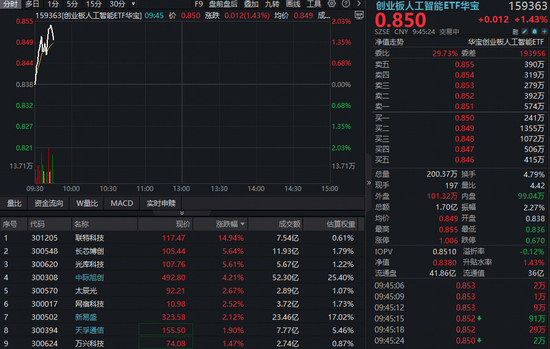
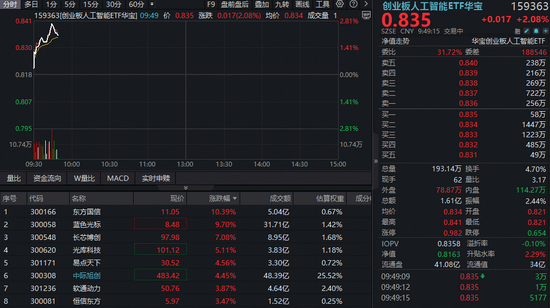
光模块CPO发力,创业板人工智能ETF(159363)再涨2%冲击三连阳!800G/1.6T光模块有望继续放量
Xin Lang Ji Jin· 2025-11-19 01:52
Core Viewpoint - The strength of optical module CPO and other computing hardware is highlighted, with significant gains in related stocks and ETFs, indicating a bullish trend in the AI and computing sectors [1][3]. Group 1: Stock Performance - LianTe Technology led the gains with over 13% increase, followed by Changxin Bochuang with over 5%, and several other stocks like Guangku Technology, Zhongji Xuchuang, Xinyi Sheng, and Tianfu Communication rising over 2% [1]. - The AI-focused ETF (159363) that contains over 54% optical module CPO saw an increase of nearly 2%, achieving a transaction volume exceeding 100 million CNY [1]. Group 2: Market Trends - The demand for 800G optical modules is expected to continue its rapid growth, with significant increases projected for 1.6T shipments and the commencement of 3.2T optical module development [3]. - The market is advised to focus on the first AI ETF tracking the ChiNext AI Index, which has a substantial allocation towards optical module leaders, capturing the AI theme effectively [3].





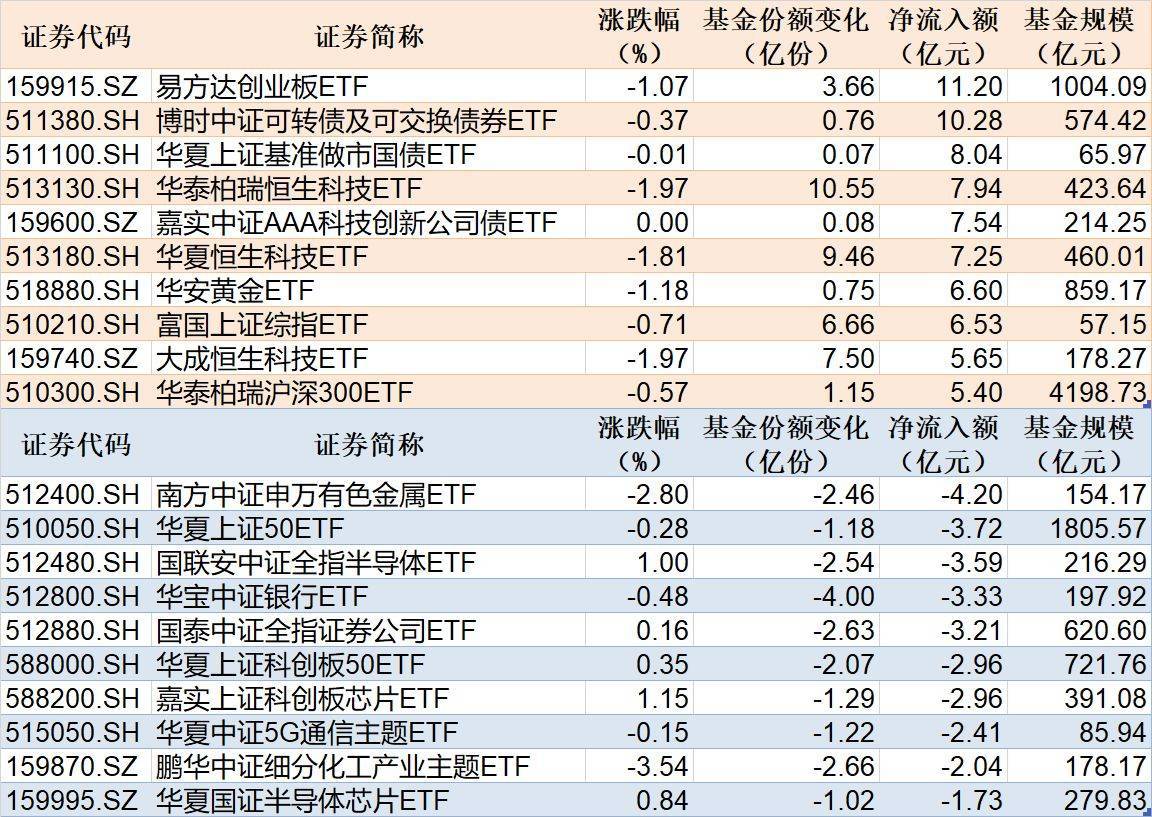
ETF规模速报 | 创业板ETF净流入超11亿元,有色金属ETF净流出超4亿元
Sou Hu Cai Jing· 2025-11-19 01:33
Market Overview - The market experienced fluctuations with the three major indices opening lower and declining throughout the day, with the Shanghai Composite Index and Shenzhen Component Index dropping over 1% [1] - AI application concepts rose against the trend, while semiconductor concepts showed active performance, and certain robotics stocks strengthened [1] ETF Market Activity - On November 18, the non-monetary ETF market saw significant inflows, with E Fund's ChiNext ETF increasing by 366 million shares and a net inflow of 1.12 billion yuan [1] - Other notable inflows included Bosera's convertible bond ETF with an increase of 76 million shares and a net inflow of 1.03 billion yuan, and Huaxia's SSE government bond ETF with an increase of 7 million shares and a net inflow of 804 million yuan [1] Fund Performance - The top-performing ETFs by net inflow for the month included: - Huaan Gold ETF with a net inflow of 5.12 billion yuan [4] - GF's non-bank financial theme ETF with a net inflow of 3.43 billion yuan [4] - Huatai-PineBridge's Hang Seng Technology ETF with a net inflow of 3.38 billion yuan [4] - The overall ETF market as of November 18 had a total of 32,079.33 billion shares and a total scale of 56,955.37 billion yuan [4] Sector and Theme Trends - The real estate sector saw the largest increase in ETF shares, with two funds tracking it [4] - The largest increase in thematic ETFs was in the China Securities Battery theme, with four funds tracking it [4] - The Hang Seng Technology index had the largest number of tracking funds, totaling 13, while the highest return index was the China Securities Semiconductor, which increased by 2.22% [4]
持有期基金成清盘主力 流动性风险不可不防
Zhong Guo Zheng Quan Bao· 2025-11-18 22:26
Core Insights - The number of public fund products (excluding asset management plans) that have been liquidated this year is approaching 200, with periodic open and holding period funds being the main contributors, accounting for over 40% of the total liquidated funds [1][3][4] - The survival space for actively managed equity funds continues to be squeezed due to the rapid development of index investing in recent years, with over 70 actively managed equity funds liquidated this year, representing nearly 40% of the total [2][3] - The design of holding period funds aims to reduce friction costs from investor behavior, but many investors have sacrificed liquidity without achieving satisfactory returns, leading to a poor investment experience [1][6][7] Fund Liquidation Trends - As of November 18, nearly 200 public funds have been liquidated this year, a decrease compared to the same period last year [2] - Among the liquidated funds, over 70 are actively managed equity funds, including various types such as mixed equity, flexible allocation, and balanced funds [2][3] - Notable liquidated thematic funds include those focused on carbon neutrality, advanced manufacturing, and healthcare, many of which were launched in 2022 and have net assets below 200 million yuan, triggering contract termination [2] Holding Period Fund Performance - Holding period funds, particularly those with fixed opening periods, have been the primary contributors to fund liquidations, with over 30 FOF products being affected [3] - Many fixed income products, including pure bond and "fixed income plus" funds, have also faced liquidation, with various terms ranging from 30 days to 30 months [3] - In the third quarter, the total number of holding period fund shares decreased by nearly 800 billion, with significant reductions in mixed equity and pure bond funds [4] Market Dynamics - Despite the overall decline, some categories of holding period funds, such as "fixed income plus" and FOFs, have seen growth, indicating a mixed market response [5] - The design of holding period funds is intended to limit frequent trading and enhance returns, but the actual investment outcomes are influenced by market conditions and fund management capabilities [6][7] - Investors are advised to carefully consider liquidity risks and the overall market environment when investing in holding period funds, as these factors can significantly impact their investment experience [6][7]
算力重拾涨势!创业板人工智能ETF(159363)反弹超2%!机构:AI带动的算力需求依然非常旺盛
Xin Lang Ji Jin· 2025-11-17 02:11
把握光模块等算力核心机会,建议重点关注全市场首只创业板人工智能ETF(159363)及场外联接(A 类023407、C类023408),标的指数重点布局光模块龙头"易中天",光模块含量超54%。从赛道分布 看,逾七成仓位布局算力,超两成仓位布局AI应用,能够高效捕捉AI主题行情。(截至2025.10.31) 数据来源:沪深交易所等。注:"全市场首只"是指首只跟踪创业板人工智能指数的ETF。 风险提示:创业板人工智能ETF华宝被动跟踪创业板人工智能指数,该指数基日为2018.12.28,发布日 期为2024.7.11。创业板人工智能指数2020-2024年年度涨跌幅分别为:20.1%、17.57%、-34.52%、 47.83%、38.44%,指数成份股构成根据该指数编制规则适时调整,其回测历史业绩不预示指数未来表 现。文中指数成份股仅作展示,个股描述不作为任何形式的投资建议,也不代表管理人旗下任何基金的 持仓信息和交易动向。基金管理人评估的本基金风险等级为R4-中高风险,适宜积极型(C4)及以上的 投资者,适当性匹配意见请以销售机构为准。任何在本文出现的信息(包括但不限于个股、评论、预 测、图表、指标、理论、 ...
A股七大资金主体面面观:从容有余,稳扎稳打
Tianfeng Securities· 2025-11-13 09:16
Group 1: Public Funds - In October, the newly established equity public fund shares amounted to 54.823 billion shares, a decrease of 42.384 billion shares from the previous month, placing it at the 86.11% percentile over the past three years [8][9] - The new issuance of active equity funds in October was 15.888 billion shares, down 13.947 billion shares month-on-month, while passive equity funds saw a new issuance of 22.538 billion shares, down 42.079 billion shares from the previous month [9][10] - Despite the decline in new fund issuance, the overall sentiment remains close to the high levels seen in June, influenced by recent U.S.-China trade agreements and expectations of increased market liquidity due to potential monetary easing by the Federal Reserve [8][9] Group 2: Private Securities Funds - As of September, the scale of private securities funds reached 5.97 trillion yuan, showing an upward trend compared to August [28] - The average position of private equity long-only strategies increased to 66.22%, up 2.40 percentage points from August, indicating a recovery in market risk appetite and investor confidence [30][31] Group 3: Northbound Capital - In October, the average daily trading volume of northbound capital was 258.308 billion yuan, a decrease of 16.80% from the previous month, with its share of total A-share trading falling to 11.94% [32][34] - The decline in northbound trading volume may be attributed to heightened trade tensions between the U.S. and China, leading to increased risk aversion among investors [32][34] Group 4: Margin Financing - As of the end of October, the total margin financing balance was 2.48 trillion yuan, an increase of 3.84% from the previous month, with the financing balance at 2.46 trillion yuan [36][37] - The net inflow of margin financing in October was 88.148 billion yuan, maintaining a high level of trading activity, supported by favorable market conditions and expectations of further easing measures [36][37] Group 5: Incremental Capital - In October, the number of new accounts opened on the Shanghai Stock Exchange showed a decline, with institutional accounts increasing by 10.48% year-on-year, while individual accounts decreased by 66.34% [45][47] Group 6: Insurance Funds - In Q2 2025, the net increase in equity assets held by property and life insurance companies was 261.914 billion yuan, although the growth rate of premium income has weakened [48][52] - Policies are being implemented to encourage large state-owned insurance companies to allocate 30% of new premiums to invest in A-shares starting in 2025 [48][52] Group 7: Bank Wealth Management - In October, the number of newly issued wealth management products was 4,900, a decrease of 27.98% from the previous month, with the proportion of newly issued equity products at 0.28%, down 0.39 percentage points [55][60] Group 8: Industrial Capital - In October, the net reduction in industrial capital was 30.529 billion yuan, with a daily average net reduction of 1.796 billion yuan, indicating a continued trend of net selling [62][64] - The upcoming release of lock-up shares in November and December may exert additional pressure on the market, particularly in the power equipment and electronics sectors [65][66] Group 9: Three Major Capital Flow Indicators - As of October 31, the three major capital flow indicators stood at 0.04, indicating a significant decline in trading activity and suggesting that major investors may be waiting for a new entry point [69][71]
年内上市ETF317只 同比增超136%
Zheng Quan Ri Bao· 2025-11-11 16:12
Core Insights - The launch of the Xinyi Zhongzheng Financial Technology Theme ETF on November 11 marks a significant milestone, bringing the total number of ETFs listed this year to 317, representing a year-on-year increase of 136.57% [1] Supply Acceleration - As of November 11, 317 ETFs have been listed this year, with a total scale of 541.174 billion yuan. This is a substantial increase compared to 163 and 156 ETFs listed in 2024 and 2023, respectively [2] - Key drivers for the surge in ETF listings include policy support, upgraded capital allocation needs, industry development trends, and accelerated product innovation [2] - Regulatory improvements, such as the establishment of a fast-track approval process for ETFs and the promotion of high-quality index investment development, have facilitated rapid product issuance [2] - The growing market demand for ETFs is driven by their transparent strategies, ease of trading, and low fees, making them increasingly popular among investors [2] Active Fund Allocation - ETFs are favored by various funds, including foreign capital and private equity, as effective tools for asset allocation [3] - Notable institutional investors in ETFs include foreign banks, brokerages, and private equity firms, indicating a diverse investor base [3] - The participation of long-term capital through ETFs is expected to foster a healthy ecosystem in the A-share market, enhancing market stability and international influence [3] Future Outlook - Over 1,300 ETFs are currently listed, with more expected to enter the market soon, as several public fund institutions have announced upcoming ETF listings [4] - The expansion of ETFs is anticipated to boost the trading activity of underlying assets, thereby enhancing market liquidity [4] - The increase in ETF listings and trading is expected to improve market liquidity and information transparency, leading to more rational and effective pricing [5]