
欧莱雅集团

Search documents
扬“链”上之帆,奏共赢乐章——第三届中国国际供应链促进博览会如约启幕
Xin Hua Wang· 2025-07-16 16:43
Core Insights - The third China International Supply Chain Promotion Expo has commenced with the theme "Linking the World, Creating the Future," emphasizing global cooperation and innovation in supply chains [1][5][6] Group 1: Event Overview - The expo is the world's first national-level exhibition focused on supply chains, showcasing a significant increase in international participation, with 651 companies from 75 countries and regions, and foreign exhibitors rising from 32% to 35% [2][5] - Notable returning participants include Apple and Cargill, while over 230 new companies are participating for the first time, highlighting the event's growing appeal [2][3] Group 2: Innovation and Technology - The expo features new products and technologies, with a focus on artificial intelligence and green technologies, as demonstrated by Nvidia's showcase of AI-driven solutions [3][4] - The event is expected to unveil over 100 new products, marking a 10% increase from the previous year, indicating a strong emphasis on innovation [4] Group 3: Global Collaboration - The "Beijing Initiative" released at the opening calls for enhanced collaboration among global businesses to leverage innovation and resource integration, positioning the expo as a key platform for building a resilient and efficient supply chain ecosystem [5][6] - Companies like Panasonic and Schneider Electric are leveraging the expo to deepen their integration with Chinese supply chains and promote sustainable practices [5]

半年盘点| 上半年化妆品卖了2291亿元,市场面临洗牌
Di Yi Cai Jing· 2025-07-16 10:33
Group 1 - The beauty industry is experiencing intense competition, leading major beauty groups to streamline their brand portfolios [1][4] - In the first half of 2023, the retail sales of cosmetics reached 229.1 billion yuan, with a year-on-year growth of 2.9%, while overall retail sales increased by 5.0% [1] - Many beauty brands, including Sasa International and Amorepacific's brands, have closed stores or exited the Chinese market, indicating a challenging operating environment [2][3] Group 2 - The closure of brands like SHIHYO and TATCHA reflects the increasing operational costs and competitive pressures in the Chinese market [3][4] - Domestic beauty companies are increasingly attracted to the capital market, with several companies planning IPOs in 2023 [5][6] - The trend of seeking capital market support is seen as a strategic move for domestic beauty companies to enhance their growth prospects [7]
溢价能力不足 国产化妆品亟待价值升维
Zhong Guo Chan Ye Jing Ji Xin Xi Wang· 2025-07-14 23:38
Core Insights - The Chinese cosmetics market has surpassed 1 trillion yuan for two consecutive years, with domestic brands holding a 55.2% market share over international brands [1][2] - The total retail scale of the Chinese cosmetics market is projected to reach 1,073.822 billion yuan in 2024, with the top 50 brands accounting for 21.74% of the market [1] - Despite the numerical advantage of domestic brands, their quality and pricing power remain significantly lower than that of international giants [2] Market Overview - The top 50 brands include 22 Chinese brands, averaging a retail scale of 4.116 billion yuan, while American brands average 5.619 billion yuan [1][2] - The market is highly fragmented, with the top 10 brands only accounting for 20.41% of the total market, indicating a competitive landscape where no single brand dominates [3] Challenges for Domestic Brands - The primary challenge for domestic cosmetics companies is achieving high-quality development and establishing high-end brands [2] - The reliance on quantity rather than quality for market share is evident, as the top 50 list shows that Chinese brands are not leading in sales volume among high-revenue categories [2] Innovation and Technology - Technological innovation is identified as a key competitive weapon for both domestic and international brands, with companies increasing investment in core materials and research [4] - Major companies like L'Oréal invest over 3% of their total revenue in R&D annually, emphasizing the importance of innovation in meeting consumer needs [4] Market Segmentation - The emergence of niche markets, such as the silver economy and male skincare, presents new opportunities for growth, with specific segments showing significant sales increases [5][6] - Brands focusing on extreme segmentation and targeted marketing are finding success in areas overlooked by larger competitors [6] Future Directions - The industry is urged to enhance R&D investment, explore cutting-edge technologies, and integrate cultural elements into product development to elevate brand value [6] - Emphasizing sustainable practices and consumer engagement in ESG initiatives is seen as crucial for the high-quality development of the cosmetics industry [6]
总裁们纷纷做“价值功课”,市场地位评价为何引发高度重视?
FBeauty未来迹· 2025-07-10 13:59
Core Viewpoint - The establishment of the market position evaluation system by the China Fragrance and Cosmetic Industry Association marks a significant shift in the Chinese cosmetics industry, emphasizing brand building and long-term value over mere sales figures [2][3][4]. Group 1: Market Position Evaluation System - The new market position evaluation system aims to promote brand building and support companies that adhere to long-term value principles, rather than simply ranking based on sales [4][5]. - The evaluation system is based on a comprehensive data collection process, including online and offline retail channels, and involves multiple verification steps to ensure accuracy [8][11]. - The system's key indicators include total retail sales (weighted at 70%) and brand accumulation (weighted at 30%), with a strict one-vote veto policy for brands with significant quality issues [11][12]. Group 2: Industry Insights and Trends - The Chinese cosmetics market has maintained a scale exceeding 1 trillion yuan, with projected market sizes of 1,044.55 billion yuan for 2023 and 1,073.82 billion yuan for 2024 [4]. - The top 50 brands accounted for 21.74% of the total retail sales in 2024, with 22 Chinese brands making the list, reflecting the rapid rise of local brands due to their adaptability to online channels [30][32]. - Despite the progress, Chinese brands still face challenges in achieving quality upgrades, as they primarily occupy the lower segments of the market structure [32][33]. Group 3: Industry Response and Future Directions - The release of the evaluation results has generated significant media attention and industry response, with many executives recognizing the importance of brand value in a changing market landscape [15][17][19]. - Companies are focusing on enhancing their brand value through technological innovation, quality control, and organizational evolution, as emphasized by industry leaders [34][35]. - The association aims to create a systematic approach to promote high-quality development across the entire cosmetics industry, advocating for a shift from a "tack" structure to an "olive" structure, which would support the growth of mid-tier companies [33][37].


厦门帮美妆“大换血”
Xin Lang Cai Jing· 2025-07-08 02:57
Core Insights - The sales momentum from the 618 mid-year shopping festival appears to have been "overdrawn" in May, leading to a decline in sales for June [1] - Major platforms like Douyin and Kuaishou show a significant drop in sales for beauty and skincare brands compared to May, indicating a potential shift in consumer behavior [1][10] Beauty and Skincare Sales - In June, Douyin's beauty and skincare brands had 36 brands estimated to reach sales of 100 million yuan, a decrease of 26.5% from 49 brands in May [1] - Kuaishou's top 500 beauty and skincare brands had an estimated total sales of 1.335 billion yuan, down 19.77% from May [1] - The top beauty and skincare brands on Tmall saw international brands occupying 13 out of the top 20 spots, with Mistine being a new entrant [4][5] - Notably, the domestic brand Pechoin rose 21 places in the rankings, attributed to the popularity of its collagen water mask [6] Brand Rankings - The top beauty and skincare brands on Douyin in June included KANS, PROYA, and L'OREAL, all estimated to exceed 100 million yuan in sales [8] - Kuaishou's top brand, Guyu, had an estimated sales of approximately 71.34 million yuan, indicating a significant gap between the top brands and others [10] - The Tmall beauty and skincare sales rankings showed a decline in international brands, with some dropping out of the top 20 [4][12] Influencer Marketing - The number of influencers achieving over 100 million yuan in sales dropped by 61% compared to May, indicating a decline in influencer effectiveness [19] - New influencers like Li Baobao emerged, achieving over 100 million yuan in sales with less than 200,000 followers, showcasing a shift in the influencer landscape [21] Consumer Behavior - The overall performance during the 618 shopping festival did not meet expectations, suggesting that consumers' enthusiasm for major promotions may be waning [23] - The extended duration of the 618 event may have contributed to consumer fatigue, impacting sales performance across platforms [23]
近60起,美妆投融资热潮来了!
Sou Hu Cai Jing· 2025-07-03 07:12
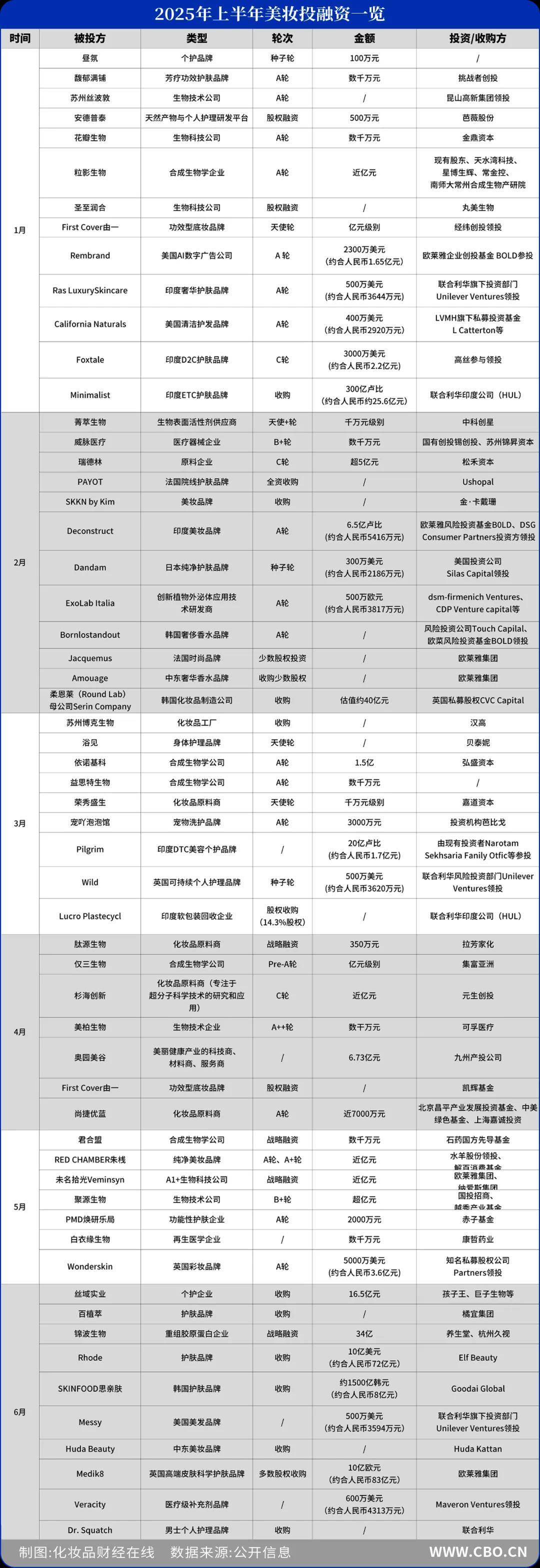
Core Insights - The beauty industry is experiencing significant activity in mergers and acquisitions, with notable transactions such as Unilever's acquisition of Dr. Squatch and the investment by Zhong Shanshan in Jinbo Biotechnology [1][12] - International giants like Unilever and L'Oréal are leading the charge in strategic mergers to enhance their brand portfolios and technological capabilities, particularly in emerging markets like India and the Middle East [1][10][12] - The trend of high-value transactions is evident, with 21 deals exceeding 100 million yuan and 6 deals over 1 billion yuan, highlighting the industry's robust investment landscape [1][12] Investment Trends - There were 58 beauty-related investment activities in the first half of the year, including 14 acquisitions, indicating a vibrant investment climate [1][12] - The focus on synthetic biology and biotechnology continues to attract capital, with companies in these sectors receiving significant funding [3][24] - The investment landscape is characterized by early-stage financing, with seed, angel, and A-round investments being predominant [12][24] Regional Focus - India, South Korea, and the Middle East are emerging as key markets for international capital, driven by their rapid growth and unique consumer preferences [12][13][17] - The Middle East beauty market is projected to grow significantly, with a current market size of $40 billion expected to exceed $60 billion by 2025 [15][17] - South Korea is becoming a major supplier of beauty products to the U.S. and Japan, with a market share of 22.2% in the U.S. [15] Company Strategies - Unilever is focusing on expanding its brand matrix in personal care and skincare, with recent acquisitions aimed at entering high-growth segments [8][10] - L'Oréal is investing in technology-driven companies and high-end brands, such as the acquisition of Medik8 for 1 billion euros, to strengthen its position in the skincare sector [10][12] - Domestic companies like Water Sheep and Betaini are actively participating in industry chain investments and acquisitions, indicating a trend towards ecosystem enhancement [12][24] Market Dynamics - The demand for functional and effective products is driving investment in brands that offer clear positioning and innovative solutions [24][26] - Emotional value and consumer experience are becoming critical factors in investment decisions, with brands that provide significant emotional engagement attracting capital [21][24] - The rise of niche markets and specific application scenarios is also influencing early-stage financing, as companies seek to address unique consumer needs [23][24]

刚刚过去的618,抖音美妆大洗牌
Xin Lang Cai Jing· 2025-07-02 03:59
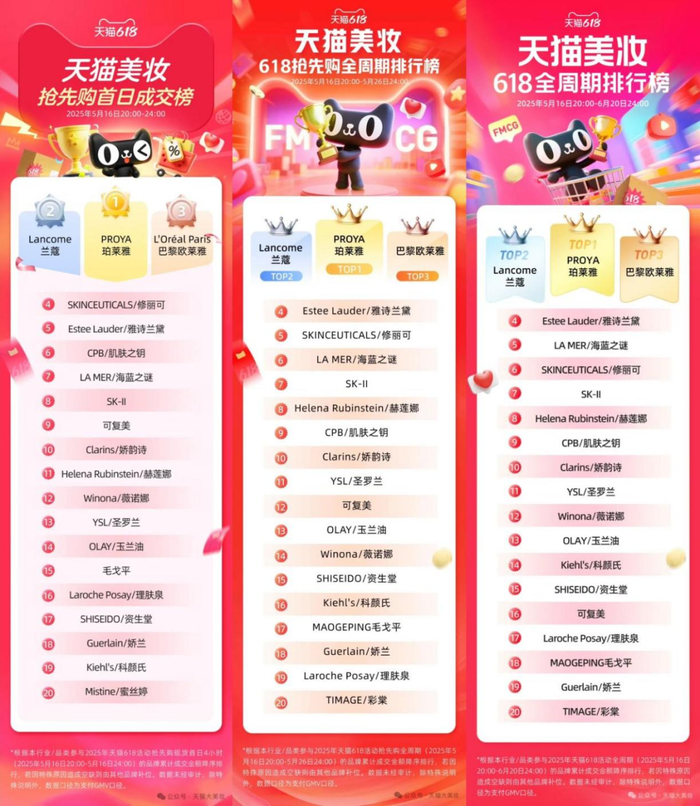
Core Insights - The beauty and skincare sales during the 618 shopping festival reached 57.5 billion yuan, marking a year-on-year growth of over 60%, setting a new record [1] - Tmall and Douyin exhibited contrasting strategies in the beauty sector, with Tmall focusing on brand strength and supply chain management, while Douyin emphasized content-driven marketing and rapid product launches [1][9] Tmall Insights - Proya emerged as the standout winner, securing the top position in Tmall's beauty rankings for three consecutive periods [4] - L'Oréal and Lancôme consistently held the second and third positions, indicating a stable top-tier brand concentration [6] - The top 10 brands on Tmall are dominated by Proya and L'Oréal's brands, reflecting a trend towards brand group consolidation [6][8] - Skincare brands dominate the Tmall beauty rankings, with consumers showing a higher preference for essential products like serums and sunscreens over color cosmetics [6] Douyin Insights - Douyin's beauty rankings are characterized by rapid changes, driven by content and marketing strategies rather than traditional brand loyalty [9] - The skincare and makeup categories on Douyin have seen significant shifts, with brands like HBN and Colanri rising rapidly in the rankings [12][14] - The emergence of new brands like Tilo Wei, which topped the Douyin makeup rankings, highlights the importance of content and visual appeal in driving consumer interest [14][16] - The competition among domestic brands is intensifying, with established players like Huaxizi and AKF struggling to maintain their positions [16] Comparative Analysis - The comparison between Tmall and Douyin reveals a dual dynamic in the beauty retail ecosystem, where Tmall emphasizes supply stability and brand accumulation, while Douyin prioritizes rapid content updates and explosive marketing strategies [17] - The structural differences in brand representation on both platforms indicate that international brands still dominate Tmall, while Douyin sees a more diverse mix of domestic brands [8][13]

卖香皂起家到品类第一,东北大叔年入12亿,即将IPO
创业邦· 2025-06-27 10:26
Core Viewpoint - Lin Qingxuan, a pioneer in the skincare industry, is on the verge of an IPO in Hong Kong, positioning itself as a leading high-end domestic skincare brand in China, with significant growth in revenue and profitability [4][5][6]. Group 1: Company Overview - Lin Qingxuan has sold 30 million bottles of its "essence oil" over 13 years, showcasing its market education efforts [4]. - The company is projected to achieve a revenue of 1.2 billion yuan in 2024, with a gross margin of 82.5% [5]. - Lin Qingxuan's gross margin is competitive, second only to the high-end brand Mao Geping, and comparable to international brands like L'Oréal and Estée Lauder [5][6]. Group 2: Market Position and Strategy - Lin Qingxuan ranks first among high-end domestic skincare brands in China and is the only domestic brand in the top 15 high-end skincare brands [6]. - The brand emphasizes its high-end positioning in its prospectus, highlighting a shift in consumer confidence towards domestic brands [6][8]. - The company has a balanced product category distribution, with its flagship product, camellia oil, accounting for 37% of sales [18]. Group 3: Growth and Expansion - Lin Qingxuan's offline store count has grown from 366 to 506 in two years, with a compound annual growth rate of 17.6%, making it the fastest-growing high-end domestic skincare brand in terms of store count [23]. - The company has a strong online presence, with online revenue growing by 81.08% to 714 million yuan in 2024, accounting for 59.1% of total revenue [25]. - Lin Qingxuan's marketing strategy includes a focus on experiential retail and personalized skincare solutions, targeting high-income consumers [24]. Group 4: Innovation and R&D - The company has invested in R&D, with 42 core ingredients developed, and aims to deepen its technological capabilities in the camellia oil sector [32]. - Lin Qingxuan has established long-term supply agreements for camellia flowers and operates two factories in Shanghai, including a carbon-neutral facility [32]. - The brand's R&D expenditure is currently below industry standards, indicating room for improvement in innovation [37]. Group 5: Future Challenges and Vision - Lin Qingxuan aims to become a leading global cosmetics group, competing with established international brands [33]. - The company faces challenges in marketing expenses and needs to enhance its R&D investment to keep pace with industry leaders [36][37]. - The brand's future plans include expanding its product matrix and targeting younger demographics, indicating a strategic shift towards broader market appeal [37].
莎莎国际关闭内地所有门店,多家美妆巨头业绩失速,下滑明显
Sou Hu Cai Jing· 2025-06-26 13:35
Core Viewpoint - Sasa International Holdings Limited has announced plans to close all offline stores in mainland China by June 30, 2025, shifting focus to online sales due to declining profitability in physical retail [1][3]. Group 1: Company Performance - Sasa International, established in 1978, is a prominent beauty retail group in Asia, listed on the Hong Kong Stock Exchange since 1997, with operations in Hong Kong, Macau, mainland China, and Southeast Asia, offering over 600 product brands [2]. - For the fiscal year ending March 31, 2025, Sasa reported a 9.7% year-on-year decline in total revenue to HKD 3.942 billion, with net profit plummeting 64.8% to HKD 76.97 million [2]. - Online sales in mainland China reached HKD 418 million, a slight increase of 0.6% year-on-year, accounting for 58.4% of the group's total online revenue [2]. Group 2: Strategic Shift - The decision to close offline stores is driven by the inability to effectively cover the vast mainland market with only 18 stores, alongside the fact that online sales constitute 80% of the group's revenue in mainland China [3]. - Sasa International plans to concentrate resources on online business, having already established seven third-party online platforms in mainland China, with improving profitability in recent years [3]. Group 3: Market Outlook - Sasa International remains optimistic about retail performance in Hong Kong and Macau, despite a 12.3% decline in revenue to HKD 2.9918 billion for the fiscal year 2024/25 [7]. - The company anticipates a recovery in foot traffic and sales in the Hong Kong and Macau markets due to government initiatives to stimulate tourism, with a narrowing decline in offline sales from 19.4% in the first half to 6.3% in the second half of the fiscal year [7]. - The company will continue to seek suitable locations for new stores in traditional tourist areas to serve both local and mainland customers [7].

星巴克中国回应高瓴资本收购传闻;永辉超市公布第二批百店计划|消费早参
Mei Ri Jing Ji Xin Wen· 2025-06-24 19:23
Group 1 - Starbucks China responded to rumors of Hillhouse Capital's acquisition, emphasizing confidence in the growth opportunities in the Chinese market and focusing on revitalizing growth [1] - The response did not directly deny the rumors but highlighted the company's long-term confidence and growth assessment, indicating a core goal of "revitalizing growth" [1] - The valuation and transaction structure remain unclear, suggesting significant variability in potential capital actions [1] Group 2 - Qunar Travel announced it has received free ticket change and cancellation policies from airlines regarding flights to Iran, Iraq, and other Middle Eastern countries [2] - The platform's quick response to airline policies reflects its emergency mechanism for regional safety risks, fulfilling social responsibility while minimizing traveler losses [2] - Future attention is needed on the long-term impact of conflicts on Middle Eastern flight routes and the efficiency of collaboration between airlines and platforms in handling complex ticket changes [2] Group 3 - Yonghui Supermarket announced a new plan to revamp 200 stores by September 30, with an average of one store reopening daily in the third quarter [3] - The completion of the first 100 store renovations marks initial success in validating the "Fat Donglai" model, but the aggressive target poses challenges for supply chain and service standardization [3] Group 4 - L'Oreal China denied rumors of withdrawing investment from the domestic high-end fragrance brand Wenxian, stating they remain optimistic about local high-end opportunities [4] - The rumors may stem from pressures faced by niche brands, but L'Oreal's denial indicates a continued strategic interest rather than a shift [4]

