防晒

Search documents
镜遇风尚·潮启新章 BJIFF·电影+|电影与时尚单元
Huan Qiu Wang· 2026-04-01 02:50
Group 1 - The 16th Beijing International Film Festival features a film and fashion unit themed "Mirror Meets Fashion, New Chapter Begins," aiming to break the boundaries between film art and fashion aesthetics [2] - The film and fashion unit explores the new possibilities of the coexistence of film art and the fashion industry, showcasing the resonance between cinematic imagery and fashion aesthetics [2] - The event includes two major fashion shows presented by leading Chinese fashion brands Bosideng and Naersi, integrating film narrative with fashion design [2][3] Group 2 - Bosideng collaborates with the festival to present the "Bosideng Multi-Faceted Appearance" fashion show, emphasizing the integration of fashion and film aesthetics [3] - The show features innovative products across various categories, including sun protection, outdoor, and business attire, showcasing the brand's commitment to fashion creativity and internationalization [3] - Naersi will present the "Elegant Workshop 2026" high-end ready-to-wear show, celebrating elegance and craftsmanship [3][4] Group 3 - The "Quality Selection of Eastern Aesthetic Lifestyle Evaluation System" is launched alongside the festival, featuring various representative brands to create an immersive experience space [5] - The initiative aims to connect cultural values, design values, manufacturing values, and commercial values, fostering sustainable Eastern aesthetic brands and ecosystems [5] Group 4 - The film fashion night gala serves as a highlight of the event, showcasing the intersection of film and fashion through artistic performances and star appearances [6] - The festival's film and fashion unit presents a new chapter in the integration of Eastern aesthetics and modern trends through three core components: fashion shows, thematic forums, and fashion galas [7]


美护大涨-关注高成长与边际改善
2026-02-10 03:24
Summary of Conference Call Records Industry Overview - The beauty and personal care sector is expected to see significant growth in 2026, driven by industry rotation and positive changes in certain companies. The market has experienced adjustments since the second half of 2025, particularly after the peak of new consumption trends, leading to declines of over 30% in some companies' stock prices. However, many companies are now at low valuation levels, and with the influence of style rotation, stock prices have rebounded significantly [2][3][4]. Key Companies and Performance - **Proya (珀莱雅)**: The main brand achieved a 24% growth in January 2026, with its OR brand doubling in growth. The company has undergone management changes and is launching new product lines, which are expected to contribute to stable growth [5][10][11]. - **Betaini (贝泰妮)**: The company has seen a recovery in e-commerce sales and profitability, with its main brand stabilizing in revenue and profit margins. The sub-brand Oksman is projected to grow over three times, indicating strong future potential [12]. - **Lurich (陆雨辰)**: Despite recent stock price adjustments due to industry style changes and regulatory uncertainties, the company remains optimistic about its growth potential, especially as it benefits from compliance with regulations [7]. - **Shangmei (尚美)**: The company has maintained good growth rates, with its sub-brands achieving significant increases in sales [6]. Market Trends and Consumer Behavior - The overall demand in the beauty sector is expected to bottom out and gradually recover in 2026. External shocks and subsidy reductions have already impacted business demand, and if housing prices stabilize and CPI rises in the second half of the year, consumer opportunities will increase [2][3]. - The growth of beauty products on platforms like Douyin (抖音) has been notable, with a 25% year-on-year increase in January 2026. This growth is attributed to organizational adjustments and operational improvements within companies [5][6]. Investment Opportunities - The focus for 2026 should be on companies that are at the bottom of their valuation with positive changes. Companies like Proya, Betaini, and Lurich are highlighted as having reflected the most pessimistic expectations in their stock prices, and any positive developments could lead to significant stock performance [4][5][6]. - The investment strategy should prioritize companies with strong fundamentals and those that have undergone structural or organizational adjustments, as these are likely to show marginal improvements and high growth potential [2][3][6]. Regulatory Environment - The regulatory landscape for NMN (Nicotinamide Mononucleotide) is evolving, with expectations that future policies will not be overly stringent. This is seen as beneficial for compliant large enterprises in the industry [8]. Conclusion - The beauty and personal care industry is poised for recovery and growth in 2026, with several companies showing promising signs of improvement. Investors are encouraged to focus on companies with strong fundamentals and positive changes, as these are likely to yield significant returns in the coming year [2][3][4].


国泰海通:受销售策略调整及春节错期影响 美妆销售淡季边际改善
智通财经网· 2026-02-09 07:30
Core Viewpoint - The beauty industry is expected to maintain steady growth in 2026, driven by product innovation and the rise of domestic brands, with Douyin's beauty GMV projected to grow over 20% year-on-year in January 2026, reflecting a marginal improvement during the off-season due to brand efforts in daily sales and self-broadcasting, alongside the impact of the Spring Festival timing [1][2]. Group 1: Strong Product and Brand Momentum - Companies with strong product and brand momentum are expected to achieve high growth through new product launches and category expansions, such as Ruoyuchen, which is focusing on high-end household cleaning and health products [3]. - Beijiaojie is maintaining stable performance in oral care and is expected to benefit from the trend of AKK ingredients in its probiotic raw material business [3]. - Maogeping is positioned as a high-end brand with ongoing expansion in offline counters and online sales, anticipating rapid growth across multiple product lines [3]. - Linqingxuan is benefiting from the trend of oil-based skincare, with its flagship essence oil performing well and new products showing promise [3]. - Shangmei Co. is expanding its main brand Han Shu and sub-brands, with strong growth expected from key products [3]. Group 2: Leading Brands with Strong Asset Value - Beitanie has been actively adjusting its channel and inventory mechanisms since 2025, leading to product structure upgrades and profit recovery, with strong GMV growth in January 2026 [4]. - Proya is expected to have a clear new product strategy in 2026, launching several key products and expanding its sub-brands to drive steady growth [4]. Investment Recommendations - Companies with strong fundamentals and high growth potential recommended for increased holdings include Ruoyuchen, Beijiaojie, Maogeping, Linqingxuan, and Shangmei Co. [5]. - Companies showing signs of bottom improvement include Beitanie, Proya, Dengkang Oral, Shanghai Jahwa, and Runben Co. [5].

科技重塑赛道,国货迎来质变增长
Sou Hu Cai Jing· 2025-12-29 11:38
Core Insights - The Chinese cosmetics industry has transitioned from a "channel-driven" model to a "dual-driven" model focusing on brand and efficacy, marking a new phase of high-quality development [1] Group 1: Industry Trends - Three core trends are reshaping the market landscape by 2025: deep technological integration, precise consumer demand, and the rise of domestic brands [3] - Technology is no longer just a marketing gimmick but has become a core competitive advantage for brands, enhancing the entire industry chain from R&D to production and consumer matching [3] Group 2: Technological Advancements - The "Holographic AI Sensory System" developed by Huaxizi in collaboration with universities quantifies user experience through brainwave and eye movement monitoring, reducing R&D cycles from 18 months to 8 months with a 30% increase in success rates [5] - Domestic companies are increasing R&D investment by 35% year-on-year, achieving breakthroughs in areas like peptide synthesis and biomanufacturing, with domestic production of key ingredients like hyaluronic acid and collagen exceeding 70% globally [7] Group 3: Market Dynamics - The functional skincare market is projected to reach 210 billion yuan by 2025, accounting for 42% of the overall skincare market, with anti-aging and repair products growing over 30% [6] - The Z generation is driving a 40% growth in niche domestic brands, while the 35-55 age group is pushing the high-end anti-aging market share to 38% [8] Group 4: Regulatory Environment - The revised "Cosmetics Efficacy Claim Evaluation Standards" will phase out "conceptual claims," making compliance a baseline for brand survival [10] - The integration of online and offline sales channels has led to a breakthrough of 350 billion yuan in live e-commerce sales, with offline beauty stores enhancing conversion rates by 22% through skin testing services [11] Group 5: Domestic Brand Growth - By 2025, domestic brands are expected to capture 58% of the cosmetics market share, surpassing foreign brands for the first time, driven by a combination of technology and cultural empowerment [12] - Brands like Winona and Proya are establishing a strong foothold through solid R&D, while luxury brands are achieving breakthroughs in green raw materials [12][15] Group 6: Export Opportunities - Continued policy support for quality domestic brands and optimized import-export policies are expected to facilitate smoother international expansion, with cosmetic exports projected to reach 85 billion yuan, a 28% increase [17] Group 7: Future Outlook - In 2025, technology will be the primary productivity driver, efficacy will be the core passport, and culture will serve as the differentiating soul of brands [19] - The rise of domestic brands is seen as a result of industrial upgrades, technological breakthroughs, and consumer awakening, emphasizing the need for brands to possess R&D capabilities, precise insights, and cultural depth to thrive in a competitive landscape [20]

金甲虫刘船高:即时零售改变不了线下
Sou Hu Cai Jing· 2025-12-24 12:29
Core Viewpoint - The recent announcement by the National Medical Products Administration regarding 37 batches of non-compliant cosmetics has highlighted the challenges of counterfeit products in the instant retail sector, particularly on platforms like Meituan [1] Group 1: Instant Retail Growth and Market Potential - The instant retail market in China is projected to exceed 1 trillion yuan by 2026 and reach 2 trillion yuan by 2030, with an average annual growth rate of 12.6% during the 14th Five-Year Plan period [1][2] - Major e-commerce platforms, including JD.com and Alibaba, have significantly invested in instant retail, with JD.com entering the food delivery sector and offering substantial subsidies to attract users and merchants [2][4] - Instant retail has shown remarkable performance during the Double 11 shopping festival, with total e-commerce sales reaching 16,950 billion yuan, a year-on-year increase of 14.2%, while instant retail sales surged to 670 billion yuan, up 138.4% [4] Group 2: Adaptability of Beauty Products in Instant Retail - Beauty products are well-suited for instant retail due to their small size, high price points, and standardized nature, making them ideal for quick delivery [5] - The beauty industry has embraced instant retail as a pioneering sector, with major platforms like Meituan and JD.com seeing significant growth in beauty product sales [6] Group 3: Differentiated Development of Beauty Brands - Beauty brands are primarily adopting an indirect entry model into instant retail, relying on beauty collection stores and large supermarkets to reach consumers [7] - Notable brands like L'Oréal and Lin Qingxuan have successfully completed official certifications for entry into instant retail platforms, while many others are still in the process [7][8] Group 4: Consumer Behavior and Market Dynamics - Despite the rise of instant retail, some industry experts argue that it may not significantly alter the current landscape of offline retail, as consumers often stock up on beauty products rather than relying on immediate purchases [9] - The overlap between instant retail customer bases and existing offline store customers suggests that speed may not be the primary concern for beauty consumers [9] Group 5: Strategic Considerations for Retailers - Retailers are advised to focus on brand strength, quality, pricing, and service rather than chasing every market trend, as a strong brand presence can naturally attract consumers regardless of channel changes [11][12] - Companies like Jinjia Chong have maintained a sustainable development model by emphasizing authenticity and affordability, which has contributed to their long-term success in the market [11]

“保湿≠补水”!秋冬季皮肤保湿的8大误区
Ren Min Wang· 2025-10-24 01:32
Core Points - The article discusses common misconceptions about skincare during the winter season, emphasizing the importance of proper hydration and moisture retention methods [1][4][6]. Misconceptions Summary - **Misconception 1: Applying toner multiple times for hydration** Toner only temporarily moistens the skin and does not lock in moisture. Overuse can strip the skin's natural oils, leading to increased dryness. The correct approach is to apply toner once and follow with serum and cream for effective hydration and moisture retention [4][6]. - **Misconception 2: Thicker cream equals better moisturization** The effectiveness of a cream is determined by its ingredients rather than its thickness. Heavy creams may not be absorbed properly and can lead to clogged pores. It is essential to choose creams based on skin type [6][8]. - **Misconception 3: Frequent mask application ensures hydration** Daily mask use can overhydrate the skin, damaging the skin barrier and leading to sensitivity. It is recommended to use masks 2-3 times a week during autumn and winter [8][10]. - **Misconception 4: "Oil-based skincare" is suitable for everyone** While oil-based products can help lock in moisture, they are not suitable for all skin types. Oily or acne-prone skin may experience clogged pores and breakouts from heavy oils [10][12]. - **Misconception 5: No need for sunscreen in autumn** UVA rays can penetrate deeper in autumn, damaging collagen and leading to dryness. It is crucial to use sunscreen with SPF 30+ and reapply every 4-6 hours [12][14]. - **Misconception 6: Switching to a full set of rich products during seasonal change** Abruptly changing to richer products can overwhelm the skin, leading to sensitivity. A gradual transition is recommended [14][16]. - **Misconception 7: Frequent exfoliation improves dryness** Over-exfoliating can damage the skin's protective barrier, making it drier and more sensitive. It is advised to reduce exfoliation frequency in winter [16][18]. - **Misconception 8: A universal moisturizer works for all skin types** Different skin types have unique hydration needs, and there is no one-size-fits-all moisturizer. Tailoring products to specific skin types is essential for effective hydration [18][21].

“什么值得买”发布8月消费关键词:夏日经济
Xin Hua Cai Jing· 2025-09-01 23:11
Core Insights - The article highlights the consumption trends in August, emphasizing the continuation of summer activities and the strong performance of various entertainment sectors, particularly in movies and gaming [1][2]. Group 1: Entertainment Consumption - Movie consumption maintained its summer momentum, with the GMV for "viewing" keywords increasing by 24.37% year-on-year, driven by popular domestic animated films [1]. - The animated film "Lao Lao Mountain Little Monster" and its related merchandise saw significant sales, while "The Legend of Luo Xiaohei" experienced a remarkable 181.58% month-on-month growth in related consumption [1]. - The confidence in the Chinese animation industry is growing, with consumers willing to invest in the long-term value of animation IPs [1]. Group 2: Gaming and Home Entertainment - Gaming console GMV surged by 122.55% year-on-year, with the launch of Nintendo's Switch2 setting global sales records [2]. - The gaming console's GMV increased by 88.58% month-on-month, highlighting its role as a key player in the gaming market [2]. Group 3: Water Sports and Outdoor Activities - Water sports equipment consumption saw significant growth, with paddleboards increasing GMV by 27.51% year-on-year, and kayaking becoming popular among young consumers with a 23.89% increase [2]. - The water park experience also gained popularity, with related consumption rising by 135.94% year-on-year, making it a favored choice for family summer activities [2]. Group 4: Travel and Cultural Experiences - Air ticket demand increased by 21.96% year-on-year, with a mix of short and long trips becoming a trend for summer travel [3]. - Popular travel destinations included Yunnan, Hainan, Southeast Asia, and Australia, with Dali tourism-related GMV growing by 41.15% [3]. - The "cultural experience" trend remained strong, with non-heritage related consumption increasing by 119.09%, as consumers sought to integrate cultural activities into their summer travel plans [4]. Group 5: Practical and Experiential Consumption - Practical consumption items like cold drinks, sunscreen, and electronics, alongside experiential consumption in water sports, culture, and movies, defined the summer consumption landscape [4]. - The unique aspect of August's consumption market was the concentrated experience of the summer's end, reflecting consumers' enduring desire for quality and personalized experiences [4].

瞄准平台流量 自然堂接入淘宝闪购
Guo Ji Jin Rong Bao· 2025-08-13 16:21
Core Insights - The skincare brand Chando has entered the competitive food delivery market by integrating with Taobao Flash Purchase, launching one-hour and half-day delivery services in five cities: Shanghai, Suzhou, Wuhan, Tianjin, and Qingyuan [1] Group 1: Product Strategy - Chando has adjusted its product selection strategy, warehousing layout, and supply chain for the flash purchase scenario, designing its inventory with a "6:3:1" ratio: 60% high-repurchase products like masks and serums, 30% seasonal new products like sunscreen, and 10% sample sets [2] - The company has differentiated its warehouse configurations across cities, significantly increasing stock for popular items and employing various delivery methods to achieve one-hour delivery [3] Group 2: Market Positioning - Within two weeks of launching on Taobao Flash Purchase, Chando ranked among the top five in the beauty category, benefiting from exposure on multiple platforms such as Taobao App, Amap, Alipay, and Ele.me, which greatly enhances brand visibility and sales opportunities [3] - The brand recognizes a shift in consumer preferences towards more environmentally friendly products, with 75% of young consumers indicating a preference for sustainable options [3] Group 3: Sustainability Initiatives - Chando has established a raw material fermentation factory to support its sustainable development strategy, aiming to mitigate supply chain vulnerabilities and enhance its green product offerings [3][4] - The company is leveraging five advanced green raw material technologies, including microbial fermentation and ultra-low temperature freeze-drying, to improve the efficiency and sustainability of its production processes [4] - The growth of domestic beauty brands is expected to continue, driven by young consumers, with projections indicating a significant rise in market presence over the next 3-5 years [4]
刚刚过去的618,抖音美妆大洗牌
Xin Lang Cai Jing· 2025-07-02 03:59
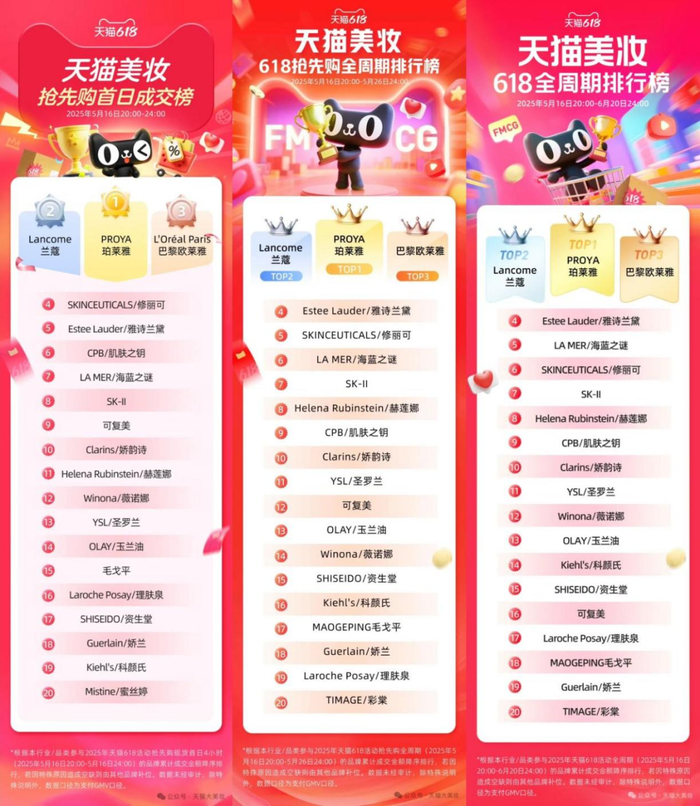
Core Insights - The beauty and skincare sales during the 618 shopping festival reached 57.5 billion yuan, marking a year-on-year growth of over 60%, setting a new record [1] - Tmall and Douyin exhibited contrasting strategies in the beauty sector, with Tmall focusing on brand strength and supply chain management, while Douyin emphasized content-driven marketing and rapid product launches [1][9] Tmall Insights - Proya emerged as the standout winner, securing the top position in Tmall's beauty rankings for three consecutive periods [4] - L'Oréal and Lancôme consistently held the second and third positions, indicating a stable top-tier brand concentration [6] - The top 10 brands on Tmall are dominated by Proya and L'Oréal's brands, reflecting a trend towards brand group consolidation [6][8] - Skincare brands dominate the Tmall beauty rankings, with consumers showing a higher preference for essential products like serums and sunscreens over color cosmetics [6] Douyin Insights - Douyin's beauty rankings are characterized by rapid changes, driven by content and marketing strategies rather than traditional brand loyalty [9] - The skincare and makeup categories on Douyin have seen significant shifts, with brands like HBN and Colanri rising rapidly in the rankings [12][14] - The emergence of new brands like Tilo Wei, which topped the Douyin makeup rankings, highlights the importance of content and visual appeal in driving consumer interest [14][16] - The competition among domestic brands is intensifying, with established players like Huaxizi and AKF struggling to maintain their positions [16] Comparative Analysis - The comparison between Tmall and Douyin reveals a dual dynamic in the beauty retail ecosystem, where Tmall emphasizes supply stability and brand accumulation, while Douyin prioritizes rapid content updates and explosive marketing strategies [17] - The structural differences in brand representation on both platforms indicate that international brands still dominate Tmall, while Douyin sees a more diverse mix of domestic brands [8][13]
水羊股份20250528
2025-05-28 15:14
Summary of Water Sheep Co. Conference Call Company Overview - **Company**: Water Sheep Co. (水羊股份) - **Core Brand**: Yi Fan (一帆单品) - **Industry**: Beauty and Personal Care Key Points Performance and Growth Expectations - Yi Fan single product did not meet expectations in 2024, but Q1 2025 shows recovery with expected growth of over 10% year-on-year, aiming for an annual growth rate exceeding 20% [2][5] - Profit margins are expected to improve year-on-year due to optimized marketing strategies, shifting from celebrity endorsements to other advertising methods [2][4] Product Diversification - The company is expanding its product categories, moving from reliance on CP series (60%-70% of sales) to include new categories like sunscreen and creams, which are performing well [2][6] - This diversification is seen as a way to mitigate risks and enhance overall profitability [2] Offline Channel Development - Water Sheep Co. is investing heavily in offline channels, which currently account for about 10% of sales, with plans for continued expansion [2][7] - New stores, such as the Zhang Yuan image store and locations in SKP and Wulin Yintai, have been profitable, with expectations for offline channel growth exceeding 20% for the year [2][7] Brand Strategy and Performance - The Yuni Fang brand experienced a decline in 2024 but is being repositioned for 2025, targeting lower-tier markets with promising early results indicating a significant reduction in losses, potentially achieving breakeven [2][8] - The PA brand has completed global ownership acquisition and is positioned in the light luxury segment, with good brand assets and potential for revenue growth in 2025 [2][9] - RV brand has already generated profits, and the company plans to refine its positioning and develop products suited for Chinese consumers [2][9] Agency Business Insights - The agency business generated approximately 2.6 billion yuan in revenue in 2024, impacted by the spin-off of Johnson & Johnson's health division, leading to a decline in related agency business [2][10] - Despite a decrease in agency revenue, the introduction of new brands has stabilized overall income, with a net profit margin of about 3% [2][10] Overall Financial Outlook - The company anticipates a significant rebound in profits for 2025, with expectations of reaching over 200 million yuan in profit, supported by the recovery of various brands [2][3][11] - Water Sheep Co. is currently valued relatively low in the beauty industry, presenting a high safety margin and potential for investors [2][14] Emerging Brands and Market Trends - The Misty Bright Drink brand has shown excellent sales performance on Douyin, with potential positive contributions to overall profits if sales continue to grow [2][13] - Smaller brands like VAA and HBS are also showing promising trends, contributing to the overall improvement in company performance as they mature [2][9] Conclusion Water Sheep Co. is strategically repositioning its brands and diversifying its product offerings while expanding its offline presence. The company is expected to recover from previous losses and achieve significant profit growth in 2025, making it an attractive investment opportunity in the beauty and personal care sector.