浙商证券

Search documents
新型政策性金融工具加速落地
Zhong Guo Zheng Quan Bao· 2025-10-10 20:57
Core Viewpoint - The article highlights the acceleration of major project construction in China as local governments leverage new policy financial tools to boost investment and economic growth in the fourth quarter [1][2][3]. Group 1: Major Project Construction - Various regions are intensifying the construction of significant projects during the "golden period" of project construction in autumn, with no work stoppages during the National Day and Mid-Autumn Festival holidays [1]. - Key projects such as the Xiaolongtan Grand Bridge of the Yukun High-speed Railway and the Qinhai Pumped Storage Power Station are making significant progress, with the former marking a major milestone in the southwest high-speed rail network [1]. - In Hubei and Anhui, provincial meetings have been held to mobilize efforts for major project construction, with Anhui launching 587 new projects with a total investment of 332.38 billion yuan [1]. Group 2: Financial Support for Projects - The National Development and Reform Commission has announced a new policy financial tool worth 500 billion yuan to supplement project capital, which is crucial for the construction of major projects [2]. - Local governments are actively utilizing this financial tool, with Jiangsu's Taicang Water Group receiving 20.76 million yuan for a water supply project and Guangxi Energy Group securing funding for a nuclear power project with a total investment of 41 billion yuan [2]. - Experts suggest that the new financial tool will facilitate the conversion of project reserves into actual construction work, with expectations of increased investment activity in the fourth quarter [2]. Group 3: Investment Growth Projections - Experts predict a recovery in both narrow and broad infrastructure investment growth rates in the fourth quarter, with narrow infrastructure investment expected to rise by 3.0% year-on-year and broad infrastructure investment by 6.0% [3]. - The 500 billion yuan policy financial tool is estimated to stimulate an additional 2 trillion to 5 trillion yuan in infrastructure investment, addressing capital shortages for projects [3]. - Recommendations for further policy support include accelerating the use of special bonds and government bonds to enhance effective investment and stimulate domestic demand [3].
全球避险情绪升温 美元暂获“喘息”机会
Shang Hai Zheng Quan Bao· 2025-10-10 18:20
Core Viewpoint - The recent unexpected appreciation of the US dollar has caught the foreign exchange market off guard, with the dollar index rising significantly amid global financial uncertainty [1][2]. Group 1: Dollar Index Performance - The dollar index has shown strong momentum, reaching a nine-week high and approaching the 100 mark, with a peak of 99.47 on October 10 [3]. - This performance marks a reversal from the earlier trend in 2023, where the dollar index had declined over 10% in the first three quarters, making "shorting the dollar" a favored strategy among traders [3]. - The recent strength of the dollar is attributed more to the weakness of other currencies, particularly the euro, pound, and yen, rather than a robust US economic fundamental [3][4]. Group 2: Market Sentiment and Risks - The global uncertainty has heightened risk aversion, supporting the dollar's rise, similar to the behavior of gold during times of crisis [4]. - Analysts express caution regarding the long-term outlook for the dollar, indicating that its future performance will depend on the resolution of the US government shutdown and upcoming economic data [5]. - Potential risks include prolonged government shutdown impacts on the economy, the influence of Trump's interventions on Federal Reserve independence, and geopolitical factors affecting market sentiment [5]. Group 3: Renminbi Performance - Contrary to the strengthening dollar, the renminbi has appreciated against the dollar, with offshore renminbi rising over 200 points from October 9 to 10 [6][7]. - Factors contributing to this trend include the announcement of new policy financial tools to support growth and a strong domestic stock market attracting foreign investment [7]. - The overall market expectation for the renminbi remains stable, with a potential for continued appreciation against the dollar, suggesting a "dual bull" scenario for both the renminbi and the dollar index [7].
券商股走强背后的三重驱动力
Shang Hai Zheng Quan Bao· 2025-10-10 18:20
Core Viewpoint - The A-share brokerage sector has shown strong performance, driven by improvements in policy, market confidence, and the fundamental outlook for the industry [1][2]. Policy Factors - The policy environment has provided a solid foundation for the brokerage sector's upward movement, with measures such as deepening the registration system, optimizing trading mechanisms, and introducing long-term capital [1]. - These initiatives have expanded the business scope for brokerages in investment banking, brokerage, and asset management [1]. Market Conditions - Market confidence has been restored, leading to active trading, with the average daily trading volume in A-shares reaching 2.1 trillion yuan in Q3, and some days exceeding 3 trillion yuan [1]. - The average margin financing and securities lending balance in the two markets exceeded 2.1 trillion yuan in Q3, a year-on-year increase of nearly 49% [1]. Fundamental Improvements - The brokerage sector's net profit is projected to reach 672 billion yuan by Q3 2025, representing a year-on-year growth of 87%, with a forecasted net profit of 1.8 trillion yuan for the first three quarters of 2023, up 55% year-on-year [2]. - The net income from brokerage business is expected to reach 136.4 billion yuan in the first three quarters, an increase of 82.5% year-on-year, while proprietary investment income is projected to be 146.2 billion yuan, up 14.1% [2]. Industry Transformation - The brokerage industry is undergoing a transformation towards high-value wealth management and institutional business, which provides independent alpha growth potential alongside market recovery [2]. - The sector is seen as having rare allocation value, with expectations for improvement in investment banking, derivatives, and public fund businesses [2][3]. Investment Recommendations - Analysts suggest focusing on three main lines for future investments: companies with strong retail business benefiting from the Hainan Free Trade Port, those with advantages in overseas and institutional business, and firms excelling in wealth management [3].

A股大消息,又“爆了”
中国基金报· 2025-10-10 12:04
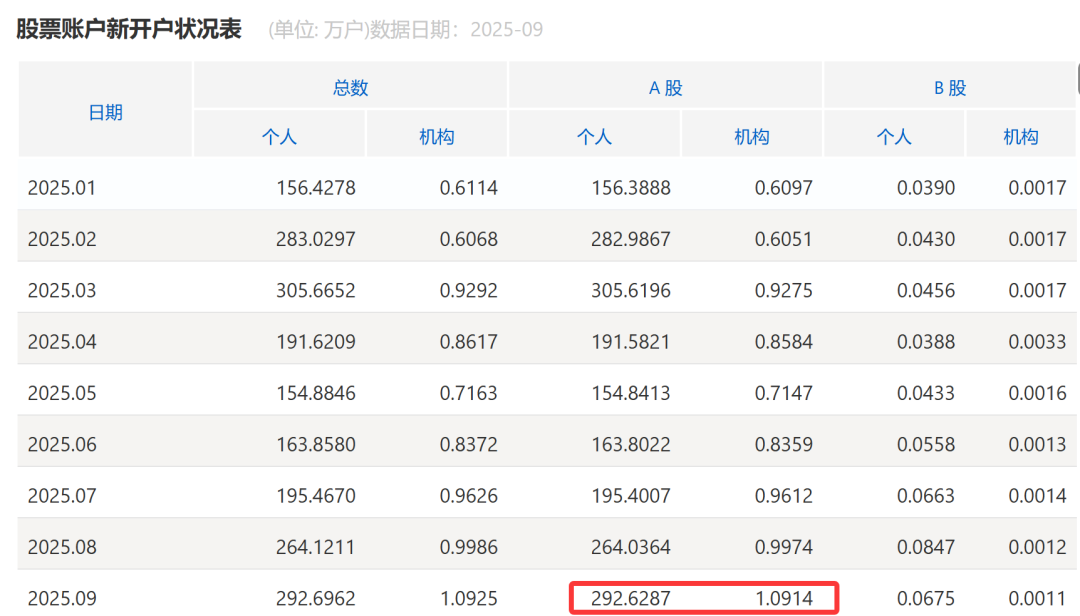
Core Viewpoint - The A-share market in China has seen a significant increase in new account openings, with September 2023 recording 2.9372 million new accounts, marking a year-on-year growth of 60.73% and the second-highest monthly figure of the year [2][5]. Summary by Sections New Account Openings - In September 2023, the Shanghai Stock Exchange reported 2.9372 million new A-share accounts, contributing to a total of 20.1489 million new accounts for the first three quarters of the year, which is a 49.64% increase compared to 13.4646 million in the same period of 2022 [5]. - Among the new accounts in September, 2.9263 million were individual accounts and 10,900 were institutional accounts, marking the first time institutional accounts surpassed 10,000 this year [5]. Market Trends - The new account openings in September reflect a trend of increasing participation from younger investors, particularly those under 35 years old, indicating a shift in the investor demographic [7]. - Despite the surge in new accounts, the current monthly opening figures are still less than half of the 6.84 million accounts opened in October 2022, suggesting a more moderate pace of entry for individual investors [7]. Margin Trading - The margin trading balance in the A-share market has reached a new high, exceeding 2.2 trillion yuan since September, with a peak of 2.44 trillion yuan on September 25, 2023 [9]. - Several brokerage firms have responded to the growing demand for margin trading by increasing their financing business limits, indicating a robust market environment [11]. - The current leverage levels in the market remain within a manageable range, with the financing balance accounting for 2.54% of the circulating market value, significantly lower than the historical peak of 4.72% [11]. Market Liquidity - The daily trading volume in the A-share market has maintained a high level, exceeding 2 trillion yuan, which reflects sufficient market liquidity and a recovery in investor risk appetite [12].


A股大消息,又“爆了”
Zhong Guo Ji Jin Bao· 2025-10-10 11:52
Core Insights - In September, the number of new A-share accounts opened reached 2.9372 million, marking a year-on-year increase of 60.73%, making it the second-highest monthly figure of the year [1][2] - The total number of new accounts opened in the first three quarters of the year reached 20.1489 million, a 49.64% increase compared to the same period last year [2] - The surge in new accounts indicates a growing interest in the A-share market, with over 30 million new accounts opened since the "9.24" market rally last year [1] New Account Breakdown - Of the 2.9372 million new accounts in September, 2.9263 million were individual accounts and 10,900 were institutional accounts, marking the first time institutional accounts surpassed 10,000 this year [3] - The monthly comparison shows a steady increase in new accounts, with a significant rise in August due to market performance, followed by a further increase in September [4] Market Trends - Despite the increase in new accounts, the current monthly account openings are still less than half of the 6.84 million accounts opened in October 2024, indicating a relatively moderate pace of new individual investor entries [5] - The recent wave of new accounts has not reached the explosive levels seen during the "9.24" rally, with younger investors (under 35) becoming the primary demographic for new accounts [6] Margin Trading Developments - The margin trading balance has reached a new high, exceeding 2.2 trillion yuan since August, and peaking at 2.44 trillion yuan on September 25 [7] - The increase in new margin accounts has also surpassed last year's figures, reflecting a robust demand for margin trading [9] Broker Responses - Several brokerage firms have raised their financing business limits in response to the growing demand in the margin trading market, indicating a strategic move to enhance service levels and market share [10][11] - The current leverage levels in the market remain within a manageable range, with the financing balance accounting for 2.54% of the circulating market value, significantly lower than historical peaks [11]


2025年10月大类资产配置月报:全球复苏逻辑强化,超配商品+权益-20251010
ZHESHANG SECURITIES· 2025-10-10 11:25
Quantitative Models and Construction - **Model Name**: Macro Scoring Model **Construction Idea**: The model evaluates macroeconomic factors to provide asset allocation signals, focusing on inflation, monetary policy, and global economic conditions[17][20] **Construction Process**: The model assigns scores to macroeconomic subcategories such as domestic and global inflation, monetary policy, and economic conditions. These scores are aggregated to generate asset-specific macro views. For example: - Domestic inflation: Score = 1 - Global inflation: Score = 0 (downward adjustment this month) - Final macro scores for October: - CSI 800: 3 - 10-year bonds: -2 - S&P 500: 2 - Gold: -1 - Oil: 3 - Copper: 3[20] **Evaluation**: The model maintains a positive outlook on equities and commodities, reflecting stable macroeconomic conditions[17][20] - **Model Name**: US Equity Timing Model **Construction Idea**: The model monitors U.S. economic indicators to assess equity market timing opportunities[21] **Construction Process**: The model uses three dimensions equally weighted: - Economic sentiment - Capital flows - Financial stress The latest composite timing indicator value is 72.3, showing improvement from the previous month[21] **Evaluation**: The model supports a bullish view on U.S. equities due to improved economic sentiment and fundamentals[21] - **Model Name**: Gold Timing Model **Construction Idea**: The model evaluates fiscal and monetary trends to determine gold allocation timing[24] **Construction Process**: The model generates a timing indicator based on fiscal deficit trends and global monetary expansion. Current indicator value: -0.63, signaling caution due to reduced U.S. fiscal deficit expansion[24] **Evaluation**: Despite the cautious signal, the model suggests gold retains strong allocation value under global fiscal expansion trends[24] - **Model Name**: Oil Timing Model **Construction Idea**: The model assesses oil market dynamics, including inventory levels and macroeconomic risks[27][29] **Construction Process**: The model calculates an oil sentiment index based on: - Inventory levels - Dollar strength - Investor expectations - Macro risk levels Current index value: 0.39, down from 0.56 last month[27][29] **Evaluation**: The model adopts a neutral stance on oil due to inventory accumulation and dollar rebound[27][29] --- Model Backtesting Results - **Macro Scoring Model**: - September return: 2.3% - 1-year return: 13.5% - Maximum drawdown: 2.9%[3][31] - **US Equity Timing Model**: - Latest indicator value: 72.3[21] - **Gold Timing Model**: - Latest indicator value: -0.63[24] - **Oil Timing Model**: - Latest sentiment index value: 0.39[27][29] --- Asset Allocation Adjustments - **Optimized Allocation**: - CSI 800: Reduced from 11.9% to 8.7% - S&P 500: Increased from 9.4% to 9.6% - Gold: Reduced from 13.5% to 7.0% - Copper: Reduced from 9.7% to 7.3% - Oil: Reduced from 3.9% to 1.9% - 10-year bonds: Increased from 34.7% to 49.8% - Short-term bonds: Reduced from 16.8% to 15.7%[36]
浙商证券:25Q3化工行业量增价跌 整体盈利分化
智通财经网· 2025-10-10 09:09
Core Insights - The chemical raw materials and products industry in China experienced a revenue of 5.95 trillion yuan with a year-on-year growth of 0.9% for the first eight months of 2025, indicating a continuous decline in growth rate since the beginning of the year [1][2] - The total profit for the industry was 246.1 billion yuan, reflecting a year-on-year decrease of 5.5%, with a profit margin of 4.14%, down 0.35 percentage points from the same period in 2024, marking a historical low [1][2] - Inventory levels reached 1.02 trillion yuan, up 2.2% year-on-year, with finished goods inventory at 470 billion yuan, increasing by 5.1% [1][2] Industry Overview - The overall industry is facing pressure with increasing volume but declining prices, leading to a downward trend in profitability for Q3 [2] - The China Chemical Product Price Index (CCPI) stood at 3958 points as of September 30, 2025, down 8.1% from the beginning of the year and down 10% year-on-year [2] - The Producer Price Index (PPI) for chemical raw materials and products, chemical fibers, and rubber and plastics showed year-on-year declines of -5.7%, -9.3%, and -2.6% respectively in August 2025 [2] Product Performance - Different sub-industries within the chemical sector are experiencing varied performance due to overall capacity pressure [3] - Sub-industries with better price performance include those with limited capacity growth such as refrigerants, essential and concentrated supply sectors like phosphate and potassium fertilizers, and import substitution sectors like modified plastics and synthetic resins [3] - As of September 26, 2025, the average prices of major chemical products in Q3 showed a distribution of 29% increasing, 3% stable, and 68% decreasing, with significant price increases in TDI, epoxy chloropropane, and other specific products [3] Future Outlook - The industry outlook suggests potential opportunities in sub-industries with improving supply-demand dynamics and new materials for import substitution [4] - Key areas of focus include resource-limited products like phosphate and potassium fertilizers, licensed products such as refrigerants, and sectors with significant potential for growth like viscose staple fiber and polyester filament [4] - New materials, particularly those with strong demand growth certainty, are also highlighted as promising, including high-speed resins and fluorinated liquids [4]
研报掘金丨浙商证券:维持东华测试“增持”评级,向机器人关节模组领域拓展
Ge Long Hui A P P· 2025-10-10 08:22
Core Viewpoint - Donghua Testing has signed a strategic cooperation agreement with Nantong Zhenkang to jointly explore market opportunities in high-precision actuators and intelligent modules for industrial and humanoid robots [1] Group 1: Strategic Cooperation - The partnership aims to enhance collaborative innovation in testing control platforms for rotary joint modules and related fields [1] - The focus is on expanding the market for high-precision actuators and intelligent modules in the industrial robot and humanoid robot sectors [1] Group 2: Product Development - The company's six-dimensional force sensor is currently in the small-batch trial production stage [1] - Downstream application areas include industrial robots, humanoid robots, aerospace, automotive, electronics, and medical sectors, which are expected to become new growth points with the industrialization of humanoid robots [1] Group 3: Financial Plans - The company plans to raise 150 million yuan through a private placement to fund the upgrade of the intelligent measurement and control industry and for working capital [1] - The company maintains an "overweight" rating [1]

浦发银行股价连续5天下跌累计跌幅5.23%,浙商证券资管旗下1只基金持1.51万股,浮亏损失9815元
Xin Lang Cai Jing· 2025-10-10 07:25
浙商汇金转型升级A(001604)基金经理为周文超。 数据显示,浙商证券资管旗下1只基金重仓浦发银行。浙商汇金转型升级A(001604)二季度持有股数 1.51万股,占基金净值比例为4.34%,位居第三大重仓股。根据测算,今日浮亏损失约302元。连续5天 下跌期间浮亏损失9815元。 浙商汇金转型升级A(001604)成立日期2016年2月3日,最新规模257.21万。今年以来收益21.56%,同 类排名4661/8166;近一年收益20.21%,同类排名4552/8014;成立以来收益63.26%。 10月10日,浦发银行跌0.17%,截至发稿,报11.78元/股,成交11.13亿元,换手率0.30%,总市值 3693.58亿元。浦发银行股价已经连续5天下跌,区间累计跌幅5.23%。 资料显示,上海浦东发展银行股份有限公司位于上海市中山东一路12号,香港中环夏悫道12号美国银行 中心15及24楼,成立日期1992年10月19日,上市日期1999年11月10日,公司主营业务涉及 吸收公众存 款;发放短期、中期和长期贷款;办理结算;办理票据贴现;发行金融债券;代理发行、代理兑付、承销政府 债券;买卖政府债券;同 ...

有色股持续走低 山东黄金跌超7% 洛阳钼业跌超6%
Zhi Tong Cai Jing· 2025-10-10 07:23
Group 1 - The core viewpoint of the article highlights a significant decline in non-ferrous metal stocks, with notable drops in companies such as Ganfeng Lithium, China Nonferrous Mining, and Shandong Gold [1] - The US dollar index has been rebounding continuously, surpassing the 99 mark, driven by a temporary risk aversion due to the potential government shutdown in the US [1] - International gold prices have sharply declined, with spot gold falling below $3960 per ounce, influenced by the strengthening dollar and easing geopolitical tensions in the Middle East [1] Group 2 - Citic Futures indicates that while copper prices are currently leading gains among base metals, there is a need for caution regarding potential pullbacks if no further macroeconomic positive factors emerge [1] - There are expectations of tighter supply and demand dynamics for copper, aluminum, and tin, which may lead to increased prices for base metals in the long term due to ongoing supply disruptions [1]