
陕西煤业

Search documents
陕西煤业股价上涨1.13% 航天煤油技术取得突破
Jin Rong Jie· 2025-08-19 17:48
Group 1 - The stock price of Shaanxi Coal Industry reached 21.41 yuan as of August 19, 2025, with an increase of 0.24 yuan, representing a rise of 1.13% [1] - The trading volume on the same day was 424,334 hands, with a total transaction amount of 909 million yuan [1] - Shaanxi Coal Industry is a significant coal production enterprise in Shaanxi Province, primarily engaged in coal mining, washing, processing, and sales [1] Group 2 - The company has a total market capitalization of 207.57 billion yuan and a price-to-earnings ratio of 10.80 times [1] - On August 18, a successful long-duration hot test of 1,030 seconds was conducted on a 130-ton liquid oxygen kerosene pump rocket engine, developed in collaboration with China Aerospace Science and Technology Corporation [1] - This technological breakthrough is expected to significantly enhance the operational efficiency of the "500,000 tons/year coal tar hydrogenation to cycloalkane oil project" at Shenmu Coal Chemical Company [1] Group 3 - On August 19, the net inflow of main funds into Shaanxi Coal Industry was 33.86 million yuan, although the overall trend over the past five days showed a net outflow of 159.45 million yuan [1]

煤炭开采板块8月19日跌1.07%,中国神华领跌,主力资金净流出2.86亿元
Zheng Xing Xing Ye Ri Bao· 2025-08-19 08:37
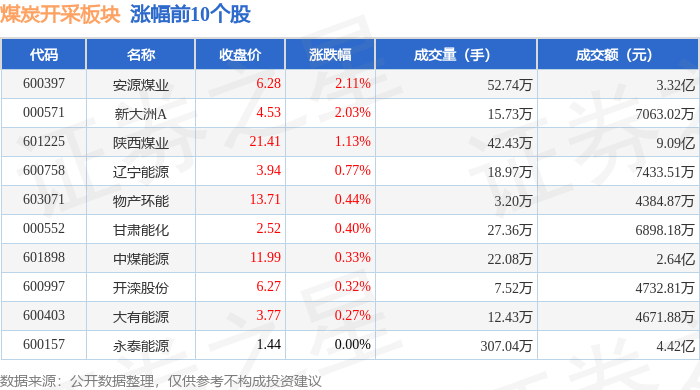
证券之星消息,8月19日煤炭开采板块较上一交易日下跌1.07%,中国神华领跌。当日上证指数报收于 3727.29,下跌0.02%。深证成指报收于11821.63,下跌0.12%。煤炭开采板块个股涨跌见下表: | 代码 | 名称 | 收盘价 | 涨跌幅 | 成交量(手) | 成交额(元) | | | --- | --- | --- | --- | --- | --- | --- | | 600397 | 安源煤业 | 6.28 | 2.11% | 52.74万 | | 3.32 乙 | | 000571 | 新大洲A | 4.53 | 2.03% | 15.73万 | 7063.02万 | | | 601225 | 陕西煤业 | 21.41 | 1.13% | 42.43万 | | 260.6 | | 600758 | 辽宁能源 | 3.94 | 0.77% | 18.97万 | 7433.51万 | | | 603071 | 物产环能 | 13.71 | 0.44% | 3.20万 | 4384.87万 | | | 000552 | 甘肃能化 | 2.52 | 0.40% | 27.36万 | 6898.18 ...


国盛证券:7月煤炭产量同、环比双降 年底煤价或以最高点收官
智通财经网· 2025-08-19 08:36
Core Viewpoint - The report from Guosheng Securities indicates a significant decline in China's coal production in July, with a year-on-year decrease of 3.8%, marking the first negative growth since May 2024 [2][3] Production Data - In July, the national industrial raw coal output reached 380 million tons, with an average daily output of 12.29 million tons, the lowest since July 2023 [2][3] - Major companies reported declines in coal production, with Zhongyue Coal achieving 11.05 million tons, down 8.7% year-on-year, and Lu'an Huanneng producing 4.48 million tons, down 9.1% [2] Factors Behind Production Decline - Prolonged heavy rainfall has severely impacted coal production and transportation in major mining areas, leading to increased shutdowns and reduced output [3] - The National Energy Administration's recent measures to check overproduction have further constrained supply, with some mines implementing a "276 working days" system [3] Price Trends - Coal prices hit a low of 618 yuan per ton in early June but began to rebound seasonally, with market sentiment shifting positively following the release of the "Document No. 108" [4] - The report suggests that coal prices may experience fluctuations or slight corrections before rising again towards the end of the year, potentially reaching unexpected highs [5] Recommendations for Companies - Companies with strong performance elasticity such as Lu'an Huanneng (601699.SH), Yanzhou Coal (600188.SH), and Jinko Coal (601001.SH) are recommended for investment [6] - Attention is also drawn to major coal enterprises like China Coal Energy (601898.SH) and China Shenhua (601088.SH), as well as companies showing signs of recovery like China Qinfang (00866) [6]
煤炭行业:炼焦煤价涨幅明显,三港口炼焦煤库存量显著下降
Dongxing Securities· 2025-08-19 08:25
Investment Rating - The coal industry is rated as "Positive" [5] Core Insights - Coking coal prices have shown significant increases, with the comprehensive Chinese coking coal price index reaching 1340.16 CNY/ton, a month-on-month increase of 199.02 CNY/ton, representing a growth of 17.44% [1][10] - The total coking coal inventory at three major ports has decreased significantly, totaling 2.7084 million tons, down 443,000 tons from the previous month, a decline of 14.06% [1][17] - The production capacity utilization rate of independent coking enterprises has increased to 74.03%, up 1.16 percentage points month-on-month [2][20] Summary by Sections Coking Coal Prices - As of August 4, 2025, the Chinese coking coal price index is 1340.16 CNY/ton, with a month-on-month increase of 17.44% [1][10] - The price of Australian main coking coal at Jing Tang Port is 1540.00 CNY/ton, up 25.20% from the previous month [1][13] Inventory Levels - The total coking coal inventory at three ports has decreased to 2.7084 million tons, a decline of 14.06% month-on-month [1][17] - Independent coking plants have seen an increase in coking coal inventory to 8.3275 million tons, up 10.67% month-on-month [2][20] Production and Utilization - The average available days of coking coal for independent coking plants is 12 days, an increase of 9.09% month-on-month [2][20] - The overall production capacity utilization rate for independent coking enterprises is 74.03%, reflecting a positive trend in production activity [2][20]
国泰海通:煤价破700大关 反内卷下国企整合加速
智通财经网· 2025-08-19 07:29
Group 1 - The core viewpoint is that coal prices have accelerated, breaking the 700 RMB/ton barrier, with significant developments in state-owned enterprise reforms, particularly the acquisition by China Shenhua [2][4] - As of August 15, the price of Q5500 thermal coal at Huanghua Port is 708 RMB/ton, an increase of 16 RMB/ton (2.3%) from the previous week [4] - In July, the raw coal production was 380 million tons, a month-on-month decrease of 40 million tons, primarily due to extreme weather conditions in Inner Mongolia and Shaanxi [2][4] Group 2 - The forecast for the second half of the year indicates a slight month-on-month decline in national production due to "overproduction checks," with total production expected to be between 2.35-2.4 billion tons, maintaining an annual total of 4.75-4.8 billion tons, which is roughly flat year-on-year [3][4] - The demand side shows a year-on-year increase of 4.3% in thermal power generation in July, with a significant improvement in the supply-demand balance [2][4] - The focus on safety production has intensified, as highlighted by the release of the "Coal Mine Safety Regulations (2026 Edition)" [2] Group 3 - The coal industry is experiencing a turning point in fundamentals, with downwards risks being fully released, making it a favorable environment for long-term capital allocation [3] - The overall supply is expected to remain stable, with domestic production and imports both contributing to this stability [4] - The recommendation for stocks includes China Shenhua, Shaanxi Coal, and China Coal Energy, among others, indicating a positive outlook for these companies [6]




全球丙烯产业发展图景展望
Qi Huo Ri Bao Wang· 2025-08-19 01:04
Core Insights - The article discusses the characteristics, industrial chain structure, production patterns, consumption, trade dynamics, and future trends of the propylene industry, highlighting its significance in the global chemical market [2][3][4][11][17]. Group 1: Basic Characteristics and Industrial Chain Structure - Propylene, with the chemical formula C3H6, is a leading chemical product globally, characterized as an unsaturated olefin with a planar triangular molecular structure [2]. - The physical properties of propylene include a melting point of -185.2℃, a boiling point of -47.7℃, and a liquid density of approximately 0.5139 g/cm3 at 20℃ [2]. - The propylene industrial chain is structured as a pyramid, comprising upstream diverse supply, midstream global circulation, and downstream extensive applications, with each segment closely linked [3][4]. Group 2: Production Patterns and Technological Pathways - Global propylene production capacity has expanded significantly from 56 million tons per year in 2000 to 168 million tons per year by 2024, with a compound annual growth rate of 4.5% [6]. - Northeast Asia accounts for 57% of global propylene production, with China contributing approximately 80% of the capacity increase in this region [6]. - The Middle East has seen an 837% increase in production capacity from 2000 to 2024, leveraging low-cost oil and gas resources [6]. - North America has developed a propylene production belt along the Gulf Coast, utilizing shale gas resources and propane dehydrogenation (PDH) technology [7][9]. Group 3: Consumption and Trade Dynamics - Northeast Asia is the core region for propylene consumption, accounting for 51.9% of global consumption in 2023, with China being the primary market [11]. - The consumption structure in North America shows a stable 11.8% share, with high-end polypropylene products making up 40% of the region's consumption [11]. - Global propylene trade exhibits a "multipolar cycle" characteristic, with China reducing its import dependency from 14% in 2019 to 3.5% in 2024 [12]. Group 4: China's Propylene Industry - China's propylene industry has undergone three development phases, significantly altering the global supply-demand landscape [14][15]. - The current phase is characterized by a shift towards quality improvement, with a diverse production structure including PDH (35%), steam cracking (29%), coal-to-olefins (18%), and catalytic cracking (18%) [15]. Group 5: Future Trends and Challenges - Global propylene capacity is expected to continue expanding, reaching 180 million tons by 2026, with China accounting for over 45% of this capacity [17]. - The fluctuation in raw material prices, particularly the price difference between propane and naphtha, significantly impacts the economic viability of production methods [17]. - The industry faces challenges in balancing raw material security, cost control, and low-carbon transformation, which will reshape the competitive landscape of the international energy and chemical markets [17].

【彬州】向“绿”而行 向“新”发力
Shan Xi Ri Bao· 2025-08-19 00:26
Core Viewpoint - Binzhou is leveraging its abundant coal resources to transition towards clean and efficient coal utilization, focusing on high-end chemical industries and technological innovation to enhance industrial value [1][2][5]. Group 1: Coal Resource Utilization - Binzhou has coal reserves of 3.24 billion tons and an annual coal production of approximately 30 million tons, with coal mining and washing industries accounting for 88.4% of the industrial output value in 2024 [1]. - The Binchang low calorific value coal 660 MW supercritical CFB demonstration project is a key initiative aimed at effectively utilizing coal slurry and coal gangue, reinforcing China's leading position in circulating fluidized bed power generation technology [2]. Group 2: Technological Advancements - The demonstration project utilizes the world's first supercritical circulating fluidized bed generator, achieving ultra-low emissions and energy consumption, with a coal consumption reduction of 19 grams per kilowatt-hour, saving approximately 53,200 tons of standard coal annually [1][2]. - The project is expected to cleanly convert about 1 million tons of low calorific value coal and low-quality fuels each year, while also managing 1 million tons of mine drainage water [2]. Group 3: Industry Development and Environmental Impact - The focus is on developing fine chemicals, high-end new materials, electronic chemicals, and pharmaceutical intermediates, aiming to create a modern high-end energy chemical base [2][4]. - The integration of carbon capture, utilization, and storage (CCUS) projects aims to reduce carbon emissions in the chemical park, transforming carbon liabilities into carbon assets [3][4]. Group 4: Economic Growth and Investment - Binzhou has attracted 33 fine chemical enterprises, with 90% being high-tech companies, enhancing its reputation as a hub for chemical production [5]. - The city aims to establish itself as a national model for new industrialization, focusing on clean coal conversion and high-end material supply [5].
山西证券研究早观点-20250819
Shanxi Securities· 2025-08-19 00:17
Group 1: Coal Industry Insights - In July 2025, coal supply showed a marginal decrease, with cumulative production from January to July reaching 2.779 billion tons, a year-on-year increase of 3.8%, but the growth rate is declining. In July alone, production was 381 million tons, down 3.8% year-on-year and 9.52% month-on-month [6][5]. - Demand for coal in the first seven months of 2025 was supported by manufacturing and infrastructure, with fixed asset investment increasing by 1.6% year-on-year. However, real estate investment fell by 12.0% [6]. - Coal prices entered a rebound phase in July, with coking coal showing resilience. The average price of Shanxi mixed 5500 thermal coal has decreased since the beginning of 2025, while the average price of coking coal at Jingtang Port has also declined [6][5]. - The report suggests that the market's pricing in July was "beyond expectations," indicating a potential shift in policy that could lead to inflationary pressures. The expectation of price increases has led to a significant rise in coal stock prices [6][5]. - The report anticipates that the low point for coal prices this year may have already occurred, with prices unlikely to fall back in the second half of the year [6]. Group 2: Biopharmaceutical Industry Insights - The report highlights the potential of next-generation immuno-oncology (IO) therapies for non-small cell lung cancer (NSCLC), particularly those combining PD-1/L1 monoclonal antibodies with VEGF inhibitors, IL-2 agonists, and antibody-drug conjugates (ADCs) [8]. - Clinical data shows that PD-1/VEGF dual antibodies have achieved significant progression-free survival (PFS) and overall survival (OS) benefits in first-line NSCLC treatments, outperforming traditional therapies [8]. - The report notes that the PD-1/IL-2α-bias dual antibody fusion protein has shown promising OS benefits in IO-treated NSCLC patients, indicating a strong potential for these innovative therapies in overcoming immune resistance [8]. Group 3: Company-Specific Insights on Beite Technology - Beite Technology reported a revenue of 1.113 billion yuan for the first half of 2025, a year-on-year increase of 14.71%, with a net profit of 55 million yuan, up 45.14% [9]. - The company’s main business segments showed steady growth, particularly in the air conditioning compressor sector, which grew by 42.13% year-on-year [9]. - Beite Technology is expanding its production capacity for planetary roller screws, which is expected to contribute to its second growth curve, alongside ongoing construction projects in Jiangsu and Thailand [9].

8月18日汇添富沪深300安中指数A净值增长1.14%,近3个月累计上涨11.49%
Sou Hu Cai Jing· 2025-08-18 12:19
金融界2025年8月18日消息,汇添富沪深300安中指数A(000368) 最新净值2.0402元,增长1.14%。该基金 近1个月收益率5.60%,同类排名2412|4110;近3个月收益率11.49%,同类排名2523|3884;今年来收益率 8.80%,同类排名2746|3421。 简历显示:吴振翔先生:中国国籍,中国科学技术大学管理学博士,中国科学院数学与系统科学院应用数学 专业博士后。曾任长盛基金管理有限公司金融工程研究员、上投摩根基金管理有限公司产品开发高级经 理。2008年3月加入汇添富基金管理股份有限公司,历任产品开发高级经理、数量投资高级分析师、基金 经理助理,现任指数与量化投资部副总监。2010年2月6日至今任汇添富上证综合指数证券投资基金的基 金经理。2011年9月16日至2013年11月7日任深证300交易型开放式指数证券投资基金的基金经理。2011 年9月28日至2013年11月7日任汇添富深证300交易型开放式指数证券投资基金联接基金的基金经理。 2013年8月23日至2015年11月2日任中证金融地产交易型开放式指数证券投资基金的基金经理。2013年8 月23日至2015年11月 ...
煤炭月度供需数据点评:7月:供给收缩,反内卷或带来“温和风暴”-20250818
Shanxi Securities· 2025-08-18 06:31
Investment Rating - The report maintains an investment rating of "Leading the Market" for the coal industry, indicating an expected price increase exceeding the benchmark index by more than 10% [1][31]. Core Insights - The coal supply has contracted, and the "gentle storm" brought by anti-involution may lead to a more moderate impact on the industry [1][6]. - From January to July 2025, the cumulative output of raw coal reached 2.779 billion tons, with a year-on-year increase of 3.8%, although the growth rate is declining [2][3]. - In July 2025, the raw coal output was 381 million tons, showing a year-on-year decrease of 3.8% and a month-on-month decrease of 9.52% [2][3]. - Terminal demand has been supported by manufacturing and infrastructure, with fixed asset investment increasing by 1.6% year-on-year in the first seven months of 2025 [3]. - Coal imports in July showed a month-on-month increase, but the cumulative import volume from January to July 2025 was 25.7 million tons, down 13% year-on-year [3][4]. Supply and Demand Summary - The report highlights a marginal decrease in raw coal supply from January to July 2025, with July's output reflecting a significant decline [2][3]. - The demand for coal is primarily driven by improvements in electricity demand and support from manufacturing and infrastructure investments [3][4]. - The report notes that the coal price entered a rebound phase in July, with coking coal showing more elasticity compared to thermal coal [4][5]. Price Trends - The report indicates that coal prices are expected to rise, with market pricing in July exceeding expectations due to anticipated policy shifts related to anti-involution [5][6]. - The report suggests that the low point for coal prices in 2025 may have already occurred, with expectations for price increases in the second half of the year [5][6]. Investment Recommendations - The report recommends focusing on specific coal companies such as Lu'an Huanneng, Jinko Coal Industry, Shanxi Coal International, and others, anticipating a slight upward or fluctuating trend in coal stocks [6][7].