
中国财险

Search documents
西安摩托车交强险及挂牌服务进驻8家车管所
Xi An Ri Bao· 2025-06-17 02:55
Core Viewpoint - The article discusses the proactive measures taken by the Xi'an Public Security Traffic Management Department to alleviate the difficulties faced by motorcycle owners in purchasing mandatory traffic insurance (交强险) in Xi'an, by facilitating the presence of insurance institutions at vehicle management offices [1][3]. Group 1: Measures Implemented - Starting from June 16, major insurance institutions in Shaanxi have been stationed at various vehicle management offices in Xi'an, including East, South, West, North districts, Chang'an, and suburban branches, as well as the Yuhua Zhai Motor Vehicle Registration Service Center and Xixian Vehicle Management Office, to provide one-stop service for motorcycle insurance purchases [1][2]. - The service hours for these vehicle management offices are Monday to Friday, from 9:00 AM to 5:00 PM [2]. Group 2: Insurance Institutions and Locations - The following insurance companies have set up points at specific vehicle management offices: - People's Insurance Company of China (人保财险) at East District and Chang'an branches [2]. - Pacific Insurance (太平洋产险) at South District and Yuhua Zhai Service Center [2]. - Tai Ping Insurance (太平财险) at North District and Xixian New Area [2]. - Ping An Insurance (平安产险) at West District and suburban branches [2]. Group 3: Additional Information and Future Plans - Motorcycle owners can also purchase insurance through the "Shaanxi Motorcycle Mandatory Insurance Convenience Platform" via WeChat or at any of the 227 insurance agency locations in Xi'an [3]. - The measures are specifically aimed at addressing the insurance purchasing difficulties faced by electric motorcycle owners, with plans for additional alternative insurance measures to be announced after the end of June [3].
大金融配置机会展望
2025-06-16 15:20
Summary of Conference Call Records Industry Overview - The real estate market is showing signs of weakness, with housing prices falling below last September's levels, indicating pressure on policies aimed at stabilizing the market. The necessity for marginal policy easing is increasing, and the State Council may push for stronger measures to stabilize the market [1][2]. Core Insights and Arguments - **Current Market Conditions**: The real estate market's fundamentals are deteriorating, with significant month-on-month price declines expected, particularly around June, where a drop of nearly 2% is anticipated. Many cities have housing prices below last September's levels, highlighting the pressure on stabilization policies [2]. - **Short-term Policy Easing**: It is expected that the short-term easing of real estate policies will be limited, with no significant deterioration in macroeconomic indicators. The actual GDP growth for Q2 is projected to exceed 5%, and while exports are declining, overall growth remains positive [3][4]. - **Stock Investment Strategy**: Real estate stocks have fallen to relatively low levels, making them attractive for bottom-fishing. Companies with low inventory pressure, sufficient impairment, good regional layouts, and product advantages, such as Binjiang, Jianfa, and Greentown, are recommended for investment [5]. - **Commercial Real Estate Valuation**: Companies like China Resources Land, with a price-to-book (PB) ratio of around 0.6, are seen as high-dividend opportunities with efficient turnover and minimal drag from development activities, making them suitable for strategic allocation [6]. Additional Important Insights - **Market Valuation of Cash Flow**: The market is currently undervaluing companies' free cash flow and cash on hand, focusing more on dividends. Future asset transactions are expected to gain more attention as the market conditions worsen, necessitating further policy easing to maintain stability [7]. - **Demand for Dividend Assets**: There is a strong outlook for increased demand for dividend assets in the second half of the year, driven by regulatory changes in the insurance sector and increased capital allocation needs from various financial institutions [8]. - **Investment Recommendations**: Recommended dividend stocks include Jiangsu Jinzheng, China Ping An (A-shares), and Taibao, with expectations of attractive dividend yields if dividend plans are enhanced next year [9][10]. - **Differences in Investment Logic**: The investment logic for Hong Kong banks focuses purely on high dividends, while A-share banks also consider defensive attributes. The trend of increasing investments from mainland insurance capital into Hong Kong banks is accelerating, with a significant reduction in the discount of Hong Kong banks compared to A-shares [11]. - **Attractiveness of A-share Banks**: While short-term attractiveness for A-share banks is limited due to low market risk appetite, long-term factors such as declining funding costs and stabilized interest margins could enhance profitability and valuations [12]. - **招商银行's Competitive Advantage**: 招商银行 is positioned for valuation recovery, offering attractive yields compared to other large state-owned banks, with no refinancing dilution potential, making it increasingly rare in the industry [13].


人保财险助力“三夏”生产
Zheng Quan Ri Bao Zhi Sheng· 2025-06-16 06:40
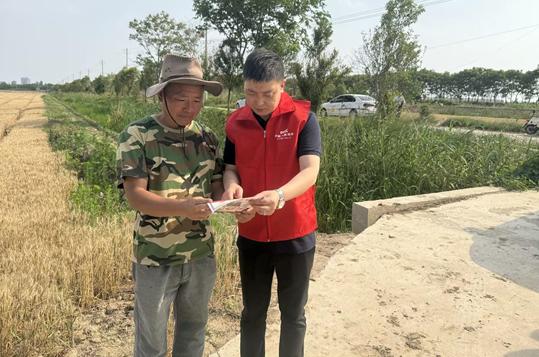
Core Viewpoint - The company is actively enhancing agricultural insurance services during the critical "Three Summer" period to ensure food security and support farmers' income through comprehensive risk management and innovative technology [1][3][6]. Group 1: Agricultural Insurance Services - The company is shifting its agricultural insurance model from "post-disaster compensation" to a full-chain service model that includes "prevention, intervention, and post-disaster claims" to safeguard summer grain production [1]. - As of now, the company has provided risk coverage of 1.915 billion yuan for 221,403 households and 2.016 million acres of wheat [1]. - In Jiangsu, the company has collaborated with local fire departments to conduct safety awareness campaigns to prevent fire risks in wheat fields, enhancing farmers' risk prevention awareness [3]. Group 2: Technological Empowerment - The company is utilizing the "Yunzhibao" platform and drone inspections to ensure precise underwriting and claims processes, thereby enhancing food security and farmers' income [3][4]. - Advanced technologies such as satellite remote sensing, high-precision aerial photography, and IoT sensors are being employed to monitor crop growth and assess risks accurately [4]. - In Hebei, the company has completed over 1,800 inspections of disaster-affected wheat fields, utilizing drones for more than 120 households [4]. Group 3: Community Engagement and Support - The company's staff, including party members, are actively engaging with farmers to address practical issues during the summer harvest, contributing to the overall agricultural productivity [6]. - In collaboration with local agricultural and meteorological departments, the company is facilitating information sharing and resource coordination to assist farmers in harvesting wheat [6]. - The company is committed to maintaining its focus on serving the agricultural sector, ensuring that support reaches farmers effectively [6].

每日投资策略-20250616
Zhao Yin Guo Ji· 2025-06-16 03:48
Macro Economic Overview - China's credit situation continues to be driven by government financing, while private sector credit demand remains weak. The growth rate of social financing in May has rebounded due to accelerated issuance of government bonds. However, tariff impacts are dragging down household purchasing, consumption, and corporate capital expenditure, leading to a continuous decline in new RMB loans year-on-year. More policy support is needed to revive private economic recovery momentum [2] - It is expected that the LPR will be further lowered by 10 basis points in the second half of 2025, and the broad fiscal deficit may moderately increase. The central bank is likely to maintain ample liquidity to support credit growth and stabilize the real estate sector, countering the impacts of tariff shocks. If a trade agreement can be reached between China and the US, China may focus on economic rebalancing, increasing fiscal expansion and consumption stimulation, and advancing manufacturing capacity reduction [2][4] Company Analysis Mindray Medical (300760 CH) - Mindray Medical recently held an investor day, focusing on the digital transformation of its equipment business and the expansion strategy of its flow-type business, aiming to build an overall solution covering all departments with "equipment + IT + AI" and "equipment + consumables." Key highlights include the establishment of a digital medical ecosystem based on IT + AI technology across three major production lines [5] - The company’s AI medical layout mainly focuses on emergency, surgery, and critical care, with the launch of a major model for critical care expected in December 2024, aiming to complete installations in over 30 hospitals this year. By the end of 2025, the company plans to release a major model for anesthesia, with specialized models for emergency, cardiovascular, ultrasound, and laboratory expected to be released in the next 1-2 years [5][6] - The automated assembly line is a key breakthrough for the IVD business, with over 200 new installations expected globally in 2024 and around 300 installations anticipated in 2025. The comprehensive IVD layout supports the company’s multi-disciplinary assembly line production, providing cost and iteration efficiency advantages [6][7] Baker Microelectronics (2149 HK) - Baker Microelectronics remains a core recommendation in the semiconductor sector, with a focus on demand prospects, geopolitical uncertainties, and upstream manufacturing resource investment plans. The company has a clear and sustainable growth strategy [8] Adobe (ADBE US) - Adobe reported a 11% year-on-year revenue growth to $5.87 billion for Q2 FY25, with non-GAAP net profit increasing by 7% to $2.17 billion, both in line with consensus expectations. The company raised its FY25 total revenue guidance to $23.5-23.6 billion, primarily driven by strong performance in its digital media business and increased penetration of AI products [8] Focus Stocks - Geely Automobile (175 HK): Buy rating, target price of 24.00 HKD, potential upside of 47% [9] - Xpeng Motors (XPEV US): Buy rating, target price of 28.00 USD, potential upside of 54% [9] - Luckin Coffee (LKNCY US): Buy rating, target price of 40.61 USD, potential upside of 15% [9] - Tencent (700 HK): Buy rating, target price of 660.00 HKD, potential upside of 29% [9] - Alibaba (BABA US): Buy rating, target price of 155.50 USD, potential upside of 38% [9]



金融活水润田 科技之翼护航——人保财险山东省分公司筑牢农业丰产屏障
Qi Lu Wan Bao· 2025-06-16 02:40
Core Viewpoint - The company is transforming agricultural insurance from a traditional "post-disaster compensation" model to a proactive "risk prevention" approach, leveraging technology and multi-party collaboration to enhance agricultural productivity and sustainability [1][3][5]. Group 1: Technological Empowerment - The company is implementing an innovative "insurance + meteorology + remote sensing + agricultural technology" business model to support farmers during the critical "one spray and three defenses" period for wheat [3][5]. - By utilizing satellite remote sensing and big data analysis, the company can accurately identify high-risk agricultural areas and provide timely weather forecasts and warnings to farmers [5]. Group 2: Multi-Party Collaboration - The company collaborates with local meteorological and agricultural departments to send out weather forecasts and warnings, as well as to provide agricultural technical guidance to farmers [5]. - In 2024, the company's integrated model will be applied to various crops, including wheat, corn, and apples, covering 800,000 acres of farmland and 1.3 million acres of public forests in Yantai [5]. Group 3: Shift in Service Philosophy - The company emphasizes that agricultural insurance is not just a risk compensation tool but also a service link for agricultural production, focusing on proactive risk intervention rather than reactive claims [5]. - The transition from passive compensation to active disaster prevention and from risk compensation to risk reduction showcases the potential of technology and finance in serving the agricultural sector [5].
人保财险山东省分公司:“菜单式”种业保险 守护农业“芯片”安全
Qi Lu Wan Bao· 2025-06-16 02:40
齐鲁晚报·齐鲁壹点 胡晓娟 通讯员 周晓光 种子被喻为农业的"芯片",是保障粮食安全和农产品供给的根本,也是农业现代化发展的根基。而作为 高风险行业的蔬菜种业,其面临的自然风险威胁尤其突出。因此建立健全风险分散机制,不仅是种业企 业需要,更是保障国家粮食安全和社会稳定的迫切需求。在"中国菜篮子"潍坊,一套量身定制的种业保 险体系已破土而出,中国人民财产保险股份有限公司(以下简称"人保财险")山东省分公司通过精准覆 盖蔬菜制种全链条风险、创新"菜单式"承保服务,同时借助科技赋能与财政补贴,为农业"芯片"上了一 把牢牢的"安全锁"。 种子从实验室到田间,每个环节都暗藏风险。人保财险山东省分公司创新构建"全链条防护网",紧抓蔬 菜制种生产链条上的重点,精准找到痛点,将关键风险点都纳入保险保障范围。该公司创新研发了三大 核心险种,包括蔬菜制种保险、种子责任保险、种子公路运输保险。分别承担制种企业自然灾害、意外 事故、爆发性病虫害直接造成的减产损失,种子缺陷造成的种植风险和消费者利益损害依法由制种企业 承担的赔偿责任,种子运输期间因自然灾害、意外事故及盗抢造成的经济损失,有效覆盖了制种企业全 产业链条面临的各类风险。 ...
保险筑牢网络安全护盾
Jing Ji Ri Bao· 2025-06-15 22:05
Core Insights - The first batch of cybersecurity insurance pilot programs in China has been successfully completed, with over 1,500 policies issued for enterprises, totaling more than 150 million yuan in premiums and nearly 11.5 billion yuan in coverage. For residents, over 2 million anti-fraud insurance policies were issued, with premiums exceeding 2.4 million yuan and coverage surpassing 100 billion yuan [1][4] Group 1: Market Overview - The global cybersecurity insurance market is projected to reach $15.3 billion by 2024, which is less than 1% of the total global property and casualty insurance premiums for that year. However, it is expected to more than double by 2030, with an average annual growth rate exceeding 10% [1] - Cybersecurity incidents are increasingly frequent due to interconnected global supply chains, geopolitical conflicts, and complex cyberattack methods, leading to a shift from traditional risk transfer tools to comprehensive risk management solutions [2] Group 2: Claims and Challenges - Claims for cybersecurity insurance are more complex compared to traditional property and liability insurance, as cyberattacks can lead to business interruption losses, legal disputes, data recovery, and privacy infringement liabilities, resulting in potentially exponential increases in payout amounts [3] - The rapid development of generative AI has heightened the risks associated with cyberattacks, with ransomware attacks forming a complete black market chain that includes subscription-based malware and AI-driven automated attack packages [3] Group 3: Regulatory Support and Product Development - The Chinese government has increased support for cybersecurity insurance, with initiatives launched in July 2023 to promote the healthy development of the market. By the end of 2024, 53 insurance companies had registered 341 cybersecurity insurance products, with 56 new products introduced in 2024 [4] - Innovative products have emerged, such as coverage for software supply chain liabilities and system defects, indicating a growing diversity in the types of cybersecurity insurance available [4] Group 4: Market Challenges - The cybersecurity insurance market in China is still in its early stages, facing challenges such as a lack of awareness among enterprises regarding the benefits of cybersecurity insurance, which affects their willingness to purchase and renew policies [5] - The industry also faces challenges on the supply side, including data scarcity, difficulties in risk quantification, limited product offerings, unclear policy terms, and the need for better collaboration within the industry [5]
积极配置非银板块优质红马,持续关注业绩高弹性个股
Changjiang Securities· 2025-06-15 15:16
Investment Rating - The report maintains a "Positive" investment rating for the non-bank financial sector, highlighting the attractiveness of quality stocks in this area [7]. Core Insights - The second quarter shows a stable improvement in policy and market trading trends, suggesting that high-quality non-bank stocks remain a good investment choice based on profitability and dividend stability [2][4]. - Recommended stocks include Jiangsu Jinzheng, China Ping An, and China Pacific Insurance for their stable earnings and high dividend yields. Additionally, stocks like New China Life, China Life, Hong Kong Exchanges, CITIC Securities, Dongfang Wealth, Tonghuashun, and Jiufang Zhitu Holdings are recommended based on their earnings elasticity and valuation levels [2][4]. Summary by Sections Market Performance - The non-bank financial index increased by 1.2%, outperforming the CSI 300 by 1.4% this week, ranking 6th out of 31 sectors. Year-to-date, the non-bank financial index is down 4.2%, underperforming the CSI 300 by 2.4%, ranking 25th out of 31 [5]. Policy and Regulatory Updates - The Ministry of Finance issued a notice to further implement the new insurance contract accounting standards, which is expected to increase the demand for equity assets among some insurance companies during the transition [4][61]. Company Announcements - Guosen Securities announced a cash dividend of 3.50 yuan per 10 shares, totaling 3.364 billion yuan [6]. Insurance Sector Insights - In April 2025, the cumulative insurance premium income reached 259.54 billion yuan, a year-on-year increase of 2.25%. Property insurance income was 64.86 billion yuan, up 5.19%, while life insurance income was 194.69 billion yuan, up 1.31% [22][23]. Investment Business Trends - The report notes a recovery in market activity, with average daily trading volume reaching 1.3717 trillion yuan, up 13.47% week-on-week. The margin financing balance also increased to 1.82 trillion yuan, up 0.53% [40][47]. Financing Activities - In May 2025, equity financing decreased to 16.795 billion yuan, down 32.2% month-on-month, while bond financing was 72.7 billion yuan, down 7.3% [49][51].


启动“防减救赔”应急响应 保险业全力迎战台风“蝴蝶”
Guang Zhou Ri Bao· 2025-06-15 14:43
Group 1 - The insurance industry in Guangdong has activated emergency response mechanisms to address the impact of Typhoon "Butterfly," ensuring the safety of people's lives and property [1][4] - A total of 560 million warning messages were sent to 310,000 customers, with over 6,400 enterprises receiving disaster weather alerts [4] - The rapid compensation mechanism was initiated, with the first payout of 1.43 million yuan for marine aquaculture insurance being processed before the typhoon made landfall [2][3] Group 2 - As of June 15, over 1,400 claims have been reported to Ping An Property & Casualty Insurance, with estimated compensation exceeding 8.7 million yuan [3] - China Life Property & Casualty Insurance reported 263 claims related to the typhoon, with estimated losses of 523.55 million yuan and 32.52 million yuan already paid out [3] - The insurance industry has implemented a mutual recognition mechanism for major disasters, facilitating collaborative damage assessment and emergency response across different companies [4]
非银行业周报20250615:蚂蚁有望入局稳定币业务探索非银金融新边界-20250615
Minsheng Securities· 2025-06-15 12:12
Investment Rating - The report maintains a positive investment rating for the non-bank financial sector, highlighting potential growth opportunities due to regulatory changes and market dynamics [4][37]. Core Insights - Ant Group is expected to apply for stablecoin issuance qualifications, which could expand the participation of non-bank financial institutions in various financial services, including custody, cross-border payments, and supply chain finance [1]. - China Pacific Insurance and New China Life Insurance reported robust premium growth in the life insurance sector, with China Pacific's life insurance premiums increasing by 10.2% year-on-year to CNY 134.79 billion in the first five months of 2025 [2]. - The monetary data for May shows that M1 and M2 growth rates remain high, indicating a potential economic recovery that could support stable capital market operations [3]. Summary by Sections Market Review - Major indices experienced fluctuations, with the non-bank financial index showing a gain of 1.16% [7]. - Key stocks in the brokerage and insurance sectors, such as China Galaxy and New China Life, saw positive performance, with increases of 2.22% and 2.80% respectively [7]. Securities Sector - The total trading volume in the A-share market reached CNY 7.85 trillion, with a daily average of CNY 1.31 trillion, reflecting a significant year-on-year increase of 76.18% [14]. - The IPO underwriting scale for the year reached CNY 338.80 billion, while refinancing underwriting totaled CNY 2,478.79 billion [14]. Insurance Sector - China Pacific Insurance reported a total premium income of CNY 2,271.69 billion for the first five months, up 6.0% year-on-year, while New China Life's premiums surged by 26.1% to CNY 990.86 billion [2][35]. - The life insurance sector continues to show strong growth, with both companies maintaining a positive outlook for the remainder of the year [2]. Liquidity Tracking - The central bank's operations included a net withdrawal of CNY 727 billion, with various interest rates showing mixed trends [27]. - Government bond yields decreased, indicating a supportive environment for capital market stability [27]. Investment Recommendations - The report suggests focusing on key insurance companies such as China Pacific, New China Life, and major brokerages like China Galaxy and CITIC Securities for potential investment opportunities [4][38]. - Non-bank financial institutions are expected to benefit from the implementation of stablecoin regulations, with companies like ZhongAn Online and Hong Kong Exchanges being highlighted as potential investment targets [4][38].

