招商银行

Search documents
8家银行首批上线,Visa支持中国消费者Apple Pay绑卡
Bei Jing Shang Bao· 2026-01-15 03:40
Core Insights - Visa announced a partnership with Apple to support Chinese cardholders in linking Visa cards to Apple Pay for payments in various scenarios abroad, including at physical merchants, mobile apps, and online websites [1] - Currently, 79% of global offline transactions are conducted through contactless payment methods [1] Group 1: Payment Features - Consumers can make contactless payments using Apple Pay by double-clicking the side button on their iPhone or Apple Watch, allowing for seamless transactions without opening any other apps [1] - Each Apple Pay transaction requires security verification through Face ID, Touch ID, or device password, with the verification result sent to the issuing bank in encrypted form [1] - Apple Pay allows users to make faster payments in overseas mobile apps or online websites without the need to create accounts or repeatedly enter personal and payment information [1] Group 2: Supported Banks - The initial banks supporting this feature include Industrial and Commercial Bank of China, Bank of China, Agricultural Bank of China, Bank of Communications, China Merchants Bank, CITIC Bank, Ping An Bank, and Industrial Bank [1] - Visa is collaborating closely with additional banks such as Shanghai Pudong Development Bank, China Construction Bank, Minsheng Bank, and China Everbright Bank to roll out these features in the future [1][2] Group 3: Additional Support - On January 15, CITIC Bank announced support for linking its Visa credit and debit cards to Apple Pay, enabling cardholders to make payments anywhere abroad where merchants accept Visa contactless payments [2]


Visa支持中国持卡人Apple Pay绑卡支付,率先破局背后有何考虑?
Di Yi Cai Jing Zi Xun· 2026-01-15 03:37
Core Insights - Visa has become the first international card organization to support Apple Pay card binding for Chinese cardholders, enhancing payment convenience [1] - The collaboration aims to facilitate cross-border payments, allowing users to make contactless payments abroad using Apple Pay with Visa cards [2][4] - Visa's payment tokenization technology is a key security feature that enhances the safety of mobile payments and e-commerce experiences [4][5] Group 1: Visa and Apple Pay Collaboration - Visa supports both single and dual-branded cards for Apple Pay binding, with initial support from eight banks including Industrial and Commercial Bank of China and China Bank [1] - The collaboration is expected to expand as Visa and Apple work with additional banks like Shanghai Pudong Development Bank and China Construction Bank [1] - This partnership marks a significant shift as Apple Pay previously only supported UnionPay cards in China [1] Group 2: Payment Convenience and Security - Users can make offline payments by simply double-clicking the side button on their devices, allowing for a seamless payment experience without opening any apps [2] - Each transaction is secured through Face ID, Touch ID, or device password, with a dynamic security code sent to the issuing bank for authorization [2] - Visa offers cardholders the same rewards and benefits as physical cards, along with exclusive promotions for first-time users and travel-related scenarios [2] Group 3: Tokenization and Security Measures - Visa's payment tokenization service removes sensitive card information during online or mobile transactions, significantly reducing fraud risk [4][5] - Over 50% of e-commerce transactions within Visa's ecosystem have adopted payment tokenization, with a goal of reaching 100% [5] - The fraud rate for transactions using Visa payment tokens has decreased by over 35%, preventing an estimated $1.1 billion in losses for the fiscal year 2025 [5] Group 4: Future Developments and Market Reach - Visa's payment network spans over 220 countries and regions, connecting approximately 175 million merchants and serving over 4.9 billion cardholders [7] - The collaboration with Apple Pay is seen as a revitalization of dual-branded cards, enhancing the payment experience for users traveling abroad [7] - Visa plans to upgrade existing "Visa + UnionPay" dual-branded credit cards to improve user experience both domestically and internationally by 2025 [7]
Visa支持中国消费者Apple Pay绑卡
Xin Lang Cai Jing· 2026-01-15 02:55
1月15日金融一线消息,Visa今日宣布支持中国持卡人 ApplePay绑卡。Visa将与Apple一起,支持中国持 卡人将Visa卡绑定至ApplePay,并在境外的线下商户、移动app或线上网站等多种场景进行支付。目 前,全球79%的线下交易来自"一拍即付"。 Visa中国区总裁尹小龙表示:"全球数字支付飞速发展的同时,消费者对基于手机的、互联互通的移动 支付方式的需求也与日俱增。一直以来,Visa致力于为中国持卡人提供多元的支付选择,让他们无论身 处何地,都能安心自在地畅享支付之旅。此次,Visa秉持着对中国市场和持卡人长期不变的承诺,在数 据安全与支付安全领域加大投入,推出支付标记化服务并率先实现其在跨境场景的应用。我们很高兴与 Apple及金融机构携手,率先为中国持卡人带来更安全、更便捷的移动支付新体验。" 首批支持的发卡银行包括:中国工商银行、中国银行、中国农业银行、交通银行、招商银行、中信银 行、平安银行及兴业银行。Visa和Apple正在与包括上海浦东发展银行、中国建设银行、中国民生银 行、中国光大银行在内的更多银行伙伴紧密合作,相关功能将于未来陆续上线。 责任编辑:王馨茹 Visa中国区总裁 ...




和讯投顾王振宇:融资保证金比例调整后,市场风格会如何变化?
Sou Hu Cai Jing· 2026-01-15 02:53
2026年伊始,A股市场便迎来降杠杆重磅举措——融资保证金比例重回100%。这一调整背后蕴含何种 深意?作为A股历史上第四次关键的杠杆调控,其传递的监管信号值得深入解读。接下来,我们将用一 分钟厘清此次调整的来龙去脉,明晰其核心影响。大家好,我是老王。首先明确核心结论:融资保证金 比例调整是监管层实施逆周期调节的直接政策工具,市场过热时上调以降温,市场低迷时下调以提振。 此次将比例上调至100%,意味着投资者需以100万元自有资金作为保证金,方可最高融资100万元,杠 杆水平从1.25倍直接回落至1倍。 回溯A股历史,四次关键调整脉络清晰:2006年融资融券试点启动,确立50%的保证金比例底线,奠定 2倍杠杆的市场基础;2015年,为遏制当时过热的市场行情,比例从50%大幅上调至100%,构成行情的 紧急调控节点;2023年,为激活市场活力、提振投资者信心,比例从100%下调至80%,释放积极政策 信号;2026年此次再度从80%回调至100%,则明确传递出"稳字当头、防范过热风险"的监管导向。 这一比例调整绝非简单的数字变化,更传递出三大核心监管信号。信号一:政策风向实现转变,从2023 年的鼓励市场活跃, ...
金价破1400,囤金还是买基?
Sou Hu Cai Jing· 2026-01-15 02:47
Core Insights - The financial market at the beginning of 2026 is divided between the fervor for gold and the calmness of funds, with gold prices reaching historical highs and a significant increase in demand for gold products among young investors [2][4][5] Group 1: Factors Driving Gold Price Surge - The recent surge in gold prices is attributed to a combination of global macroeconomic conditions, policy directions, and consumer demand, driven by geopolitical risks and central bank purchases [4][5] - Geopolitical tensions, including military actions and ongoing conflicts, have accelerated the influx of safe-haven investments into gold, with a notable increase in global gold ETF holdings [5][6] - Central banks, particularly in emerging markets, have been increasing their gold reserves, with China's reserves reaching approximately 2306.32 tons, contributing to a long-term support for gold prices [5][6] Group 2: Investment Choices and Their Characteristics - Young investors are divided into two camps: those buying gold and those sticking with funds, reflecting different value preservation logic and risk profiles [7][9] - Gold investments are categorized into three types: jewelry, investment bars, and gold ETFs, each with varying levels of value preservation and risk [9][10] - Gold ETFs have seen significant growth, with assets under management increasing from $55 billion to $178 billion, offering a low-cost and flexible investment option [10][11] Group 3: Comparative Analysis of Gold and Funds - The intrinsic value preservation of gold is based on its scarcity and risk-hedging properties, while funds rely on asset appreciation and are more sensitive to macroeconomic conditions [11][12] - The performance of equity funds has lagged behind gold, with average global stock index gains around 20% compared to gold's 67% increase in 2025 [10][12] - Investment strategies vary based on risk tolerance and investment horizon, with recommendations for different asset allocations between gold and funds [14][15][16] Group 4: Conclusion and Future Outlook - The surge in gold prices reflects a broader anxiety among ordinary investors in uncertain markets, highlighting the need for balanced asset allocation strategies [17][19] - The financial landscape in 2026 will continue to be influenced by factors such as interest rate changes, geopolitical risks, and economic recovery, emphasizing the importance of a long-term investment approach [19][20]


A股“点刹”引爆震荡!三大交易所突提融资保证金,慢牛信号拉满
Sou Hu Cai Jing· 2026-01-15 02:47
Group 1 - The core message of the news is that the Chinese stock market is experiencing a significant regulatory intervention aimed at cooling down an overheated market, with a specific focus on reducing leverage in margin trading [1][3] - The margin financing ratio was raised from 80% to 100%, which directly reduces the leverage available to investors, indicating a clear shift in policy from a "crazy bull" market to a "slow bull" market [1] - The regulatory measures are designed to prevent a repeat of the 2015 market crash, with a focus on ensuring that market growth is driven by company performance rather than excessive speculation [3] Group 2 - High valuation and high leverage stocks, such as Cambrian and robotics, faced significant sell-offs, while established tech manufacturers and high-dividend sectors like banks and utilities became safe havens [3] - Approximately 70% of new retail investors who bought at high prices were trapped, highlighting the vulnerability of retail behavior in the current market environment [3] - The policy aims to transition the market from being driven by capital inflows to being driven by earnings, as evidenced by the recent performance of quality companies [3]
苹果宣布为中国大陆用户支持Apple Pay跨境支付:可添加Visa信用卡
Feng Huang Wang· 2026-01-15 02:43
Core Viewpoint - Apple Inc. expands the cross-border payment support for Apple Pay in mainland China, allowing users to add local bank-issued Visa credit and debit cards to Apple Wallet for use during international travel [1] Group 1: Announcement Details - Starting immediately, users in mainland China can add Visa credit and debit cards issued by local banks to Apple Wallet for cross-border payments [1] - The initial banks supporting this feature include Industrial and Commercial Bank of China, Bank of China, Agricultural Bank of China, Bank of Communications, China Merchants Bank, Citic Bank, Ping An Bank, and Industrial Bank, with additional support from Shanghai Pudong Development Bank, China Construction Bank, China Minsheng Bank, and China Everbright Bank expected in the coming months [1] - Mastercard has also announced plans to provide this functionality to cardholders of certain issuing institutions in the upcoming months [1] Group 2: Security Features - Users can add cards through the latest bank app or the Wallet app on iPhone, requiring Face ID, Touch ID, or device password along with a one-time dynamic security code for authentication [1] - Apple emphasizes that security and privacy are core design principles, stating that actual card numbers will not be stored on the device or Apple servers [1] Group 3: Historical Context - Apple Pay was officially launched in mainland China in February 2016, primarily supporting UnionPay cards prior to this expansion [2]
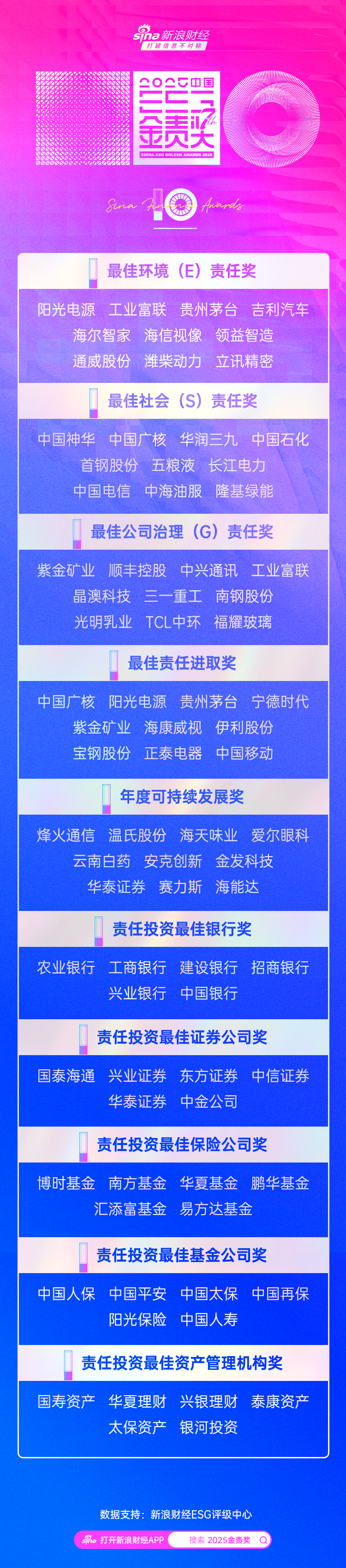
2025中国企业ESG“金责奖”评选结果揭晓 共筑可持续发展新生态
Xin Lang Cai Jing· 2026-01-15 02:38
Core Viewpoint - The 2025 China Enterprise ESG "Golden Responsibility Award" aims to recognize companies and institutions that have made significant contributions to ESG initiatives in China, reflecting a shift from voluntary practices to compliance requirements in ESG performance [1][18]. Group 1: Award Categories and Winners - The award includes ten categories: Best Environmental Responsibility Award, Best Social Responsibility Award, Best Corporate Governance Responsibility Award, Best Responsibility Initiative Award, Annual Sustainable Development Award, Best Responsible Investment Bank Award, Best Responsible Investment Securities Company Award, Best Responsible Investment Insurance Company Award, Best Responsible Investment Fund Company Award, and Best Responsible Investment Asset Management Institution Award [1][18]. - The Best Environmental Responsibility Award winners include: Sungrow Power Supply, Industrial Fulian, Kweichow Moutai, Geely Automobile, Haier Smart Home, Hisense Visual Technology, Linyang Electronics, Tongwei Co., Weichai Power, and Luxshare Precision [10][28]. - The Best Social Responsibility Award winners include: China Shenhua, China General Nuclear Power, China Resources Sanjiu, Sinopec, Shougang, Wuliangye, Yangtze Power, China Telecom, China Oilfield Services, and LONGi Green Energy [10][28]. - The Best Corporate Governance Responsibility Award winners include: Zijin Mining, SF Holding, ZTE Corporation, Industrial Fulian, JA Solar, Sany Heavy Industry, Nanjing Steel, Bright Dairy, TCL Zhonghuan, and Fuyao Glass [10][28]. - The Best Responsibility Initiative Award winners include: FiberHome Technologies, Wens Foodstuff Group, Haitian Flavoring and Food, Aier Eye Hospital, Yunnan Baiyao, Anker Innovations, Kingfa Sci. & Tech., Huatai Securities, Silex, and Hainengda [11][28]. - The Annual Sustainable Development Award winners include: China General Nuclear Power, Sungrow Power Supply, Kweichow Moutai, Contemporary Amperex Technology, Zijin Mining, Hikvision, Yili, Baosteel, Chint Electric, and China Mobile [11][28]. Group 2: Responsible Investment Awards - The Best Responsible Investment Bank Award winners include: Agricultural Bank of China, Industrial and Commercial Bank of China, China Construction Bank, China Merchants Bank, Industrial Bank, and Bank of China [11][28]. - The Best Responsible Investment Securities Company Award winners include: Guotai Junan, Everbright Securities, CITIC Securities, Huatai Securities, and CICC [12][28]. - The Best Responsible Investment Insurance Company Award winners include: China Life Insurance, China Ping An, China Pacific Insurance, China Re, Sunshine Insurance, and China Life [13][28]. - The Best Responsible Investment Fund Company Award winners include: Bosera Funds, Southern Fund, China Asset Management, Penghua Fund, Huitianfu Fund, and E Fund [14][28]. - The Best Responsible Investment Asset Management Institution Award winners include: China Life Asset Management, Huaxia Wealth Management, Xingyin Wealth Management, Taikang Asset, Taikang Asset, and Galaxy Investment [15][28]. Group 3: ESG Development Context - By 2025, China's ESG development has transitioned from "setting standards" to "strengthening regulations," with a comprehensive disclosure standard system being established [1][18]. - The ESG performance of enterprises is now a compliance requirement, linking commercial value with social value [1][18]. - The ESG rating center aims to promote sustainable development and responsible investment, enhancing the ESG performance of listed companies [17][34].



14日两融余额增加152.38亿元 计算机行业获融资净买入居首
Sou Hu Cai Jing· 2026-01-15 01:49
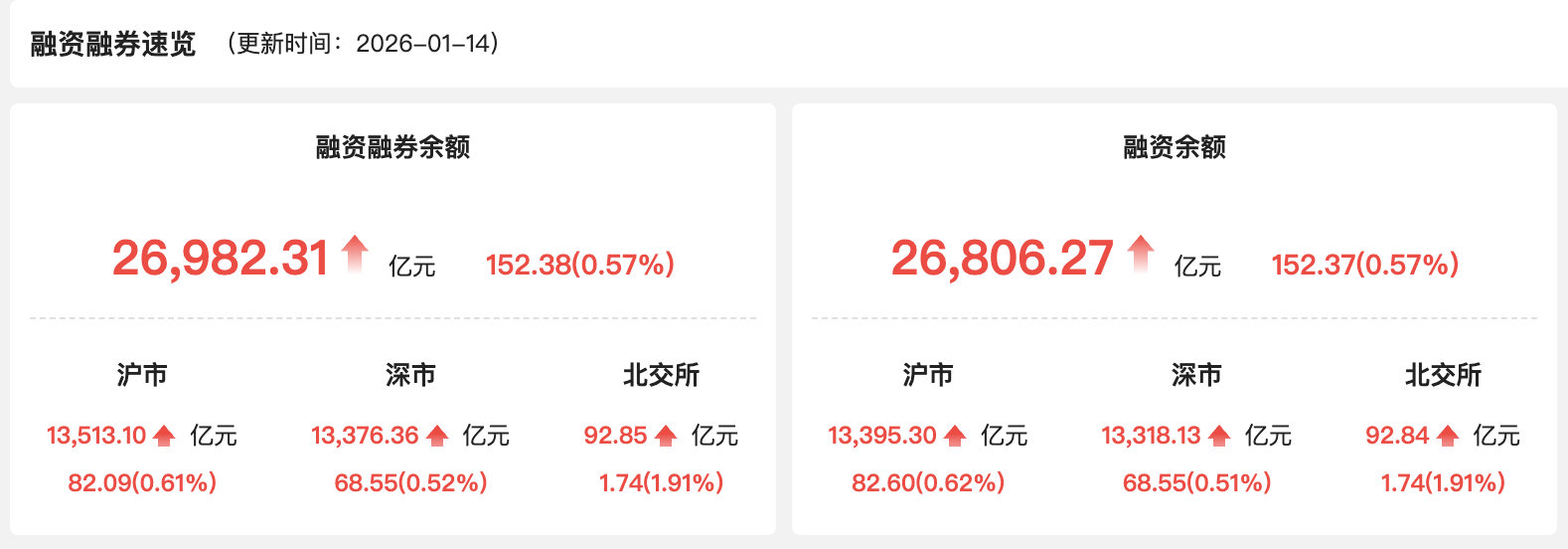
Group 1 - The total margin financing balance in A-shares reached 26,982.31 billion yuan, an increase of 15.238 billion yuan from the previous trading day, accounting for 2.60% of the A-share circulating market value [1] - The margin trading volume on the same day was 4,519.11 billion yuan, which is an increase of 46.76 billion yuan from the previous trading day, representing 11.33% of the total A-share trading volume [1] Group 2 - Among the 31 primary industries, 22 experienced net financing inflows, with the computer industry leading at a net inflow of 3.964 billion yuan [3] - Other industries with significant net financing inflows include telecommunications, public utilities, pharmaceutical biology, banking, non-bank financials, and media [3] Group 3 - A total of 87 individual stocks had net financing inflows exceeding 100 million yuan, with Changjiang Electric Power leading at a net inflow of 1.383 billion yuan [3][4] - Other notable stocks with high net financing inflows include Tebian Electric Apparatus, Zhongji Xuchuang, Huasheng Tianc, China Ping An, Yanshan Technology, China Satellite, China Merchants Bank, Shanzi Gaoke, and Bluefocus [3][4]




今日看点|国新办将举行货币金融政策支持实体经济高质量发展成效新闻发布会
Jing Ji Guan Cha Bao· 2026-01-15 01:48
Group 1 - The State Council Information Office will hold a press conference on January 15 to discuss the effectiveness of monetary and financial policies in supporting the high-quality development of the real economy [1] - The Ministry of Commerce will also hold a press conference on January 15 to introduce recent key work in the business sector [2] Group 2 - The People's Bank of China will conduct a 900 billion yuan reverse repurchase operation on January 15 to maintain ample liquidity in the banking system, with a term of 6 months (181 days) [3] Group 3 - On January 15, a total of 9 companies will have their restricted shares unlocked, with a total unlock volume of 304 million shares, amounting to a market value of 15.476 billion yuan [4] - The companies with the largest unlock volumes include Hanma Technology, Zhongke Lanyun, and Huitong Technology, with unlock shares of 140 million, 76.2838 million, and 52.872 million respectively [4] - The companies with the highest unlock market values are Zhongke Lanyun, Huitong Technology, and Sikan Technology, with values of 10.97 billion, 1.529 billion, and 1.344 billion yuan respectively [4] Group 4 - On January 15, 11 companies disclosed progress on stock repurchases, with one company’s repurchase plan approved by the shareholders' meeting and nine companies completing their repurchase plans [5] - Yuheng Pharmaceutical has the highest proposed repurchase amount of up to 2.7 million yuan, while Kaifa Electric has completed a repurchase of 4.2068 million yuan [5] Group 5 - Five companies disclosed progress on private placements on January 15, with four companies announcing private placement plans and one plan approved by the exchange [6] - The highest proposed fundraising amounts are from *ST Songfa and Lante Optics, with amounts of up to 7 billion and 1.055 billion yuan respectively [6] Group 6 - Ten A-shares will undergo equity registration on January 15, with all ten companies planning to distribute dividends [7] - The companies with the largest dividend payouts are China Merchants Bank, Huayan Precision Machinery, and Industrial Fulian, with payouts of 10.13 yuan, 5.00 yuan, and 3.30 yuan per 10 shares respectively [7]