
台积电

Search documents
破釜沉舟!特斯拉斥资200亿美元将工厂改建机器人产线,马斯克:80%价值靠他它实现
Zhi Tong Cai Jing· 2026-01-30 03:37
Core Viewpoint - Tesla is shifting its focus from electric vehicles to robotics, planning to invest $20 billion this year to support this transformation, indicating a significant pivot in its business strategy [1][2]. Group 1: Financial Performance and Investment Plans - Tesla's capital expenditure decreased by 24% to $8.6 billion last year, but it is projected to more than double to over $20 billion by 2026 as the company transitions towards artificial intelligence and robotics [1][3]. - The automotive revenue, which constitutes about 70% of Tesla's business, is expected to decline by 10% in 2025 due to the lack of new electric vehicle models and increased competition, particularly from BYD in China and Volkswagen and BMW in Europe [2]. Group 2: Product Development and Future Vision - Tesla plans to end production of the Model S and Model X, which accounted for less than 3% of total deliveries last year, to repurpose the Fremont factory for producing the Optimus robot [2][4]. - Elon Musk envisions that Optimus could eventually make Tesla a $25 trillion company, with 80% of its value derived from robotics [2]. Group 3: Technological Challenges and Competition - The company faces significant competition in both robotics and autonomous driving, with rivals like Waymo and Baidu expanding their services [5]. - Tesla is also planning to establish a large-scale chip manufacturing facility, TeraFab, to ensure it can meet its hardware needs and mitigate geopolitical risks [6]. Group 4: Expansion of Services - Tesla aims to expand its Robotaxi fleet in the U.S. and is testing a fully autonomous ride-hailing service in Austin, Texas, with plans to extend this service to seven additional markets [4].


超越富士康!AI浪潮下的“卖铲人”胜利:台达电子市值破千亿美元登台股第二
智通财经网· 2026-01-30 03:06
去年年9月,该公司超越了芯片设计公司联发科技(MediaTek)。随后在本月早些时候,它又超越了鸿海 精密工业股份有限公司(Hon Hai Precision Industry)——这家也被称为富士康(Foxconn)的iPhone和服务器 制造商。 智通财经APP获悉,自去年4月以来,台达电子(Delta Electronics)的市值已增至逾四倍,使这家AI服务器 零部件制造商超越长期稳居台股市值第二位的鸿海精密(富士康),跃升为仅次于台积电的台股第二大市 值企业。 截至2026年1月22日,台达电子股价凭借AI机房需求的强力支撑封上涨停板,报收1245元新台币,其总 市值正式突破1000亿美元大关,折合新台币约3.23兆元。 与此同时,受益于与谷歌(GOOGL.US)在AI芯片领域的深度合作,联发科股价近期再度迎来反弹。当前 中国台湾股市的亚军争夺战愈发激烈,尽管台积电(TSM.US)仍以1.5万亿美元的市值稳居榜首,如泰山 般稳固。 据了解,台达电子此次市值飙升的核心逻辑在于AI服务器产业链中关键零部件的估值重塑。与侧重组 装业务的富士康不同,台达电子在AI高压直流电源(HVDC)管理系统及液冷散热技 ...
深夜史诗级反转:现货黄金一度跌超5%,失守5100美元/盎司
Sou Hu Cai Jing· 2026-01-30 02:01
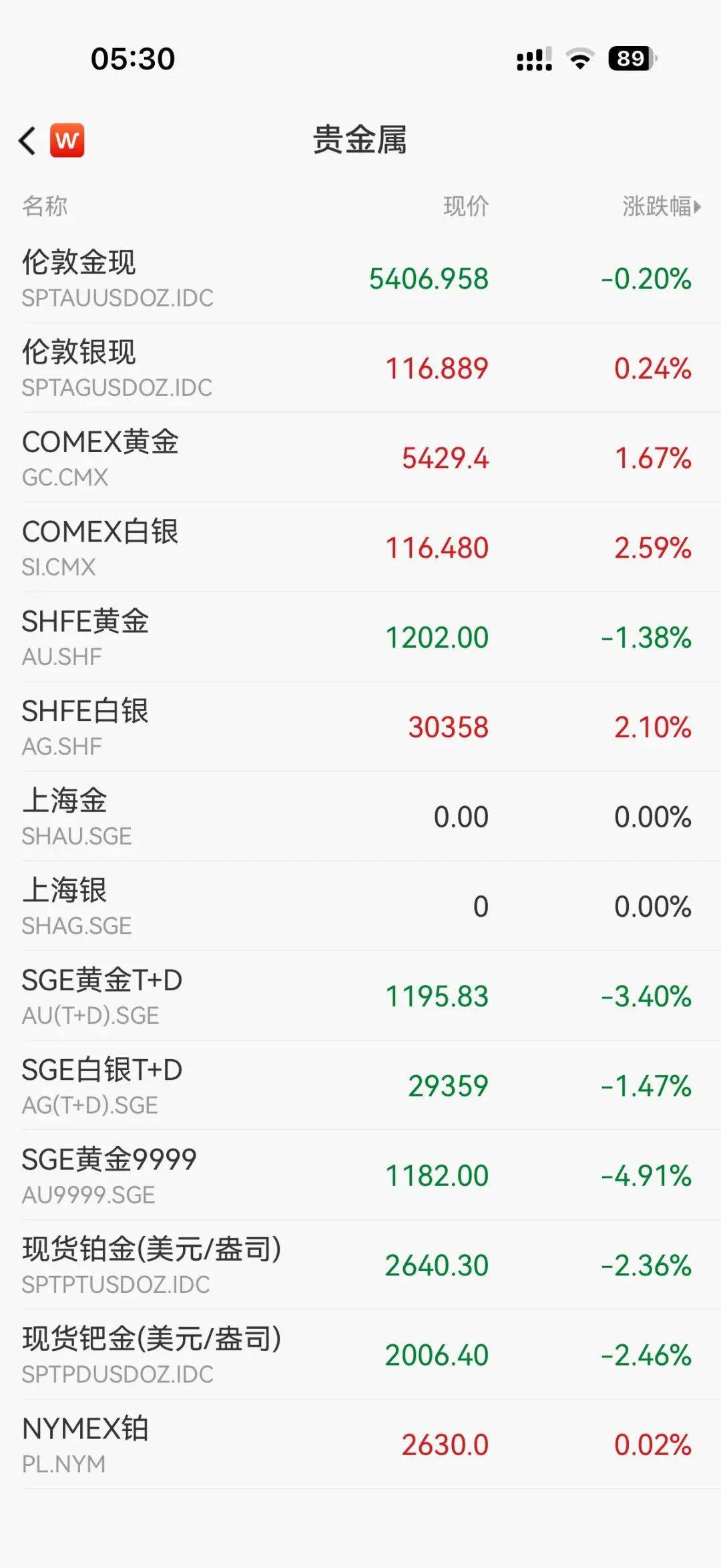
Market Overview - The U.S. stock market experienced fluctuations with major indices showing mixed results; the Dow Jones Industrial Average rose by 0.11%, while the Nasdaq and S&P 500 fell by 0.72% and 0.13% respectively [2] - Large technology stocks mostly saw gains, with notable movements including META rising over 10%, marking its largest single-day increase since July, while Microsoft dropped approximately 10%, resulting in a market cap loss of $357 billion [3] Commodity Prices - Precious metals experienced significant volatility, with spot gold dropping over 5% at one point, falling below $5100 per ounce, and spot silver declining over 8% [1][7] - As of the latest updates, London gold was down 0.20% at $5406.958 per ounce, while COMEX gold rose by 1.67% to $5429.4 per ounce [7][8] - Other precious metals showed varied performance, with platinum down 2.36% at $2640.30 per ounce and palladium down 2.46% at $2006.40 per ounce [7][9] Energy Sector - Energy stocks showed positive movement, with Exxon Mobil increasing by 2.05%, Chevron by 0.7%, and ConocoPhillips by 1.39% [4] Airline Sector - The airline sector displayed mixed results; Boeing fell by 3.12%, while Delta Airlines rose by 1.06% and Southwest Airlines surged by 18.53% [5] Gold Mining Stocks - Gold mining stocks faced a downturn, with major companies like AngloGold Ashanti dropping over 7% and Newmont Mining down 3.81% [6]

隔夜欧美·1月30日
Sou Hu Cai Jing· 2026-01-29 23:56
Market Performance - The three major US stock indices closed mixed, with the Dow Jones up 0.11% at 49,071.56 points, the S&P 500 down 0.13% at 6,969.01 points, and the Nasdaq down 0.72% at 23,685.12 points [1] - Major tech stocks mostly rose, with META up over 10%, Microsoft down about 10%, Tesla down over 3%, TSMC down 1%, ARM down 1.39%, and ASML up over 2% [1] - Popular Chinese concept stocks showed mixed results, with Futu down over 2%, Bilibili and NetEase down over 1%, NIO up over 3%, and TAL Education up over 18% [1] - European stock indices closed mixed, with Germany's DAX down 1.92% at 24,347.16 points, France's CAC40 up 0.06% at 8,071.36 points, and the UK's FTSE 100 up 0.17% at 10,171.76 points [1] Commodity Prices - COMEX gold futures rose 1.32% to $5,410.80 per ounce, and COMEX silver futures rose 1.98% to $115.78 per ounce [1] - US oil main contract rose 3.64% to $65.51 per barrel, while Brent oil main contract rose 3.43% to $69.68 per barrel [1] Currency and Bond Markets - The US dollar index fell 0.20% to 96.16, and the offshore RMB against the US dollar decreased by 12.0 basis points to 6.9449 [1] - US Treasury yields were mixed, with the 2-year yield down 0.60 basis points to 3.557%, the 3-year yield down 1.39 basis points to 3.626%, the 5-year yield down 0.86 basis points to 3.814%, the 10-year yield down 0.59 basis points to 4.233%, and the 30-year yield up 0.01 basis points to 4.853% [1] - European bond yields collectively fell, with the UK 10-year yield down 3.3 basis points to 4.509%, France's 10-year yield down 0.9 basis points to 3.417%, Germany's 10-year yield down 1.8 basis points to 2.838%, Italy's 10-year yield down 1.9 basis points to 3.444%, and Spain's 10-year yield down 1.6 basis points to 3.202% [1]
特斯拉超大晶圆厂 蓝图浮现
Jing Ji Ri Bao· 2026-01-29 23:16
马斯克说,台积电(2330)、三星及美光等现有供应商,供应特斯拉的芯片量都无法达到该公司所需的 水准,"这对确保我们能抵御地缘政治风险将非常重要。"特斯拉目前主要向三星电子与台积电采购芯 片。 目前还不清楚这座"TeraFab"晶圆厂将设于美国何处,以及具体时程为何。马斯克只有透露,这座晶圆 厂会涵盖制造逻辑芯片、存储器以及封装,特斯拉未来将就TeraFab发出"更重大的公告"。 特斯拉执行长马斯克警告,未来三到四年的成长恐受AI与存储器芯片供应所限,因此必须兴建并自行 营运他形容的超大型晶圆厂"TeraFab",用来制造半导体。这意味特斯拉将再次跨足电动车业务以外的 领域。 马斯克28日在财报会议上表示,"为了消除三到四年后可能出现的产能瓶颈,我们将必须建造一座特斯 拉TeraFab。""将是一座非常大型的晶圆厂,涵盖逻辑芯片、存储器以及封装,而且会设在国内。" ...
苹果芯片,损失惨重
半导体芯闻· 2026-01-29 10:10
如果您希望可以时常见面,欢迎标星收藏哦~ 市场传出,苹果(Apple Inc.)及供应商去(2025)年严重错估消费者对iPhone Air的需求,如今正在 结算报废零件的损失,粗估金额可能有数亿美元之谱。 独立科技记者Tim Culpan 28日透过个人的Substack电子报订阅平台指出,消息显示尽管苹果已在 去年10月下令减产,该公司与供应商手中仍累积了最多150万台iPhone Air的零组件。 更惨的是,据传部分零件无法转作他用,或许只有报废一途。要厘清的是,这不代表有150万支 iPhone需要报废,而是指iPhone Air专用的特定零件。 根据Culpan分析,那些无法重新利用的零件所引发的资产减损金额,应落在数亿美元左右(low hundreds of millions of dollars)。 iPhone在2025年7-9月的整体销售额多达490亿美元、10-12月 预估销售额更有望达约800亿美元,区区数亿美元其实不算严重。 Culpan直指,真正的问题应该是,苹果何以这么不了解自家顾客的需求,以及这场混乱会对供应 链产生什么影响。据说,虽然部分供应商需自行承担损失,但苹果会吸收大部分 ...

模拟芯片需求复苏再添力证!意法半导体(STM.US)Q4营收及Q1指引均超预期
Zhi Tong Cai Jing· 2026-01-29 07:52
Core Viewpoint - The demand for analog chips is showing signs of recovery, as evidenced by STMicroelectronics (STM.US) reporting better-than-expected Q4 revenue and Q1 guidance for 2026 [1] Financial Performance - STMicroelectronics reported Q4 revenue of $3.329 billion, a year-on-year increase of 0.2%, surpassing analyst expectations of $3.29 billion [1] - Gross profit decreased by 6.5% year-on-year to $1.172 billion, with a gross margin of 35.2% [1] - Operating profit fell by 66.0% year-on-year to $125 million; excluding a $141 million impairment charge from business restructuring, the operating profit would be $266 million [1] - Non-GAAP earnings per share were $0.11, down 70.3% year-on-year [1] - For Q1 2026, STMicroelectronics expects revenue of $3.04 billion, exceeding analyst expectations of $2.99 billion, with a projected gross margin of 33.7% [1] Market Context - STMicroelectronics is a joint venture between France and Italy, providing a wide range of chips, including high-performance power chips for Tesla (TSLA.US) and core chips for Apple (AAPL.US) [2] - The company heavily relies on U.S. customers, with about 20% of its revenue coming from Apple and Tesla, but lacks manufacturing facilities in the U.S., potentially leading to additional costs for customers [2] Industry Trends - Competitors like Texas Instruments (TXN.US) and Analog Devices (ADI.US) have also reported strong performance, indicating a potential recovery in the analog chip market [3] - Texas Instruments forecasts Q1 2026 revenue between $4.32 billion and $4.68 billion, with an expected earnings per share of $1.22 to $1.48 [3] - The global semiconductor market is gradually recovering, driven by AI demand, with analog chips experiencing tightening supply and longer lead times [4] - Analog chips play a crucial role in various applications, including communication, automotive electronics, and AI data centers, where they are essential for power management and signal processing [4] Supply Chain Dynamics - There is a notable shortage of certain analog chip models in automotive, industrial, and AI server sectors, primarily due to the reduction in 8-inch wafer production capacity by major manufacturers like Samsung and TSMC [5] - The global 8-inch wafer capacity is expected to decrease by 2.4% by 2026, contributing to the supply constraints in the analog chip market [5] - The World Semiconductor Trade Statistics (WSTS) anticipates continued strong demand for chips, including analog and MCU chips, entering a robust recovery phase in 2026 [5]

AI军备竞赛进入白热化!Meta豪掷1350亿美元再创纪录,三星电子等硬件供应商迎来“黄金时代”
Sou Hu Cai Jing· 2026-01-29 07:27
Group 1 - Major tech companies are showing no signs of reducing AI spending, with record investments driving growth for hardware suppliers like Samsung and SK Hynix [1] - Meta has disclosed a spending plan of up to $135 billion for this year, marking one of the largest capital expenditure plans in the business sector [1] - The demand for AI hardware is expected to continue until 2026, as highlighted by the earnings reports of industry giants like Meta, Microsoft, Amazon, and Alphabet [1] Group 2 - Samsung and SK Hynix are key manufacturers of storage chips required for Nvidia's AI accelerators and data center servers, with both companies experiencing significant profit growth [2] - The ongoing demand for AI is exacerbating the global chip supply-demand imbalance, impacting various industries from smartphones to automotive manufacturing [2] - Elon Musk indicated that semiconductor supply could become a major bottleneck for companies like Tesla, potentially necessitating the establishment of a factory capable of producing logic and storage chips [2] Group 3 - Manufacturers of storage chips are shifting production lines to high-bandwidth memory (HBM) to meet AI data center demands, which is reducing supply for consumer electronics [3] - Microsoft reported a 66% increase in capital expenditure, exceeding expectations, but its Azure cloud revenue growth slowed to 38% [3] - Meta's CEO discussed the significant AI acceleration in the tech industry, emphasizing the rapid development trajectory [3] Group 4 - Samsung's chip division reported a fivefold profit increase, significantly surpassing analyst expectations, and announced a stock buyback of 3.57 trillion won along with a special dividend [4] - The focus in Asia is on the competition for the next-generation HBM4, which will integrate with Nvidia's upcoming flagship processor [7] - Samsung's foundry business is expected to see a 130% increase in 2nm orders by 2026, with active discussions with clients in the US and China [7]






AI军备竞赛进入白热化!Meta(META.US)豪掷1350亿美元再创纪录,三星电子等硬件供应商迎来“黄金时代”
Zhi Tong Cai Jing· 2026-01-29 07:09
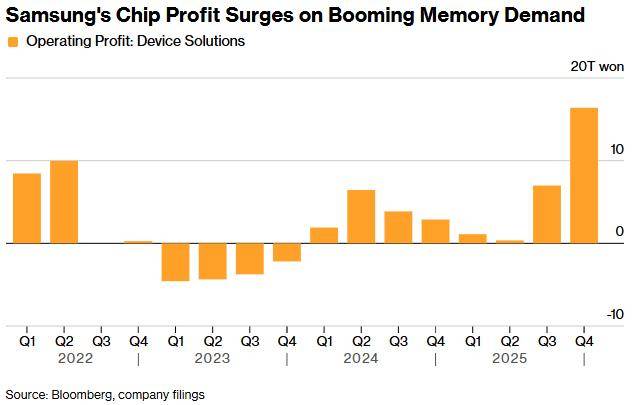
Core Insights - Major tech companies are showing no signs of reducing AI spending, driving growth for hardware suppliers like Samsung and SK Hynix [1] - Meta has announced a significant spending plan of up to $135 billion this year, the largest in the business sector, prompting suppliers to increase capital expenditures [1] - The demand for AI hardware is robust and expected to continue until 2026, as highlighted by recent earnings reports from industry giants [1] Group 1: Company Performance - Samsung and SK Hynix, key manufacturers of storage chips for AI accelerators, have seen profits increase several times over [2] - Samsung's chip division reported a fivefold profit increase, exceeding analyst expectations, and announced a stock buyback of 3.57 trillion won along with a special dividend [4] - SK Hynix plans to significantly increase capital expenditures to meet the rising demand for high bandwidth memory (HBM) [3] Group 2: Market Dynamics - The surge in demand for AI is exacerbating the global chip supply-demand imbalance, affecting various industries from smartphones to automotive manufacturing [2] - The shift towards producing high bandwidth memory (HBM) is reducing supply for consumer electronics, potentially leading to price increases for personal computer manufacturers [3] - Companies like Microsoft are experiencing slower growth in cloud revenue, raising concerns about the sustainability of AI demand despite increased capital expenditures [3] Group 3: Future Outlook - The competition for the next generation HBM4 is intensifying, with Samsung set to ship its new product in February, aiming to catch up with SK Hynix [3][7] - Samsung's contract chip manufacturing business is expected to see a 130% increase in orders for 2nm technology by 2026, indicating strong future growth prospects [7]
未知机构:光连接专家交流CPONPOLPOAOC技术进展客户订单价值量及拆分供应商-20260129
未知机构· 2026-01-29 01:50
Summary of Conference Call on Optical Interconnect Technologies Industry Overview - The discussion focused on optical interconnect technologies, specifically AOC (Active Optical Cable), LPO (Linear Passive Optical), NPO (New Passive Optical), and CPO (Coherent Passive Optical) [1][2][17]. Key Points and Arguments AOC Technology - AOC is defined as a fixed optical fiber module suitable for short-distance multimode transmission, particularly within 50 meters, as used by Google [2][19]. - AOC's cost structure was analyzed, with 800G AOC priced over a thousand dollars and 400G AOC costing several hundred dollars [2][19]. - AOC is expected to support 1.6T transmission capabilities in the future, although current limitations exist [20]. LPO Technology - LPO modules differ from traditional optical modules by omitting DSP (Digital Signal Processor), utilizing linear drive technology, and achieving a transmission distance of up to 500 meters [4][19]. - LPO is projected to see shipments of three to four million units in 2023, potentially doubling by 2027 due to demand from major clients like Google, Microsoft, and Meta [5][19]. - The combination of AOC and LPO is anticipated for different application scenarios, with AOC for short-distance interconnects and LPO for longer distances [19]. NPO Technology - NPO optical engines are compact, low-power, and do not require an external shell, making them suitable for high-density applications like AI accelerators [7][10]. - NPO technology is expected to mature and be sold to cloud providers and equipment manufacturers, with significant market potential [9][23]. - The cost of NPO components, such as the optical engine, is estimated to be around $35 to $40 per unit [26]. Market Dynamics - The market for 800G optical modules is currently in mass production, while 1.6T modules are still in early development, expected to mature in two to three years [5][6][22]. - The supplier landscape is concentrated, with limited opportunities for new entrants, particularly in the TIA (Transimpedance Amplifier) and driver chip sectors dominated by companies like Marvell [6][22]. Technical Challenges - The discussion highlighted challenges in the 200G optical module market regarding transmission distance and industry maturity [3]. - The transition from NPO to CPO technology was noted as technically feasible but with potential challenges in product form factor [9][23]. Future Trends - The integration of optical communication technologies in data centers is expected to grow, with a focus on reducing costs and power consumption while improving system latency [10][14]. - The potential for NPO to replace existing GB300 systems was discussed, contingent on its maturity and performance improvements [25]. Additional Important Content - The role of silicon photonics in NPO technology was emphasized, with key suppliers identified as Group, Tog, and TSMC [15][28]. - The discussion also touched on the advantages of glass substrates in CPU applications, highlighting their cost-effectiveness compared to ceramic and PCB substrates [27]. - The collaboration between Google and various suppliers for LPO technology was noted, with initial production expected from companies like Xuchuang [28]. This summary encapsulates the critical insights and developments in the optical interconnect technology sector as discussed in the conference call.