三星电子

Search documents
美股异动丨阿斯麦盘前涨近5%,开盘势创历史新高,台积电亮眼业绩提振+小摩唱多
Ge Long Hui A P P· 2026-01-15 09:48
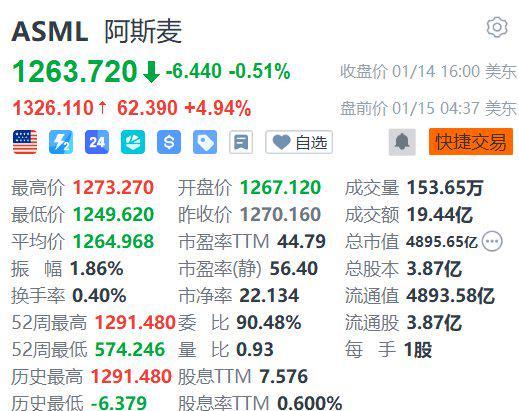
Core Viewpoint - ASML's stock price rose nearly 5% to $1326 in pre-market trading, potentially reaching a historical high, following TSMC's strong Q4 performance and optimistic 2026 outlook [1] Group 1: TSMC Performance - TSMC reported a significant 35% year-on-year increase in net profit for Q4, achieving a record high that exceeded market expectations [1] - The gross margin for TSMC in Q4 reached 62.3%, which was well above market forecasts [1] - TSMC provided a strong revenue guidance for 2026, projecting a further 30% increase [1] Group 2: ASML's Market Position - Morgan Stanley's report indicates that ASML's Q4 order intake is expected to reach €7 billion, surpassing market consensus by approximately 4% due to orders from TSMC and Samsung [1] - The firm maintains an "overweight" rating on ASML's stock with a target price of $1518, suggesting a potential upside of about 20% from the closing price on January 14 [1]


大行评级丨小摩:维持对阿斯麦“增持”评级 目标价为1518美元
Ge Long Hui· 2026-01-15 09:30
摩根大通发布研报称,受来自台积电和三星电子的订单推动,预计阿斯麦第四季度订单额将达到70亿欧 元,较市场共识预期高出约4%。该行维持其对阿斯麦美股的"增持"评级,目标价为1518美元。这一目 标价较该股1月14日收盘价有约20%的上涨空间。 ...
阿斯麦(ASML.US)绩前小摩唱多:2025年Q4订单额料表现强劲 股价有望再涨20%
智通财经网· 2026-01-15 09:15
小摩解释称,第四季度往往是获得Y+2订单的首个季度。阿斯麦在2025年第四季度的订单大部分将关联 到2027年的出货。鉴于目前人工智能市场,尤其是DRAM/HBM市场表现出的巨大需求,芯片制造商很 可能为2027年第一季度起的交付预订大量阿斯麦的设备。特别是,由于洁净室交付周期延长,芯片制造 商在2026年的产能扩张将受限,因此必须为2027年扩产做准备。 小摩补充道,台积电是阿斯麦在2025年订单额和出货量的主要推动力,而在2025年大幅减少光刻机采购 的三星电子可能在未来成为阿斯麦订单增长的最强驱动力。SK海力士和美光科技也将是阿斯麦订单增 长的推动力,但就绝对值而言,由于三星电子拥有可配备设备的现有洁净室空间,其带来的订单增长可 能最为强劲。小摩还表示,相信台积电在为2027年上半年订购所需先进制程设备方面也会表现积极。 智通财经APP获悉,光刻机巨头阿斯麦(ASML.US)将于美东时间1月28日公布2025年第四季度业绩。摩 根大通发布研报称,受来自台积电和三星电子的订单推动,预计阿斯麦第四季度订单额将达到70亿欧 元,较市场共识预期高出约4%——而市场共识预期已被不断上调。该行维持其对阿斯麦美股的" ...
韩国股市今年连续10日上涨,逼近4800点大关
Xin Lang Cai Jing· 2026-01-15 07:31
Group 1 - The South Korean stock market has risen for the tenth consecutive trading day, reaching a new historical high and approaching the 4800-point mark, driven by significant gains in the semiconductor and automotive sectors [1][3]. - The Korea Composite Stock Price Index (KOSPI) increased by 74.45 points, or 1.58%, closing at 4797.55 points [4]. - The trading volume for the day was 540 million shares, with a total transaction value of 23.6 trillion KRW (approximately 16 billion USD), where 482 stocks rose and 389 stocks fell [5]. Group 2 - Foreign and institutional investors were the main drivers of the index's rise, with net purchases of 334.4 billion KRW and 130 billion KRW, respectively, while retail investors net sold 180 billion KRW [5]. - Key stocks contributing to the record rise included Samsung Electronics, which rose by 2.57% to 143,900 KRW, and SK Hynix, which increased by 0.94% to 749,000 KRW [6]. - Hyundai Motor's stock price increased by 2.55% to 422,000 KRW, while its sister company Kia Motors surged by 6.64% to 152,500 KRW [7]. Group 3 - Korea Zinc's stock price soared by 11.47% to 1,440,000 KRW, and POSCO's stock rose by 1.88% to 351,500 KRW [8]. - However, internet giant Naver's stock fell by 4.62% to 247,500 KRW, and NCSOFT's stock decreased by 1.41% to 244,000 KRW, following the elimination of its subsidiary in a government-led competition for local AI model developers [9].
三星优化产线布局,年内关闭一座8英寸晶圆代工厂
Huan Qiu Wang Zi Xun· 2026-01-15 07:19
Core Viewpoint - Samsung Electronics is accelerating the restructuring of its foundry production lines by planning to close its 8-inch wafer foundry S7 in the Giheung area of South Korea within 2024, focusing resources on more profitable 12-inch production lines to enhance overall business competitiveness [1]. Group 1: Company Actions - Samsung currently operates three 8-inch wafer fabs in the Giheung area, with S6 and S8 remaining operational after the closure of S7 [2]. - Following this adjustment, Samsung's monthly production capacity for 8-inch wafers will decrease from 250,000 to below 200,000 wafers [2]. - The decision to close the S7 plant is driven by the overall operating rate of Samsung's 8-inch wafer fabs being around 70%, and the migration of core products like CMOS image sensors and display driver chips to 12-inch lines, leading to increased operational cost pressures [2]. Group 2: Industry Trends - The global capacity for 8-inch wafers is expected to decline by 2.4% year-on-year in 2024, with TSMC also reducing its related capacity since 2023, indicating a trend of capacity optimization within the industry [2]. - Despite the reduction in capacity, market demand remains strong, particularly due to the rapid growth of the AI server industry, which is driving high demand for power management chips [3]. - TrendForce predicts that the average operating rate of global 8-inch wafer fabs will rise to between 85% and 90% in 2024, prompting some foundries to plan price increases ranging from 5% to 20% [3]. - DB Hitek, a local foundry in South Korea, is expected to benefit from this capacity contraction, as its production capacity is fully utilized and it currently cannot accept new orders due to significant order backlogs [3].
龙旗科技港股上市:AI端领军者,智能ODM迎爆发增长
Xin Lang Cai Jing· 2026-01-15 04:23
Core Viewpoint - Shanghai Longqi Technology Co., Ltd. (stock code: 09611.HK) has officially launched its IPO in Hong Kong, planning to issue 52.26 million H-shares with a maximum price of HKD 31.00 per share, aiming to capitalize on the booming demand in the AI sector for performance growth and valuation enhancement [3][5]. Company Overview - Established in 2004, Longqi Technology has evolved into a leading ODM service provider for smart products, offering a comprehensive range of services from product research and design to manufacturing and support [3][5]. - The company has a global presence with R&D centers in Shanghai, Shenzhen, and Huizhou, and production bases in Huizhou, Nanchang, Vietnam, and India, along with branches in the US, South Korea, Japan, Singapore, and Hong Kong [3][5]. Market Position - Longqi Technology holds a 22.4% market share, ranking as the second-largest consumer electronics ODM globally and the largest smartphone ODM with a 32.6% market share [5][14]. - The company has established long-term partnerships with major brands like Xiaomi, Samsung, Lenovo, and OPPO, with several collaborative models exceeding 10 million units in shipments [5][15]. Business Model - The company employs a "1+2+X" framework, focusing on smartphones as the core, personal computing and automotive electronics as key growth areas, and emerging consumer electronics like tablets and wearables [5][7]. - In 2024, smartphone revenue reached RMB 36.13 billion, accounting for 77.9% of total revenue, while AIoT revenue surged by 122% year-on-year to RMB 5.57 billion, representing 12.0% of total revenue [7][8]. Financial Performance - Revenue grew from RMB 29.34 billion in 2022 to RMB 46.38 billion in 2024, with a compound annual growth rate (CAGR) of 25.7% [8][9]. - Net profit improved from RMB 5.6 billion in 2022 to RMB 5.1 billion in the first nine months of 2025, reflecting a 20.9% year-on-year increase [8][9]. Competitive Advantages - Longqi Technology invests heavily in R&D, with cumulative expenditures of RMB 7.23 billion from 2022 to the first nine months of 2025, focusing on wireless communication, audio, display, optics, and AI applications [11]. - The company has established a robust global supply chain and production capabilities, enhancing its competitive edge in responding to market demands and fluctuations in raw material prices [11][12]. Industry Outlook - The global ODM market for consumer electronics is expected to grow, with a forecasted increase in shipment volumes from 2.11 billion units in 2024 to 2.49 billion units by 2029, driven by AI technology integration [12][13]. - The automotive electronics market is projected to expand from RMB 2.5 trillion in 2024 to RMB 3.3 trillion by 2029, indicating significant growth opportunities for ODM manufacturers [13][14]. Future Growth Potential - Longqi Technology is well-positioned to benefit from the AI-driven demand surge in smartphones and other smart products, with expectations of substantial revenue growth in AIoT, AI PCs, and automotive electronics [15][16]. - The company anticipates achieving a net profit of RMB 6.85 billion in 2025, representing a 29.4% year-on-year increase, with further growth projected for 2026 and 2027 [16].
2026年,半导体市场10大关注点
芯世相· 2026-01-15 04:23
Core Viewpoint - The global semiconductor market is expected to be dominated by AI, particularly in the data center sector, while demand for consumer electronics like PCs and smartphones remains stagnant [2][3]. Group 1: NVIDIA and AI - NVIDIA continues to emphasize its leadership in AI, with plans to launch the new product "Rubin" in 2026, potentially priced between $100,000 and $120,000 [4][6]. - The company is focusing on "physical AI" applications, which are essential for real-world implementations such as autonomous driving and robotics [6]. Group 2: TSMC's Market Position - TSMC's market share in the foundry business is projected to exceed 60% in 2024 and possibly 70% in 2025, maintaining its dominance in advanced process technologies [7]. - TSMC has begun mass production of 2nm technology, with Apple expected to be its first major customer [7]. Group 3: Intel's Manufacturing Challenges - Intel's manufacturing division is facing significant financial losses, with a reported $20 billion loss in the manufacturing sector for the fiscal year 2024, raising concerns about its long-term viability [8]. - Discussions about potential funding and management for Intel's manufacturing operations are ongoing, but no concrete plans have emerged [8]. Group 4: Semiconductor Market Growth - The global semiconductor market is forecasted to grow from $772.2 billion in 2025 to $975.5 billion in 2026, translating to approximately 151.2 trillion yen [11]. - Japan's semiconductor industry is at risk of declining market share, potentially falling below 5% due to rapid global market growth driven by AI [11]. Group 5: DRAM Market Dynamics - The DRAM market is experiencing volatility due to increased demand from AI applications, with contract prices rising sharply [16]. - There are concerns that aggressive investments in DRAM production could lead to a market downturn in the latter half of 2026 [16]. Group 6: Emerging Competitors - Chinese power device manufacturers are gaining competitiveness, with a significant portion of the market share in power devices expected to shift towards them [17]. - The potential for oversupply in the power device market is a risk that needs monitoring as demand dynamics evolve [17]. Group 7: Nexperia's Market Position - Nexperia holds a 20% market share in the small signal transistor market, with over 50% of its revenue coming from the automotive sector, indicating potential vulnerabilities [19]. Group 8: TSMC's Expansion in Japan - TSMC's expansion in Japan is becoming increasingly important, with plans to introduce advanced process nodes in its facilities, despite current underutilization of existing capacity [20].


特朗普关税之手终于伸向半导体! 英伟达H200与AMD MI325X遭遇25%“点名关税”
Zhi Tong Cai Jing· 2026-01-15 02:16
Core Viewpoint - The Trump administration has announced a 25% import tariff on certain semiconductor products, including high-end chips from Nvidia and AMD, effective from the 15th, aimed at bolstering domestic semiconductor manufacturing and reducing reliance on foreign supply chains [1][2]. Group 1: Tariff Announcement and Implications - The new tariff specifically targets imports of high-end semiconductor products, including Nvidia's H200 AI chip and AMD's MI325X chip, while excluding chips imported to support U.S. technology supply chain development [1][2]. - The tariff is part of a broader strategy to enhance domestic semiconductor production capabilities and address national security concerns related to semiconductor imports [2]. - The U.S. Commerce Department's investigation under the Trade Expansion Act of 1962 indicated that current import levels of semiconductors pose a threat to national security [2]. Group 2: Market Reactions and Company Impact - Following the tariff announcement, Nvidia's stock experienced a decline of nearly 3% intraday, closing down 1.44%, while AMD's stock rose by 1.19% [3]. - The tariff increases the cost of cross-border sales for high-performance AI chips, potentially suppressing overseas market demand and putting pressure on profit margins and pricing strategies for both Nvidia and AMD [4][5]. Group 3: Domestic Semiconductor Manufacturing - The tariff policy emphasizes reducing dependence on foreign semiconductor supply chains, pressuring fabless companies like Nvidia to consider relocating advanced chip manufacturing back to the U.S., which could significantly raise manufacturing costs [5]. - The policy does not apply to chips used directly in U.S. data centers or consumer devices, indicating a strategic compromise between export control and allowing some commercial exports [5]. Group 4: Industry Outlook and Equipment Manufacturers - U.S. semiconductor equipment manufacturers, such as KLA, Lam Research, and Applied Materials, are expected to benefit from the tariff, as it may drive domestic chip manufacturers to purchase more U.S.-made semiconductor equipment [7]. - Analysts predict a bullish outlook for the semiconductor equipment sector, with expectations of increased capital expenditures from major chip manufacturers like TSMC, Intel, and SK Hynix due to rising demand for AI chips and storage solutions [8].

1.15犀牛财经早报:0费率理财产品涌现 机构盯上万亿存款搬家蛋糕
Xi Niu Cai Jing· 2026-01-15 01:40
Group 1: Cross-Border ETFs - The total scale of cross-border ETFs has surpassed 1 trillion RMB for the first time, reaching 10098 billion RMB as of January 13 [1] - The growth rate of cross-border ETFs has been significant, with an increase of 138% from 4242 billion RMB at the beginning of 2025 [1] - The surge in cross-border ETF popularity is attributed to global market rallies and increased interest in sectors like artificial intelligence and innovative pharmaceuticals [1] Group 2: Bank Wealth Management - Bank wealth management companies are experiencing a wave of zero-fee and low-fee products as they compete for market share, targeting the growing pool of deposit funds [2] - The total scale of bank wealth management has reached a record high, with 14 companies managing over 1 trillion RMB, reflecting an increase of nearly 30 billion RMB since early 2025 [3] - The industry is entering a "true net value era," where market fluctuations will directly impact product net values [3] Group 3: Fund Management - Some high-performing equity funds are implementing measures like suspending subscriptions or limiting purchases to manage inflows and maintain operational stability [2] - The adjustments in fund subscriptions reflect managers' considerations of performance sustainability and market conditions [2] - The trend of limiting subscriptions is seen as a way to balance fund size and strategy execution space, providing insights into future market trends [2] Group 4: Commodity and Technology Sectors - The demand for non-gold-related metal theme funds is increasing, with significant net subscriptions exceeding 51 billion RMB over the past year [2] - The average spot price of DRAM chips has risen by 9.64%, while NAND flash prices have also increased, although trading volumes remain low due to various market factors [5] - The pig farming market is expected to face continued pressure in the first half of 2026 due to oversupply and weak demand, despite seasonal factors [6]
SK海力士完成中国工厂升级,加速扩产
半导体行业观察· 2026-01-15 01:38
Core Viewpoint - SK Hynix has successfully upgraded its Wuxi factory, a significant DRAM production base in China, to a more advanced 1a process, enhancing its production capabilities despite U.S. sanctions on semiconductor technology [1][2] Group 1: Factory Upgrade and Production Capacity - The Wuxi factory's existing 1z process has been upgraded to the 1a process, with a monthly production capacity of 180,000 to 190,000 12-inch wafers, of which approximately 90% is now produced using the 1a process [1] - The Wuxi factory accounts for 30% to 40% of SK Hynix's total DRAM production, making the upgrade crucial for the company's overall output [1] - The transition to the 1a process, which requires extreme ultraviolet (EUV) lithography technology, was completed in two years, despite challenges posed by U.S. export restrictions on EUV equipment [1][2] Group 2: Strategic Importance and Future Plans - The Wuxi factory is vital not only for SK Hynix but also for the global semiconductor supply chain, as highlighted by the company's president, who emphasized the need to monitor U.S. regulatory developments closely [2] - SK Hynix plans to accelerate upgrades to its domestic DRAM wafer fabs to the sixth-generation 1c process, focusing investments on its M14 and M16 fabs in Icheon, South Korea [2] - The production structure will involve general DRAM products being manufactured in China, while advanced DRAM products will be produced in South Korea [2] Group 3: Market Demand and Expansion Plans - Due to surging demand for memory chips, SK Hynix is expediting the opening of a new factory by three months, with operations set to begin in February [4] - The company is responding to a global memory chip shortage that has increased prices for consumer electronics and slowed down data center construction for AI applications [4] - SK Hynix's CEO noted the necessity to support memory consumption for AI infrastructure, indicating a strategic partnership with Nvidia [4][5] Group 4: Market Trends and Financial Performance - The global memory chip market is experiencing unprecedented growth, with some product prices rising over 300% year-on-year due to increased demand from AI infrastructure [5] - SK Hynix has seen its stock price increase by 280% over the past year, solidifying its position as the second-largest memory chip manufacturer globally, following Samsung Electronics [5]