
天弘基金

Search documents
盘中实时成交额近2亿元,科创综指ETF天弘(589860)昨日“吸金”超2100万,居同标的第一
2 1 Shi Ji Jing Ji Bao Dao· 2025-08-08 06:50
Group 1: Market Overview - A-shares experienced fluctuations on August 8, with the technology sector showing a slight pullback [1] - The Tianhong Sci-Tech Innovation Index ETF (589860) fell by 1.02%, with a trading volume exceeding 194 million yuan, ranking first among similar products [1] - Notable gainers among constituent stocks included Sainuo Medical, Kewell, Zhejiang Haideman, and Nanmo Biology, all hitting the daily limit [1] Group 2: Fund Flow and Investment Trends - The Tianhong Sci-Tech Innovation Index ETF attracted over 21 million yuan in inflows on August 7, leading among 19 similar ETFs [1] - The index closely tracks the Sci-Tech Innovation Index (000680.SH), covering approximately 97% of the market capitalization of the Sci-Tech Innovation Board, with a focus on small-cap hard technology companies [1] Group 3: Positive Catalysts for Investment - Three favorable factors for the Sci-Tech Innovation Index were highlighted: 1. Catalysts from leading stocks, particularly in the domestic chip sector, benefiting companies like SMIC and Cambrian [2] 2. Resonance between the semiconductor and pharmaceutical sectors, with potential for long-term valuation recovery in pharmaceuticals [2] 3. Policy changes and new merger regulations that could unlock long-term growth opportunities for Sci-Tech Innovation Board companies [2] Group 4: Sector Analysis - The pharmaceutical sector is gradually recovering from the impact of centralized procurement, with a shift in policy attitudes and optimization of procurement rules [3] - Increased R&D investments are leading to a harvest period for pharmaceutical companies, with a growing trend in overseas business development reflecting the competitiveness of domestic innovative drugs [3] - The pharmaceutical industry is expected to undergo a valuation re-rating as policy and earnings improve [3]
一箭11星即将在日照发射,航空航天ETF天弘(159241)盘中净申购700万份,年内份额增109%
2 1 Shi Ji Jing Ji Bao Dao· 2025-08-08 06:40
Group 1 - Aerospace sector experienced fluctuations, with Tianhong Aerospace ETF (159241) down 0.41% and trading volume exceeding 720 million yuan, leading among similar products [1] - As of August 7, Tianhong Aerospace ETF (159241) saw a net subscription of 7 million shares, with a year-to-date share increase rate of over 109%, ranking first among similar products [1] - The Tianhong Aerospace ETF closely tracks the Guozheng Aerospace Index, which has a significant weight of nearly 98% in the defense and military industry, making it the highest military content index in the market [1] Group 2 - From August 9 to August 11, the Jielong-3 remote rocket will launch 11 satellites for the "Geely Constellation 04 Group," aimed at providing high-precision positioning and satellite communication for Geely's brands [2] - According to Zhongjin Company, China's commercial aerospace industry is expected to enter a rapid development phase, highlighting investment opportunities in satellite manufacturing, launching, and downstream applications [2] - Xingye Securities indicates that expectations for a new round of military orders are increasing, supporting the long-term logic of continuous improvement in the military industry fundamentals [2]
红利基金买哪个好?港股红利原来这么香!
Xin Lang Cai Jing· 2025-08-08 05:33
Core Viewpoint - The article emphasizes the increasing interest of investors in dividend funds, particularly in the context of declining deposit rates, highlighting the characteristics and advantages of the Tianhong CSI Hong Kong Stock Connect High Dividend Investment Index A (022072) fund. Group 1: Fund Characteristics - The Tianhong CSI Hong Kong Stock Connect High Dividend Investment Index A (022072) focuses on high dividend assets, with a portfolio concentrated in traditional high dividend sectors such as finance, industrials, and energy, aligning with the core logic of selecting mature companies [1][3]. - The fund tracks the CSI Hong Kong Stock Connect High Dividend Investment Index, which requires constituent stocks to meet strict criteria such as continuous dividends and high liquidity [1]. Group 2: Performance and Returns - The fund achieved a dividend yield of 5.8% over the past 12 months, significantly higher than the prevailing bank deposit rates and most bond yields [3]. - In the first half of 2025, the fund's return reached 10.96%, outperforming its benchmark by 2.14%, primarily due to the recovery in stock prices of high dividend constituents [3]. - The fund has conducted three dividend distributions in 2025, supporting a "dividend reinvestment" option to enhance long-term returns through compounding [3]. Group 3: Risk Management and Stability - The fund exhibits low volatility and defensive attributes, with a maximum drawdown lower than the Hang Seng Index over the past four years, demonstrating resilience during market downturns [4]. - The index is rebalanced semi-annually to sell stocks with declining dividend yields and buy those with rising yields, which helps mitigate valuation bubble risks [4]. Group 4: Market Environment and Sensitivity - The fund's investment value is enhanced in a low-interest-rate environment, with an average dividend yield of 7.2% for its constituents in the second quarter of 2025 [5]. - The current market interest rates have decreased by approximately 50 basis points from 2023 to 2025, further emphasizing the attractiveness of high dividend assets [5]. Group 5: Cost Efficiency - The fund has a low management fee of 0.15% per year and a custody fee of 0.05% per year, resulting in a total cost ratio of 0.20%, which is significantly lower than actively managed dividend funds [6]. Group 6: Target Audience and Strategy - The fund is suitable for investors seeking stable dividend income, such as retirees and low-risk investors, as well as those looking to diversify their investments through the Hong Kong Stock Connect [8]. - Tactical allocation strategies suggest using the fund as a bond substitute during declining interest rates to enhance portfolio returns, while a strategic approach involves "regular investment + dividend reinvestment" to smooth out volatility [9].
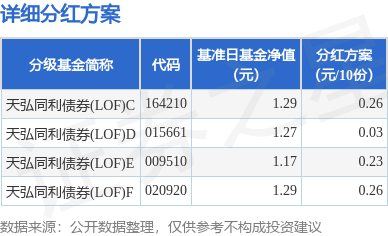
基金分红:天弘同利债券(LOF)基金8月11日分红
Sou Hu Cai Jing· 2025-08-07 14:21
本次分红对象为权益登记日在基金注册登记机构登记在册的本基金全体基金份额持有人。,权益登记日 为8月8日,现金红利发放日为8月11日。选择红利再投资方式的投资者,其红利按2025年08月08日除息 后的基金份额净值转换为基金份额,转换后的基金份额将于2025年08月11日直接计入其基金账户,2025 年08月12日起可以查询。根据相关法律法规规定,基金向投资者分配的基金收益,暂免征收所得税。本 基金本次分红免收分红手续费;选择红利再投资方式的投资者其红利再投资所得的基金份额免收申购费 用。 | 分级基金简称 | 代码 | 基准日基金净值 (元) | | 分红方案 (元/10份) | | | --- | --- | --- | --- | --- | --- | | 天弘同利债券(LOF)C 164210 | | | 1.29 | | 0.26 | | 天弘同利债券(LOF)D 015661 | | | 1.27 | | 0.03 | | 天弘同利债券(LOF)E 009510 | | | 1.17 | | 0.23 | | 天弘同利债券(LOF)F 020920 | | | 1.29 | | 0.26 | 证券 ...

基于ETF的A股因子配置研究
Hengtai Securities· 2025-08-07 10:15
Group 1 - The report focuses on factor allocation research based on ETFs in the A-share market, providing effective strategies for investors to utilize ETFs for style allocation [2][4] - Style factors significantly influence the returns of A-share strategies, with notable style trends observed over the past decade, such as small-cap value and large-cap growth, leading to substantial excess returns when aligned with main style trends [2][10] - There are currently 107 factor strategy ETFs in China, with a total net asset value of approximately 127.06 billion, representing about 4.09% of the total net asset value of equity ETFs, but these products face challenges in style coverage and liquidity [2][14][17] Group 2 - The report proposes a stock-based ETF factor allocation scheme starting from holding styles, exemplified by the construction of a dividend low-volatility ETF combination that aligns closely with the CSI Dividend Low Volatility Total Return Index [2][26] - The use of ETF style scoring for factor allocation offers significant advantages, allowing for broader coverage of style factors and providing more liquid solutions when the scale of related factor strategy ETFs is small [2][36] - A multi-factor strategy is constructed based on the "anti-involution" policy, focusing on high-quality growth and high-margin safety combinations, with backtesting showing strong performance for both strategies [2][38][51] Group 3 - The report highlights the importance of using a comprehensive ETF selection process to address the limitations of existing factor strategy ETFs, particularly in terms of style coverage and liquidity [2][18][36] - The methodology for constructing the dividend low-volatility ETF combination involves detailed indicator breakdowns and ETF product sorting based on style characteristics [2][26][30] - The performance analysis of the constructed multi-factor strategies indicates a strong correlation with benchmark indices, showcasing the effectiveness of the proposed ETF combinations [2][32][51]
股票ETF失血628亿跌破万亿关口,资金缘何弃宽基投主题?
第一财经· 2025-08-07 09:55
Core Viewpoint - The ETF market is experiencing a shift from broad-based products to sector-specific investments, with significant outflows from broad-based ETFs and inflows into thematic ETFs, indicating changing investor preferences [2][5][8]. Group 1: ETF Market Trends - As of August 5, stock ETFs have seen a net outflow of 628 billion yuan over the past month, marking a decline below 1 trillion units for the first time since October of the previous year [2][5]. - Broad-based ETFs, particularly those tracking the CSI A500 index, have faced severe redemption pressures, with only one out of 38 products seeing net inflows [5][6]. - In contrast, thematic ETFs have attracted 176 billion yuan in net inflows, with sectors like dividends, banking, and coal being popular among investors [2][6]. Group 2: Market Dynamics - The ETF market, valued at 4.64 trillion yuan, is characterized by a significant concentration of assets, with the top ten firms controlling nearly 80% of the market share [2][8]. - Major players like Huaxia and E Fund have seen their ETF scales increase by over 100 billion yuan this year, while many smaller firms struggle to reach 10 billion yuan [2][8]. - The competitive landscape is intensifying, with many mid-sized firms facing high resource and cost barriers, leading to a "war of attrition" in the market [3][9]. Group 3: Investor Behavior - Investors are shifting their focus from broad-based ETFs to sector-specific products, reflecting a desire for more targeted investment strategies during market fluctuations [7][10]. - The trend indicates that investors are looking for higher returns through short-term trading in strong sectors, rather than relying on the broader market [7][10]. Group 4: Challenges for Fund Companies - The ETF business, while seen as a growth avenue, presents significant resource and cost challenges, particularly for smaller firms [9][10]. - The high costs associated with system maintenance, marketing, and operations make it difficult for smaller companies to compete effectively in the ETF space [9][10]. - Despite these challenges, some mid-sized firms are beginning to re-evaluate their strategies and invest in ETF capabilities to capture market opportunities [10].

“反内卷”相关基金产品梳理-20250807
Minsheng Securities· 2025-08-07 09:32
Group 1 - The report identifies investment opportunities in various industries under the "anti-involution" theme, drawing parallels with the supply-side reform period from 2015 to 2018, focusing on policy effects, inventory cycles, and industry prosperity [1][8] - The current "anti-involution" theme has a broader industry coverage, with a positive outlook on photovoltaic and medical devices based on their clearing reversal elasticity, while chemicals and building materials are favored for their certainty in prosperity [2][14] Group 2 - The report outlines the criteria for selecting actively managed equity funds related to the "anti-involution" theme, requiring a significant holding in relevant industry stocks and a minimum fund size [3][16] - For ETF funds, a scoring system based on various performance metrics is used to identify the top products in the same category [3][16]
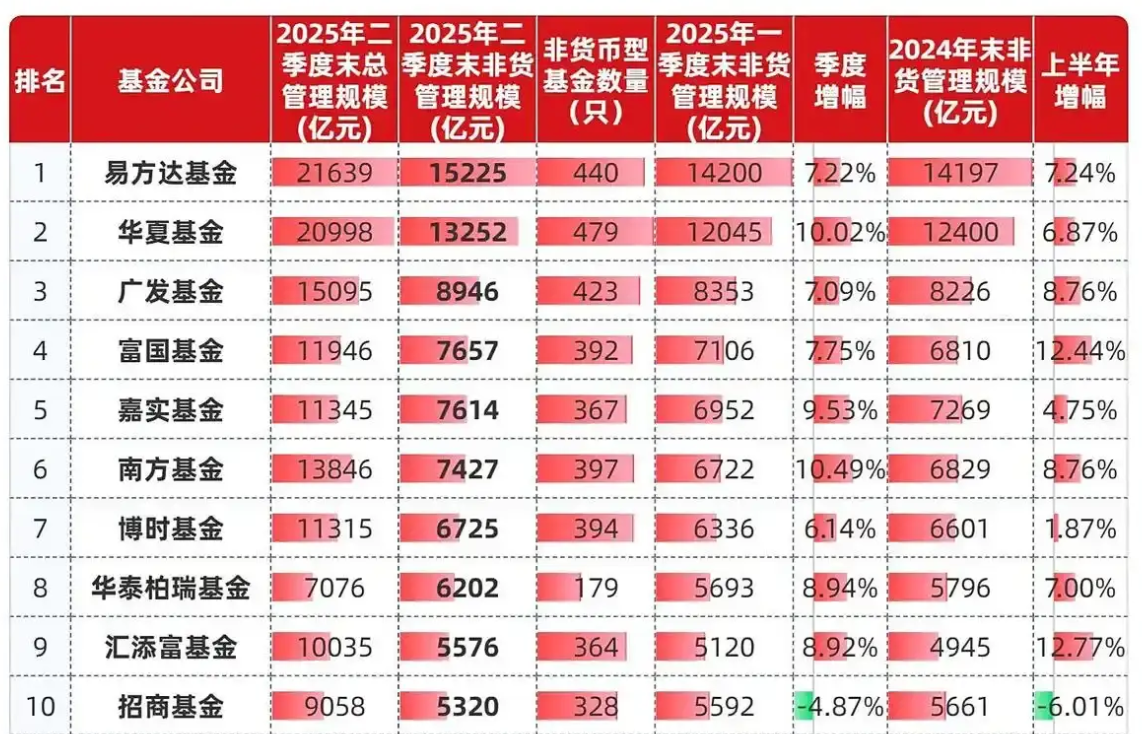
招商基金掉队了?
Hu Xiu· 2025-08-07 08:54
Core Insights - The competitive landscape of public funds continues to favor leading firms, with only minor shifts in rankings, notably the decline of China Merchants Fund to the tenth position, marking it as the only top ten institution to experience a drop [1][3] - In stark contrast, leading firms like E Fund and Huaxia Fund have seen significant growth, with China Merchants Fund's non-monetary fund scale shrinking by 27.204 billion yuan in Q2 alone, totaling a decline of 60 billion yuan in the first half of the year [1][2] Fund Performance - As of mid-2025, China Merchants Fund's non-monetary fund scale has decreased to 532.015 billion yuan, making it the only firm in the top 20 to report negative growth [1][2] - The firm has faced a continuous decline since reaching its highest ranking in Q2 2022, with revenue and net profit both decreasing in 2023, and a projected net profit decline of 5.87% in 2024 [2][3] Market Position and Strategy - China Merchants Fund's bond fund scale increased from 267.216 billion yuan in 2021 to 364.454 billion yuan in 2024, ranking fourth in the industry, but the firm is now facing challenges in its fixed income business due to market pressures [3][4] - The firm has a heavy reliance on fixed income products, with 79.89% of its total fund scale attributed to bond and money market funds, while equity products account for only 18.61% [3][4] Talent and Management Changes - The departure of key fixed income personnel, including the notable figure Ma Long, has raised concerns about the stability and capability of the fund management team [5][10] - In the past year, eight fund managers have left China Merchants Fund, significantly higher than the industry average of 2.16, leading to questions about the firm's team stability and management effectiveness [13][19] ETF and Equity Business - China Merchants Fund has struggled in the ETF space, ranking 20th in total ETF management scale at 36.572 billion yuan, which is less than 1/20th of Huaxia Fund's scale [16][18] - The firm has seen a decline in its active equity product scale from 278.892 billion yuan in 2021 to 184.123 billion yuan in 2024, with nearly 20% of its products reporting losses since inception [9][16] Organizational Challenges - The firm has faced significant personnel changes, including the resignation of its general manager and the appointment of new executives, which may hinder strategic execution and external communication [18][19] - The conservative management style influenced by its banking roots has limited the firm's ability to innovate and adapt to the rapidly changing asset management landscape [17][19]
最高收益近8%!首批“新型”基金旗开得胜,“第二波”已经上路
Sou Hu Cai Jing· 2025-08-07 08:02
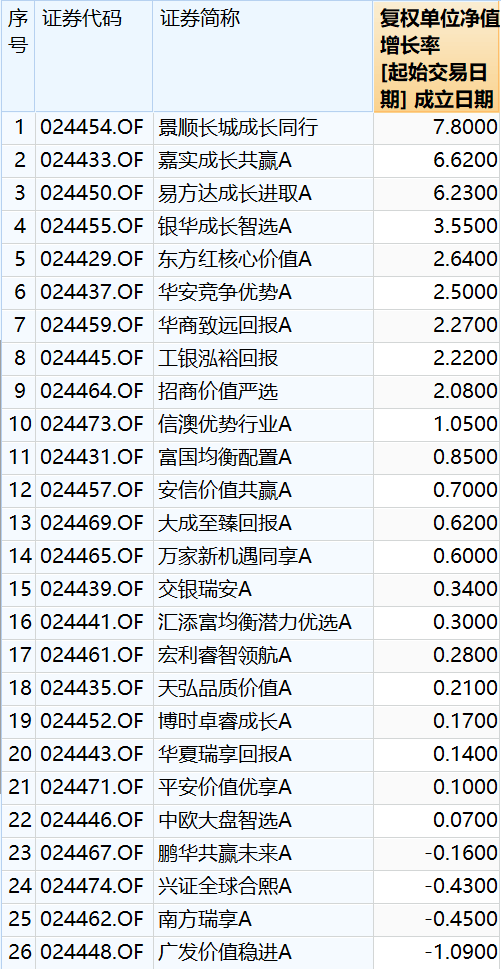
Core Insights - The first batch of floating rate funds has shown strong performance, with 22 out of 26 funds achieving positive returns since their inception, with the best performer, Invesco Great Wall Growth, nearing an 8% return [1][3] - The average fundraising scale for these new floating rate funds is approximately 1 billion, significantly higher than the average of 440 million for actively managed equity funds, indicating strong market acceptance [4][6] - The second wave of floating rate funds has been approved, with 12 new products set to launch, including both broad market and industry-specific funds, expanding the product offerings in this category [6][8] Fund Performance - Among the 26 floating rate funds, notable performers include Invesco Great Wall Growth (7.8), Harvest Growth Sharing A (6.62), and E Fund Growth Progress A (6.23), while several others have returns around 1% [2] - The overall performance of these funds has varied due to different asset allocation strategies and market conditions, with the Shanghai Composite Index reaching 3600 points during their establishment period [2][3] Fund Size and Market Response - The total size of the first batch of floating rate funds reached nearly 26 billion, with significant increases in fund shares, particularly for Huashang Zhi Yuan Return A, which exceeded 2 billion shares [4][5] - The market's positive response to these funds has helped alleviate concerns regarding the floating rate mechanism, as evidenced by the substantial capital inflow [4][6] Upcoming Products - The second batch of floating rate funds includes products from both new and established fund managers, with a focus on industry themes such as healthcare and manufacturing, marking a shift from the previous broad market focus [6][8] - Notable new products include the Bank of China Quality Emerging Mixed Fund and the Ping An Research-Driven Mixed Fund, which are set to launch soon [7][8] Innovative Features - The new funds are incorporating innovative features such as performance-based fee structures and quarterly dividend distributions to enhance investor experience and align management incentives with investor returns [8][9] - The introduction of dual-market investment options, including Hong Kong stocks, is also a key feature of the new products, allowing for broader investment strategies [8]
长城军工再度冲击涨停,“含航量”最高的航空航天ETF天弘(159241)盘中净申购1800万份,规模续创新高
2 1 Shi Ji Jing Ji Bao Dao· 2025-08-07 06:14
Group 1 - The aerospace and defense sector has shown a strong performance recently, with the military industry experiencing a three-month consecutive increase in market performance [2] - The Tianhong Aerospace ETF (159241) has seen significant trading activity, with a net subscription of 18 million units and a trading volume reaching 4.69 billion yuan since its launch on May 29 [1] - The National Aerospace Index, which the Tianhong Aerospace ETF closely tracks, has a high concentration in the defense and military industry, with nearly 98% weight in this sector [1] Group 2 - External factors affecting the military industry are expected to remain weak, while internal factors include policy expectations, industry catalysts, and mid-year performance reports [2] - The military sector is recommended for investment during the mid-year reporting season, particularly focusing on companies with positive growth indicators [2]
